





The IQ Bell Curve Explained: Ranges, Percentiles, and What They Mean
Discover the different ranges of IQ level with comprehensive IQ testing information. Learn about IQ scores and range interpretations to enhance your knowledge.


An IQ score is a position on a curve, not a raw mark. The average is 100, and about 68% of people score between 85 and 115. Roughly 2% reach 130 or above, the usual gifted cutoff, and 145 or above is about 1 in 1,000. Fewer than 2.3% score below 70.
| Score range | Share of people | What the band means |
|---|---|---|
| Below 70 | ~2.2% | Intellectual disability range; usually assessed with adaptive functioning, not the score alone. |
| 70 – 85 | ~13.6% | Borderline to low average. |
| 85 – 115 | ~68% | The average range — 85–99 low average, 100–115 high average. |
| 115 – 130 | ~14% | Above average (bright). |
| 130 – 144 | ~2% | Moderately gifted — the cutoff used by high-IQ societies such as Mensa. |
| 145 – 159 | ~0.1% | Highly gifted; roughly 1 in 1,000 people. |
| 160+ | <0.003% | Profoundly gifted; hard to measure reliably at this extreme. |
When people talk about Intelligence Quotient (IQ), they often throw around numbers like 100, 130, or 160. But without context, these numbers are just arbitrary figures. To truly understand an IQ score, you have to understand the IQ Bell Curve.
The Bell Curve (or Normal Distribution) is the statistical foundation of almost all modern IQ tests. It explains why most people are “average,” why “geniuses” are rare, and how we compare cognitive ability across the population.
In this guide, we’ll visualize the curve and break down the specific score ranges used by psychometricians today.
Where does the IQ score come from?
One way to evaluate a person’s cognitive capacity is by calculating their intelligence quotient (IQ). It includes things like working memory, processing speed, verbal comprehension, and perceptual reasoning.
Common methods for assessing IQ often involve administering standardized tests that measure different cognitive abilities. The goal of these tests is to provide a numerical score that represents a student’s level of intelligence relative to their peers. The most widely used and comprehensive IQ test is the Wechsler Adult Intelligence Scale (WAIS).
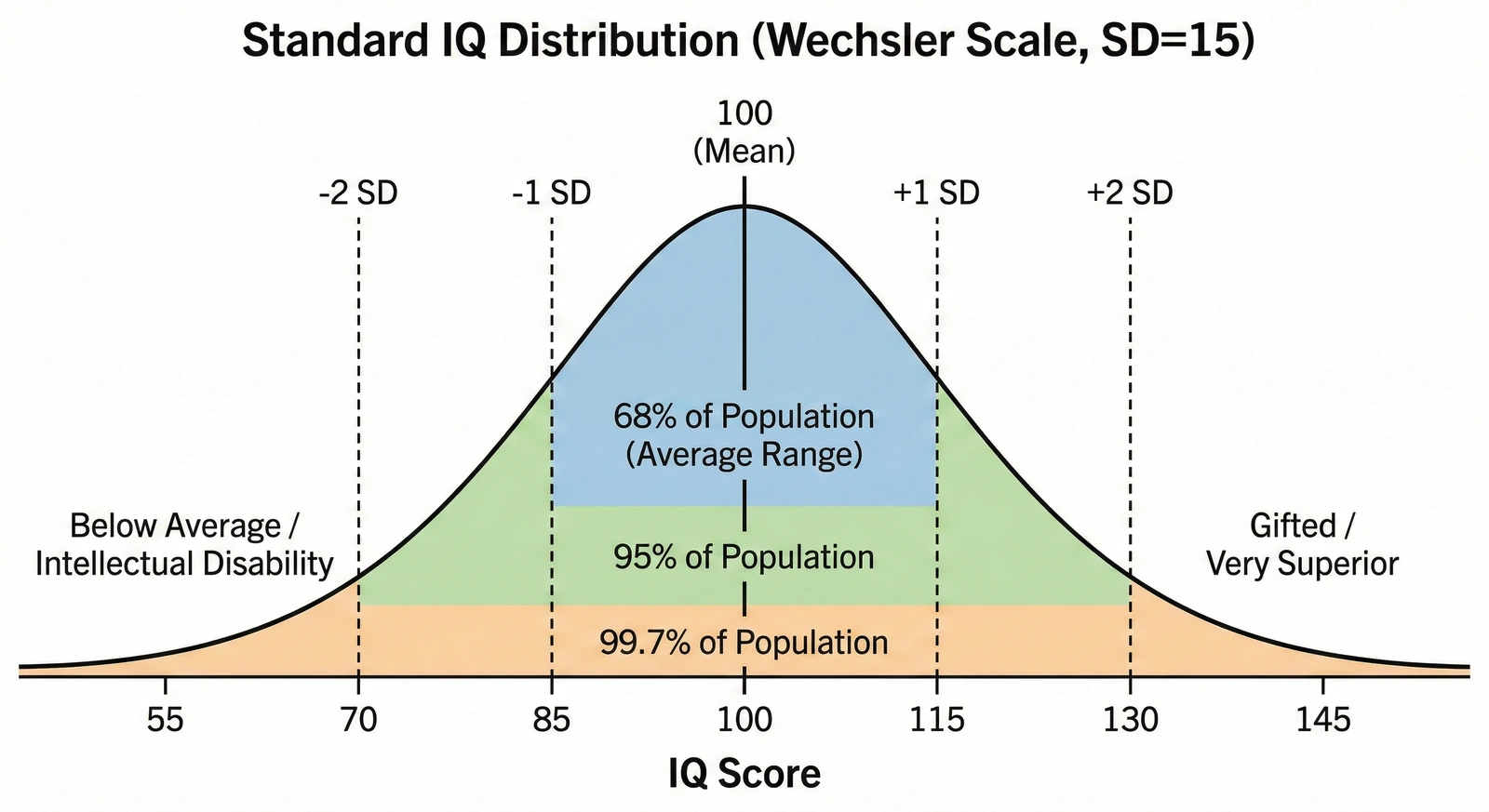
Understanding Standard Deviation
To understand the “ranges,” you need to understand Standard Deviation (SD). In most modern tests, such as the Wechsler Adult Intelligence Scale (WAIS) , the standard deviation is 15 points.
Think of the SD as a “step” away from the average.
- 68% of people fall within one step of the average (between 85 and 115).
- 95% of people fall within two steps (between 70 and 130).
- 99.7% of people fall within three steps (between 55 and 145).
If you score 130, you aren’t just “smart”—you are statistically two full deviations above the norm, placing you in the top 2% of the population.
Where would your own score land?
Take the IIF-certified assessment and get your score with the scale it was measured on, the percentile it corresponds to and the confidence range around it — the three figures most online tests leave out.
Find your IQ score now! →IQ Score Ranges Breakdown
While different tests (like Stanford-Binet vs. Wechsler) use slightly different classifications, here is the generally accepted breakdown of IQ ranges.
85 – 115: The Average Range
- Population Share: ~68%
- Description: This is where the vast majority of humanity sits. People in this range can perform most jobs, complete high school and college, and function effectively in society.
- 85–99: Low Average
- 100–115: High Average
115 – 130: Above Average (Bright)
- Population Share: ~14%
- Description: Individuals in this range often grasp complex concepts faster than their peers. They tend to perform well in universities and professional fields such as engineering, law, and medicine.
130 – 144: Moderately Gifted
- Population Share: ~2%
- Description: This is the cutoff for high-IQ societies like Mensa. People in this range often exhibit early reading abilities and strong pattern recognition. They represent 1 in 50 people.
145 – 159: Highly Gifted
- Population Share: ~0.1%
- Description: This is a rare level of cognitive ability (roughly 1 in 1,000 people). Individuals here often have radically different learning needs and may accelerate through standard education systems rapidly.
160+: Profoundly Gifted
- Population Share: <0.003%
- Description: This is the “tail” of the curve. These scores are difficult to measure accurately because the sample size of people at this level is so small. This range is often associated with child prodigies and revolutionary thinkers, though high IQ does not guarantee high achievement.
Below 70: Intellectual Disability
- Population Share: ~2.2%
- Description: Scores below 70 may indicate cognitive challenges. This range often requires support systems for daily living or specialized education plans.
Does High IQ Equal Success?
It is important to remember that the Bell Curve measures cognitive processing speed and pattern recognition —not worth, creativity, or potential for happiness.
While a high score correlates with academic success and income, it does not measure:
- Emotional Intelligence (EQ)
- Grit and determination
- Creativity and divergent thinking
A person with an IQ of 105 who works incredibly hard will often outperform a person with an IQ of 135 who lacks discipline.
Key Takeaways
- The average IQ is 100.
- Most people (68%) score between 85 and 115.
- A score of 130+ puts you in the top 2% of the population.
- IQ is a comparative metric, not an absolute measure of human value.
- * *
Ready to test your own cognitive skills? Take yourIQ Test here
Keep reading
All articles → Scores & Scales
IQ Scale for Adults
In intelligence, we eagerly await the day when human mind secrets are exposed. This article will discuss the Adult IQ Scale, a powerful tool for assessing intelligence and revealing latent skills.
 Scores & Scales
IQ Score Ranges Explained: What Your IQ Number Really Means
Today, there are several IQ test ranges with varying formats, questions, and scoring systems. These exams provide a typical IQ assessment.
 Scores & Scales
IQ Level Chart
A systematic way to measure intelligence is the IQ level chart, which uses a scale that goes from below average to above average. Assessments of cognitive capacity and academic accomplishment often employ this visual aid.