IQ Metrics
IIF Certified Assessment Start IQ Test
IIF Certified Assessment

ADHD, Autism and Dyslexia in IQ Testing

Taking a Test

How ADHD, Autism and Dyslexia Change What an IQ Test Measures

A test score is a measurement, and a measurement can be biased by the conditions under which it is taken. ADHD, autism and dyslexia each depress performance on particular kinds of item without lowering the reasoning underneath. Here is what actually interferes, condition by condition, and what to do next.
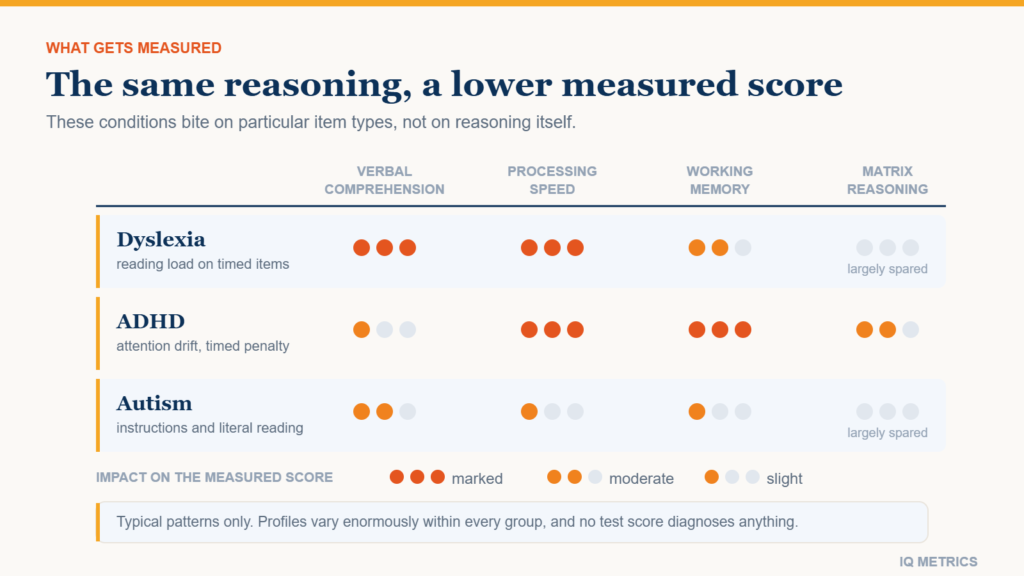
Grid rating how far dyslexia, ADHD and autism affect four IQ test domains: verbal comprehension, processing speed, working memory and matrix reasoning, which is largely spared

If you have ADHD, autism or dyslexia, a score from a timed online test is not meaningless, but for many people it reads lower than their reasoning does. ADHD and IQ test scores interact through the format rather than through intelligence: attention, reading load and the clock all sit between your thinking and the number at the end. What follows names the mechanism for each condition, and what to do about it.

This site publishes tests and explains scores; it has no clinical standing, and nothing here is diagnosis or medical advice. No IQ score, and least of all an unproctored online one, can indicate or rule out ADHD, autism or dyslexia. A qualified assessor is the only route to that answer.

A Depressed Score Is Not a Lower Ability

Much of what is written about neurodevelopmental conditions and testing quietly folds two different claims into one. The first is that measured composites in these groups often come out lower than in comparison samples. For ADHD and dyslexia that is a reasonably consistent finding; for autism it depends heavily on which test was used and how the sample was recruited.

The second claim is that these groups reason less well. That does not follow from the first. A test score is a measurement, and any measurement can be distorted by the conditions under which it is taken. It is more precise to say the score is depressed than that the ability is lower.

A bathroom scale on a thick carpet reads wrong; the reading changed, the weight did not. Much of what these three conditions do to a test result is carpet.

Ordinary test-day variables work the same way; the same person can land several points apart across a fortnight. Our longer piece on the factors that affect IQ test results covers sleep, anxiety, caffeine and practice. The difference is that these three conditions are stable features of how you process information, not the state you turned up in.

Where the Interference Actually Lands

A modern battery is not one thing. It samples several fairly distinct abilities and averages them into a single composite, and interference rarely hits all of them equally. It lands hard on one or two, and the composite carries the damage without saying so.

  • Verbal comprehension – vocabulary, similarities, general knowledge; all of it delivered in written language.
  • Fluid reasoning – matrices and number series, the part closest to raw pattern-finding.
  • Working memory – holding material in mind and manipulating it while you use it.
  • Processing speed – how quickly you get through easy items, not how hard the items are.
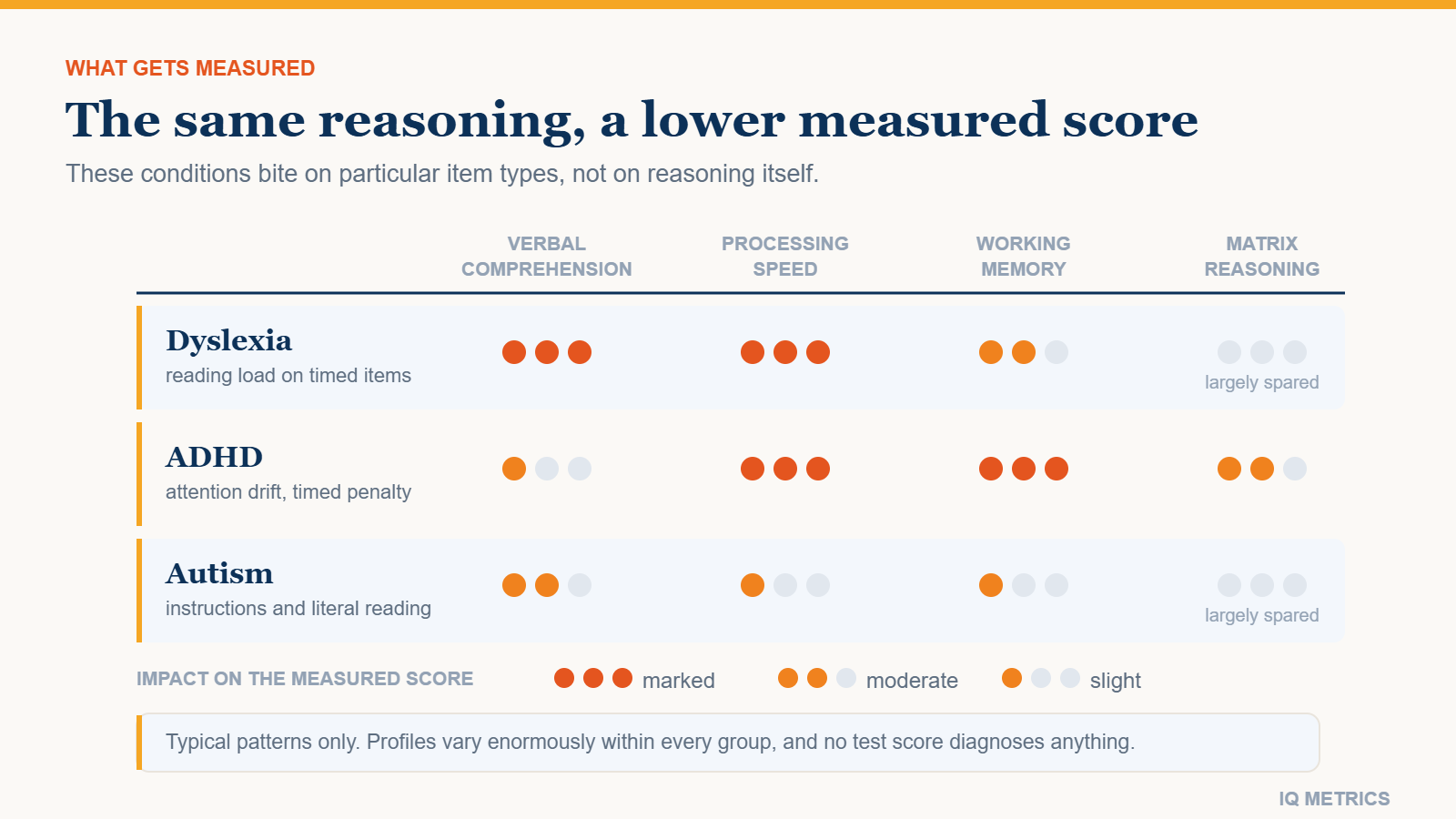
Grid rating how far dyslexia, ADHD and autism affect four IQ test domains: verbal comprehension, processing speed, working memory and matrix reasoning, which is largely spared

This is exactly why a profile beats a composite, and why the index-by-index breakdown produced by professionally administered tests is worth far more to a reader in this position than the headline figure.

Dyslexia: The Reading Load Hidden Inside the Test

Dyslexia is a difficulty with accurate or fluent word recognition, decoding and spelling, neurobiological in origin and not explained by a lack of instruction. On a test it lands in two predictable places. Verbal comprehension items have to be read, and so do the instructions and the answer options.

Processing-speed items are trivially easy in content and hard to finish. On a professional battery they use symbols rather than words, and are still often lower in dyslexic profiles because naming things quickly is part of what they measure. On an online test the speeded items are usually words and sentences, which puts the reading load back on top of the clock.

Fluid reasoning typically holds. A dyslexic reader who grinds through a vocabulary section will often complete matrix items at roughly the level the rest of their profile predicts, because a matrix does not have to be read. The composite then averages one fair estimate with one depressed estimate and understates the reasoning.

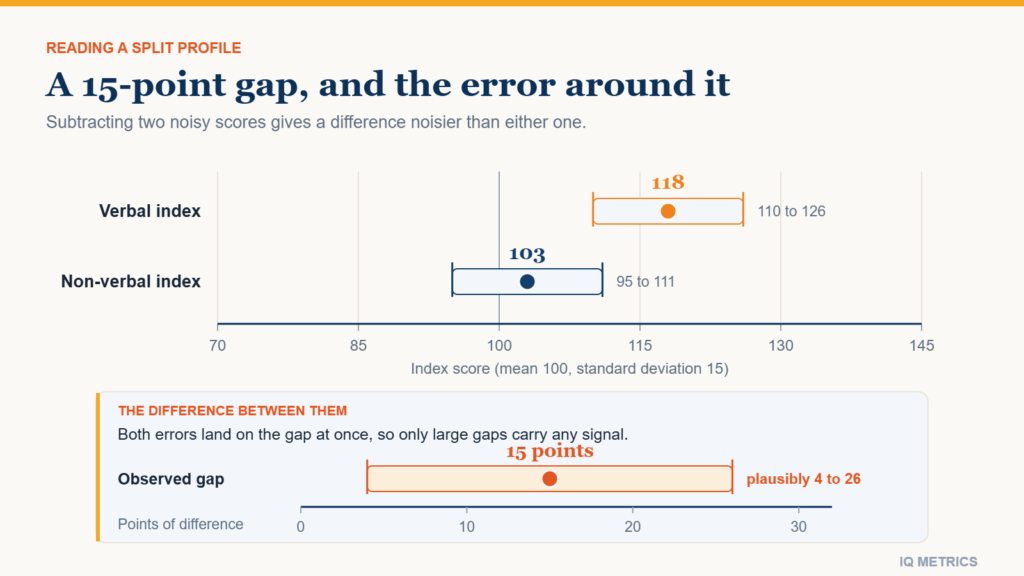
How large that gap gets varies from person to person, and a gap is not automatically meaningful on its own. The companion piece on verbal and non-verbal score splits covers when a difference between two indexes is big enough to interpret at all.

ADHD and IQ Test Scores: Inconsistency, Not a Lower Ceiling

The characteristic pattern for ADHD on a test is not uniformly weaker performance. It is variability. The same person can solve a hard matrix item in seconds and then miss three easy ones in the block that follows, and where in the session an item fell can matter more than how hard it was.

Three separate things cost points here, and they are worth keeping apart because they respond to different fixes.

  • Time pressure. A per-item or whole-test clock converts a slow start into lost items, even when the reasoning would have arrived a few seconds later.
  • Sustained-attention drift. Dozens of near-identical matrix puzzles in a row is close to a worst case: low novelty, no feedback, and wrong answers that feel exactly like right ones.
  • Working-memory load. Items that require holding several constraints at once are harder to finish when the holding itself takes effort.

That last one is worth holding apart from reasoning itself: the two are related but not interchangeable, and someone can have a genuinely low working-memory index and strong fluid reasoning at the same time. An item that loads both is limited by the weaker of the two.

Sleep and time of day move ADHD test performance, and so can where someone is in their usual routine on the day. That is another reason to treat one sitting as a single sample rather than a verdict, and to be sceptical of any score taken at the end of a long day.

Your own number

Where would your own score land?

Take the IIF-certified assessment and get your score with the scale it was measured on, the percentile it corresponds to and the confidence range around it — the three figures most online tests leave out.

Find your IQ score now!

Secure & encryptedInstant results10–20 minutes

Autism: Uneven Profiles and Confounded Instructions

There is no autistic IQ profile. Autistic people cover the entire measured range, and the variation inside the group is far larger than any average difference between it and everyone else. Anything that describes one shape of profile as typical is describing a subset and calling it a population.

One pattern does show up often enough to be worth naming: a split between verbal and perceptual performance, running in either direction. Some autistic people score markedly higher on matrix reasoning than on verbal subtests, particularly where verbal items reward conventional usage; others show the reverse.

The larger measurement problem is often the wrapper rather than the item. Instructions written loosely can be read literally and answered correctly by their own logic. Asking which one does not belong has several defensible answers, and an item lost that way costs the same as an item nobody could solve. The score cannot tell the two apart.

Conditions matter too. An unfamiliar room, harsh lighting, the social weight of being watched while you think: none of that is reasoning, and all of it can move a number.

What an Online Screener Does to These Profiles

An unproctored online test has no way to accommodate anyone. It cannot verify a diagnosis, grant extra time, offer a quiet room, read an item aloud, or notice that you stopped concentrating twenty minutes ago. It records what happened and scores it.

Format still changes the size of the problem. A timed IQ test stacks the effects above into their worst configuration: a speed penalty, no way back from a slow opening, and a hard stop that arrives whether or not you were nearly there.

If the clock is your main obstacle, the untimed classical format is a fairer instrument for you. If reading load is the obstacle, a culture-fair test built from figures rather than sentences takes most of the language out from between you and the item. Neither is a formal accommodation; each just removes one confound.

Accommodations, and Who Can Authorise Them

Formal assessment does have answers to all of this, and they are unglamorous rather than clever.

  • Extended time, commonly one and a half times the standard limit, sometimes double.
  • Scheduled breaks between subtests, or the session split across more than one day.
  • A separate quiet room, with the examiner present and nobody else.
  • Untimed administration of subtests where speed is not the ability being measured, reported alongside the standard scoring rather than in place of it.
  • Items read aloud, or answers given orally rather than written.

None of that is self-service, which is the practical point most articles skip. Accommodations are authorised by whoever owns the assessment: a qualified psychologist for a clinical evaluation, a school’s special educational needs process for a child being tested, a university disability service, or an employer’s occupational-health route at work. Each normally wants documentation first, which is one more reason a screener result cannot start the process.

If You Think Your Score Is an Underestimate

Start by treating the number as information about a sitting rather than about you. Which sections felt bad, and why? Running out of clock, losing the thread halfway through a block, and reading the same sentence four times are three different failures, each pointing at a different index dragging the composite down.

Then take the test again in a format that removes the thing you identified, and compare. Two scores with a known difference between the conditions that produced them tell you more than one score of any size, and that comparison is the closest thing to self-accommodation a free screener can offer.

If a defensible number actually matters — for a school placement, an accommodation request, an assessment — an online result will not do that job. What a free online IQ test gives you is a rough bearing and, taken twice under deliberately different conditions, a sense of how much of your score is about the format rather than your reasoning.

Share this article

Know someone who keeps seeing these numbers quoted without the scale they were measured on? Send it to them.

Professional IQ Tests

Taking a Test

Professional IQ Tests: What Psychologists Actually Use

When a psychologist measures intelligence, they reach for one of a small number of standardised instruments. This guide covers what the Wechsler scales, Stanford-Binet, Woodcock-Johnson and Raven’s Progressive Matrices each measure, who each one is for, and where an online test genuinely fits.
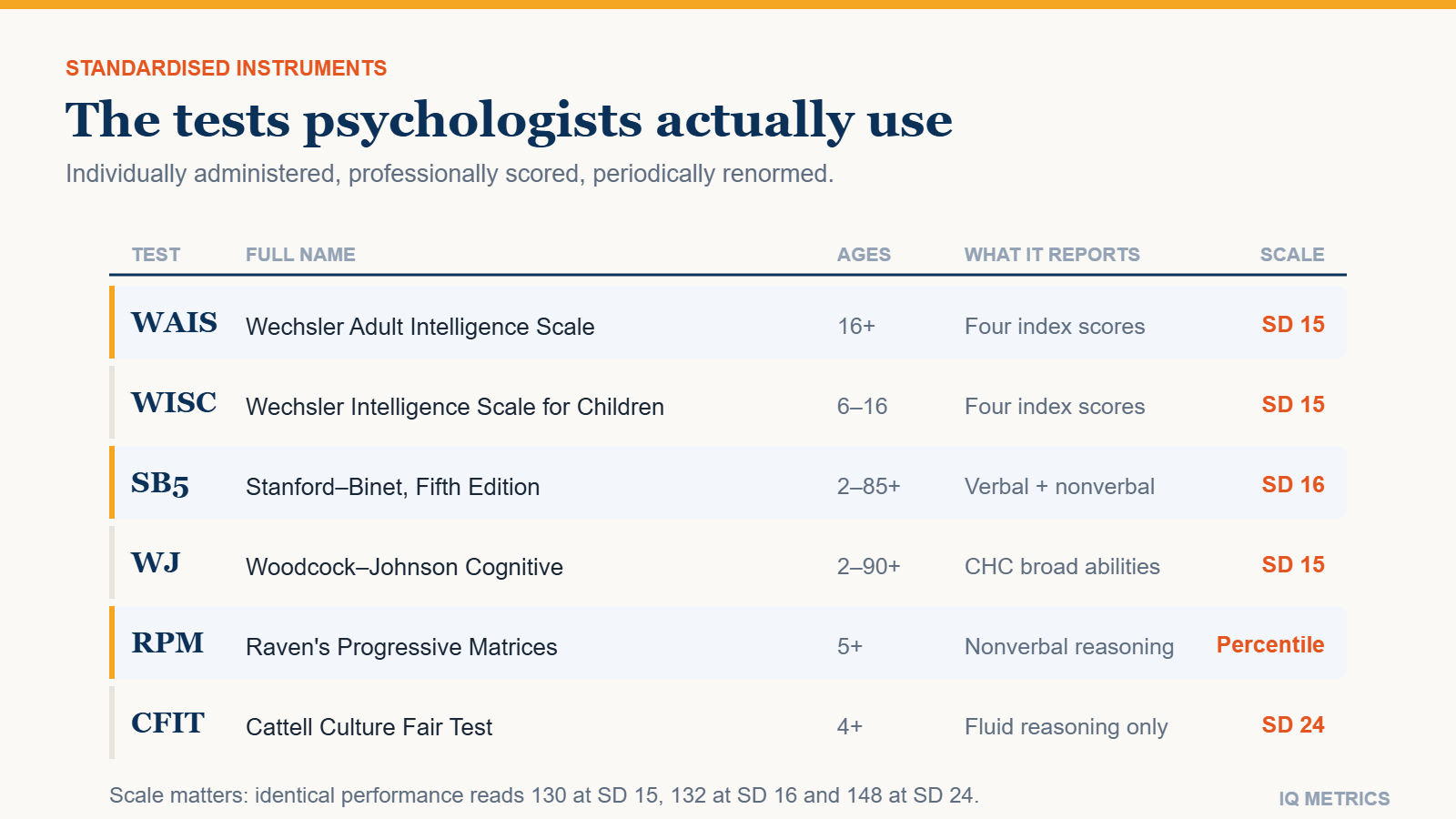

Comparison of the professional IQ tests psychologists use and what each measures

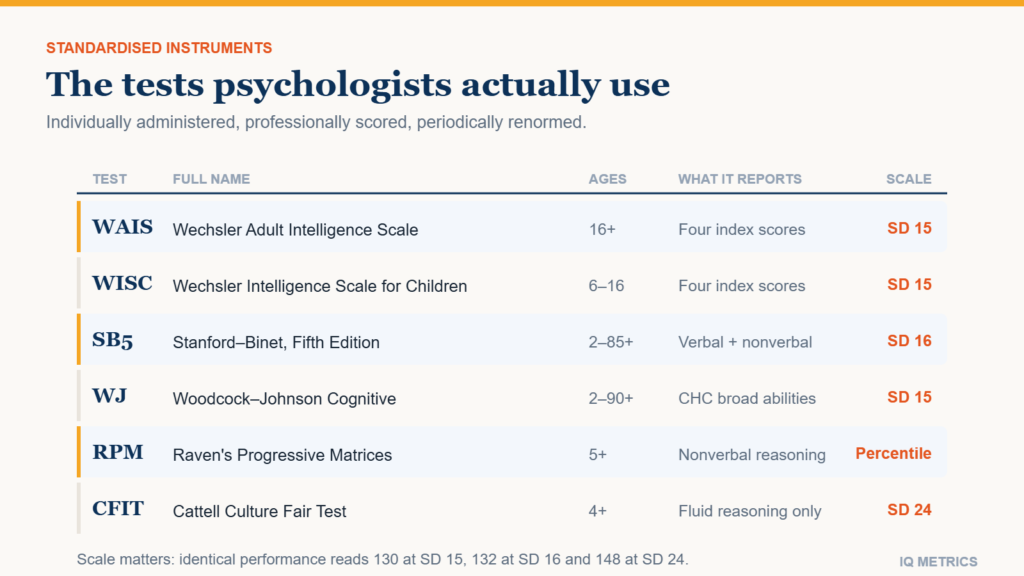
“IQ test” is a category, not a product. When a psychologist actually measures intelligence, they reach for one of a small number of standardised instruments, and those instruments differ in how they are delivered, what abilities they sample, how long they take, what age group they were normed on, and how heavily they lean on language. A score means very little until you know which of them produced it.

This guide walks through the tests professionals actually use, what each is genuinely good at, and how to work out which kind of result you are looking at. If you want to compare the shorter formats available on this site instead, the IQ tests hub covers those.

The first division: individual or group

The most important split is not verbal versus nonverbal — it is whether a trained administrator sits with you.

Individually administered tests are delivered one-to-one over roughly one to two hours. The administrator controls timing, watches how you approach each item, and can tell the difference between not knowing an answer and misunderstanding the question. These are the tests used clinically, educationally and diagnostically, and they are the reference standard for accuracy.

Group tests are delivered to many people at once, usually on paper or screen, with fixed instructions and no individual observation. They are far cheaper and faster, which is why they dominate schools, military selection and large-scale screening. They are also less precise for any single individual, because none of the observational detail survives.

The major individually administered tests

Comparison of the main types of IQ tests and what each one measures

The Wechsler scales: WAIS and WISC

The Wechsler tests are the most widely used individual intelligence tests in the world. The WAIS covers adults and older adolescents; the WISC covers school-age children; the WPPSI covers preschoolers. They are periodically revised, and each revision is renormed on a fresh standardisation sample.

Rather than producing one number, a Wechsler test reports a full-scale score built from index scores covering verbal comprehension, visual-spatial and fluid reasoning, working memory and processing speed. That structure is the real value: two people can reach the same composite by very different routes, and the profile of indexes is often more informative than the headline figure. Wechsler tests use a standard deviation of 15.

The Stanford-Binet Intelligence Scales

The Stanford-Binet is the direct descendant of the original Binet-Simon scale and the oldest continuously developed intelligence test still in use. Its current edition covers an unusually wide age span in a single instrument and assesses five factors in both verbal and nonverbal form, which makes it useful at the extremes of the range where other tests run out of items. It uses a standard deviation of 16, which is why Stanford-Binet scores sit slightly higher than Wechsler scores for identical performance — a difference our IQ score converter handles directly. The test’s long history is covered in our piece on the history of IQ testing.

The Woodcock-Johnson Tests of Cognitive Abilities

The Woodcock-Johnson is built explicitly on the Cattell-Horn-Carroll model of intelligence, which organises cognitive ability into a hierarchy of broad and narrow factors. Its distinguishing feature is that it pairs with a co-normed achievement battery, so cognitive ability and academic attainment can be compared on the same standardisation sample. That makes it a common choice in educational assessment, particularly where a learning difficulty is in question.

The Kaufman batteries

The KABC-II was designed with a specific concern in mind: reducing the influence of acquired knowledge and language on the resulting score. It offers alternative theoretical scoring models and a version that minimises verbal demands, which makes it useful for children from varied linguistic and cultural backgrounds.

Nonverbal and culture-reduced tests

Every verbal test carries an unavoidable problem: it measures language proficiency alongside reasoning. For someone tested in a second language, or from a background unlike the norm group, that confound can be large. Nonverbal tests exist to reduce it.

Raven’s Progressive Matrices

Raven’s is the best known nonverbal reasoning test and one of the purest measures of fluid intelligence available. Every item is a visual pattern with a piece missing; you choose the piece that completes the rule. There are no words, no cultural references and no general knowledge anywhere in it. It comes in progressive difficulty levels, from Coloured for young children through Standard to Advanced for high-ability adults.

The Cattell Culture Fair Intelligence Test

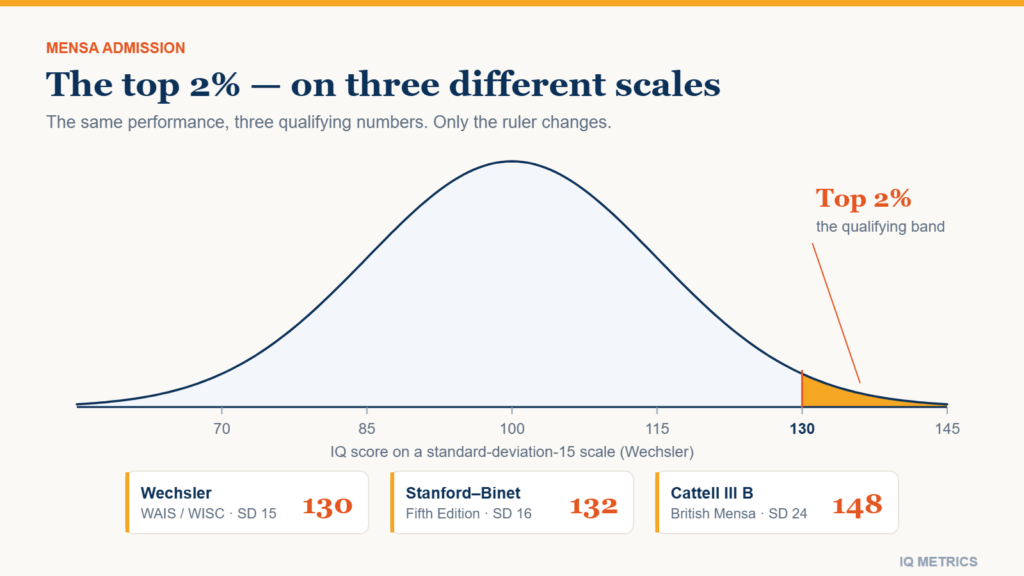
The CFIT was built for the same purpose using series completion, classification, matrix and conditional reasoning items, all nonverbal. It reports on a scale with a standard deviation of 24, which is why Cattell scores look dramatically higher than Wechsler ones — the ruler is wider, not the person. This is the scale British Mensa uses, as covered in our article on Mensa IQ score requirements.

TONI, UNIT and Leiter

These go further still, minimising or removing language from the instructions as well as the items. They are designed for people who cannot be validly assessed in a language-loaded format — including those with hearing impairment, speech and language disorders, or no shared language with the administrator.

One caveat applies to all of them. “Culture fair” is a design goal, not an achieved state. Familiarity with abstract diagrams, formal schooling and test-taking conventions still varies across populations, and no test has eliminated that entirely.

Your own number

Where would your own score land?

Take the IIF-certified assessment and get your score with the scale it was measured on, the percentile it corresponds to and the confidence range around it — the three figures most online tests leave out.

Find your IQ score now!

Secure & encryptedInstant results10–20 minutes

Group and screening tests

Group-administered cognitive tests are used at scale where individual assessment would be impossible: school-wide ability screening, military and occupational selection, and large research studies. They are efficient and, at the population level, statistically sound.

Their limitation is individual precision. A single low score on a group test can reflect a bad morning, an unfamiliar format, misread instructions or a missed line on an answer sheet, and nothing in the procedure would catch it. Good practice treats a group result as a flag for further assessment, never as a diagnosis. Our article on what makes an IQ test reliable covers why that distinction matters.

Where online IQ tests fit

Online tests occupy a real and legitimate niche, provided everyone is honest about what it is. An unsupervised test cannot verify who is taking it, cannot control the environment, cannot stop you looking something up and cannot prevent retakes. For that reason no online test qualifies anyone for Mensa, and none is diagnostic.

What a well-built online test can do is give you a properly normed estimate. The features that separate a serious one from a novelty quiz are concrete and checkable:

  • It states the scale its score is on, so the number can be compared with anything else.
  • It reports a percentile, not just a score, so the rank is explicit.
  • It gives a confidence range, acknowledging measurement error instead of implying false precision.
  • It is timed and consistent, so your result and someone else’s were produced under the same conditions.
  • It describes its norm group rather than leaving you to guess who you are being compared against.

Our own IQ test reports the scale, percentile and confidence range together, and the IQ tools collection lets you convert a score between scales or see where it sits on the distribution. For a fuller treatment of what separates a good online test from a bad one, see your guide to good online IQ tests.

Choosing the right kind of test

The right test depends entirely on the question you are asking.

  • For a clinical or educational decision — a diagnosis, a placement, an accommodation — only an individually administered test by a qualified professional will do.
  • For someone tested outside their first language, or from a background unlike the norm group, a nonverbal test such as Raven’s gives a fairer reading.
  • For Mensa or another high-IQ society, only an approved supervised test on their published list counts.
  • For personal curiosity, a properly normed online test that reports scale, percentile and confidence range is a reasonable and inexpensive starting point.

One last boundary is worth drawing. None of these tests measures emotional skill, and the emotional intelligence questionnaires sometimes sold alongside them are a different construct with a different evidence base — we compare the two in IQ vs EQ.

What none of them will give you is a single unarguable number that captures your intelligence. Every test samples a slice of cognitive ability through one particular method, and the score is an estimate of where that slice sits relative to other people. Knowing which slice and which method is what turns the number into information.

Share this article

Know someone who keeps seeing these numbers quoted without the scale they were measured on? Send it to them.

IQ Scale By Age

IQ Scale by Age: How IQ Changes Over a Lifetime

Understanding how IQ scores relate to different age groups can help you interpret test results more meaningfully. IQ, or intelligence quotient, is a standardized measure of cognitive abilities such as reasoning, memory, and problem-solving. While IQ is generally stable in adulthood, age-related trends and life experiences can influence performance on different types of tasks.

The IQ: A definition and explanation

A thorough familiarity with the IQ scale is required prior to exploring the subject of IQ score changes over time. A person’s intelligence quotient (IQ) is a measure of their cognitive abilities, which include their memory, reasoning, problem-solving, and language skills. The ideal result on the IQ test is 100, while the standard deviation is 15. The average score is somewhere between 85 and 115, although a score below 70 indicates intellectual disability and a score above 130 indicates talent.

IQ Scale by ageIn order to gauge a person’s intelligence, an IQ test will usually comprise a battery of questions or activities. Standardisation and understanding the typical behaviour of a certain age group are two goals of administering the exams to large samples of the population. To determine an individual’s IQ, test scores are compared to predetermined standards.

Things that influence IQs

Numerous factors can influence an individual’s IQ. Genetic factors have a significant impact on cognitive ability, according to the notion that intelligence is partially inherited. At the same time, environmental influences may influence IQ scores. A person’s intelligence quotient (IQ) is affected by a variety of elements that impact their brain development. These determinants include things like a person’s social status, cultural background, dietary habits, and access to education.

During the first few years of life, a child’s cognitive growth and intellect are greatly influenced by environmental circumstances, parental participation, and the quality of their schooling. People who are getting on in years deserve more care and attention. Hormonal shifts during puberty, one’s social network, educational chances, major life events, and intelligence tests are only a few of the variables.

Does age have any bearing on intelligence?

There is a complex relationship between age and IQ. The idea that IQ changes very little from one generation to the next is popular. However, recent studies have shown that IQ levels can vary significantly between age groups, casting doubt on this long-held view.

A child’s IQ typically increases slowly during infancy in tandem with the development of their cognitive abilities and body of information. However, research shows that IQ scores stop increasing altogether after puberty and even fall significantly. This decrease could be due to hormonal shifts or other factors, such as the influence of peers or an increasing focus on interpersonal connections.

It seems that average IQs do level out with age, however there may be some variation from individual to person. As people age, their scores on cognitive tests, such the intelligence quotient (IQ), typically decline. As we become older, our brains become less malleable, which speeds up the onset of neurodegenerative diseases and other age-related impairments in cognitive processing speed.

Research comparing cognitive test results from individuals of different ages
A lot of studies have looked at how IQ scores fluctuate throughout time. In the 1980s, Flynn conducted research that would later be known as the “Flynn effect.” The “effect” here is the general trend towards ever-increasing IQ, whereby newer generations routinely outperform older ones. Reasons given for this increase in IQ scores include environmental factors, such as the growing complexity of our contemporary society, improved nutrition, and more educational opportunities.

Several studies have looked into the correlation between chronological age and IQ. For instance, research has demonstrated that IQs tend to be lower among children from lower-income families when contrasted with those from higher-income families. Processing speed and working memory are two indicators of intellect that may decline with age, according to research.

The origins of IQ tests and the Flynn effect

The Flynn effect is of interest to scientists because it provides an explanation for the large age gap in intelligence tests. Following political scientist James Flynn’s initial observation, this concept has been the subject of numerous investigations.

As the Flynn effect shows, an increasing proportion of people from all walks of life and economic backgrounds have experienced an increase in their IQ during the past century. Growth in cognitive capacity, including the capacity to think critically and solve problems, is due more to external factors than to intrinsic traits. The increasing complexity of modern life, along with improvements in nutrition, educational opportunities, and technology, is largely responsible for the general rising trend in IQ assessments.

The Flynn effect can affect any demographic or culture, as has been pointed out in many studies. This study casts doubt on the long-held belief that IQ is entirely heritable and provides strong evidence that upbringing and experience shape mental abilities.

The benefits and drawbacks of intelligence testing for various age groups

Despite their widespread use, IQ tests have limitations that become more apparent when comparing results from different age groups. As a measure of cognitive ability, intelligence quotient (IQ) exams look at things like processing speed, working memory capacity, and language understanding. However, it’s conceivable that these tests don’t account for all potential cognitive capacities or give erroneous IQ scores for different age groups.

Impatience with test forms, limited attention span, and immaturity in linguistic abilities are some of the reasons why children’s IQ scores may be misleading. Even more concerning is the idea that intelligence tests, which focus on aspects of intelligence that can decline with age, fail to account for the unique characteristics and abilities of the elderly.

This is an important consideration when comparing IQ testing for individuals of various ages. Like any thorough evaluation tool, IQ testing should account for factors like cultural influences, life experiences, and educational level.

Achieving a higher IQ regardless of age

Intelligence is a trait that can be honed at any age, so it’s vital to keep that in mind even though IQs could vary from generation to generation. There is a wide variety of approaches that can raise an individual’s intelligence and cognitive capacity:

Young children’s cognitive development is greatly enhanced when they are provided with a stimulating and caring environment during their formative years. Improving one’s cognitive capacities and establishing the groundwork for future intellectual growth can be achieved through reading, solving puzzles, and playing educational games.

Academics and other kinds of intellectual stimulation should be front and centre throughout adolescence. Engaging in cognitively taxing activities, thinking critically, and solving problems are all ways to promote cognitive development and keep or raise IQ levels.

A lifelong commitment to learning will pay dividends in the form of a healthy, bright brain as you age. It is suggested that regular exercise, staying educated, and participating in mentally difficult activities might help preserve or even increase cognitive function and IQ.

As we get older, it is more important than ever to engage in activities that promote brain health and cognitive vitality. Exercise, social contact, and cognitive training can preserve or even enhance cognitive capacities, especially the IQ-evaluable aspects of intelligence.

Keeping one’s mind sharp requires a steadfast commitment to lifelong learning.
Keeping one’s mind active requires a dedication to lifelong learning, since intelligence tests show that IQs decline with age. Brain health and potential IQ enhancement can be achieved by consistent practice of mentally taxing activities and an insatiable appetite for knowledge.

The advantages of continuing one’s education throughout life go far beyond how well one does on IQ testing. In addition to enhancing brain health, memory, and cognitive flexibility, it protects against cognitive decline and neurodegenerative diseases. Individual development, enhanced health, and a broader range of knowledge and skills are further advantages of continuing one’s education throughout life.

Adopting a growth mindset, which promotes an endless quest for knowledge, improves one’s adaptability to a continuously changing world and fosters one’s innate curiosity. When individuals proactively pursue new information, mentally challenge themselves, and embrace intellectual curiosity, they can achieve rich, intellectually robust lives.

The idea that cognitive capacities change with age is the last thing to think about

As a conclusion, the IQ scale reveals that IQ levels fluctuate with age, suggesting that the mind is inherently unstable. The plethora of variables influencing cognitive capacities and the large range of IQs make it feasible for there to be differences in IQ between age groups.

Knowing that intelligence quotients (IQs) may alter over time might assist shed light on how our brains function and the decisions we can make to improve our cognitive ability. The incredible changes that take place in our cognitive capacity from infancy into old age are caused by a variety of factors, including genetics, the environment, and personal experience.

By acknowledging that IQ differs across demographics, we can perhaps gain a deeper appreciation for the contributions made by individuals of all ages. Another piece of proof that IQ is not static is that one can strive to increase their intelligence at any age. As long as they make it a lifelong habit to learn new things and have an intellectually curious mindset, everyone has the chance to find their intellectual footing and thrive.

If you’d like to better understand your own cognitive strengths and how your score fits into broader demographics, you can take an online IQ test on our homepage.

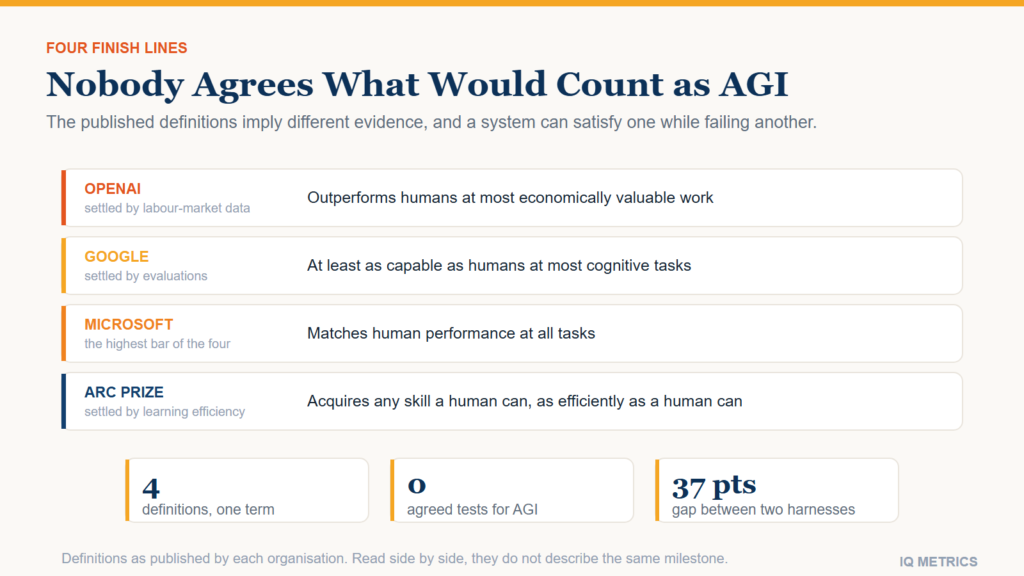
What Is AGI?

What Is AGI?

Artificial general intelligence means a system that can learn and

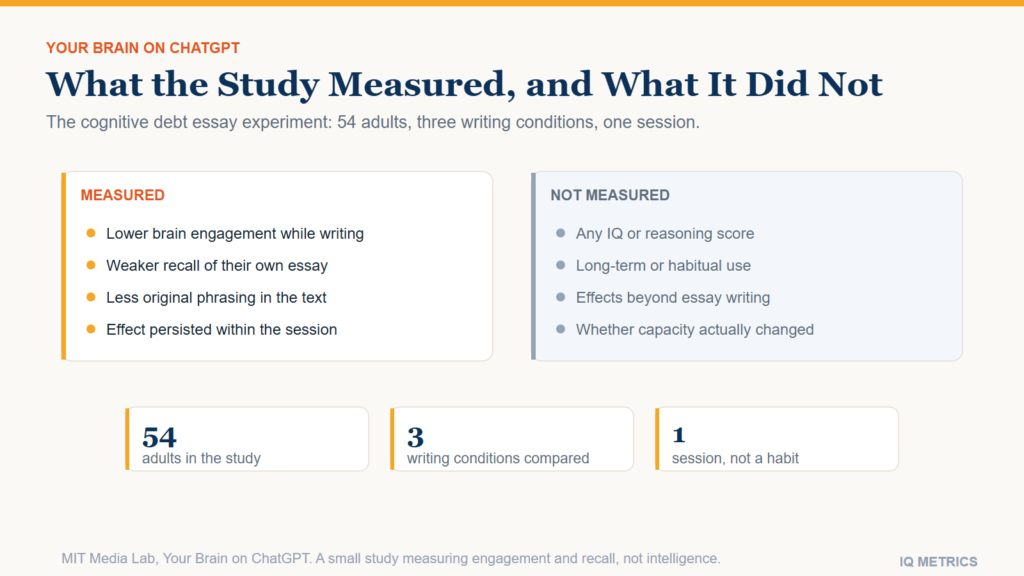
Does Using AI Make You Dumber?

Does Using AI Make You Dumber?

The claim that AI is making us stupider has real

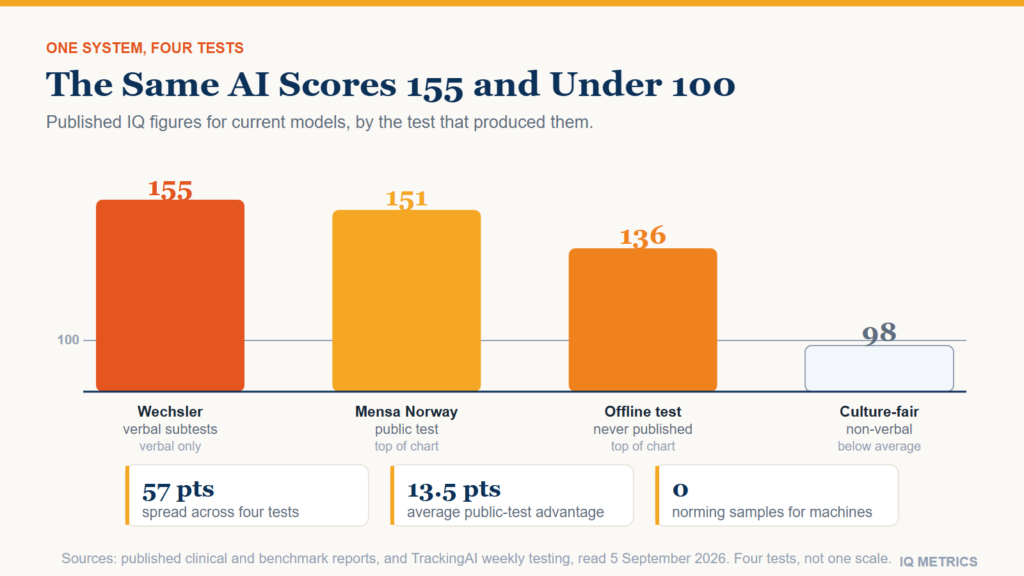
What Is ChatGPT’s IQ Score?

What Is ChatGPT’s IQ Score?

Search for ChatGPT’s IQ score and you will find 155,

What Is Genius IQ Level

What Is Genius IQ Level

Imagine being able to enter a genius’s mind and understand their superintelligence secrets. Amazing people with genius IQ are the subject of this article.

Just how bright are the really brilliant?

Genius intelligence is usually 140 or higher. IQ is a test-based cognitive capacity assessment. Despite these shortcomings, intelligence tests (IQs) can assist assess and compare mental talents.

Genius IQ Level Geniuses are smarter than others. Their intelligence, ingenuity, and understanding of complicated concepts are remarkable. Some people can see connections and patterns that others miss, which permits geniuses to produce art and make discoveries that change society.

Distinguished thinkers from various time periods

Many intelligent people have left lasting effects on history. Famous scientists like Newton and Einstein and artists like Mozart and Leonardo da Vinci have revolutionized our vision of the universe and human potential.

For instance, Albert Einstein’s theory of relativity revolutionized science. His research on space, time, and gravity changed our understanding of the universe. A talented painter, Leonardo da Vinci was also a scientist, engineer, and developer. He advanced anatomy, engineering, and architecture with his relentless curiosity and creativity.

These examples show that many occupations have astounding intelligence. Geniuses have helped humanity realize its full potential in art, music, literature, and science throughout history.

Individuations of a genius

There are several characteristics of genius that distinguish them from others. These include a great recall, ingenuity, laser-like focus, and a thirst for information.

Brilliant people can absorb and retain lots of information. Their exceptional memory lets them understand even the most difficult ideas. Geniuses can quickly digest and remember information, allowing them to find creative connections between seemingly unrelated concepts and make significant discoveries.

Geniuses are known for their recall and focus. Due to their capacity to ignore distractions and focus on work, no one can match their productivity. Due to their laser-like focus, they can examine difficult issues from all angles and weigh various perspectives.

A genius’s creativity lets them see challenges differently and find innovative solutions. They are smart because they can think of new concepts and make unusual connections. Their creativity lets them push the limits and come up with new ideas.

The last characteristic shared by geniuses is an unquenchable hunger for knowledge and a commitment to learning throughout life. They search for new ideas and seek answers to basic concerns about the cosmos because they have an unquenchable need for information. They possess exceptional cognitive abilities that are driven by their relentless hunger for knowledge.

Nature vs. nurture and exceptionally bright people: the age-old conflict
For a long time, scholars and thinkers have argued about whether geniuses’ IQs are more a product of their environment than their genes. Proponents of the theory that geniuses are born with remarkable abilities disagree with those who believe that extraordinary intelligence is a result of a person’s environment and family history.

To achieve genius level talent, it is essential to have both genetic and environmental components, as is universally acknowledged. Although a person’s genes do play a role, their environment also plays an important role in developing their potential for exceptional cognitive abilities.

The role of heredity in very high IQ

There is a lot of evidence that shows how important genes are in IQ testing. Investigating the similarities and differences between fraternal and identical twins has shed light on the hereditary basis of intelligence. Similar intellectual quotients (IQs) are more common among identical twins, who share all of their DNA, as opposed to fraternal twins, who share half of their DNA.

The ability to think clearly can be affected by genetic variations, such as SNPs (single nucleotide polymorphisms). A complex and poorly understood association between specific genes and intelligence is still a mystery, yet there are genes that have been linked to IQ.

Take note that IQs in the exceedingly high range cannot be accounted for by genetics alone. Cognitive abilities are inherited, but it is the environment that plays a pivotal role in shaping and realizing them.

The impact of upbringing and parental guidance on the emergence of exceptionally bright individuals
A person’s educational chances, socioeconomic stability, and early life experiences are all environmental elements that significantly impact their intelligence, perhaps leading to a genius level of performance. In a stimulating and supportive setting, people can reach their maximum cognitive capacity.

The events of early infancy have a disproportionately large impact on the maturation of cognitive abilities. A stimulating environment that encourages exploration, curiosity, and learning can help develop cognitive abilities. Exposure to many fields, such as science, literature, art, and music, can mold the neural networks and cognitive processes that support genius-level brilliance.

Education is also crucial for attaining an IQ level comparable to that of a genius. Through an excellent education that promotes critical thinking, creativity, and problem-solving, an individual’s cognitive potential can be completely developed. Students can tremendously benefit from having access to resources that support their intellectual development and growth, such as books, computers, and educational programs.

Studies and research are the catalysts for a genius’s IQ

A lot of resources have been invested by scientists in the quest to understand the thought processes of geniuses and the neural circuits that underlie their extraordinary intelligence. The processes underlying exceptional reasoning have been better understood thanks to recent advances in cognitive psychology and neuroscience.

An area of study focuses on the concept of “cognitive flexibility.” To be cognitively flexible is to be able to switch gears and look at problems from different perspectives. A common trait among very talented people is a high degree of cognitive flexibility, which allows them to approach problems from different angles and integrate new information seamlessly.

Another fascinating subject is the role of working memory in general intelligence. The ability to store and recall information, known as working memory, is crucial for creative problem-solving and complex thought. Geniuses are characterized by their exceptional working memory abilities, which allow them to deftly handle the complexity of multiple ideas and concepts simultaneously.

Neuroimaging studies have also illuminated the anatomical and functional differences in the brains of very bright individuals. Different patterns of activation and connectivity in brain regions associated with creativity, attention, and cognitive control have been found in these experiments.

While much research remains in this field, our current understanding of the processes underlying genius-level intellect provides valuable direction for future advancements.

Strategies for developing a level of intelligence similar to a genius

Although heredity is a factor, it is far from being the sole one that determines overall IQ. Through the application of specific strategies, one can develop and refine their cognitive capacities.

Engaging in purposeful practice is a viable strategy. Deliberate practice entails structured and targeted training with the objective of improving certain abilities. Individuals can gradually hone their cognitive abilities by taking stock of their current skill sets and working to strengthen those areas where they fall short.

Another strategy is to cultivate a growth mindset. A person with a growth mindset believes they can improve their intelligence and competence via deliberate practice. Those who embrace difficulties, bounce back from setbacks, and actively seek out ways to learn and improve are more prone to possessing a growth mindset.

Reading, solving puzzles, and acquiring new knowledge are all mental stimulants that can enhance cognitive abilities. Memory, thinking, and creativity are just a few of the cognitive qualities that might benefit from frequent mental exercises.

A variety of resources and techniques designed to enhance cognitive abilities and intelligence
Personal skills and a variety of tools and resources can be used to improve one’s cognitive talents and IQ.

More and more individuals are using brain-training applications and games these days. These apps can improve your memory, focus, and problem-solving skills, among other cognitive qualities. Professionals are still arguing over the efficacy of these apps, but nobody can deny that they provide a fun and fresh way to challenge one’s brain.

Books and online courses that focus on increasing one’s intelligence and cognitive development are other valuable resources. Here you can find additional information regarding the study of intelligence and methods to improve your cognitive abilities.

Conclusion

It is highly recommended that you seek out the assistance of a psychologist or educational specialist who can boost your IQ to the level of a genius.

Overall, we ought to embrace and honor the diversity of intelligences.
A remarkable characteristic that has had a profound impact on society is intelligence comparable to that of a genius. While the exact variables that contribute to a genius IQ remain a mystery, what is known is that a person’s upbringing and genes play significant roles in developing their cognitive abilities.

If we can all take the time to study what it takes to be intellectually brilliant and apply that information to our own cognitive abilities, we can all reach our maximum intellectual potential. We must accept and value the diversity of intelligence since everyone has something unique to offer and can help make the world a better place.

This being the case, let us draw inspiration from the works of the extraordinary minds that have attained genius-level brilliance. The journey to genius IQ is an intriguing and thrilling one, whether our aim is to utilize our own dormant ability or simply to marvel at the intellect of individuals about us.

What Is AGI?

What Is AGI?

Artificial general intelligence means a system that can learn and

Does Using AI Make You Dumber?

Does Using AI Make You Dumber?

The claim that AI is making us stupider has real

What Is ChatGPT’s IQ Score?

What Is ChatGPT’s IQ Score?

Search for ChatGPT’s IQ score and you will find 155,

Ranges of IQ Level

The IQ Bell Curve Explained: Ranges, Percentiles, and What They Mean URL Slug

Introduction

When people talk about Intelligence Quotient (IQ), they often throw around numbers like 100, 130, or 160. But without context, these numbers are just arbitrary figures. To truly understand an IQ score, you have to understand the IQ Bell Curve.

The Bell Curve (or Normal Distribution) is the statistical foundation of almost all modern IQ tests. It explains why most people are “average,” why “geniuses” are rare, and how we compare cognitive ability across the population.

In this guide, we’ll visualize the curve and break down the specific score ranges used by psychometricians today.

Where does the IQ score come from?

One way to evaluate a person’s cognitive capacity is by calculating their intelligence quotient (IQ). It includes things like working memory, processing speed, verbal comprehension, and perceptual reasoning.

Common methods for assessing IQ often involve administering standardized tests that measure different cognitive abilities. The goal of these tests is to provide a numerical score that represents a student’s level of intelligence relative to their peers. The most widely used and comprehensive IQ test is the Wechsler Adult Intelligence Scale (WAIS).

Understanding Standard Deviation

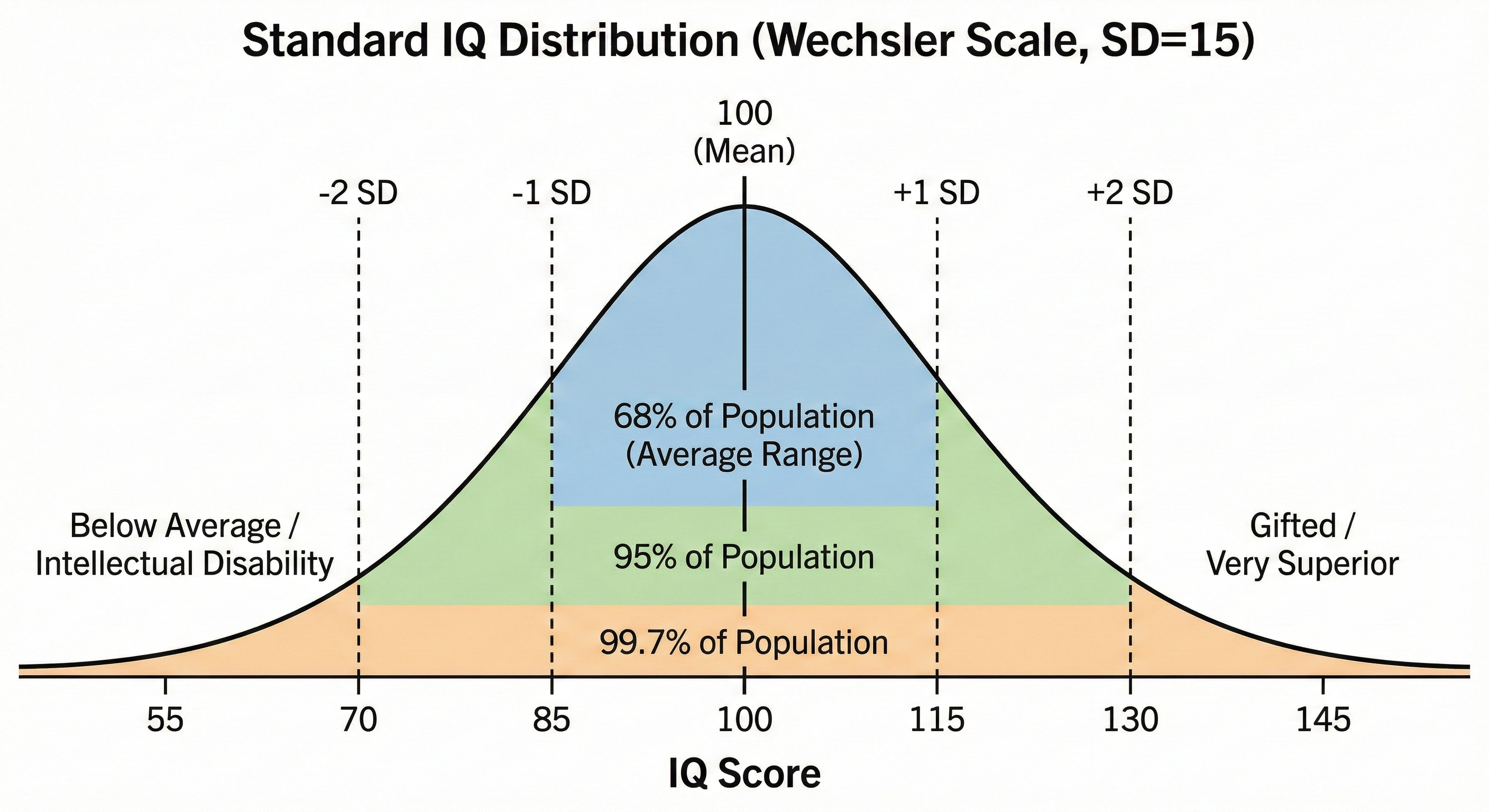
To understand the “ranges,” you need to understand Standard Deviation (SD). In most modern tests, such as the Wechsler Adult Intelligence Scale (WAIS), the standard deviation is 15 points.

Think of the SD as a “step” away from the average.

  • 68% of people fall within one step of the average (between 85 and 115).

  • 95% of people fall within two steps (between 70 and 130).

  • 99.7% of people fall within three steps (between 55 and 145).

If you score 130, you aren’t just “smart”—you are statistically two full deviations above the norm, placing you in the top 2% of the population.

IQ Score Ranges Breakdown

While different tests (like Stanford-Binet vs. Wechsler) use slightly different classifications, here is the generally accepted breakdown of IQ ranges.

85 – 115: The Average Range

  • Population Share: ~68%

  • Description: This is where the vast majority of humanity sits. People in this range can perform most jobs, complete high school and college, and function effectively in society.

    • 85–99: Low Average

    • 100–115: High Average

115 – 130: Above Average (Bright)

  • Population Share: ~14%

  • Description: Individuals in this range often grasp complex concepts faster than their peers. They tend to perform well in universities and professional fields such as engineering, law, and medicine.

130 – 144: Moderately Gifted

  • Population Share: ~2%

  • Description: This is the cutoff for high-IQ societies like Mensa. People in this range often exhibit early reading abilities and strong pattern recognition. They represent 1 in 50 people.

145 – 159: Highly Gifted

  • Population Share: ~0.1%

  • Description: This is a rare level of cognitive ability (roughly 1 in 1,000 people). Individuals here often have radically different learning needs and may accelerate through standard education systems rapidly.

160+: Profoundly Gifted

  • Population Share: <0.003%

  • Description: This is the “tail” of the curve. These scores are difficult to measure accurately because the sample size of people at this level is so small. This range is often associated with child prodigies and revolutionary thinkers, though high IQ does not guarantee high achievement.

Below 70: Intellectual Disability

  • Population Share: ~2.2%

  • Description: Scores below 70 may indicate cognitive challenges. This range often requires support systems for daily living or specialized education plans.

Does High IQ Equal Success?


It is important to remember that the Bell Curve measures cognitive processing speed and pattern recognition—not worth, creativity, or potential for happiness.

While a high score correlates with academic success and income, it does not measure:

  • Emotional Intelligence (EQ)

  • Grit and determination

  • Creativity and divergent thinking

A person with an IQ of 105 who works incredibly hard will often outperform a person with an IQ of 135 who lacks discipline.

Key Takeaways

  • The average IQ is 100.

  • Most people (68%) score between 85 and 115.

  • A score of 130+ puts you in the top 2% of the population.

  • IQ is a comparative metric, not an absolute measure of human value.


Ready to test your own cognitive skills? Take your IQ Test here 

What Is AGI?

What Is AGI?

Artificial general intelligence means a system that can learn and

Does Using AI Make You Dumber?

Does Using AI Make You Dumber?

The claim that AI is making us stupider has real

What Is ChatGPT’s IQ Score?

What Is ChatGPT’s IQ Score?

Search for ChatGPT’s IQ score and you will find 155,