



Working Memory and Maths Underachievement: The Data
A 2022 meta-analysis of 46 studies and more than 11,000 children finds a real but moderate link between working memory and arithmetic, and the two kinds of working memory matter differently as children get older.


What you need to know
- A meta-analysis pooling 46 studies, 187 effect sizes and 11,224 children aged 6 to 12 found a medium correlation between working memory and arithmetic performance (r = 0.312, 95% CI 0.276 to 0.348).
- Verbal working memory, holding words or numbers in mind, correlates more strongly with arithmetic (r = 0.332) than visuospatial working memory (r = 0.297), but the verbal link fades with age while the visuospatial one stays stable.
- A separate meta-analysis of children with diagnosed learning difficulties found that those with combined reading-and-maths difficulties have the most severe working-memory deficits of any group, in both verbal and numerical working memory.
- A moderate correlation is not a diagnosis. Working memory is one contributor to maths underachievement among several, including attention, anxiety and prior instruction, not a single cause.
Why do some children with plenty of maths instruction still struggle with it? One well-supported answer, backed by a 2022 meta-analysis of 46 studies and more than 11,000 children, is working memory: the mental workspace that holds information while it is being used. It is a real contributor, though not the whole story.
What is working memory, and how was it measured here?
Working memory is the capacity to hold a small amount of information in mind while actively using it, for example remembering to carry the 2 while still tracking the rest of a multi-digit sum. Zhang, Tolmie and Gordon (Brain Sciences, 2022) pooled 46 studies covering 187 separate effect sizes and 11,224 children aged 6 to 12 across 55 independent samples, to ask how strongly working memory tracks arithmetic performance in ordinary primary-school populations.
How strong is the link?
The pooled correlation was r = 0.312 (95% confidence interval 0.276 to 0.348), what researchers typically call a medium effect. That means working memory reliably tracks arithmetic performance, but on its own it explains less than 10 percent of the variation in scores (0.312 squared is about 0.097), leaving plenty of room for instruction quality, practice, motivation and anxiety.
- Verbal working memory, holding words or numbers in mind: r = 0.332
- Visuospatial working memory, holding mental images or spatial layouts in mind: r = 0.297
- The gap between the two was statistically significant (p = 0.041)
Age changes which type matters more. The correlation between verbal working memory and arithmetic got weaker as children got older, while the visuospatial correlation stayed roughly stable across the 6-to-12 age range. That fits a common explanation in the field: younger children may lean on verbally rehearsing numbers, repeating 'carry the 2' to themselves, while older children shift toward more visual or spatial strategies as arithmetic becomes more automatic.
A medium correlation is real, and worth building on, but it explains less than a tenth of why one child's arithmetic score differs from another's.
Is the picture different for children who are actually underachieving?
A separate, earlier meta-analysis focused specifically on diagnosed learning difficulties adds an important piece. Peng and Fuchs (Journal of Learning Disabilities, 2016), pooling 29 studies and 110 comparisons, found that children with combined reading-and-mathematics difficulties showed the most severe working-memory deficits of any group studied, worse than children with a reading difficulty alone or a maths difficulty alone, and affecting both verbal and numerical working memory. That suggests working memory's role gets more, not less, important at the underachieving end of the distribution, even though the general-population correlation above is moderate.
Does working-memory training improve maths grades?
This is where the evidence gets less encouraging than the correlation above might suggest. Melby-Lervag and Hulme (Developmental Psychology, 2013), reviewing working-memory training programs such as Cogmed, found that children reliably improve on the trained working-memory tasks themselves and on very similar untrained tasks, but found no reliable evidence that those gains transfer to real-world academic outcomes such as maths or reading achievement. A follow-up review in 2016 reached the same conclusion. That does not undercut the correlation Zhang and colleagues found; it means training working memory in isolation is not a shortcut to better maths scores, and support is better aimed at the specific classroom demands, listed below, that overload working memory during arithmetic.
What does this mean in a classroom?
It means maths underachievement is rarely explained by one factor, and working memory is one of the more measurable ones. Reducing how much a child has to hold in mind at once, writing out intermediate steps, breaking multi-step problems into smaller written stages, reducing time pressure, targets the specific bottleneck this research identifies, without requiring a diagnosis first. It is not a substitute for good instruction, and a child who is behind in maths for other reasons, gaps in prior teaching, anxiety, or language barriers, will not be helped much by working-memory accommodations alone. For how schools tell a knowledge gap from an ability gap, see our piece on achievement tests versus IQ tests.
Where would your own score land?
Curious how a working-memory-related score would actually be reported? Take the IQ Metrics test to see your profile broken down by ability area.
Find your IQ score now! →Learn how IQ tests work and take the IQ test to see your own profile broken down by area.
Common questions
Does working memory cause maths underachievement?
It is a meaningful contributor, not a single cause. A 2022 meta-analysis of 46 studies and over 11,000 children found a moderate correlation (r = 0.312) between working memory and arithmetic performance.
Which type of working memory matters more for maths?
Verbal working memory correlates slightly more strongly with arithmetic (r = 0.332) than visuospatial working memory (r = 0.297), but the verbal link weakens with age while the visuospatial one stays stable.
Do children with maths difficulties have worse working memory?
Children with combined reading-and-maths difficulties show the most severe working-memory deficits of any group studied, according to a separate meta-analysis of 29 studies, more than children with only a reading or only a maths difficulty.
Is a working-memory deficit the same as having a low IQ?
No. A child can have age-typical general reasoning ability and still have a specific working-memory bottleneck that limits multi-step arithmetic.
Sources for this story
- Zhang, Y., Tolmie, A. and Gordon, R., The Relationship between Working Memory and Arithmetic in Primary School Children: A Meta-Analysis, doi 10.3390/brainsci13010022 — Brain Sciences, 2022
- Peng, P. and Fuchs, D., A Meta-Analysis of Working Memory Deficits in Children With Learning Difficulties, doi 10.1177/0022219414521667 — Journal of Learning Disabilities, 2016
Corrections: spotted an error? Email corrections@iqmetrics.org and we will update this story and note the change here.
Related stories
All news →Working Memory and Reasoning Are Closely Related. They Are Not the Same Thing
The correlation between them is one of the sturdier findings in cognitive psychology. How strong it is, and what it implies about training either one, is where the agreement stops.
Falling Reading Scores Are Not Falling IQ. Here Is the Difference
National reading results have dropped again, and around forty per cent of American fourth-graders are now below the NAEP Basic level. That is a fact about an achievement test, and achievement tests are built to show exactly the movement an IQ score is built to hide.
ISEE Scores Explained: Scaled Scores, Stanines and the IQ Question
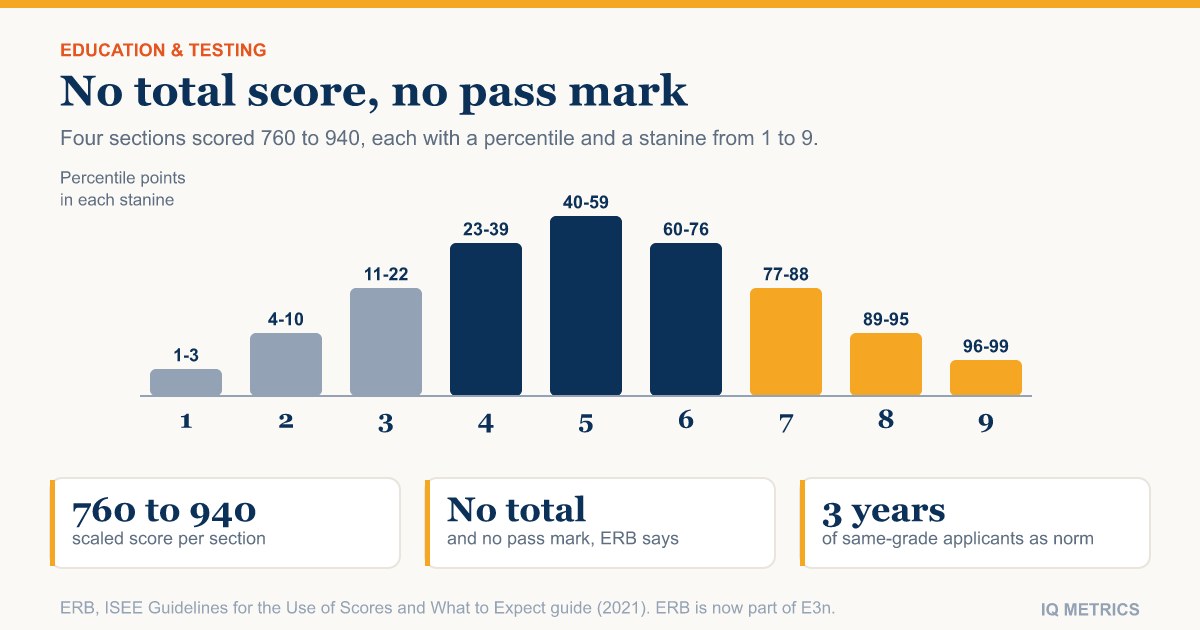
The ISEE reports four section scores of 760 to 940, a percentile and a stanine for each, and no total or pass mark. Its maker never calls it an IQ test, and its percentiles compare a child with other private-school applicants.
Read the research.
Then find your own number.
Our IIF-certified assessment reports your score with its scale, percentile and confidence range — and a breakdown of the cognitive domains behind it.
Start IQ Test →