



ISEE Scores Explained: Scaled Scores, Stanines and the IQ Question
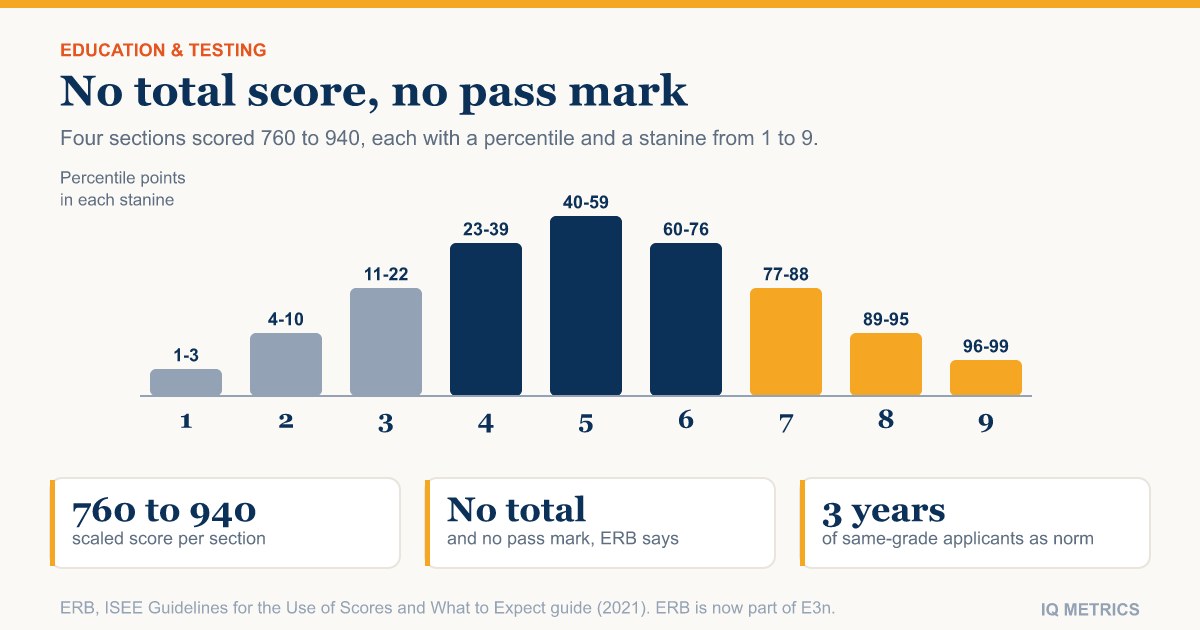
The ISEE reports four section scores of 760 to 940, a percentile and a stanine for each, and no total or pass mark. Its maker never calls it an IQ test, and its percentiles compare a child with other private-school applicants.

What you need to know
- Each ISEE section gets a scaled score from 760 to 940, a percentile rank and a stanine from 1 to 9. There is no total score: ERB, the test's maker, advises schools to look at each subscore, and it says there is no pass mark and no way to call a score good or bad.
- Percentiles compare a child with students applying for the same grade who took the ISEE in the past three years, a group ERB calls very competitive. ERB's 2021 guide says ISEE percentiles run 10 to 40 points lower than those on national-norm tests, so a 50th percentile is not an average child.
- ERB describes the reasoning sections as showing what a student is capable of learning, but the words IQ and intelligence appear in none of its documents we read. We found no independent study comparing the ISEE with an IQ test, and ERB's own validation study is the maker's.
- The questions you see on the test are not all scored. In the Upper Level guide, 21 of the 160 multiple-choice questions are unscored trial items, and ERB merged with the SSAT's organisation into E3n on 1 March 2026, so its pages now sit at admission.org.
The ISEE (Independent School Entrance Exam) reports four section scores, each a scaled score between 760 and 940 with a percentile rank and a stanine from 1 to 9. It does not report a total score, and its maker says there is no pass mark and no way to call a score good or bad. Percentiles compare a child with other students who applied for the same grade and took the test in the past three years, mostly applicants to selective independent schools. The ISEE is not an IQ test, and nothing converts an ISEE score into an IQ. This guide explains how the scores work, what the questions and timings are, what the maker says the test measures, how it differs from the SSAT, and the 2026 merger that moved the ISEE's pages.
How are ISEE scores calculated?
Each of the four scored sections, Verbal Reasoning, Quantitative Reasoning, Reading Comprehension and Mathematics Achievement, starts as a raw score: the number of questions answered correctly. Nothing is deducted for a wrong answer, so leaving a question blank has no advantage. The raw score becomes a scaled score from 760 to 940. ERB, which created the test, says each form gets its own conversion that adjusts for small differences in difficulty, so a scaled score means the same on any form. Scores are reported four ways: the scaled score, the percentile rank, the stanine and a stanine analysis, which shades a band of one stanine either side of the actual stanine to show that a score is not exact. The i-Ready tests publish the same idea as a standard error; see i-Ready scores by grade level.
There is no overall score. In a 2023 paper on the equitable use of ISEE scores, ERB says that a composite of the four subscores is less illuminating, and advises schools to consider each subscore. Schools may weight sections differently, for example giving double weight to the verbal sections or to the maths sections. Our guide to the IQ score margin of error explains why a band around a score is more honest than a single number.
What do ISEE percentiles and stanines mean?
A percentile is not the share of questions answered correctly. It is the share of the comparison group who scored the same or lower. The group is every student applying for the same grade who took the ISEE over the past three years, recalculated each year. ERB's guidelines call it a very competitive group applying to selective schools, and its 2021 guide for families says ISEE percentiles are generally 10 to 40 percentile points lower than those on tests with national norms. A 50th percentile on the ISEE therefore describes a typical applicant to these schools, not a typical child. The SSAT works the same way: its 2026-27 tables put the grade 8 median at a total of 2013 out of 2400; see the SSAT percentile chart by grade.
A stanine divides the group into nine bands, with 5 as the midpoint. ERB's 2021 table gives the percentile range of each:
- Stanine 1: percentiles 1 to 3
- Stanine 2: percentiles 4 to 10
- Stanine 3: percentiles 11 to 22
- Stanine 4: percentiles 23 to 39
- Stanine 5: percentiles 40 to 59
- Stanine 6: percentiles 60 to 76
- Stanine 7: percentiles 77 to 88
- Stanine 8: percentiles 89 to 95
- Stanine 9: percentiles 96 to 99
ERB reads 1 to 3 as below average, 4 to 6 as average and 7 to 9 as above average, for this applicant group. Stanines are also used in school tests such as the CAT4, explained in our guide to CAT4 scores. For comparison only, on the IQ scale with a mean of 100 and a standard deviation of 15, the general-population percentiles 50, 75, 90, 95 and 99 correspond to IQ 100, 110, 119, 125 and 135 (our percentile calculator and score converter give any other value). Do not read an ISEE percentile that way. Because the ISEE group is selective, an ISEE 50th percentile probably sits above the general-population 50th, so a naive translation would, if anything, understate the child. That is our reasoning, not an ERB statement, and no conversion exists.
How many questions and minutes are on the ISEE?
The Middle Level (applying to grades 7 and 8) and the Upper Level (grades 9 to 12) have the same structure. The questions below are the total printed on the public table, and they include unscored items.
- Verbal Reasoning: 40 questions, 20 minutes (synonyms and sentence completions)
- Quantitative Reasoning: 37 questions, 35 minutes
- Reading Comprehension: 36 questions, 35 minutes
- Mathematics Achievement: 47 questions, 40 minutes
- Essay: one prompt, 30 minutes, not scored
- Total: 160 multiple-choice questions and about 2 hours 40 minutes, plus two breaks
The Lower Level (grades 5 and 6) has 34, 38, 25 and 30 questions in the same four sections and takes about 2 hours 20 minutes; the Primary levels for grades 2 to 4 test reading and mathematics only. The full question counts overstate the scored items. In ERB's 2021 Upper Level guide the scored questions are 35 of 40 in Verbal Reasoning, 32 of 37 in Quantitative Reasoning, 30 of 36 in Reading Comprehension and 42 of 47 in Mathematics Achievement. By our addition that is 139 scored and 21 unscored items, which ERB may use on future editions; the 2018 Middle Level guide shows the same split.
Does the ISEE measure IQ?
ERB does not say so. In the guidelines, quick-facts guide, 2023 paper, three What to Expect guides and web pages we read, the words IQ and intelligence appear nowhere, nor does aptitude. ERB splits the four scored sections into achievement and reasoning. Reading Comprehension and Mathematics Achievement show what a student knows and can do at the time of testing; Verbal Reasoning and Quantitative Reasoning show what a student is capable of learning, in ERB's phrase. The verbal sections test vocabulary and reasoning with synonyms and sentence completions, and the quantitative section tests how well a child thinks mathematically with little calculation. Our guide to vocabulary size and IQ shows why vocabulary tests correlate so well with general ability, and our guide to achievement tests and IQ tests sets out the wider distinction.
Two limits matter. ERB's guides say there is no formal comparison between the ISEE and other national tests, so no one has published a conversion. And we found no independent study correlating the ISEE or the SSAT with an IQ test or with later achievement. ERB's guidelines say the test's predictive power is on par with the SAT, ACT and GRE, citing ERB's own 2017 validation study, which we could not read. WGBH News reported in 2018 that the sample was large enough to draw conclusions only for white students, a news report, not a peer-reviewed finding. For tests that do report on an IQ-style scale, see our guides to CogAT and NNAT scores and WPPSI-IV scores.
An ISEE percentile compares a child with other private-school applicants, so it is not an IQ percentile, and no official conversion exists.
How often can you take the ISEE, and what do schools see?
A student can register once per testing season, up to three times a school year: Fall covers August to November, Winter December to March, and Spring or Summer April to July. The test is offered on paper, online at a test centre and online at home, with the same questions, timing and answer-changing rules in each. Scores from online tests are usually ready in three to five days, and paper tests in five to ten. Reports go to the schools the family chose, and a school can only receive a complete report: families cannot send one section from one sitting and another section from a different sitting. The essay is unscored and goes only to schools, and families do not receive a copy. ERB's guidelines call super-scoring a research-supported practice that schools may choose, and say any policy should be applied consistently. Another high-school entrance exam, the HSPT, reports an IQ-style quotient of its own; see HSPT scores explained.
How does the SSAT compare?
ERB and the SSAT's organisation, the Enrollment Management Association, merged into a single non-profit, E3n, on 1 March 2026. The ISEE and SSAT are now run by the same organisation, and the old erblearn.org pages redirect to admission.org. The tests still differ. The Upper Level SSAT (grades 8 to 11) and Middle Level (grades 5 to 7) have 50 quantitative questions in two 30-minute sections, 40 reading questions in 40 minutes and 60 verbal questions in 30 minutes, 30 synonyms and 30 analogies, plus an unscored 25-minute writing sample and an experimental section. On the Middle and Upper SSAT a wrong answer costs a quarter of a point; the ISEE has no penalty. SSAT percentiles compare a student with first-time test takers in the same grade over the past three years in the US and Canada, and E3n's help page says they are not based on gender, which contradicts some prep sites. The SSAT allows up to six Standard sittings and one Flex sitting a testing year on paper. We could not verify the SSAT scaled score ranges from an official page, so we do not print them. For the UK independent-school counterpart, see our guide to ISEB Common Pre-Test scores.
What should families do with an ISEE score?
Read each section on its own, look at the stanine band and not the single number, and ask each school how it uses the scores, because ERB says it sets no cutoff and schools decide. A percentile of 90 on the ISEE means better than 90% of recent applicants, a strong result, but it is not a measurement of IQ and should not be quoted as one. For general background on how gifted programs set cut scores, see our blog guide to gifted cutoff scores and our news guide to universal screening.
Where would your own score land?
Want a result on the standard IQ scale, with its percentile and a full report? Take the IQ Metrics test, or the kids test for younger children.
Find your IQ score now! →To see how a score of your own compares with the population, take the IQ Metrics test, or try the kids IQ test for a child, and read the result against the IQ bell curve.
Common questions
What is a good ISEE score?
ERB says there is no passing score and no way to call a score good or bad; each school decides. Percentiles compare a child with other applicants for the same grade over the past three years, and stanines of 7 to 9 are above average for that group.
What is the ISEE scoring scale?
Each of the four scored sections has a scaled score from 760 to 940, reported with a percentile rank, a stanine from 1 to 9 and a stanine analysis. There is no total score, and wrong answers are not penalised.
Is the ISEE an IQ test?
No. ERB never calls it one: the words IQ and intelligence appear in none of its documents we read. It describes the reasoning sections as showing what a student can learn, and offers no IQ conversion.
How many times can you take the ISEE?
Once per testing season, up to three times a school year: Fall (August to November), Winter (December to March) and Spring or Summer (April to July). A school can only receive a complete score report, not one section from each sitting.
Sources for this story
- ISEE by ERB: Guidelines for the Use of Scores (REV03) — Educational Records Bureau (now E3n)
- ISEE about and score-report pages (admission.org, 2026); who we are: E3n formed 1 March 2026 — E3n
- What to Expect on the ISEE, Upper Level and Lower Level (2021) and Middle Level (2018 edition); ISEE Quick Facts Guide 2025-2026 — Educational Records Bureau
- The Equitable Use of ISEE Scores (14 November 2023) — Educational Records Bureau
- SSAT about, Upper and Middle Level, score-report and percentile help pages — E3n (Enrollment Management Association)
- Boston schools ignored anti-bias bid specs in awarding testing contracts (2 November 2018) — WGBH News
Corrections: spotted an error? Email corrections@iqmetrics.org and we will update this story and note the change here.
Related stories
All news →Why a CogAT 132 and an NNAT 132 Are Not the Same Score
The two tests American schools use most to screen for gifted programmes print their results on scales that differ by one point of standard deviation. At the level where cutoffs are set, that moves the same printed number by most of a percentile.
Falling Reading Scores Are Not Falling IQ. Here Is the Difference
National reading results have dropped again, and around forty per cent of American fourth-graders are now below the NAEP Basic level. That is a fact about an achievement test, and achievement tests are built to show exactly the movement an IQ score is built to hide.

SSAT Percentile Chart 2026-27: Scores by Grade and the IQ Question
The SSAT percentile is a rank among first-time takers in the same grade, not a mark out of 100. In the 2026-27 guide a grade 8 student needs a total of about 2013 of 2400 for the 50th percentile and 2343 for the 99th. The test does not claim to measure IQ.
Read the research.
Then find your own number.
Our IIF-certified assessment reports your score with its scale, percentile and confidence range — and a breakdown of the cognitive domains behind it.
Start IQ Test →