





GRE and LSAT Scores to IQ: What the Research Actually Says
There is no official GRE-to-IQ or LSAT-to-IQ conversion. See what the SAT research actually found, what the GRE and LSAT predict instead, and why online conversion calculators have no scientific basis.

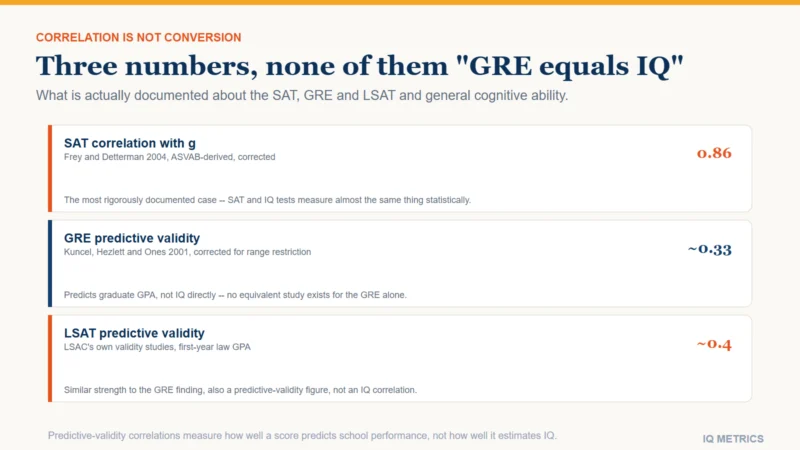
There is no official conversion from a GRE or LSAT score to an IQ score. The best- documented related case is a different test, the SAT: Frey and Detterman’s 2004 study found it correlates with g, general cognitive ability drawn from a full test battery, at 0.82, rising to 0.86 once corrected for the nonlinear relationship at the extremes. Because the GRE is built by the same organisation using similar item types, a comparably strong link is plausible — but nobody has run that exact study on the GRE alone, and the LSAT’s own literature is thinner still. This article covers what is actually documented for each test, why a direct GRE-to-IQ or LSAT-to-IQ number is not scientifically supported, and what a strong score can responsibly tell you.
- Clearest evidence: the SAT correlates with g at 0.82 (0.86 corrected), per Frey & Detterman’s 2004 study using ASVAB-derived cognitive scores.
- GRE: predicts graduate-school GPA at about 0.32 to 0.34 corrected — a predictive-validity figure, not a direct g-correlation.
- LSAT: predicts first-year law-school GPA at a broadly similar strength, again predictive validity rather than a measured IQ correlation.
- The catch: everyone sitting the GRE or LSAT already holds a college degree, a group with an average IQ around 107 — so both tests only ever see a narrow, already-selected slice of the full population range.
Why there is no official GRE-to-IQ or LSAT-to-IQ conversion
A conversion needs two tests equated against the same population using the same statistical methods, and that work has never been done for the GRE or the LSAT against a Wechsler-style scale. The norm groups differ: IQ tests are normed against the general population, while the GRE and LSAT are normed against college graduates and law-school applicants, groups already well above the population average. The content differs too — verbal reasoning, quantitative reasoning and (for the LSAT) formal logic games, rather than the broader mix of verbal, spatial, working-memory and processing-speed tasks a full IQ battery covers. The site’s own SAT-to-IQ conversion piece covers the closest related case the field has actually studied.
What the SAT research actually found, and why it matters here
Frey and Detterman (2004) extracted g from the Armed Services Vocational Aptitude Battery and correlated it with SAT scores for 917 participants in a national longitudinal sample: r = 0.82, rising to 0.86 once corrected for the nonlinear relationship at very high and very low scores. A second study in the same paper compared SAT scores against Raven’s Advanced Progressive Matrices in 104 undergraduates: r = 0.483, correcting to 0.72 once the restricted range of a selective college sample is accounted for. Because the GRE shares a publisher, a similar construction philosophy and considerable item-type overlap with the SAT, researchers commonly treat this as suggestive evidence for the GRE too — but suggestive is not the same as measured, and no study has repeated Frey and Detterman’s design on the GRE by itself.
| Test | What was measured | Correlation | Source |
|---|---|---|---|
| SAT | correlation with g (ASVAB-derived) | 0.82 (0.86 corrected) | Frey & Detterman, 2004 |
| GRE | predicts graduate-school GPA | ~0.32 to 0.34 (corrected) | Kuncel, Hezlett & Ones, 2001 |
| LSAT | predicts first-year law-school GPA | ~0.4 (similar range) | LSAC validity studies |
What the LSAT and GRE structurally have in common with an IQ test
Even without a dedicated g-correlation study, the LSAT and GRE share structural features with the tasks an IQ battery uses. The LSAT’s logical reasoning and analytical reasoning sections ask test-takers to track abstract relationships between statements and draw valid conclusions under time pressure, a task family closely related to the matrix-reasoning and fluid-reasoning subtests that carry much of the weight on a modern IQ battery. The GRE’s quantitative reasoning section overlaps with the numerical- reasoning and working-memory demands of standard cognitive testing, and its verbal reasoning section tracks the vocabulary and verbal-comprehension subtests IQ batteries have used for a century. None of this substitutes for an actual correlation study — task similarity is suggestive, not proof, and two tests can look alike on paper while measuring somewhat different things in practice. It does explain why researchers expect the GRE and LSAT to correlate meaningfully with g even without a Frey-and-Detterman-style study to confirm exactly how strongly.
The historical Mensa-GRE connection, and why it ended
Mensa once accepted GRE scores from before 30 September 2001 as a qualifying admission test, alongside the SAT and several other individually normed instruments available at the time. The GRE was substantially rescaled in 2011 and no longer sits on norms Mensa recognises, so current GRE scores are not accepted for admission. The LSAT has never been on Mensa’s qualifying-test list at all. It is a useful anchor: even the organisation most associated with treating a test score as an IQ proxy draws a hard line here, rather than accepting either test at face value.
What a very high GRE or LSAT score does and does not tell you
A top-percentile GRE or LSAT score is strong evidence of strong reasoning ability in the specific domains those tests cover: verbal and quantitative reasoning for the GRE, formal logical reasoning and reading comprehension for the LSAT. It says comparatively little about domains those tests do not touch, such as spatial reasoning or processing speed, the way a full IQ battery would test them directly. See multiple intelligences theory and which parts of the brain IQ tests measure for how much a single score can and cannot capture. For context on how rare an actual top-tier IQ score is, see what an IQ of 150 means.
Where would your own score land?
Take the IIF-certified assessment and get your score with the scale it was measured on, the percentile it corresponds to and the confidence range around it — the three figures most online tests leave out.
Find your IQ score now! →Why online "GRE to IQ" calculators are not credible
A GRE-to-IQ conversion has no scientific basis: no published equating study links the two scales, and the calculators that circulate online typically apply an arbitrary formula rather than a validated statistical transformation. They also ignore restricted range — a GRE percentile among test-takers who already hold a degree is not the same as a percentile against the general population, so a naive conversion overstates how rare a given GRE score really is on an IQ scale. IQ test accuracy covers the same distortion in other contexts.
If you want an actual estimate of your general cognitive ability
The only route to a number that means what an IQ score means is an individually administered test given and interpreted by a psychologist, not a graduate-admissions exam repurposed for a different job. How to prepare for an IQ test and professional IQ tests cover what that actually involves. A strong GRE or LSAT score remains a reasonable, if indirect, signal of strong reasoning ability — just not a substitute for a test built and normed to measure it.
Quick answers
- Can I convert my GRE score to an IQ score? Not accurately. No validated conversion exists between the two scales.
- Is the LSAT correlated with IQ? It correlates with general reasoning ability, but the documented figures are predictive-validity correlations with law-school grades, not a direct IQ correlation.
- Does Mensa accept GRE or LSAT scores? No. Mensa stopped accepting the GRE after its 2011 rescaling and has never accepted the LSAT.
- Is the SAT basically an IQ test? Statistically, it comes close — a 0.82 to 0.86 correlation with g is very high for two differently designed tests.
- Does a perfect GRE or LSAT score mean a genius-level IQ? It strongly suggests high verbal, quantitative or logical reasoning ability, but is not proof of a specific IQ number.
The bottom line
The GRE and LSAT both correlate with general cognitive ability, but neither converts to an IQ score with any scientific backing. The SAT is the only admissions test with a rigorously measured g-correlation, at 0.82 to 0.86; the GRE and LSAT are documented mainly through predictive-validity studies against school performance, a related but different kind of evidence. Treat a strong score as a sign of strong reasoning in the tested domains, not a stand-in for an actual IQ test.
Sources
- Frey, M.C. & Detterman, D.K. (2004), Psychological Science: Scholastic Assessment or g? The relationship between the SAT and general cognitive ability.
- Kuncel, N.R., Hezlett, S.A. & Ones, D.S. (2001), Psychological Bulletin: a comprehensive meta-analytic relationship between GRE scores and graduate school success.
Keep reading
All articles →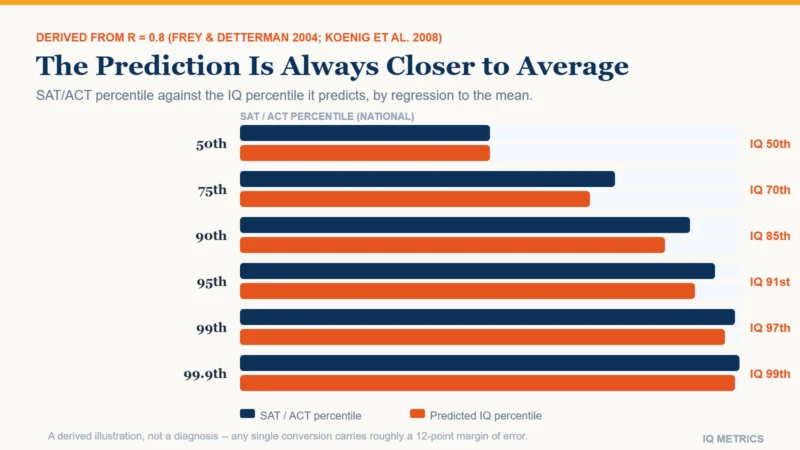 Scores & Scales
SAT and ACT Score to IQ Conversion
Neither the SAT nor the ACT is an IQ test, but two landmark studies found they correlate with general cognitive ability at 0.77 to 0.86. Here is what that correlation actually predicts by percentile, the real 12-point margin of error around any single conversion, and why the method breaks down at the extremes.
 Scores & Scales
What an IQ of 150 Means
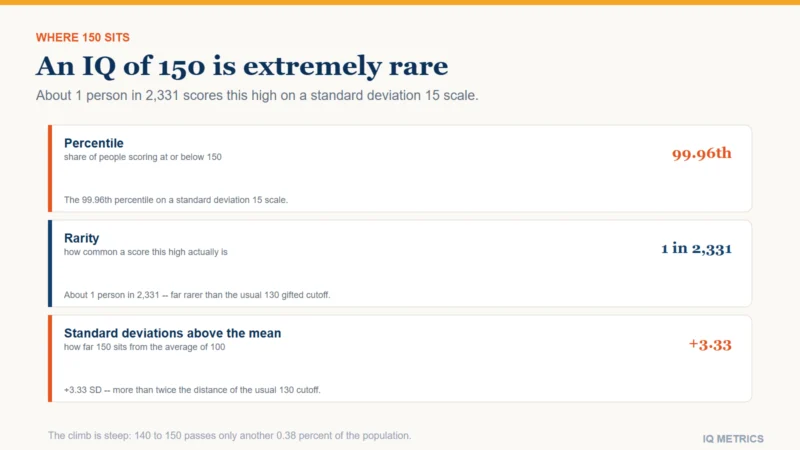
An IQ of 150 is about 1 person in 2,331 on a standard deviation 15 scale, the 99.96th percentile. See how rare it really is, what "genius" cutoffs actually mean, and why scores this high need a real test to trust.
 Scores & Scales
Mensa IQ Score Requirements
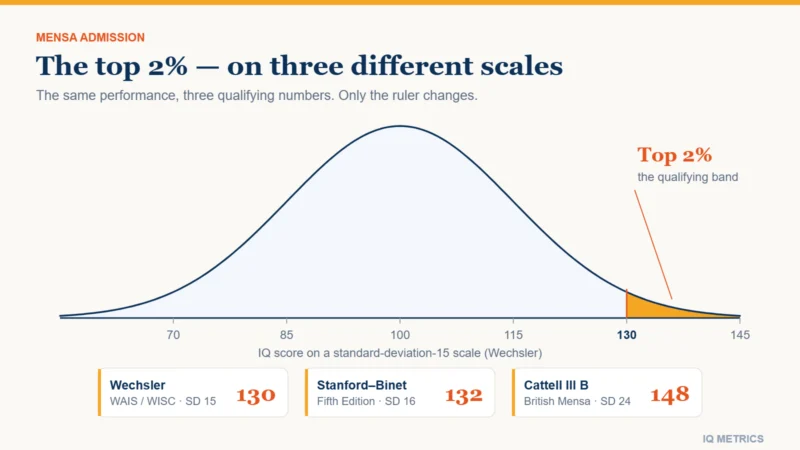
Mensa admits the top 2% of scorers, but "the top 2%" is a rank, not a number, and the number it maps to changes with the test you sat. Here is what qualifies on the Wechsler, Stanford-Binet and Cattell scales, the two routes to membership, and what the supervised admission test is actually like.