



Cattell Culture Fair Intelligence Test Explained
Raymond Cattell built the CFIT in 1949 to measure fluid reasoning without leaning on language or schooling. It is still used in cross-cultural research today, its four nonverbal subtests are unlike anything on a Wechsler scale, and its scoring uses a standard deviation of 24, not the usual 15.


What you need to know
- Raymond Cattell built the CFIT in 1949 to measure fluid intelligence, gf, while minimizing the influence of culture, language and formal schooling — four nonverbal, timed subtests: Series, Classification, Matrices and Conditions.
- Its standard score uses a mean of 100 but a standard deviation of 24, not the usual 15 — so a CFIT score and a Wechsler score of the same number sit different distances from average.
- A 1986 study testing American, Nigerian and Indian adolescents on the CFIT found 59% of its items showed measurable cultural bias, a reminder that "culture-fair" was always a design goal rather than a guarantee.
- The test is still in active use: a 2025 study compared fluid intelligence in Russian and Emirati undergraduates using CFIT Scale 3, and the Triple Nine Society, open only to the top 1 in 1,000, accepts a combined score of 85 across the test's two parallel forms.
The Cattell Culture Fair Intelligence Test (CFIT) is a nonverbal IQ test built to measure reasoning ability without leaning on the vocabulary, general knowledge or schooling that verbal tests reward. Its four subtests are pictures and shapes, not words, and its standard score uses an unusual spread — a standard deviation of 24 rather than the 15 used by the Wechsler scales and the Stanford-Binet 5, which this piece explains alongside how the test is scored, how well it actually avoids cultural bias, and where it is still used three-quarters of a century after it was built.
What is the Cattell Culture Fair Intelligence Test?
Psychologist Raymond Cattell created the CFIT in 1949 as an attempt to measure cognitive ability without the sociocultural and environmental influences that shape performance on more traditional, language-heavy tests. It grew out of Cattell's own theory that general intelligence splits into two parts: fluid intelligence (gf), the biologically based capacity to reason with new problems, and crystallized intelligence (gc), the knowledge and skill built up through culture and schooling. The CFIT targets gf specifically — our guide to CHC theory covers how that fluid/crystallized split became the backbone of most modern test batteries, and our blog's piece on fluid versus crystallized intelligence explains the distinction on its own.
The CFIT was originally published by Cattell's own Institute for Personality and Ability Testing (IPAT), which he founded the same year the test was released, and its catalogue later passed through several rounds of assessment-industry consolidation, so no single easily citable "current publisher" can be given for the original English-language test here. A related instrument is easier to pin down: the publisher Hogrefe currently sells the CFT 20-R, a German-language revision built on the same series-classification-matrices-conditions structure, for ages 8 to 17 — evidence the underlying design is still considered useful enough to keep revising rather than retire, more than three-quarters of a century after Cattell first published it.
What do the four CFIT subtests measure?
Scales II and III of the CFIT share the same four nonverbal, timed subtests. Scale I, built for young children and adults with intellectual impairment, uses a different eight-task structure built around mazes, copying and matching drawings instead.
- Series: pick the figure that continues a sequence
- Classification: pick the figure that does not belong with the others
- Matrices: complete a grid of geometric patterns
- Conditions: pick the design that satisfies the same spatial rule shown in a sample
Scale 1 is commonly described as suited to ages four to eight and to adults with intellectual impairment; Scale 2 to children around eight to thirteen and to adults of average ability; and Scale 3 to more able teenagers, college students and higher-ability adults. Scales 2 and 3 each come in two parallel forms, A and B, which is what lets a single combined score be built from both forms together, the way the high-range society mentioned further down requires.
Every item is a picture, never a word, which is the whole design premise: a test-taker with limited English or limited formal schooling is not supposed to be at a disadvantage answering it. Our guide to whether IQ is just pattern recognition covers the broader question of what nonverbal, figural items like these actually measure.
How is the CFIT scored?
Like most IQ tests, CFIT standard scores are centered on a mean of 100. Unlike most, Cattell built the test with a standard deviation of 24 rather than the 15 used by the Wechsler scales, the Stanford-Binet 5 and most other modern instruments. Our guide to standard deviation 15 versus 16 covers why the spread a test uses changes what a given number means; a CFIT spread of 24 goes further still. A 15-point difference from 100 is under a full standard deviation on the CFIT's own scale, where it would be a full standard deviation on a Wechsler scale — so a score cannot be compared across tests without converting it first, which our score converter does directly.
Cattell scored the CFIT with a standard deviation of 24, not the 15 nearly every other modern IQ test uses.
Does the CFIT actually eliminate cultural bias?
Not entirely, and Cattell's own test proved it. A 1986 study administered the CFIT to a large sample of American, Nigerian and Indian adolescents and examined the items for cultural bias; the test's claim to measure a single fluid-intelligence factor held up well across all three groups, but 59% of its individual items were flagged as showing measurable bias, leading the researcher to conclude the test could not claim universal validity as a culture-fair measure. The problem sat at the item level rather than in the test's basic structure — the CFIT was still measuring one coherent factor across all three groups, which means the finding is about which specific pictures favored which culture, not about whether the test measured anything real.
That finding sits alongside a broader, honest caveat about the whole category of "culture-reduced" tests, CFIT and Raven's Progressive Matrices included: neither fully escapes the influence of culture and learning, even though both were built to minimize it. Our guide to Raven's Progressive Matrices scores covers the best-known test in the same category.
Where is a culture-reduced test like this most useful?
A test built to minimize the influence of language and schooling matters most for exactly the populations a verbal test disadvantages: people being assessed in a language they are still learning, people with limited formal education, and any comparison across countries or cultures where a shared vocabulary test would tilt toward whichever group speaks it natively. That was Cattell's stated purpose in 1949, and it remains the CFIT's main niche today — cross-cultural comparison research, like the 2025 study below, rather than the general clinical role the Wechsler scales and the Stanford-Binet 5 fill in most English-language clinics. A test with a genuinely different item type also gives psychologists a second, independent estimate of reasoning ability when a verbal score looks out of step with everyday functioning.
Is the CFIT still used today?
Yes. A 2025 study in PLoS ONE used CFIT Scale 3, Form A, to measure fluid intelligence in 106 undergraduates — 53 from HSE University in Moscow and 53 from the American University of Sharjah in the UAE — as part of a cross-cultural comparison of intelligence and creativity. That is precisely the use case Cattell built the test for: comparing reasoning ability across two groups who do not share a first language or an education system, where a vocabulary-heavy test would tell you more about which group had studied more English than about which group reasoned better.
The test also has a foothold in high-range testing: the Triple Nine Society, membership open only to people scoring at or above the top 1 in 1,000, accepts a combined raw score of 85 across the CFIT's two parallel forms, A and B, on Scale III. Our guide to the Mensa IQ score requirement covers the far more common 1-in-50 threshold for comparison — a reminder that "high-IQ society" covers a wide range of actual rarity depending on which one is doing the admitting.
Where would your own score land?
See how your own reasoning score lines up with a standard mean-100 scale. Take the IQ Metrics test and get your score with its percentile attached.
Find your IQ score now! →The CFIT set out to measure reasoning ability on a level field, and mostly succeeds at being nonverbal even where it falls short of erasing cultural influence entirely. The IQ Metrics test reports a score on the familiar mean-100, standard-deviation-15 scale with its percentile shown alongside it.
Common questions
What is the Cattell Culture Fair Intelligence Test?
A nonverbal IQ test created by psychologist Raymond Cattell in 1949 to measure fluid reasoning — the ability to work out new problems — without relying on vocabulary, general knowledge or formal schooling. It uses four picture-based subtests: Series, Classification, Matrices and Conditions.
How is the CFIT scored?
On a scale centered on a mean of 100, like most IQ tests, but with a standard deviation of 24 rather than the usual 15. That wider spread means a CFIT score cannot be compared directly to a Wechsler or Stanford-Binet score without converting between scales.
Does the CFIT eliminate cultural bias?
Not entirely. A 1986 study testing American, Nigerian and Indian adolescents found 59% of CFIT items showed measurable cultural bias, even though the test was specifically designed to minimize it.
Is the CFIT the same as Raven's Progressive Matrices?
No, though the two are often grouped together as the best-known nonverbal, culture-reduced tests of fluid reasoning. They use different item types, and neither has been shown to fully eliminate cultural influence.
Sources for this story
- Cross-Cultural Bias Analysis of Cattell Culture-Fair Intelligence Test — ERIC / Nenty, 1986
- Unravelling the tapestry: Cross-cultural insights into intelligence and creativity — PLoS ONE, 2025
- Cattell's Fluid Intelligence Test (CFT 20-R): product page — Hogrefe
- Cattell Culture Fair Intelligence Test: reference entry — Wikipedia
Corrections: spotted an error? Email corrections@iqmetrics.org and we will update this story and note the change here.
Related stories
All news →Raven's Progressive Matrices: What the Score Actually Is
The test returns a raw count of correct items, not an IQ. Everything the number means arrives later, from a norm table that expires faster than almost any other test's.

CHC Theory: The Model Behind Every Modern IQ Test Score
A full-scale IQ is not one thing a test measures directly. It is a composite built from several index scores, and the theory that decides which ones is called Cattell-Horn-Carroll — CHC for short.
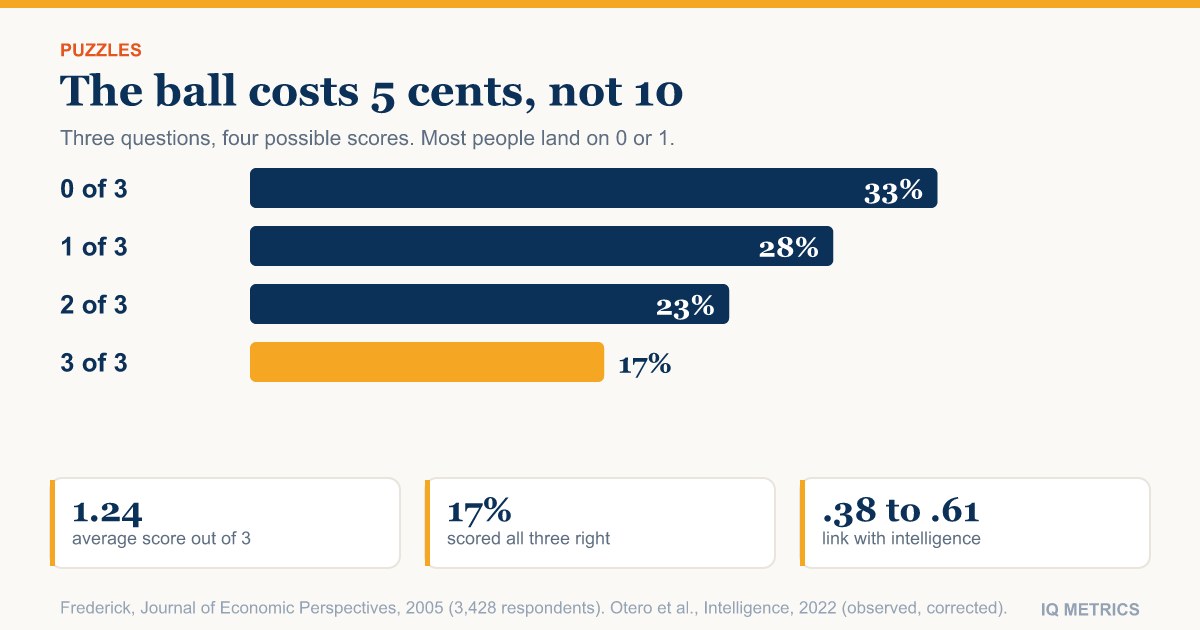
Cognitive Reflection Test: What the Bat-and-Ball Score Says About IQ
Across 3,428 people the three-question Cognitive Reflection Test averaged 1.24 correct, and only 17% got all three. Its link to IQ is moderate, not one-to-one, and the questions are now so well known that familiarity shifts scores.
Read the research.
Then find your own number.
Our IIF-certified assessment reports your score with its scale, percentile and confidence range — and a breakdown of the cognitive domains behind it.
Start IQ Test →