



Puzzles & Brain Training
A reasoning puzzle every day with the full working shown, plus honest coverage of what brain-training products can and cannot do.

Einstein's Riddle: Who Owns the Fish? The Answer, the Proof and the 98% Myth
The German owns the fish. The riddle's best-known label does not hold up: we found no evidence Einstein wrote it and no source for the claim that only 2% can solve it. An exhaustive search shows what its clues really do.

Does Sudoku Increase IQ? Why No Chart Can Turn Solving Time Into a Score
Search suggestions offer "sudoku iq 188" and "sudoku iq correlation", but we found no study, norm table or formula that converts a Sudoku time into an IQ. What exists is an app score, a puzzle-difficulty model that correlates 0.95 with crowd solving times, one large observational sample and one small crossword trial.
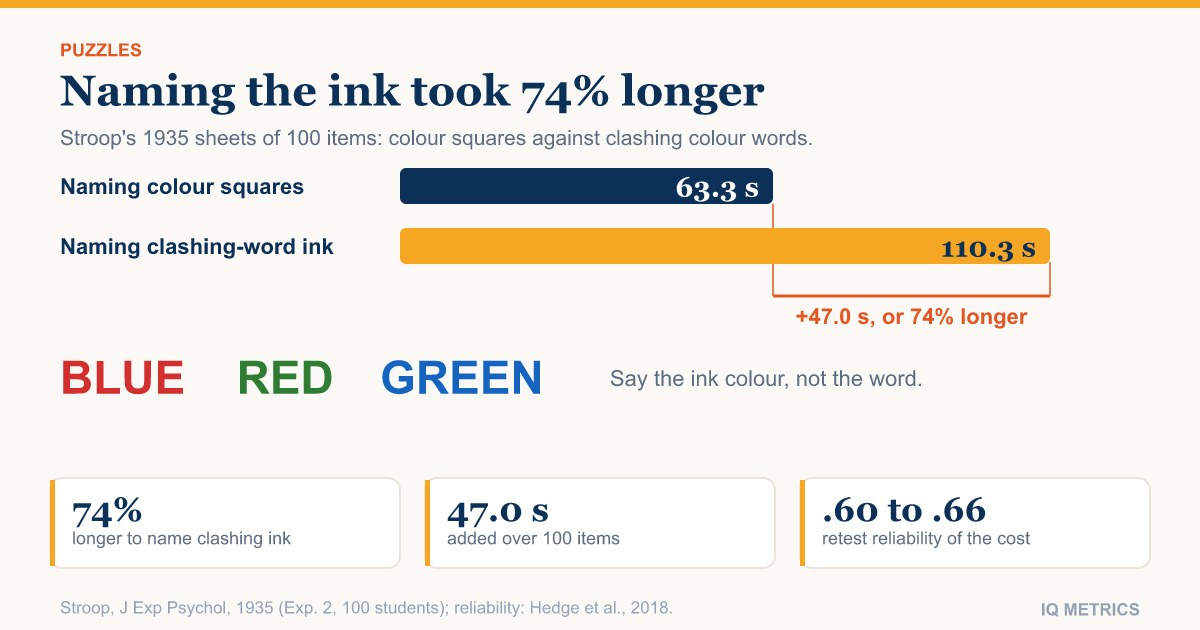
Stroop Test Explained: What It Measures and the IQ Link
In Stroop's 1935 study, naming the ink colour of 100 conflicting colour words took 47 seconds longer than naming coloured squares. The effect is among the most reliable in psychology, yet one person's score is not, and it tracks IQ only weakly.
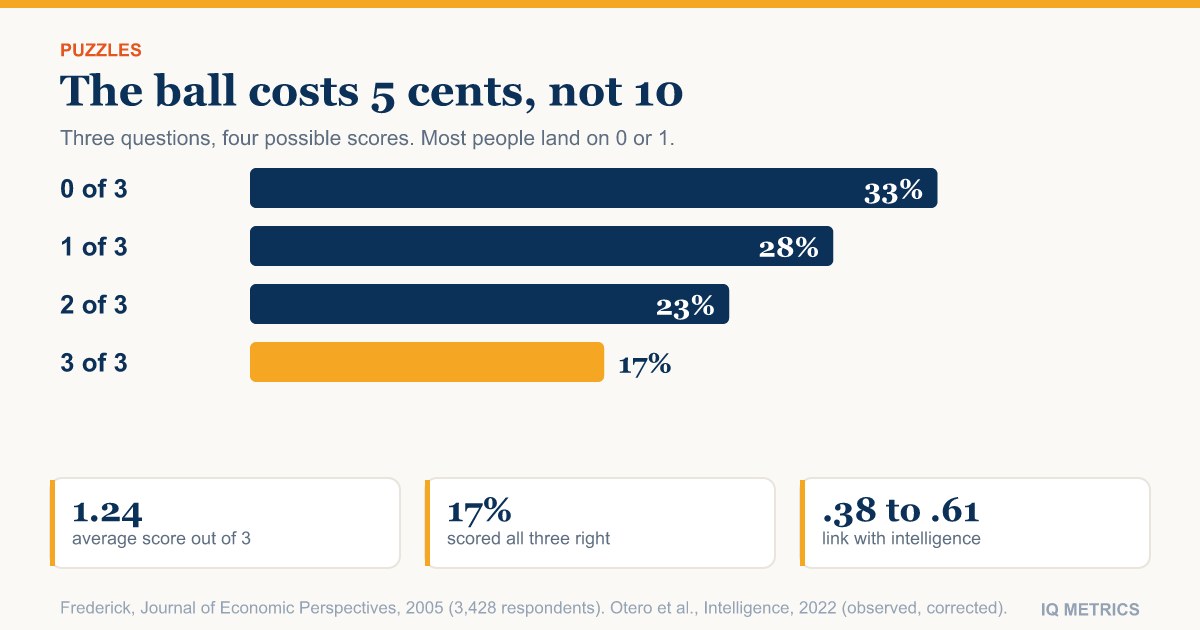
Cognitive Reflection Test: What the Bat-and-Ball Score Says About IQ
Across 3,428 people the three-question Cognitive Reflection Test averaged 1.24 correct, and only 17% got all three. Its link to IQ is moderate, not one-to-one, and the questions are now so well known that familiarity shifts scores.

Cattell Culture Fair Intelligence Test Explained
Raymond Cattell built the CFIT in 1949 to measure fluid reasoning without leaning on language or schooling. It is still used in cross-cultural research today, its four nonverbal subtests are unlike anything on a Wechsler scale, and its scoring uses a standard deviation of 24, not the usual 15.

Is IQ Just Pattern Recognition? What the Test Items Show
Pattern-finding is the best single route to g, but on the WAIS-5 only two of the seven Full Scale subtests are built around it, and the other five load .56 to .68 on g. A 2026 independent analysis of the WAIS-5 reverses the WAIS-IV finding that Vocabulary beat Matrix Reasoning.

High-IQ Riddles Are Not IQ Test Items — Here's Why
Viral "only a genius can solve this" riddles share almost nothing with the items on an actual IQ test. The difference is standardization, norming, and what the item is designed to measure.

The Hardest IQ Test Question: What Actually Makes It Hard
There's no single fixed “hardest question” on every IQ test — but the items that sit at the top of a real test's difficulty curve share an exact property, and a landmark cognitive-science study of the Raven's Progressive Matrices shows precisely what it is.

Syllogism Questions on IQ Tests: Why the Right Answer Feels Wrong
A syllogism gives you two statements and asks what must follow. Decades of research show most people answer with what they already believe instead — and the fix is one simple substitution trick.

Odd-One-Out Questions: When Two Rules Both Work, the Item Is Broken
Four items share a rule and one breaks it, but only if that rule is the only sentence that fits. When a second, equally valid rule points at a different item, the puzzle is testing which distractor you noticed first, not how well you reason.

Paper Folding and Mental Rotation: How Spatial IQ Questions Work
Two item types dominate the spatial section of a cognitive battery, and both were built on a finding you can reproduce on yourself: the time it takes to decide whether two shapes match rises in a straight line with how far apart they are rotated.

Raven's Progressive Matrices Score: What It Means and How to Read It
The test returns a raw count of correct items, not an IQ. Everything the number means arrives later, from a norm table: five percentile grades, an age group and a norm year that is decades old for the classic forms.
Analogy Questions on IQ Tests: The One Rule That Solves Them
Every analogy item asks the same thing twice. Name the relation between the first pair in a single sentence, then find the pair that takes the same sentence — and the plausible-looking wrong answers stop being tempting.
Do Brain Training Apps Work? One Trial Survived 20 Years
A follow-up published in February 2026 tracked 2,802 adults for two decades after five weeks of cognitive training. One of the three training arms showed a lower rate of dementia diagnosis. The other two showed nothing.
Number Sequence IQ Test Questions: Six Checks, Always in Order
Number series items are not solved by inspiration. They are solved by a short, finite list of checks run in a fixed order — and by the standard a matrix item demands: if the rule cannot be said in one sentence, it is the wrong rule.
A Matrix Puzzle With One Rule You Can Say Out Loud
Three rows, three columns, two things changing at once. The worked solution is below — and so is an honest account of what solving it does and does not tell you about yourself.
Written to be checked, not just clicked
Every number carries its scale
An IQ figure is meaningless without the scale it was measured on and the range around it. Every story here reports all three, or says plainly that the source did not.
Sources are listed, not implied
Each story ends with the studies, datasets and documents it draws on, named and attributed, so you can go and read them yourself.
We correct in public
Spotted an error? Write to corrections@iqmetrics.org. Corrections are made on the story and noted at the bottom of it — never quietly.
Read the research.
Then find your own number.
Our IIF-certified assessment reports your score with its scale, percentile and confidence range — and a breakdown of the cognitive domains behind it.
Start IQ Test →