



Does Iodine Deficiency Lower IQ? What Trials and Cohorts Show
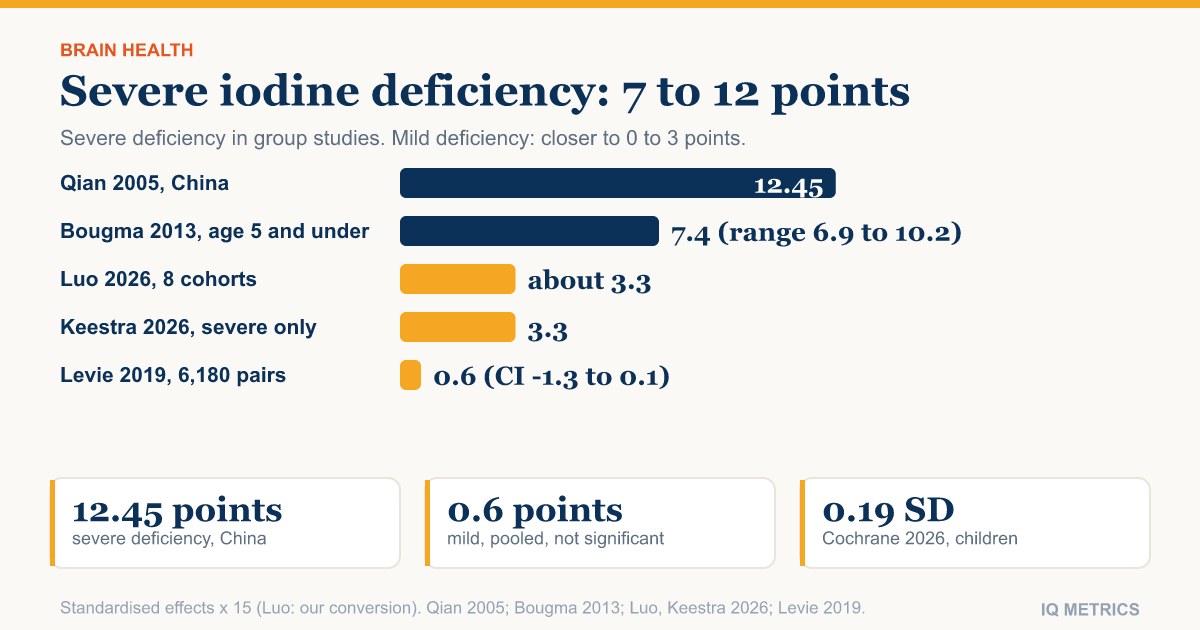
Severe deficiency costs roughly 7 to 12 IQ points in group studies. For the mild deficiency found in richer countries, a UK cohort links it to weaker verbal scores, the main pregnancy trial found no effect, and a Cochrane review in September 2026 found a slight gain in children.

What you need to know
- Severe iodine deficiency clearly lowers scores. A meta-analysis of 37 studies of 12,291 children in China put the gap at 12.45 IQ points, and a review of children aged 5 and under estimated 7.4 points, but both rest mostly on comparisons between areas, not randomised trials.
- For mild deficiency the evidence is mixed. The UK ALSPAC cohort found 1.58 times the odds of a bottom-quartile verbal IQ at age 8, a pooled analysis of 6,180 mother-child pairs found a verbal IQ gap of only 0.6 points (95% CI -1.3 to 0.1), and the main pregnancy trial found no effect on IQ at 5 to 6 years.
- A Cochrane review of children published on 10 September 2026 found a slight gain in cognition, a standardised difference of 0.19 (95% CI 0.04 to 0.34), but from one study of 166 children. The Cochrane review of pregnancy trials says there are insufficient data for conclusions.
- US salt iodisation in 1924 is the best natural experiment: it raised an inferred IQ by about 15 points in the most deficient quarter of the country, and 3.5 points nationally. That figure is inferred from Air Force assignment, not measured test scores.
Severe iodine deficiency lowers children's IQ scores, by roughly 7 to 12 points in group studies. For the mild deficiency found in countries such as the UK, the answer is less certain: a large UK cohort links low iodine in early pregnancy to weaker verbal and reading results, a pooled analysis of three European cohorts finds almost no average difference in verbal IQ, and the main trial of iodine in pregnancy found no effect on child IQ. This guide sets out the evidence in the order of how much weight it can bear: meta-analyses of severe deficiency, a US natural experiment, cohort studies of mild deficiency, and randomised trials. It is an evidence summary, not medical advice.
How many IQ points does severe iodine deficiency cost?
The largest figures come from China. Qian and colleagues (2005, Asia Pacific Journal of Clinical Nutrition) analysed 37 studies covering 12,291 children under 16 who lived in naturally iodine-sufficient areas or severely deficient ones, or who were born before and after iodine supplementation began. IQ was measured with the Binet or Raven scales. Children in sufficient areas scored about 12.45 IQ points higher than children in deficient areas with no supplementation, and the authors estimate that supplementation before and during pregnancy recovered about 8.7 points.
Bougma and colleagues (2013, Nutrients) reviewed children aged 5 and under. Across four study designs the effect sizes translated into 6.9 to 10.2 IQ points lower in iodine-deficient children, and their best estimate from supplementation studies, 16 effect sizes across 10 studies, was 0.49 standard deviations, or 7.4 IQ points. The paper was funded by the Micronutrient Initiative, and an erratum was later published that we could not read. Two cautions apply to every figure of this kind. The IQ points are standardised effect sizes multiplied by 15, which is a conversion (our guide to why IQ scales use 15 or 16 explains the multiplier, and the score converter does the arithmetic). And the same review lists weak study designs, missing confounders and small samples among the problems, noting that communities in the older comparisons may differ in many ways besides iodine.
What did US salt iodisation show?
The cleanest natural experiment is American. Salt was iodised in the United States beginning in 1924, over a short period. Feyrer, Politi and Weil (2017, Journal of the European Economic Association) compared men born before and after iodisation in places that were naturally poor or rich in iodine, using 151 regions measured by goitre rates in First World War draft physicals and 2.27 million Second World War enlistment records. They conclude that for the one quarter of the population most deficient in iodine the intervention raised IQ by about one standard deviation, or 15 points, which implies about 3.5 points nationally and roughly one decade of the Flynn effect; our guide to the stalled Flynn effect covers that trend.
The size of that effect needs care. The test scores were mostly missing from the wartime data, so the authors inferred the gain from the share of recruits assigned to the Air Force, which rose by 3.8 to 10 percentage points in high-goitre areas against a sample average of roughly 14%. They call the inference crude, and say their estimates are lower bounds. The same paper documents a large rise in thyroid-related deaths after iodisation, mostly among older people in deficient localities, which the authors put at several thousand premature deaths. The benefit was real for children, and the cost was real for some adults.
What do cohort studies of mild deficiency show?
The best-known study is the UK Avon Longitudinal Study of Parents and Children. Bath and colleagues (2013, The Lancet) measured iodine and creatinine in first-trimester urine from 1,040 pregnant women, then followed their children. The group was mildly to moderately deficient, with a median urinary iodine of 91.1 micrograms per litre, and about two thirds of the women fell below the benchmark of 150 micrograms of iodine per gram of creatinine. After adjusting for 21 factors, children of women below that benchmark had 1.58 times the odds of a bottom-quartile verbal IQ at age 8 (95% CI 1.09 to 2.30), and higher odds of low reading accuracy and comprehension at age 9. Scores worsened across the steps from 150 and above, to 50 to 150, to under 50. That is an odds ratio, not an IQ gap, and it rests on a single urine sample per woman.
Later work narrows the picture. Levie and colleagues (2019, Journal of Clinical Endocrinology and Metabolism) pooled three cohorts, Generation R, INMA and ALSPAC, with 6,180 mother-child pairs. Below 150 micrograms per gram was not associated with lower nonverbal IQ (-0.6 points, 95% CI -1.7 to 0.4) or verbal IQ (-0.6 points, 95% CI -1.3 to 0.1, P = 0.082), although the verbal association was present when iodine was measured up to 14 weeks of pregnancy. Keestra and colleagues (2026, European Journal of Nutrition) followed 1,211 ALSPAC children to age 15 and found full-scale IQ 3.3 points lower, and vocabulary 4.25 T-score points lower, only in the group whose mothers were severely deficient, under 50 micrograms per gram, compared with sufficient mothers; the continuous link with full-scale IQ was not significant. A May 2026 meta-analysis of eight cohorts (Luo and colleagues, Nutrients) found cognitive outcomes lower by 0.22 standard deviations (95% CI -0.30 to -0.14) when maternal iodine was suboptimal, about 3 points by the same multiply-by-15 conversion.
What do the randomised trials show?
The largest pregnancy trial, Gowachirapant and colleagues (2017, The Lancet Diabetes and Endocrinology), randomised 832 women in Bangalore and Bangkok to 200 micrograms of iodine a day or placebo from an average of 10.7 weeks until delivery. Only 313 children were tested on the WPPSI-III at age 5 to 6, and the differences were small and not significant: verbal IQ -0.7 points (95% CI -2.9 to 1.5) and performance IQ -1.6 (95% CI -4.5 to 1.3). The authors concluded that supplementation in mildly deficient pregnant women had no effect on child neurodevelopment at that age. Supplementation started in the first trimester, and attrition was large, so the trial cannot rule out a small effect.
Trials in children are more encouraging. Gordon and colleagues (2009, American Journal of Clinical Nutrition) gave 184 mildly deficient New Zealand children aged 10 to 13 either 150 micrograms a day or placebo for 28 weeks. The overall cognitive score was 0.19 standard deviations higher with iodine (P = 0.011), driven by two of four subtests, picture concepts and matrix reasoning. By our conversion that is about 3 IQ points, though the trial used four subtests, not a full IQ test. A Cochrane review of children and adolescents published on 10 September 2026 pooled eight trials of 2,528 participants and reports a slight increase in cognitive function (standardised difference 0.19, 95% CI 0.04 to 0.34) from one study of 166 children, graded high certainty. The abstract does not name the study; the figures match Gordon's trial, which is our inference. The 2017 Cochrane review of women before, during and after pregnancy found insufficient data for meaningful conclusions, and noted that almost all the evidence came from mild or moderate deficiency.
- Qian 2005 (China, 37 studies, 12,291 children, mostly area comparisons): about 12.45 IQ points in severe deficiency
- Bougma 2013 (children 5 and under): 6.9 to 10.2 points by design, best estimate 7.4 points
- Feyrer 2017 (US salt iodisation): about 15 points inferred in the most deficient quarter, 3.5 nationally
- Bath 2013 (UK cohort, 1,040 women): odds ratio 1.58 for a bottom-quartile verbal IQ, no IQ gap reported
- Levie 2019 (three cohorts, 6,180 pairs): verbal IQ -0.6 points, 95% CI -1.3 to 0.1
- Gowachirapant 2017 (pregnancy trial): verbal IQ -0.7 and performance IQ -1.6, neither significant
- Gordon 2009 (children trial): 0.19 standard deviations, about 3 points by our conversion
Severe iodine deficiency costs about 7 to 12 IQ points in group studies; for mild deficiency the best estimates run from about 0 to 3 points, and trials have not settled it.
Is iodine deficiency still a problem?
Globally the picture has improved. The Iodine Global Network scorecard for 2025 lists 21 countries with insufficient iodine status in school-age children, down from 113 in 1993, with 59 countries lacking recent data and no maps yet for pregnant women. For pregnancy, the European Food Safety Authority proposes an adequate intake of 200 micrograms a day, against 150 for other adults, and a 2025 review citing the WHO treats a population median urinary iodine below 150 micrograms per litre as insufficient in pregnant women. That is a population benchmark, not a test for one person, and Bath's 2013 analysis applied a similar cut-off to individual women.
In the UK, Bath, the lead author of the ALSPAC study, wrote in early 2026 that national survey data for 2019 to 2023 classify several groups, including women of childbearing age, as mildly iodine deficient, while adding that the evidence for health effects of mild deficiency is weaker than for severe deficiency. A Canadian cohort reported in 2025 found no link between urinary iodine in pregnancy and development at 3 to 4 years, and a UK trial called PoppiE, testing 20 against 200 micrograms a day in women who already get enough, was due to finish collecting data in July 2026; we found no results yet. A 2025 review suggests that too much iodine may also be harmful, so the question is not simply more is better.
What this means for IQ scores
A shift of about 3 points matters for a population and matters little for one person. The error band around a single IQ result is wider than that, as our guide to the IQ score margin of error shows, so a mildly low iodine intake cannot be read from anyone's score. At the scale of a country the picture changes: a 3-point drop across a generation is the size of the Flynn effect shifts that norm committees track. Iodine sits alongside other nutrition and exposure questions our readers ask about, including fluoride and IQ and creatine and IQ, and the blog guide to nutrition and IQ places iodine among the other nutrients.
Where would your own score land?
Want a score on the standard IQ scale, with its percentile and a full report? Take the IQ Metrics test.
Find your IQ score now! →To see how a score of your own compares with the population, take the IQ Metrics test and read the result against the IQ bell curve.
Common questions
Does iodine deficiency lower IQ?
Severe deficiency does: meta-analyses put the gap at about 7 to 12 IQ points in group studies. For mild deficiency the evidence is mixed. A UK cohort found weaker verbal scores, but a pooled analysis of 6,180 pairs found only a 0.6-point verbal IQ gap (95% CI -1.3 to 0.1).
How many IQ points does iodine deficiency cost?
A meta-analysis of studies in China estimated 12.45 points in severe deficiency, and a review of children aged 5 and under estimated 7.4 points. Those are standardised effects multiplied by 15, mostly from non-randomised comparisons. For mild deficiency, our summary is roughly 0 to 3 points.
Does iodine supplementation raise IQ in children?
Slightly, on current evidence. A Cochrane review published on 10 September 2026 found a standardised gain of 0.19 (95% CI 0.04 to 0.34), from one study of 166 children, graded high certainty. It is not a large effect and it concerns mildly deficient children.
Does iodine in pregnancy raise a child's IQ?
The main trial, which randomised 832 women, found no effect on child IQ at age 5 to 6 (verbal IQ difference -0.7, 95% CI -2.9 to 1.5). The 2017 Cochrane review found insufficient data for conclusions. This is not medical advice; ask a clinician about supplements.
Sources for this story
- Qian et al. (2005), Asia Pacific Journal of Clinical Nutrition 14(1):32-42; Bougma et al. (2013), Nutrients 5(4):1384-1416 — Asia Pacific Journal of Clinical Nutrition; Nutrients
- Bath et al. (2013), The Lancet 382:331-337 (ALSPAC); Levie et al. (2019), J Clin Endocrinol Metab 104(12):5957-5967; Keestra et al. (2026), European Journal of Nutrition 65(3):111 — The Lancet; Journal of Clinical Endocrinology and Metabolism; European Journal of Nutrition
- Feyrer, Politi and Weil (2017), The Mental and Economic Effects of Iodine Deficiency: salt iodization in the United States, J Eur Econ Assoc 15(2):355-387 — Journal of the European Economic Association
- Gowachirapant et al. (2017), Lancet Diabetes Endocrinol 5(11):853-863; Gordon et al. (2009), Am J Clin Nutr 90(5):1264-1271 — The Lancet Diabetes & Endocrinology; American Journal of Clinical Nutrition
- Velasco et al. (2026), CD014475.pub2; Harding et al. (2017), CD011761.pub2: iodine supplementation reviews — Cochrane Database of Systematic Reviews
- EFSA dietary reference values for iodine (2014); Global scorecard of iodine nutrition 2025; Bath (2026), Proc Nutr Soc; Luo et al. (2026), Nutrients 18(9):1474 — EFSA Journal; Iodine Global Network; Proceedings of the Nutrition Society; Nutrients
Corrections: spotted an error? Email corrections@iqmetrics.org and we will update this story and note the change here.
Related stories
All news →
Does Fluoride Lower IQ? Why the Biggest Studies Disagree
A 2024 US government review linked fluoride above 1.5 mg/L to lower IQ in children. An April 2026 study of 10,317 people found no sign of harm from community fluoridation. The two findings are about different doses, and the dose is the whole argument.

Does Creatine Raise IQ? What the Trials Show About Memory and Reasoning
One 2003 trial in 45 vegetarians started the claim. A preregistered replication in 123 people did not confirm it on the same test, and the EU food safety panel says no cognitive effect is established.

Does Weed Lower IQ? What the Long-Term Studies Actually Show
The best-known study found a drop of about 6 IQ points in people with repeated cannabis dependence. Twin studies, adjusted analyses and a 2026 teen study paint a more mixed picture. Here are the numbers, and what nobody has shown yet.
Read the research.
Then find your own number.
Our IIF-certified assessment reports your score with its scale, percentile and confidence range — and a breakdown of the cognitive domains behind it.
Start IQ Test →