



Brain Health & Aging
Sleep, exercise, diet, illness, medication and environment — what each one measurably does to thinking, and by how much.

Are C-Section Babies Smarter? What the IQ Studies Show
Searches for C-section and IQ run in both directions. The largest study with an intelligence test, 1.4 million Danes, found a gap of 0.36 points on a 78-item test. A Brazilian cohort found C-section teenagers 5.8 IQ points ahead, until the researchers adjusted for family and birth factors.

Sleep Apnea and IQ: What Studies Show in Children and Adults
In children, sleep-disordered breathing goes with IQ scores a few points lower in some studies, yet the largest cohort found no link with cognition scores and no treatment trial has shown an IQ gain. In adults, attention and executive function are affected more than IQ.

Do Smart Drugs and Nootropics Raise IQ? What the Trials Measured
We found no trial in healthy adults that used an IQ test as its outcome. The best meta-analysis of modafinil, methylphenidate and amphetamine measured recall, attention and inhibition, and found small effects of 0.12 to 0.21 standard deviations.
Does Dual N-Back Training Raise IQ? What Replications Show
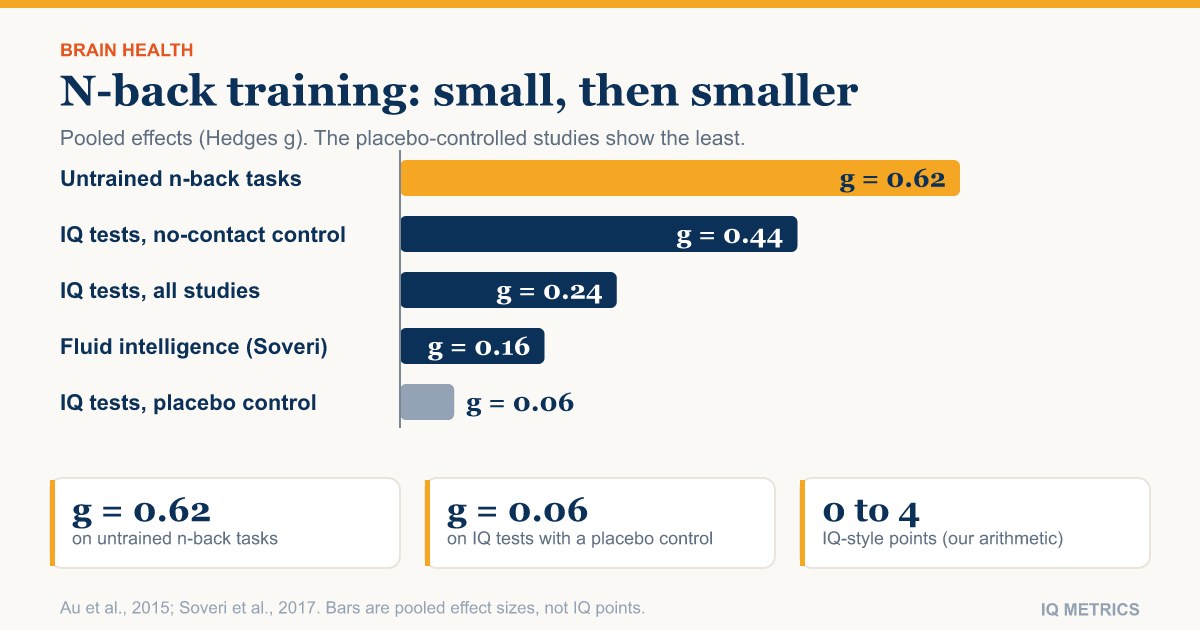
A 2008 PNAS study said dual n-back training raised fluid intelligence. Placebo-controlled replications found nothing, and meta-analyses put the gain at roughly 0 to 4 IQ-style points, smallest where the control group also had a task to do.
Does Iodine Deficiency Lower IQ? What Trials and Cohorts Show
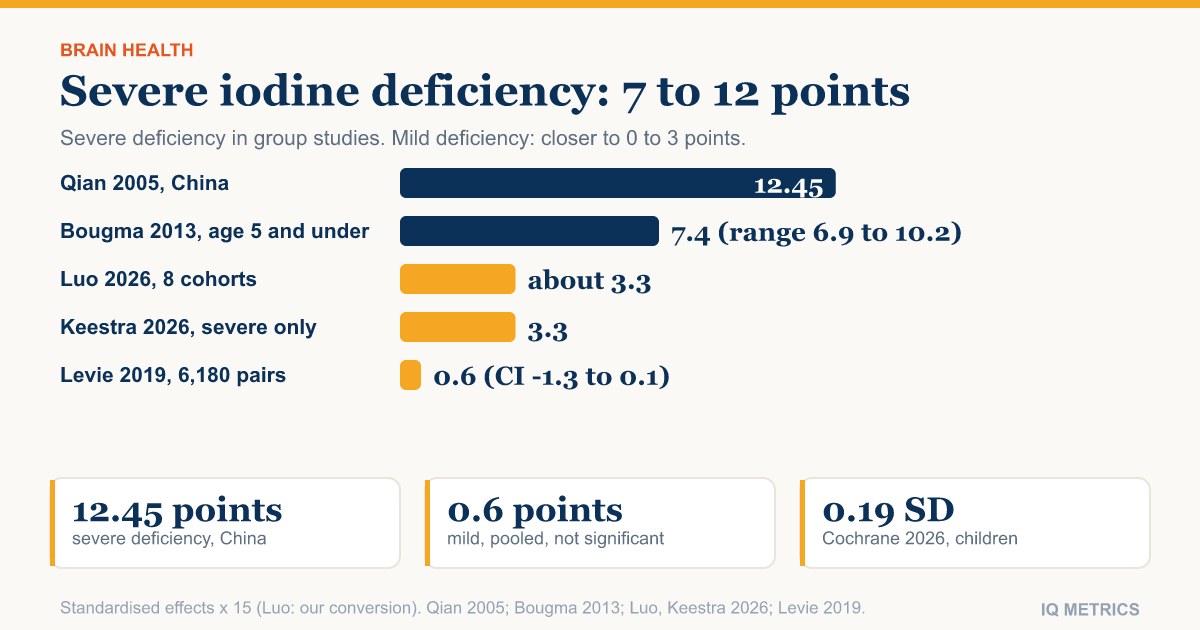
Severe deficiency costs roughly 7 to 12 IQ points in group studies. For the mild deficiency found in richer countries, a UK cohort links it to weaker verbal scores, the main pregnancy trial found no effect, and a Cochrane review in September 2026 found a slight gain in children.

Does Creatine Raise IQ? What the Trials Show About Memory and Reasoning
One 2003 trial in 45 vegetarians started the claim. A preregistered replication in 123 people did not confirm it on the same test, and the EU food safety panel says no cognitive effect is established.

Does Weed Lower IQ? What the Long-Term Studies Actually Show
The best-known study found a drop of about 6 IQ points in people with repeated cannabis dependence. Twin studies, adjusted analyses and a 2026 teen study paint a more mixed picture. Here are the numbers, and what nobody has shown yet.

Cognitive Reserve and Brain Wiring: What a 2026 Study Really Shows
Headlines say healthy “wiring” shields the aging mind from gray-matter loss. The study behind them, 459 older adults in India scanned once, found a small link to language only, and it does not claim to have measured cognitive reserve.

Growing Up in East Germany Predicted Sharper Cognition After 50
A study of more than 5,000 older Germans found people schooled in the socialist East kept sharper memory and processing speed after 50 than West Germans the same age — despite worse heart health and shorter life expectancy.

Does Fluoride Lower IQ? Why the Biggest Studies Disagree
A 2024 US government review linked fluoride above 1.5 mg/L to lower IQ in children. An April 2026 study of 10,317 people found no sign of harm from community fluoridation. The two findings are about different doses, and the dose is the whole argument.

Menopause and Cognitive Test Scores: The Dip Is Real and Temporary
Large longitudinal studies find verbal memory scores dip, on average, during the menopause transition — then recover for most women afterward. Online discussion of "menopause brain fog" usually keeps only the first half of that finding.

Hearing Loss Changes Cognitive Test Scores Before It Changes Cognition
The Lancet Commission ranks hearing loss as the largest single modifiable risk factor for dementia in midlife. It is also the most under-recognised way to depress a score on a test that is read aloud — two different problems that are easy to confuse.
Four Languages, a Brain 13 Years Younger: Read the Caveats
Research presented at a European neuroscience meeting in July 2026 used magnetic brain recordings to estimate biological brain age, and found multilingual speakers scoring years below their calendar age. The gradient is striking. The design cannot show that languages caused it.
At What Age Does Intelligence Peak? It Depends Which Ability You Mean
Processing speed peaks in your twenties. Vocabulary and knowledge keep climbing into your sixties. A synthesis published in Intelligence puts overall psychological functioning at its highest between 55 and 60 — and your IQ score cannot tell you where you sit on any of those curves.
Does Caffeine Improve Test Performance? Not the Reasoning Part
Caffeine reliably lifts alertness, vigilance and reaction time, most of all in people who are tired. Evidence that it improves reasoning in rested, habitual drinkers is far weaker — and a disputed but substantial share of what it appears to add is a deficit the absence of the last cup created.
Childhood IQ Scores Predict Later Health. Nobody Agrees Why
Almost every eleven-year-old in Scotland sat the same test on the same day in 1932. Decades later those scores turned out to track survival — and the argument about what that means has run ever since.
Sleep Loss Changes Test Scores. Which Scores Depends on the Test
A bad night does not lower intelligence. It reliably lowers the things a timed test happens to measure most closely — sustained attention, working memory and speed — while leaving vocabulary and general knowledge comparatively intact.
Written to be checked, not just clicked
Every number carries its scale
An IQ figure is meaningless without the scale it was measured on and the range around it. Every story here reports all three, or says plainly that the source did not.
Sources are listed, not implied
Each story ends with the studies, datasets and documents it draws on, named and attributed, so you can go and read them yourself.
We correct in public
Spotted an error? Write to corrections@iqmetrics.org. Corrections are made on the story and noted at the bottom of it — never quietly.
Read the research.
Then find your own number.
Our IIF-certified assessment reports your score with its scale, percentile and confidence range — and a breakdown of the cognitive domains behind it.
Start IQ Test →