



National Merit 2027 Cutoffs: What 208 to 223 Mean in Percentiles and IQ
NMSC named more than 16,000 Semifinalists on 9 September 2026, under 1% of U.S. seniors. A prep firm puts state cutoffs between 208 and 223 on the Selection Index, which maps to totals near 1380 to 1490 and, as an expected IQ, to roughly 129 give or take 11.


What you need to know
- National Merit Scholarship Corporation announced more than 16,000 Semifinalists on 9 September 2026 in the program's 72nd year: under 1% of U.S. high school seniors, competing for about 6,700 scholarships worth about $24 million. About 95% are expected to reach Finalist standing. NMSC does not publish the cutoffs; the prep firm Compass compiles 208 to 223 by state.
- The Selection Index is (2 x Reading and Writing + Math) / 10 on a 48 to 228 scale, so verbal counts double. A total near 1380 to 1400 is the 99th percentile among U.S. 11th graders (96th among PSAT takers); a total of 1470 to 1490 is in College Board's top band, "99+", among U.S. students (99th among takers).
- Equating rank on an IQ scale gives about 135 for the 99th percentile, but the PSAT is not an IQ test. With a test-to-IQ correlation of .82 (Frey and Detterman, 2004, SAT and a general-ability measure), the expected IQ at the 99th percentile is about 129, and four in five such students would fall between roughly 118 and 140.
- The cutoffs differ by state because Semifinalists are the top scorers in each state, not because tests differ. Compass reports 208 in states such as Alaska, Montana, North Dakota, West Virginia and Wyoming, and 223 in New Jersey and the District of Columbia.
On 9 September 2026 the National Merit Scholarship Corporation (NMSC) named more than 16,000 high school seniors as Semifinalists in the 72nd annual National Merit Scholarship Program. They are the highest scorers in each state on the 2025 PSAT/NMSQT, they represent under 1% of U.S. seniors, and they compete for about 6,700 scholarships worth about $24 million, offered in spring 2027. This autumn's juniors are sitting the 2026 PSAT/NMSQT, the entry route for the class of 2028. Parents searching for "National Merit cutoff" want a number; this guide explains what the number is, what it corresponds to in percentiles, and why it is not an IQ.
What did the National Merit program announce for the class of 2027?
The announcement is NMSC's own release, reproduced by many local news outlets. The program began with more than 1.2 million juniors at about 20,000 high schools who took the 2025 PSAT/NMSQT. College Board puts the number who meet entry requirements in a normal year at about 1.3 million, almost all of them juniors. NMSC does not post Semifinalist names online; it gives them to news media and schools.
- More than 16,000 Semifinalists, under 1% of U.S. high school seniors and roughly 1.3% of the 1.2 million to 1.3 million entrants
- About 6,700 National Merit Scholarships worth about $24 million to be offered in spring 2027, including 2,500 awards of $2,500
- About 95% of Semifinalists are expected to attain Finalist standing, notified in February
- Winner announcements are scheduled for 21 April, 12 May, 2 June and 12 July 2027
NMSC does not publish the state cutoffs. The figures people quote come from a prep firm, Compass, which compiles them from reports. Compass counts 16,230 Semifinalists, about 5% fewer than in each of the previous two years (more than 17,000), and lists 208 as the Commended level, 2 points below the class of 2026. It puts the state Semifinalist cutoffs between 208 and 223: New Jersey and the District of Columbia at 223, Maryland, Massachusetts, Virginia and Washington at 221, California, Connecticut and New York at 220, and Alaska, Montana, North Dakota, West Virginia and Wyoming at 208. These are a company's compilation, not an NMSC table, so treat each state number as approximate until your school confirms it.
How does the Selection Index work?
The Selection Index is NMSC's first screen. College Board, which runs the PSAT/NMSQT, explains it in its Fall 2026 guide: double the Reading and Writing section score, add the Math section score, and divide the sum by 10. Section scores run from 160 to 760, so the index runs from 48 to 228. College Board's own example is a Reading and Writing score of 620 and a Math score of 500, which gives (2 x 620 + 500) / 10 = 174.
The doubling matters. Two students with the same total can have different indexes. A total of 1480 made of 750 Reading and Writing and 730 Math gives 223, while 730 Reading and Writing and 750 Math gives 221. Moving 20 points from Math to Reading and Writing adds 2 points to the index. A one-point difference at a state's cutoff therefore corresponds to 5 points of Reading and Writing, or 10 points of Math, on the 160 to 760 scales. College Board says score ranges, derived from the standard error of measurement, show how much a student's scores would likely vary on another sitting under identical conditions. For the same idea applied to IQ scores see our guide to the margin of error in IQ scores.
What do cutoffs of 208 to 223 mean in percentiles?
College Board publishes percentiles for PSAT/NMSQT total scores in two forms. The nationally representative percentile is weighted to stand for all U.S. students in grade 10 or 11, whether or not they usually take the test. The user percentile (the all-tester percentile on the score report) compares a student with people who took the PSAT/NMSQT or PSAT 10 in the past three school years, a self-selected group. The first is the one that tells you where a student stands among peers; the second is stricter. These are the 11th-grade values for totals that correspond to the cutoff range.
- Index 208 (for example 700 Reading and Writing plus 680 Math, total 1380; or 680 plus 720, total 1400): nationally representative 99th percentile, user 96th
- Index 214 (for example 720 plus 700, total 1420): nationally representative 99th, user 97th
- Index 221 to 223 (for example 740 plus 730, total 1470; or 750 plus 730, total 1480): nationally representative "99+" (College Board's top band), user 99th
- Index 228 (760 plus 760, total 1520, the maximum): "99+" on both
- For comparison, a total of 1300 is the 96th nationally representative and 91st user percentile; a total of 1200 is the 90th and 82nd
The table is why the cutoffs read as "top 1%". They sit in the top 1% of U.S. students nationally, but state by state: a Wyoming junior needs 208 and a New Jersey junior 223 because each state's Semifinalists are its own top scorers. College Board's grade-level benchmarks for 11th graders, the "on track for college" line, are 460 in Reading and Writing and 510 in Math, far below the section scores a National Merit cutoff implies.
One index point at a state's cutoff is 5 points of Reading and Writing, or 10 points of Math.
Why did the cutoffs fall?
According to Compass, all 50 state cutoffs came in below the class of 2026's, and it says the cause was a scaling problem in the test, not a change in students. It argues that Reading and Writing scores, not Math, drove both the earlier record highs and this drop, and it rules out learning loss, the Desmos calculator and test preparation. That is a private firm's analysis; we found no statement from NMSC or College Board on the cause, and we cannot confirm or refute it. What we can say is that a cutoff is a rank, not a level of skill, so when the score distribution moves, the cutoff moves with it.
Does a National Merit Semifinalist have an IQ of 130?
No IQ is measured, so any figure is an estimate. There are two defensible ways to make one, and they give different answers. Rank-equivalence asks what IQ would sit at the same rank. A 99th-percentile student ranks like an IQ of about 135 on the standard scale (mean 100, standard deviation 15). That assumes the PSAT and IQ are the same thing, which they are not.
Regression asks what IQ a student with that PSAT score is expected to have. If the test and IQ correlate at .82, the figure Frey and Detterman reported in 2004 for the SAT and a general-ability measure in 917 young adults, a student at the 99th percentile (2.33 standard deviations above the mean) is expected to be 0.82 x 2.33 = 1.91 standard deviations above, an IQ near 129. The spread around that is wide: the standard error is 15 x the square root of (1 – .82 squared), about 8.6 points, so four in five students with that score would fall between roughly 118 and 140. That correlation comes from an older SAT, the PSAT uses the same score scale as the SAT, and we know of no PSAT-specific IQ study, so the estimate is an illustration, not a finding. Our SAT score to IQ conversion guide explains the method, and the IQ percentile calculator converts any percentile for you.
What should students and families take from the numbers?
- Ask the school counselor for the state cutoff NMSC applied; a prep firm's table is an estimate
- Read a Selection Index against the percentile table for the same grade, using the nationally representative column for a national rank
- Remember the index weights Reading and Writing double, so a stronger verbal score moves it twice as far
- Remember one index point is only 5 Reading and Writing points or 10 Math points, and that College Board reports score ranges because one sitting varies
- Do not read a percentile or a cutoff as an IQ: an IQ comes from a test built for that purpose
Where would your own score land?
A PSAT percentile ranks you among U.S. students on school-based skills. For a score on the standard IQ scale, with a percentile among the general population and a full report, take the IQ Metrics test.
Find your IQ score now! →Our IQ Metrics test reports on the same scale used throughout this site, so you can place a result on the IQ bell curve. For this year's other score releases, see our reports on SAT scores for the class of 2026 and on the average IQ of MIT, Oxford and Yale students. If your child is being screened for a gifted program, read what universal screening changes and the gifted cutoff scores guide.
Common questions
What is the National Merit cutoff for the class of 2027?
NMSC does not publish state cutoffs. The prep firm Compass reports Semifinalist cutoffs on the Selection Index between 208 and 223 depending on the state, with 223 in New Jersey and the District of Columbia and 208 in states such as Alaska, Montana and Wyoming, and a national Commended level of 208. Check with your school counselor for the figure NMSC used.
How is the National Merit Selection Index calculated?
Double your PSAT/NMSQT Reading and Writing section score, add your Math section score, and divide by 10. Section scores run from 160 to 760, so the index runs from 48 to 228. A Reading and Writing score of 620 and a Math score of 500 give an index of 174, as in College Board's own example.
What PSAT score is a National Merit Semifinalist?
It depends on the state and the split between sections. An index of 208 to 223 corresponds to totals of roughly 1380 to 1490, which are the 99th percentile or above among U.S. 11th graders and the 96th to 99th percentile among PSAT takers, according to College Board's percentile table.
Is a National Merit Semifinalist's IQ above 130?
Not necessarily, and no IQ is measured. Ranking a 99th-percentile student like an IQ of 135 is one estimate; regression with a test-to-IQ correlation of .82 gives an expected IQ near 129, with four in five such students between about 118 and 140. The PSAT is an achievement test, not an IQ test.
Sources for this story
- Semifinalists in the 2027 National Merit Scholarship Program (press release, 9 September 2026) — National Merit Scholarship Corporation
- Fall 2026 PSAT/NMSQT Understanding Scores for Students and Families (August 2026) — College Board
- PSAT/NMSQT User Percentiles (11th-grade total score table) — College Board Research
- National Merit Semifinalist Cutoffs Class of 2027 — Compass Education Group
- Frey and Detterman, Scholastic Assessment or g? The relationship between the SAT and general cognitive ability, Psychological Science 15(6), 373-378 (2004) — Psychological Science (SAGE)
Corrections: spotted an error? Email corrections@iqmetrics.org and we will update this story and note the change here.
Related stories
All news →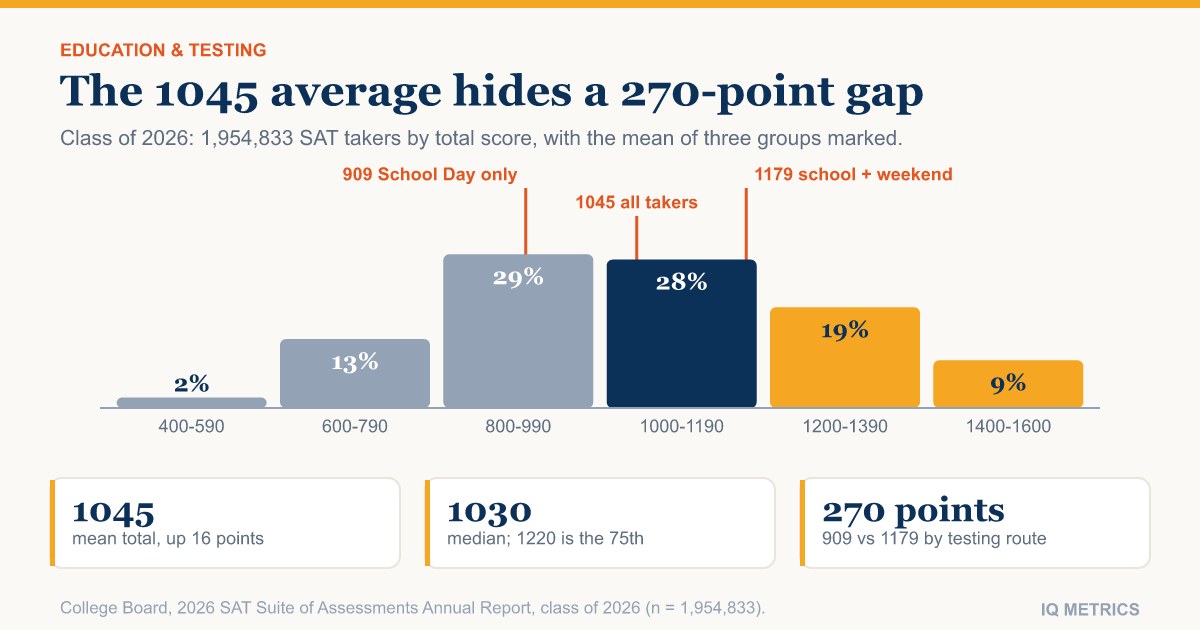
SAT Scores for the Class of 2026: What the 1045 Average Means
The College Board reports a mean of 1045 for 1,954,833 test takers, 16 points up on last year. The median is 1030, and two groups of takers sit 270 points apart, so the headline average reflects who sits the test as well as how well they do.
Falling Reading Scores Are Not Falling IQ. Here Is the Difference
National reading results have dropped again, and around forty per cent of American fourth-graders are now below the NAEP Basic level. That is a fact about an achievement test, and achievement tests are built to show exactly the movement an IQ score is built to hide.

What Is a Good TARA Score? Official Data From Oxford's New Admissions Test
UAT-UK sets no pass mark for the TARA and reports two separate scores from 1.0 to 9.0. Its first technical report shows medians of 4.0 and 4.7 for 2,626 candidates, and a standard error of about one point.
Read the research.
Then find your own number.
Our IIF-certified assessment reports your score with its scale, percentile and confidence range — and a breakdown of the cognitive domains behind it.
Start IQ Test →