



What is Ashton Kutcher’s IQ?
Left the engineering degree unfinished, and built a $250 million venture record instead.
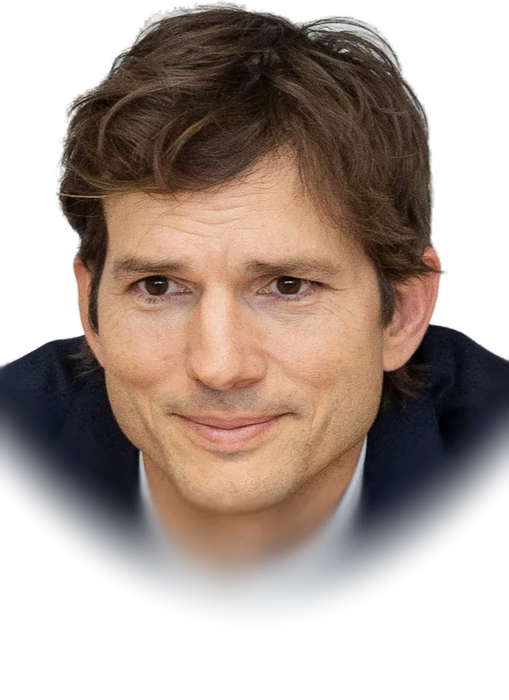
Ashton Kutcher left the University of Iowa in 1997 without finishing a biochemical engineering degree. He spent the following decade acting, and the one after that building one of the most closely documented venture-investing records to come out of Hollywood — a $30 million fund that grew to roughly $250 million on early stakes in Skype, Uber, and Airbnb. The 160 attached to his name online traces to no test anyone can find.
Ashton Kutcher’s estimated IQ
- Enrolled at the University of Iowa in August 1996 to study biochemical engineering — a major widely reported to reflect his twin brother Michael’s heart condition — and left roughly a year later, in 1997, without completing the degree, after a modeling scout approached him in an Iowa City bar.
- Co-founded the venture capital firm A-Grade Investments in 2010 with entertainment manager Guy Oseary and investor Ron Burkle, then its successor, Sound Ventures, in 2015 with Oseary — formalizing a technology-investing career that has continued for more than fifteen years, including a $240 million fund for artificial intelligence companies raised in 2023.
- Made an early personal stake in Skype in 2009 that is reported to have roughly tripled in value when Microsoft acquired the company for $8.5 billion in 2011, one of several outsized early bets that also included Uber and Airbnb, both invested in years before either was a household name.
- Forbes reported in March 2016 that A-Grade’s original $30 million fund had grown into a portfolio worth roughly $250 million, citing Uber and Airbnb among the holdings behind that growth.
No IQ test result for Kutcher has ever been published. Unlike others in this category, his only attempt at formal technical training ended without a degree after about a year, so this estimate rests almost entirely on a business record rather than an academic one — and sustained investing success is a loose proxy for intelligence at best, rewarding judgment, timing, and access to deal flow as much as raw cognitive ability.
- Born
- 7 February 1978, Cedar Rapids, Iowa
- Education
- University of Iowa, biochemical engineering, 1996–97 (left without a degree)
- Venture firms
- Co-founder, A-Grade Investments (2010) and Sound Ventures (2015), with Guy Oseary
- Early bets
- Skype (2009), Uber, and Airbnb — years before each was a household name
- Portfolio value
- A $30M fund grown to roughly $250M by 2016, per Forbes
- Documented IQ test
- None on record — “160” circulates on listicles with no cited source
What an IQ of 115–130 actually means
Set the claim aside for a moment. If someone genuinely scored in this range, here is what that would represent.
Average is 100 by construction, and about two-thirds of people fall between 85 and 115. Take the test to place your own score on this scale.
| Score range | Classification | Share of people | What it indicates |
|---|---|---|---|
| 85 – 114 | Average | ~68% | The range most people fall into. |
| 115 – 129 | Above average | ~13.6% | Roughly one person in seven. |
| 130 – 144 | Gifted | ~2% | The threshold most high-IQ societies use. |
| Above 144 | Highly gifted | ~0.1% | Figures above this range are extrapolated from the curve rather than measured. |
Percentages are approximate and describe a normal distribution. The same number means different things on tests with different standard deviations.
Thirty questions gives you a measured position on this exact scale — your score, your percentile and the ability breakdown behind it.
Find out in 30 minutes →Who Ashton Kutcher is
Christopher Ashton Kutcher was born on 7 February 1978 in Cedar Rapids, Iowa, the fraternal twin of Michael Kutcher, who has cerebral palsy and underwent an emergency heart transplant at thirteen after a viral infection enlarged his heart. Ashton enrolled at the University of Iowa in 1996 intending to major in biochemical engineering. In 1997, a modeling scout approached him at a bar in Iowa City and persuaded him to enter the “Fresh Faces of Iowa” contest; he won a trip to a modeling convention in New York and left college without finishing his degree.
He was cast as Michael Kelso on Fox’s That ’70s Show in 1998, a role he held through the series’ end in 2006, and went on to create and produce the hidden-camera show Punk’d. Acting is the reason he is famous; it is not the part of his record this page is built to audit, since no IQ claim attaches to his performances.
His second career grew up alongside the first. He made early personal technology investments in the late 2000s, including a stake in Skype in 2009, then formalized the practice by co-founding A-Grade Investments in 2010 with Guy Oseary and Ron Burkle, whose early bets included Uber, Airbnb, and Spotify. He and Oseary launched a successor firm, Sound Ventures, in 2015, and have continued raising funds together since. Asked about his unfinished degree, Kutcher told Newsweek he was “still interested in” the field and had “just invested in a biotech company” working on amyotrophic lateral sclerosis and Parkinson’s disease.
 By Elora Mercer, Celebrity Research WriterFigures checked by Leon Falkner, Data & Research Analyst
Reviewed by Aarav Vardhan, Editor-in-Chief · Last reviewed August 2026
.jpg)
Where the 160 figure came from
Following a claim back to its first appearance is the part almost nobody does — and it is what most people are actually asking.

Kutcher’s “160” shows no sign of a first source. It appears across a small ecosystem of celebrity-IQ listicle sites that share the same format — a name, a number, no citation — and at least one displays the figure inside a user-submission form with a disclaimer that nothing on the page is verified. That isn’t a source that has drifted out of view over time; it reads like a site that was never sourced to begin with.
The direction of the error is the usual one on this site: the real record is more specific, and more checkable, than the number that replaced it. A rounded, unsourced “160” is easy to repeat across dozens of near-identical pages. A $30 million fund becoming a documented $250 million portfolio, with named companies and a named business publication attached, is not the kind of thing that gets invented — which is exactly why it is the fact the listicles tend to leave out.
Kutcher’s is also the thinnest academic record among the actors profiled on this site, and it is worth being direct about that rather than letting the investing numbers paper over it. Dolph Lundgren completed a chemical-engineering master’s degree before choosing acting over a Fulbright to MIT; Kutcher left a comparable field about a year in, with no credential to show for it. His estimate instead leans on the kind of evidence behind Arnold Schwarzenegger’s range — a real, sustained, independently reported business record standing in for a finished degree, not a cognitive test.
How we read a number →Confirms his major as biochemical engineering and that he left before completing a degree, after being approached by a modeling scout.
Direct quotes from Kutcher on leaving Iowa without debt, and on his continued interest in the field via a later biotech investment.
Origin of the reported $30 million-to-$250 million fund growth figure; names Uber and Airbnb among the early bets behind it.
Source of the circulating “160” figure. One posts it inside an open user-submission form with a disclaimer that scores are “not guaranteed”; a rival site lists 154 instead. No original test or study could be located behind either number.
No school, military, clinical, or media record of a test taken by Kutcher appears in any source we could find.
The sources behind our estimate
The figures that circulate for Ashton Kutcher, what we were able to confirm, and where the two diverge.
160 is the figure most often attached to Kutcher on celebrity-IQ ranking sites; at least one rival aggregator lists 154 instead.
We found no published IQ test result for Ashton Kutcher, and no interview in which he states a number himself. The 160 figure circulates across a cluster of celebrity-IQ listicle sites, several of which post it beside general disclaimers that scores are “not guaranteed” and offered “for entertainment purposes only” — one displays it inside an open form inviting readers to submit their own guess. What is real and independently documented instead: a biochemical-engineering programme he left unfinished, and a venture-capital record — Skype, Uber, Airbnb — that Forbes credits with turning $30 million into roughly $250 million.
The credentialed range and the popular number aren’t close, and the popular number isn’t even stable — a rival ranking site lists 154 instead of 160, the kind of drift that comes from a figure being copied and rounded, not measured.
Want a number that does hold up? Every figure on this page is somebody’s claim. Take the 30-question test and get a percentile you can check rather than a figure you have to trust.
Ashton Kutcher — frequently asked
What is Ashton Kutcher’s IQ?
No verified score exists. The figure of 160 that circulates on celebrity-IQ ranking sites traces to no test, date, or named source — one site posts it inside an open submission form with a disclaimer that nothing on the page is verified. What is documented instead is a venture-investing record: co-founding A-Grade Investments in 2010, which Forbes reported had turned a $30 million fund into roughly $250 million by 2016.
Did Ashton Kutcher study engineering at the University of Iowa?
Yes. He enrolled in August 1996 intending to major in biochemical engineering, a choice widely linked to his twin brother Michael’s heart condition. He left about a year later, in 1997, without finishing the degree, after a modeling scout spotted him at a bar in Iowa City.
Did Ashton Kutcher graduate from college?
No. He left the University of Iowa without a degree after roughly a year, when a local modeling contest, “Fresh Faces of Iowa,” led to a trip to a New York modeling convention and, eventually, an acting career.
What tech companies did Ashton Kutcher invest in early?
Through A-Grade Investments (2010, with Guy Oseary and Ron Burkle) and its successor Sound Ventures (2015), he took early stakes in Skype, Uber, Airbnb, and Spotify. His personal investment in Skype, made in 2009, is reported to have roughly tripled in value when Microsoft bought the company for $8.5 billion in 2011.
Where does the “160” figure for Ashton Kutcher come from?
No original source could be located. It circulates across a cluster of celebrity-IQ listicle sites that give no citation, at least one of which lists 154 instead — a sign of a number being copied and lightly altered rather than independently measured.
How does Kutcher’s case compare to other actors on this site?
His is the thinnest academic record among them: unlike Dolph Lundgren, who completed a chemical-engineering master’s before choosing acting, Kutcher left a comparable field about a year in with no degree. His range instead rests on a documented business record, the same kind of evidence behind Arnold Schwarzenegger’s estimate.
How does my IQ compare with Ashton Kutcher?
You can find out in about fifteen minutes. The IQ Metrics assessment is 30 questions, scored on the same 100-mean scale used throughout this page, so your result and the estimate above are at least expressed in the same units — one measured, one inferred. Once you have a number, the leaderboard shows where it would sit, and how we score and norm it explains the benchmarking.
Where does this estimate come from?
From the documented record rather than a test — the method is named above and set out in full under how we read a number. Compare it against the other actors profiles, starting with Natalie Portman.
- Take the 30-question IQ test — get a measured score and percentile of your own
- Average IQ by country — how the scale behaves across populations
- How IQ Metrics scores its assessment — the method behind our own number
- More on how IQ testing works — reliability, error and what a score can and cannot say
- More actors profiles — same field, same method
More actors

Photograph by Montclair Film, CC BY 4.0. Background removed for the portrait above. · Photograph by iDominick (PaleyFest, March 2013), CC BY-SA 2.0. Background removed for the portrait above. · Photograph by DanByers (March 2010), public domain. Cropped and with background removed for the portrait above.


An estimate is an inference.
Yours can be measured.
Thirty questions, scored against general-population benchmarks. Your score, your percentile, your ability breakdown and a printable IIF certificate.
Find your IQ score now! →