



Hamm v. Smith Decision: What the Court Left Open on Multiple IQ Scores
The Supreme Court took Hamm v. Smith to say how courts should weigh several IQ scores near 70, then dismissed it on 21 May 2026 without a holding. The opinions still lay out five scores, an SEM of 3 and two views of a lower bound of 69.

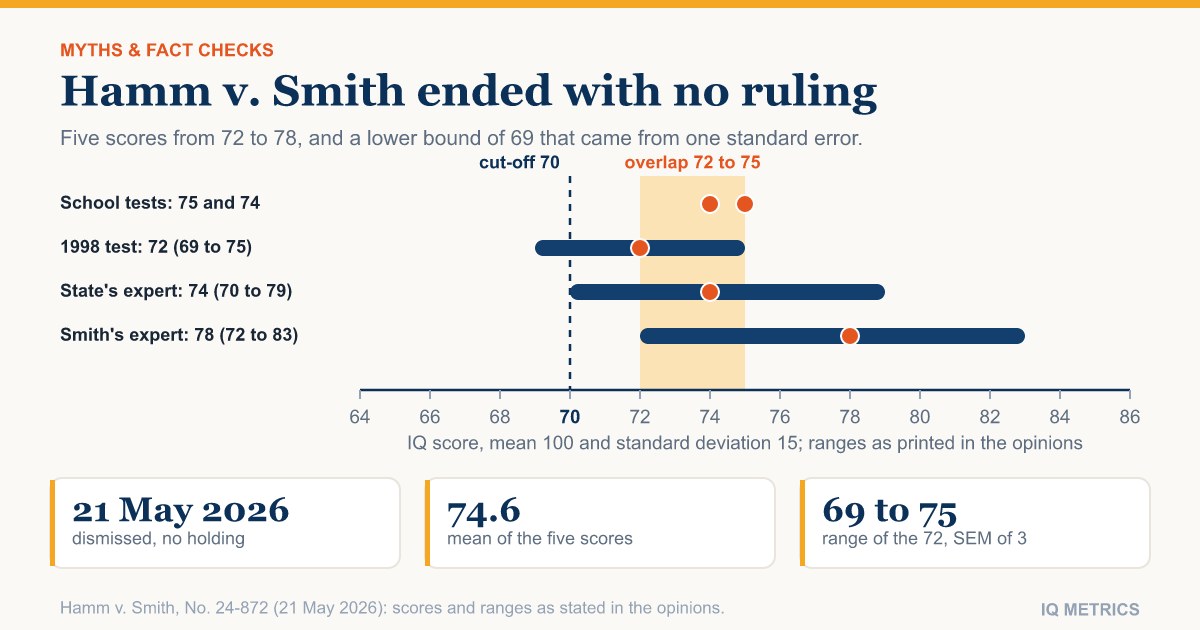
What you need to know
- On 21 May 2026 the Supreme Court dismissed Hamm v. Smith (No. 24-872) as improvidently granted in a one-line per curiam order. It set no rule on how to weigh multiple IQ scores, and the lower courts' finding that Joseph Clifton Smith is intellectually disabled stands.
- Smith has five valid scores: 75, 74, 72, 78 and 74, a mean of 74.6 and a median of 74. The 'as low as 69' that drove the case is the 72 minus one standard error of measurement of 3, which is a 68 per cent interval; two SEMs would give about 66 to 78.
- The parties agreed no single formula is required. Alabama named the median, average, composite score, overlap of error ranges and highest score, and the opinions split on whether higher scores or the boundary-clustering argument should carry more weight.
- The words Flynn effect and practice effect appear nowhere in the 63 pages of opinions. Smith's lawyers counted 43 Atkins cases with multiple scores in 12 years; the dissent counts at least 56.
The US Supreme Court did not decide how courts must weigh multiple IQ scores. On 21 May 2026 it dismissed Hamm v. Smith as improvidently granted, in a one-line unsigned order, so the lower courts' finding that Joseph Clifton Smith is intellectually disabled stands and the question the Court took the case to answer is still open. What the opinions do contain is the fullest public argument yet over how to read five scores that sit between 72 and 78, and it turns on ideas this site explains: the standard error of measurement, confidence intervals and what a cut-off of 70 really means.
What did the Supreme Court decide in Hamm v. Smith?
The whole order says the writ of certiorari is dismissed as improvidently granted. A dismissal on that ground sets no precedent. Justice Sotomayor, joined by Justice Jackson, wrote separately to say the Court was "not equipped in this case to provide any meaningful guidance" on how courts should assess multiple IQ scores. Justice Alito, joined by Justice Thomas, dissented, with the Chief Justice and Justice Gorsuch joining parts of his opinion, and Justice Thomas dissented separately.
The case reached the Court on a narrow question, proposed by the US government in a friend-of-the-court brief: whether and how courts may consider the cumulative effect of multiple IQ scores in an Atkins claim, a claim under Atkins v. Virginia (2002), which bars executing people with intellectual disability. The Court passed over Alabama's own two questions, which asked whether a State may require proof of an IQ of 70 or less and whether every valid score of about 75 or less must support a claim.
What were Joseph Smith's IQ scores?
Alabama's definition, set in a 2002 case, has three parts, each to be shown by a preponderance of the evidence: an IQ of 70 or below, significant deficits in adaptive behaviour, and onset before age 18. Smith's record holds five valid scores, listed in Justice Alito's dissent as 75, 74, 72, 78 and 74.
- Two school tests: 75 and 74
- A test around his 1998 trial: 72, with a standard error range of 69 to 75
- The State's expert: 74, with a 95 per cent confidence interval of 70 to 79
- Smith's expert: 78, with a 95 per cent confidence interval of 72 to 83
The examiner who gave the 72 reported it at the 3rd percentile, which our arithmetic confirms: on a scale with a mean of 100 and a standard deviation of 15, a 72 is the 3.1st percentile. The five scores have a mean of 74.6 and a median of 74. A score of 70 is exactly two standard deviations below the mean, the 2.3rd percentile or about one person in 44, and 75 is the 4.8th percentile, about one in 21. The District Court called it a "close case", and the numbers show why.
What does the standard error of measurement do near 70?
Every IQ score carries a standard error of measurement, or SEM: how far a score would be expected to move between repeat tests for reasons unrelated to the person. Justice Alito's opinion notes that a 68 per cent confidence interval spans one SEM either side of a score and a 95 per cent interval spans two. Our guide to IQ score margin of error explains why a reported 72 is a range, not a point.
The Court's earlier cases turn on that range. In Hall v. Florida (2014), which involved seven valid scores between 71 and 80, it held that each separate score must be assessed using the SEM, that a score cannot be treated as final and conclusive, and that a claimant whose scores were all above 70 must still be allowed to present other evidence. In Moore v. Texas (2017), a 74 with a range of 69 to 79 meant the state court had to move on to adaptive functioning. Smith's 72 has a range reaching 69, and the State's expert's 74 has one reaching 70, so his scores sit in the same territory.
One detail is easy to miss. Justice Alito's dissent gives the SEM on the 72 as 3, so the range of 69 to 75 is one SEM either side, which by his own footnote is a 68 per cent interval. A 95 per cent interval would run about two SEMs either side, from roughly 66 to 78. He also notes that Hall did not say which confidence level courts must use, and the choice moves the lower bound by three points. The lower bound at the heart of the case is therefore partly a product of a convention.
The Eleventh Circuit's first opinion could be read as giving that 69 conclusive weight, and in 2024 the Supreme Court sent the case back because the opinion "might be read to afford conclusive weight" to the lower end of the range for the lowest score. The circuit answered that it had taken a holistic approach and rejected any suggestion that a court may find the IQ criterion met solely because the lower end of the range for the lowest of several scores is 69.
How should several scores be combined?
Alabama told the Court there is no single mechanical rule, and it named several methods a court could use: the median, the average, a composite score, the overlap between each score's error range, or the highest score alone. The United States and Smith also agreed that the Eighth Amendment prescribes no single formula, and Smith argued for a holistic reading in which the scores are weighed with expert testimony and other evidence of functioning. Justice Alito preferred methods that combine the scores, such as a composite score, which he described as a more precise single estimate, and called it indefensible to use the lower bound of the lowest score to decide whether the true IQ is 70 or below.
We applied the named methods to the scores as reported in the opinions. These are our calculations, an illustration and not a legal answer.
- Mean of the five scores: 74.6
- Median: 74
- Highest score: 78
- Lower bound of the lowest score's range: 69
- Overlap of the three stated ranges (69 to 75, 70 to 79 and 72 to 83): 72 to 75
The methods do not agree on whether Smith's estimated IQ sits above or below 70. The point estimates and the overlap all land in the low to mid 70s, and only the lower bound of the lowest score reaches 69. That gap, more than any single number, is what the case was about.
A score near 70 is a range with error on both sides, and the Supreme Court has left it to lower courts and experts to decide how five such ranges should be combined.
The opinions also show experts pulling in opposite directions. The dissent argues that when a person has several scores, the higher ones are likely to be more indicative of intelligence than the lower ones, and that values near the middle of a confidence interval are likelier estimates of the true score than its edges. The concurrence cites the American Association on Intellectual and Developmental Disabilities (AAIDD), which says that when scores are all close to the boundary the true score may be even lower than the reported ones, and a chapter on intelligence testing that warns against accepting the higher score in a rote fashion. The Court left that dispute where it was. Our page on regression to the mean covers the statistical idea the AAIDD cites.
Why did the Court step back?
The concurrence gives the reasons. The parties agreed there is no required method, Alabama had not argued in the lower courts that scores must be combined in any particular way, and none of the experts in Smith's case calculated a composite, a mean or a median, or looked at the overlap of error ranges: each weighed all the scores with other evidence and used clinical judgment. It adds that there is no split among the lower courts, and that in the 12 years since Hall, Smith's lawyers found only 43 Atkins cases in which courts weighed multiple IQ scores. The dissent counts at least 56 from the same appendix and says the silence has produced confusion.
One absence stands out. The words Flynn effect and practice effect do not appear anywhere in the opinions, which run to 63 pages. Those are the drift in average scores that makes old norms too easy and the gain from repeat testing, and both bear on how far five scores taken over many years can be compared. Our pieces on the Flynn effect and expiring norms and on WAIS-IV and WAIS-5 index scores, where a new edition scored about two points lower than the old one, explain both.
What do the diagnostic manuals say about 70?
The AAIDD's current manual describes intellectual disability as significant limitations in both intellectual functioning and adaptive behaviour that originate before the age of 22, and its page says an IQ score of around 70 or as high as 75 generally indicates a significant limitation in intellectual functioning. Alabama's rule says onset before 18. The American Psychiatric Association revised the DSM-5-TR text so that one should not be bound narrowly to the 65 to 75 range, while the diagnosis would not suit people with substantially higher scores, and the concurrence quotes the manual as saying that IQ scores alone are insufficient. Our guides to what an IQ of 70 means, low IQ and learning disability and the disability-benefit score rules show how the same range is used outside court.
What this means when you read a score near 70
Three points carry over to any report. A single score is a range, and its lower bound is a statement about error, not about the person, so ask which confidence level was used. A cut-off such as 70 is one criterion in a three-part definition, and both the manuals and the Court's cases say IQ cannot stand alone. And when several scores exist there is no agreed formula for combining them, so ask which method a report used and whether the scores came from the same test or different ones, since each test has its own norms and standard error.
Our percentile calculator and score converter show where a score sits on the scale, our guide to full-scale IQ and index scores explains what a total score summarises, and a different court fight over an IQ number is in our piece on the police IQ cap case.
Where would your own score land?
Want a score that comes with its scale and percentile? Take the IQ Metrics test and see where you sit.
Find your IQ score now! →An IQ score is an estimate with a stated margin, and the same is true of any range quoted in court. The IQ Metrics test reports your score with its percentile, so the number always comes with its context.
Common questions
What did the Supreme Court decide in Hamm v. Smith?
Nothing on the merits. On 21 May 2026 it dismissed the case as improvidently granted, which sets no precedent, so the lower courts' finding that Joseph Clifton Smith is intellectually disabled stands and the question of how to weigh multiple IQ scores stays open.
What were Joseph Smith's IQ scores?
Five valid scores: 75, 74, 72, 78 and 74. The 72 had a standard error range of 69 to 75, the State's expert's 74 a 95 per cent interval of 70 to 79, and Smith's expert's 78 a 95 per cent interval of 72 to 83.
Is an IQ of 70 the cut-off for intellectual disability?
Alabama's rule asks for an IQ of 70 or below, but the Supreme Court held in Hall v. Florida that courts must consider a test's standard error of measurement, and the diagnostic manuals treat IQ as one of three criteria alongside adaptive behaviour and onset in the developmental period.
How do you combine multiple IQ scores?
There is no mandated method. Alabama named the median, the average, a composite score, the overlap of error ranges and the highest score, and the parties agreed the Eighth Amendment requires no single formula, so courts weigh the scores with expert testimony.
Sources for this story
- Hamm v. Smith, No. 24-872: per curiam order, concurrence and dissents (21 May 2026) — Supreme Court of the United States
- Smith v. Commissioner, Alabama Department of Corrections, No. 21-14519 (11th Cir. 2023) — U.S. Court of Appeals for the Eleventh Circuit
- Hall v. Florida, 572 U.S. 701 (2014) — Cornell Legal Information Institute
- Atkins v. Virginia, 536 U.S. 304 (2002) — Cornell Legal Information Institute
- Intellectual disability: definition (12th edition) — AAIDD
- Intellectual developmental disorder (intellectual disability): DSM-5-TR fact sheet (PDF, 2022) — American Psychiatric Association
Corrections: spotted an error? Email corrections@iqmetrics.org and we will update this story and note the change here.
Related stories
All news →An IQ Score Is a Range, Not a Number: The Margin of Error
Every properly built test publishes a standard error of measurement alongside the score. On a mean-100, standard-deviation-15 scale it is large enough that a reported 104 and a reported 111 are not reliably different results.

Low IQ and Disability Benefits: What the Score Rules Actually Say
No IQ number qualifies anyone for US disability benefits on its own. Social Security writes 70 and 75 into its intellectual-disorder listing, but each sits inside a three-part test, and a rule many pages still describe was removed in 2017.

Is IQ Debunked? What Critics Get Right and Wrong
The score is stable, predicts exam results and survival, and is not debunked. What critics have challenged, with more success, is the idea that it is fixed, complete or explained by a single cause.
Read the research.
Then find your own number.
Our IIF-certified assessment reports your score with its scale, percentile and confidence range — and a breakdown of the cognitive domains behind it.
Start IQ Test →