





What Does an IQ of 70 Mean? Why the Line Is Really a Zone
An IQ of 70 sits two standard deviations below the mean, at about the 2nd percentile. It is the score most often linked with intellectual disability, but a diagnosis never rests on the number alone: measurement error turns the line into a zone, and adaptive functioning decides who is inside it.

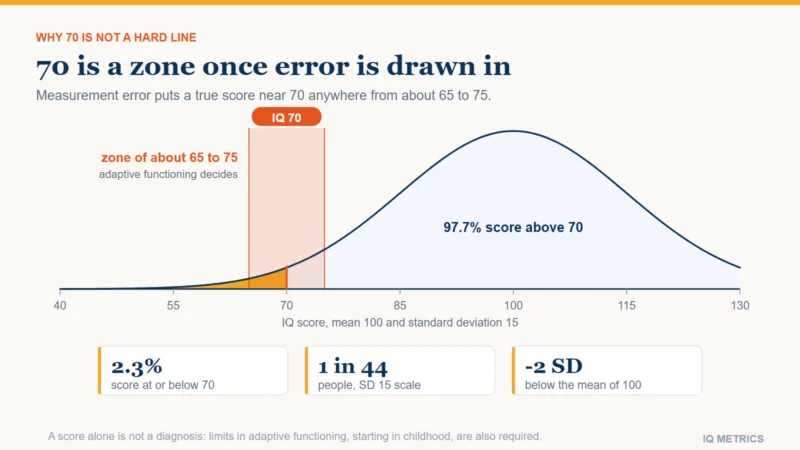
An IQ of 70 is two standard deviations below the population mean. On a test scaled to a mean of 100 and a standard deviation of 15, that places it at about the 2nd percentile: roughly 2.3% of people score 70 or lower, which is about one person in 44.
It is also the score most often linked with intellectual disability, and that is where most of the confusion starts. Current diagnostic criteria do not treat 70 as a hard cut-off. They treat the region around it, about 65 to 75 once measurement error is counted, as a zone where the deciding evidence is how a person actually manages everyday life. This article covers what an IQ of 70 means for adults and children, what it does not mean, and what to do with one.
Where does an IQ of 70 sit?
IQ scores describe position, not quantity. A 70 is 30 points below the mean of 100, and on a standard deviation 15 scale that is exactly two standard deviations.
- 2nd percentile: about 2.3 people in 100 score at or below 70, and about 97.7 score above it.
- 1 in 44 people score 70 or lower.
- On a test that uses a standard deviation of 16, a 70 is slightly less unusual: about 3% of people score at or below it.
Test manuals attach different words to the same score. On the WISC-V, 70 is the bottom of the Very Low band (70 to 79), and 69 or below is Extremely Low. Older Wechsler editions called the 70 to 79 band Borderline, which is why that word still turns up in reports.
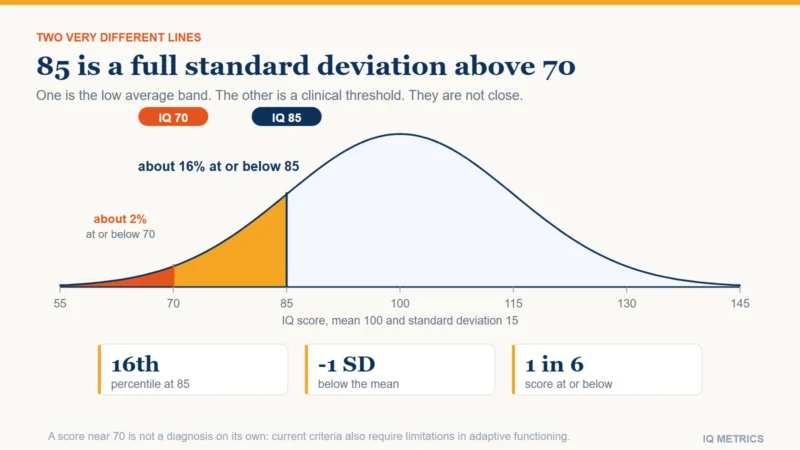
The curve is symmetric, so 70 is exactly as far below the mean as 130 is above it, and exactly as common. The IQ percentile calculator places any score on the same curve, and what an IQ of 85 means covers the low average band a full standard deviation higher.
Is an IQ of 70 an intellectual disability?
Not by itself. Under the DSM-5-TR, a diagnosis of intellectual developmental disorder (intellectual disability) needs three things together:
- Deficits in intellectual functions such as reasoning, problem solving and learning, confirmed by clinical assessment and individually administered standardized testing.
- Deficits in adaptive functioning: everyday conceptual, social and practical skills, compared with others of the same age and background.
- Onset during the developmental period, meaning childhood or adolescence.
The intellectual criterion is scores about two standard deviations below the mean, which the manual puts at roughly 65 to 75 once measurement error is allowed for, and the American Psychiatric Association adds that clinicians should not be bound narrowly to that range. Severity — mild, moderate, severe or profound — is defined by adaptive functioning, not by IQ scores. The World Health Organization’s ICD-11 uses the same two-standard-deviation line (about the 2.3rd percentile), and the American Association on Intellectual and Developmental Disabilities requires the disability to begin before age 22.
So two people who both score 70 can receive different conclusions. Someone who struggles with communication, money and self-care may meet the criteria; someone who manages work, bills and relationships independently may not. According to the American Psychiatric Association, intellectual disability affects about 1% of the population, and about 85% of those people are in the mild range.
Why 70 is a zone, not a line
Every test score carries measurement error. For full-scale IQ on the major Wechsler tests the standard error is about 3 points, so publishers report a 95% confidence interval roughly 10 to 11 points wide, leaning slightly back toward 100. A measured 70 is best read as a true score probably somewhere between the mid 60s and the mid 70s, which is why the diagnostic manual’s own range is 65 to 75. An IQ score is a range, not a number walks through the arithmetic.
The US Supreme Court turned that point into law in Hall v. Florida (2014). By 5 votes to 4 it struck down a Florida rule that treated any score above 70 as final, holding that when a score falls within the test’s margin of error, the person must be allowed to present other evidence of intellectual disability, including evidence about adaptive functioning.
What is the mental age of someone with an IQ of 70?
The question comes from the original IQ formula: mental age divided by chronological age, multiplied by 100. On that old ratio scale, a 10-year-old who performed like an average 7-year-old scored 70, and for children it still gives a rough picture of where test performance sits.
For adults the idea breaks down. Raw test performance stops climbing in the late teens, so dividing by an adult’s age produces nonsense, which is one reason modern tests replaced the ratio with deviation scores (see deviation IQ vs ratio IQ). The figure that circulates online, a mental age of about 11 for an adult with an IQ of 70, comes from multiplying 0.7 by an assumed adult ceiling of 16. It describes test items, not a person. An adult who scores 70 still has adult experience, adult interests and adult relationships, and often practical skills that no test item measures.
Where would your own score land?
Take the IIF-certified assessment and get your score with the scale it was measured on, the percentile it corresponds to and the confidence range around it — the three figures most online tests leave out.
Find your IQ score now! →What can a person with an IQ of 70 do?
A great deal, and the range between people is wide. Most people with intellectual disability are in the mild range, and a 2015 National Academies report describes people with mild intellectual disability as able to learn practical life skills that let them function in ordinary life with minimal support. The American Association on Intellectual and Developmental Disabilities adds that with the right personalized supports over time, life functioning generally improves.
Jobs follow fit rather than a number. No score closes a particular career by itself; what matters is how the demands of a role match a person’s adaptive skills, and how much support comes with it. Support tends to matter most for complex, high-stakes tasks such as contracts, large financial decisions and unfamiliar paperwork. A score of 70 does not cap what someone can learn; it describes how much explicit teaching and practice new skills are likely to take.
When a 70 is a measurement problem
A low score can reflect the testing situation as much as the person. Before treating a 70 as a finding, a careful assessor rules out:
- Language: taking a test in a second language can pull verbal scores well down.
- Hearing and vision: hearing loss changes test scores before it changes cognition.
- The day itself: pain, fatigue or medication, and possibly anxiety; see test anxiety and IQ scores.
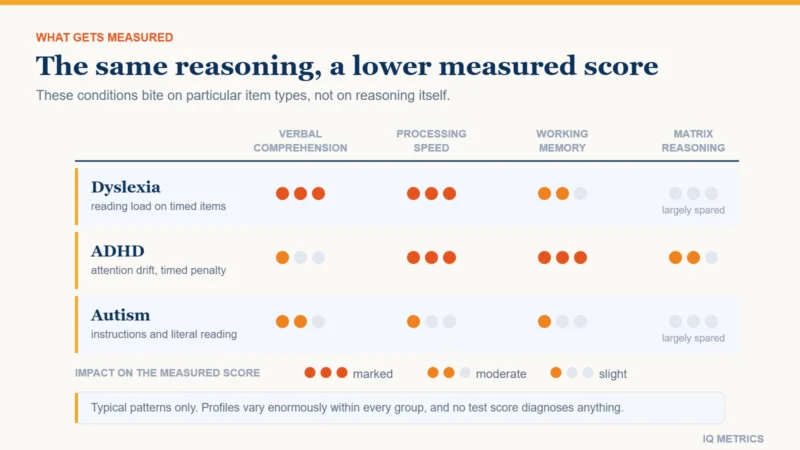
- Conditions that clash with the format: ADHD, autism and dyslexia can all depress a score without lowering ability.
- An uneven profile: a full-scale 70 can average a verbal score in the 80s with a much lower processing-speed score; full-scale IQ vs index scores shows why the index scores matter.
- The wrong kind of test: brief screening tests and group tests can produce invalid scores at this level.
An online IQ test cannot diagnose intellectual disability. Diagnosis needs an individually administered standardized test and an assessment of adaptive behavior, carried out by a qualified professional; professional IQ tests covers the instruments psychologists use.
Where an IQ of 70 matters in law and benefits
Because 70 appears in legal and administrative definitions in the United States, a few points can carry real consequences:
- Atkins v. Virginia (2002): by 6 votes to 3, executing people with intellectual disability violates the Eighth Amendment. The Court set no score cut-off and left enforcement to the states.
- Hall v. Florida (2014): a strict line at 70 is unconstitutional when a score falls within the margin of error.
- Moore v. Texas (2017): courts may not ignore current medical standards when deciding whether someone has intellectual disability.
- Social Security: the adult listing for intellectual disorder (12.05) includes a full scale IQ of 70 or below, or 71 to 75 with a verbal or performance score of 70 or below, alongside marked or extreme limits in mental functioning and evidence the disorder began before age 22.
- Special education: under IDEA, intellectual disability means significantly subaverage general intellectual functioning together with deficits in adaptive behavior, appearing during the developmental period and affecting educational performance. The law names no IQ number.
Test age matters too. Outdated norms tend to inflate scores, the Flynn effect, so an old test can put someone above 70 who would score below it on a current edition. Some experts adjust older scores for this, but courts are divided on whether that is required, which is one more reason the same person can be described as above or below 70 depending on the test and the year.
IQ scores between 70 and 85
Scores from about 71 to 84 are often described as borderline intellectual functioning. That range comes from the older DSM-IV; the current manual lists borderline intellectual functioning only as a condition that may be a focus of clinical attention, not as a disorder, and gives it no score range. People in this band usually do not qualify for disability-based support, yet they can find school, complex jobs and paperwork genuinely hard, which is worth recognizing even without a diagnosis.
If you or your child scored 70
Treat the number as a reason for a full assessment, not a verdict. Ask for the confidence interval and the index scores, check hearing, vision, language and health, and make sure adaptive behavior was measured with a standardized tool rather than inferred from the IQ.
For a child, a diagnosis can open access to school support and early services, and skills in this range respond well to explicit teaching. For an adult, the most useful result of an assessment is usually a clear map of which tasks need support and which do not. Down syndrome and IQ covers one of the most common genetic causes of intellectual disability, and what an IQ of 140 means shows the same distance from the mean in the other direction.
Keep reading
All articles →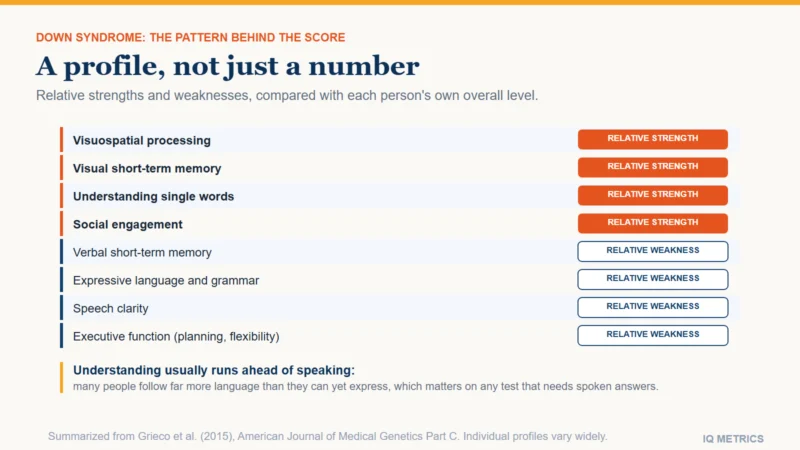 Understanding IQ
Down Syndrome and IQ
Most people with Down syndrome score in the mild to moderate range of intellectual disability, with an average IQ of around 50 and a typical range of about 30 to 70. The number hides a wide spread, a consistent profile of strengths, and test limits that matter more here than almost anywhere else.
 Scores & Scales
What an IQ of 85 Means
A score of 85 sits exactly one standard deviation below the population mean, at roughly the 16th percentile. It is the bottom edge of what test manuals call low average, it is well clear of any clinical threshold, and on its own it says considerably less about a person than the number appears to.
 Taking a Test
ADHD, Autism and Dyslexia in IQ Testing
A test score is a measurement, and a measurement can be biased by the conditions under which it is taken. ADHD, autism and dyslexia each depress performance on particular kinds of item without lowering the reasoning underneath. Here is what actually interferes, condition by condition, and what to do next.