





Low IQ vs Learning Disability: What Is the Difference?
A low IQ, an intellectual disability and a specific learning disability are three different things, and the UK uses "learning disability" for the second. What each requires, how each is assessed, the US and UK terms, and what to do if you are worried.

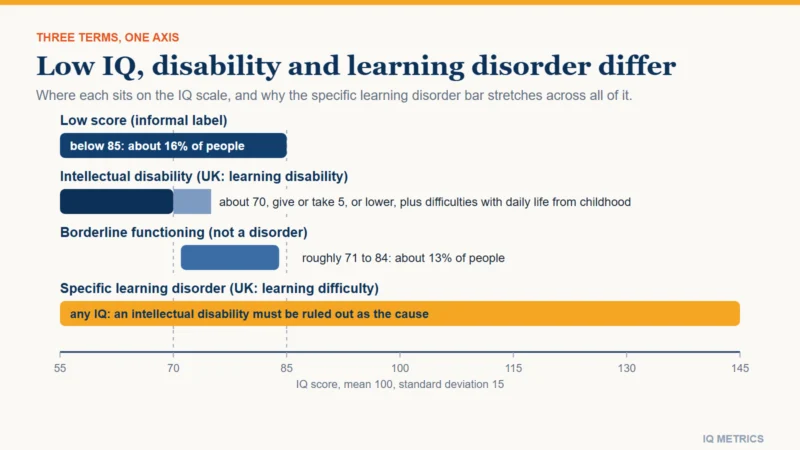
A low IQ and a learning disability are not the same thing. A low IQ is a test score. An intellectual disability is a diagnosis that needs a low score plus difficulty with everyday skills, starting in childhood. A specific learning disability, of which dyslexia is the best known, is an unexpected difficulty with reading, writing or mathematics that can occur at any IQ, including a high one. To add to the confusion, in the UK “learning disability” means what the US calls an intellectual disability. This article sorts out the three terms, what each one requires, how they are assessed, and what to do if you are worried.
- Low IQ: a number, usually meaning a score well below 100. Not a diagnosis on its own.
- Intellectual disability: a low score (about 70, give or take 5) plus difficulty with daily life, starting in childhood. About 1% of people.
- Specific learning disorder: a persistent, unexpected difficulty with reading, writing or maths, with no IQ cut-off. About 5 to 15% of school-age children.
- Terminology trap: the UK’s “learning disability” is the US “intellectual disability”.
Low IQ, intellectual disability and learning disability: the three terms
| Term | What it is | Is a low IQ score required? | Roughly how common |
|---|---|---|---|
| Low IQ | A test result, usually a score well below the average of 100 | It is the score. On its own it is not a diagnosis | About 16% score below 85 and about 2.3% below 70 on a standard deviation 15 scale |
| Intellectual disability (US). UK: “learning disability” | A diagnosis: deficits in intellectual functioning and in adaptive functioning, with onset in childhood | Yes: about two standard deviations below the mean, roughly 65 to 75 once measurement error is allowed for | About 1% of the population (DSM-5) |
| Specific learning disorder (US). UK: “specific learning difficulty” | Persistent difficulty with reading, written expression or maths, well below what age and teaching predict | No. Intellectual disability must be ruled out as the explanation | About 5 to 15% of school-age children (DSM-5) |
| Borderline intellectual functioning | Scores of roughly 71 to 84. Not a disorder, but a range where daily life can be hard | It is a score band, not a diagnosis | About 13% of people if the curve holds |
What does an intellectual disability require?
Under DSM-5 and the American Association on Intellectual and Developmental Disabilities definition, three things have to be present together. First, deficits in intellectual functioning, such as reasoning, problem solving, planning, abstract thinking and learning from experience, confirmed by clinical assessment and an individually administered IQ test. The score is about two standard deviations below the mean, roughly 65 to 75 with the margin of error included. Second, deficits in adaptive functioning across the conceptual (language, reading, money, time), social and practical (self-care, work, travel) areas that mean ongoing support is needed. Third, onset during the developmental period.
Since DSM-5 in 2013, severity (mild, moderate, severe, profound) is set by adaptive functioning, not by IQ bands. The old term “mental retardation” was replaced in US federal law by “intellectual disability” through Rosa’s Law in 2010. Because 70 is a zone rather than a line, what an IQ of 70 means goes into the detail, and the Social Security score rules cover how benefits treat the same numbers. Two conditions that often come with intellectual disability are covered in Down syndrome and IQ and fetal alcohol spectrum disorder and IQ.
What is a specific learning disability?
In US education law, a specific learning disability is a disorder in one or more of the basic processes involved in understanding or using language, spoken or written, that can show up as an imperfect ability to listen, think, speak, read, write, spell or do mathematical calculations. It covers conditions such as dyslexia, and it excludes problems that are mainly due to vision, hearing or motor disabilities, intellectual disability, emotional disturbance, or environmental, cultural or economic disadvantage. DSM-5 calls the same idea a specific learning disorder: difficulties with reading, written expression or mathematics that persist for at least six months despite targeted help, with skills substantially and measurably below what is expected for age, beginning in the school years.
It is common. DSM-5 puts it at 5 to 15% of school-age children across languages and cultures. In the US in 2022–23, 7.5 million students aged 3 to 21 (15% of public school students) received special education under the federal disability law, and 32% of them, about 2.4 million, were classed as having a specific learning disability, compared with 6%, about 450,000, classed as having an intellectual disability (National Center for Education Statistics).
Why the words change from country to country
The UK uses “learning disability” for what US clinicians call intellectual disability. The English government definition (Valuing People, 2001) describes a significantly reduced ability to understand new or complex information and to learn new skills, with a reduced ability to cope independently, which started before adulthood. Dyslexia and dyspraxia are “specific learning difficulties” there, not learning disabilities. The World Health Organization’s ICD-11 avoids the clash by using “disorders of intellectual development” for the first and “developmental learning disorder” for the second. When you read advice, check which country wrote it before assuming which condition it means.
Do you need a gap between IQ and achievement?
For decades the answer in the US was yes. The 1977 federal rules identified a specific learning disability by a severe discrepancy between IQ and achievement. Critics said the approach made children wait to fail, and that an IQ test cannot separate a child’s ability from what they have been taught. The 2004 revision of the federal law removed the requirement: schools are not required to consider a discrepancy, states may not require it, and schools may instead look at how a child responds to research-based teaching. DSM-5 does not require a gap either. In practice an evaluation now looks for a pattern of difficulty that persists despite good instruction, and rules out other explanations. That is also why an IQ of 85 does not rule out a specific learning disability, and why a score in the top hundredth of a percent (see what an IQ of 160 means) does not either.
Can someone have a high IQ and a learning disability?
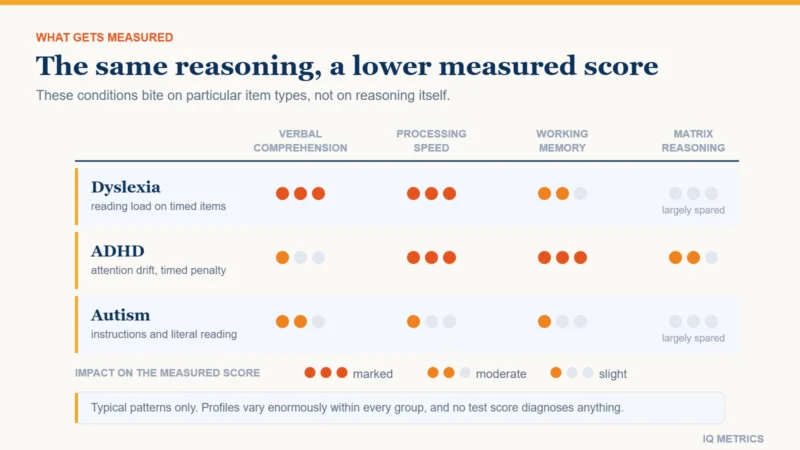
Yes. Educators call it twice-exceptional: strong reasoning alongside a specific difficulty such as dyslexia or dysgraphia. A single full-scale IQ can hide the pattern, because modern tests report separate index scores. The WISC-V, for example, gives five primary indexes (verbal comprehension, visual spatial, fluid reasoning, working memory and processing speed), and a large gap between them is often the first clue. See WISC-V index scores explained, full-scale IQ versus index scores, processing speed and IQ and high IQ and ADHD for how the profile is read, and ADHD, autism, dyslexia and IQ test scores for how these conditions affect the score.
Where would your own score land?
Take the IIF-certified assessment and get your score with the scale it was measured on, the percentile it corresponds to and the confidence range around it — the three figures most online tests leave out.
Find your IQ score now! →How is each one assessed?
A full evaluation normally combines several tools, each answering a different question.
- A cognitive test such as the WISC-V, WAIS-IV or Stanford–Binet 5 gives the IQ and the index profile.
- An achievement test such as the WIAT-4 or the Woodcock–Johnson measures reading, writing and maths directly; achievement tests versus IQ tests explains how the two differ.
- An adaptive behaviour scale such as the Vineland-3 or the ABAS-3, completed by parents or teachers, shows how a person manages daily life.
- History and screening cover hearing, vision, health, schooling and language background, all of which can mimic or hide a disability.
An intellectual disability needs the first and third to agree. A specific learning disorder needs the second to fall well below expectations, with the first used mainly to rule out an intellectual disability. For the difference between a score on one instrument and a diagnosis, see how to read an IQ test report.
What about scores between 70 and 85?
This band, often called borderline, is not an intellectual disability, yet day-to-day demands such as reading contracts or managing money can still be hard. On a normal curve about 13% of people fall in it. Many people in this range sit between services: too able to qualify for disability programmes built around a score of about 70 to 75, yet struggling in ways an average score would not predict. What an IQ of 85 means covers the upper edge of the band and IQ classifications shows where the labels come from.
If you are worried about a child, or yourself
- Start with the school or a psychologist. In the US a parent can ask the school in writing for an evaluation; elsewhere, a GP, paediatrician or educational psychologist is the usual route.
- Ask for the whole profile. Request the index scores, the achievement results and any adaptive ratings, not just one IQ number.
- Ask what each result rules in or out. A good report says whether the pattern fits an intellectual disability, a specific learning disorder, both or neither.
- Do not use an online quiz to decide. No online IQ test, this site’s included, can diagnose anything; see IQ test accuracy.
- Expect support to matter. An intellectual disability is lifelong, but daily functioning usually improves with the right supports, and a specific learning disorder does not disappear but responds to targeted teaching.
Quick answers
- Is a learning disability the same as a low IQ? No. A low IQ is a score; a specific learning disability is an unexpected difficulty with reading, writing or maths that can occur at any IQ.
- What IQ counts as a learning disability? There is no IQ cut-off for a specific learning disability. For an intellectual disability, which the UK calls a learning disability, the score is about 70 give or take 5, plus difficulty with daily life.
- Is dyslexia a low IQ? No. Dyslexia occurs across the whole IQ range.
- What is the difference between intellectual disability and learning disability? In the US, the first affects overall intellectual and adaptive functioning and the second affects specific skills. In the UK, the first is what the second means.
- Can you have a learning disability and a high IQ? Yes. It is called twice-exceptional.
- Is an IQ of 75 a learning disability? Not by score alone. It sits in the zone around the cut-off, where adaptive functioning decides.
The bottom line
Low IQ, intellectual disability and specific learning disability answer three different questions. A low IQ says how a person scored. An intellectual disability says that a low score and difficulty with daily life go together and began early. A specific learning disability says that one skill, most often reading, is well below where teaching and age say it should be, whatever the IQ. Check which country the words come from, ask for the full profile instead of one number, and treat a score as a starting point for a conversation with a professional.
Sources
- American Psychiatric Association: what are specific learning disorders?
- National Center for Education Statistics: students with disabilities (2022–23 counts).
- Challenging Behaviour Foundation: formal definitions of learning disability, including the 2001 Valuing People wording.
- Foundation for People with Learning Disabilities: what are learning disabilities?
- Also cited: American Psychiatric Association (2013), DSM-5, intellectual disability and specific learning disorder criteria and prevalence; Individuals with Disabilities Education Improvement Act (2004), 20 U.S.C. 1414(b)(6); Rosa’s Law (2010), Public Law 111-256.
Keep reading
All articles →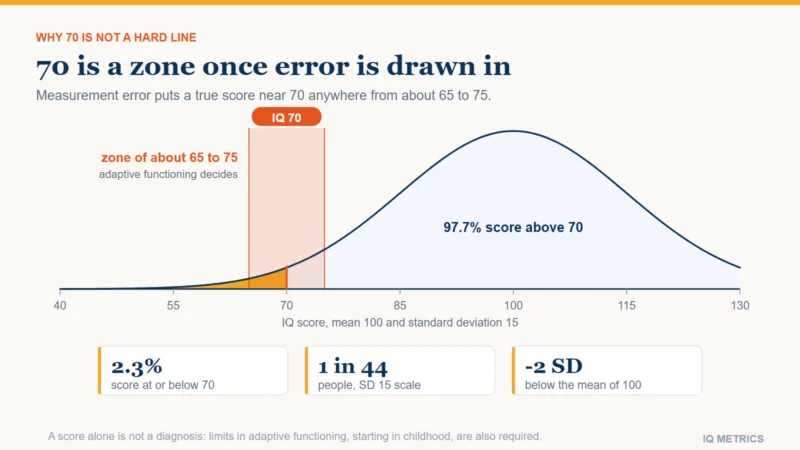 Scores & Scales
What an IQ of 70 Means
An IQ of 70 sits two standard deviations below the mean, at about the 2nd percentile. It is the score most often linked with intellectual disability, but a diagnosis never rests on the number alone: measurement error turns the line into a zone, and adaptive functioning decides who is inside it.
 Taking a Test
ADHD, Autism and Dyslexia in IQ Testing
A test score is a measurement, and a measurement can be biased by the conditions under which it is taken. ADHD, autism and dyslexia each depress performance on particular kinds of item without lowering the reasoning underneath. Here is what actually interferes, condition by condition, and what to do next.
 Scores & Scales
What an IQ of 160 Means
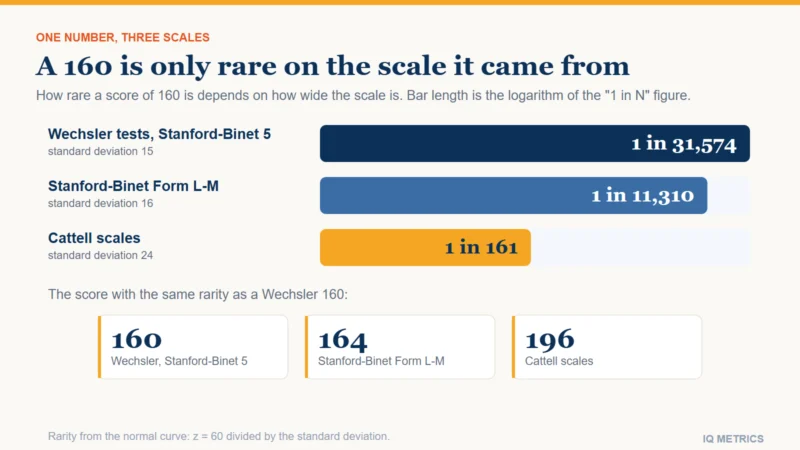
An IQ of 160 is about 1 person in 31,600 on a standard deviation 15 scale, but only 1 in 161 on the Cattell scale. What a 160 means on each scale, which tests can print one, how accurate it is, what it predicts and where the claims come from.