





Creativity and IQ: What the Threshold Theory Gets Wrong
Creativity and IQ correlate only weakly. The largest meta-analysis ever run on the question, covering 45,880 people, found no significant threshold at IQ 120, just a modest overall link of about .17 to .25. See what the strongest evidence shows, and why the classic claim does not hold up.

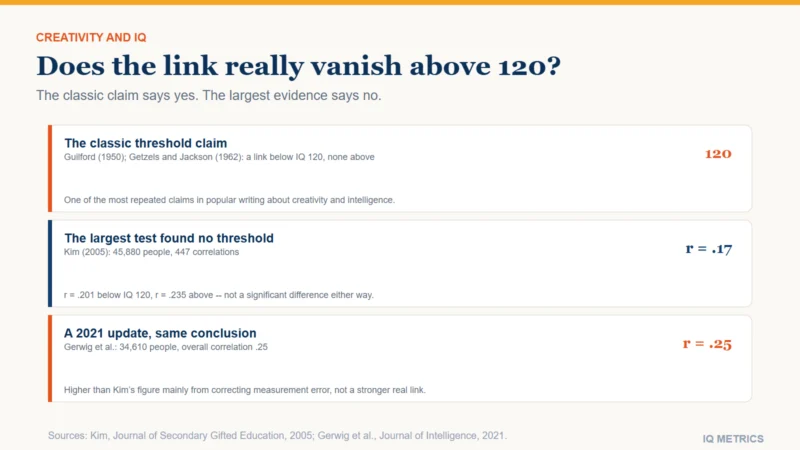
Creativity and IQ correlate only weakly, and not in the way the famous threshold theory claims. Are creative people more intelligent? Only slightly. That theory says intelligence and creativity correlate up to about IQ 120, then the link flattens out completely. The largest meta-analysis ever run on the question, pooling 447 correlations from 45,880 people, found a correlation of about .17 overall and no significant difference between the below-120 and above-120 groups — its author concluded plainly that “this study does not support threshold theory.” This guide covers where the threshold idea came from, what the two largest meta-analyses actually found, a more recent study that found the breakpoint moves depending on how creativity is measured, and what the field’s most famous creativity-test follow-up study found instead.
- The classic claim: intelligence and creativity correlate below about IQ 120; above it, no further relationship (Guilford, 1950; Getzels and Jackson, 1962).
- The largest test of it: a 2005 meta-analysis of 45,880 people found a weighted mean correlation of .174, with no significant difference above versus below IQ 120.
- A 2021 update, correcting for measurement error: 34,610 people, overall correlation .25 — still modest, not the strong link pop psychology sometimes implies.
- Creative-test scores predicted personal achievement, not public achievement, in a 50-year follow-up of Torrance Test takers; public creative achievement needed high scores on both creativity and intelligence.
Where the threshold theory came from
J.P. Guilford’s 1950 address to the American Psychological Association, titled simply “Creativity,” argued that standard intelligence tests miss an entire class of abilities: divergent thinking, the capacity to generate many different valid responses to an open-ended problem, rather than converge on the one correct answer an IQ test rewards. Getzels and Jackson followed in 1962 with Creativity and Intelligence: Explorations with Gifted Students, comparing high-IQ and high-creativity groups of students and finding they overlapped only partly. Out of that era came the threshold claim, credited across the literature to Barron (1961), Getzels and Jackson (1962), Guilford himself (1967) and MacKinnon (1962): below roughly IQ 120, a certain amount of intelligence is needed to be creative, so the two correlate; above it, intelligence stops being the limiting factor and the correlation should flatten toward zero.
It is one of the most widely repeated claims in popular writing about intelligence and creativity. It is also, on the best current evidence, not well supported as a hard cutoff.
The largest test of the threshold claim found no threshold
Kyung Hee Kim’s 2005 meta-analysis, “Can Only Intelligent People Be Creative?”, pooled 447 correlation coefficients from 21 studies published between 1961 and 2004, covering 45,880 people. The overall weighted mean correlation between intelligence and creativity was .174 (95% confidence interval .165 to .183) — positive, but modest.
| IQ band | Correlation (r) | Number of coefficients |
|---|---|---|
| Below 100 | .260 | part of 65 below-120 |
| 100 to 120 | .140 | part of 65 below-120 |
| 120 to 135 | .259 | part of 14 above-120 |
| Above 135 | -.215 | only 2 coefficients, unreliable |
| All below IQ 120 | .201 | 65 coefficients |
| All above IQ 120 | .235 | 14 coefficients |
If the threshold theory were right, the correlation above 120 should collapse toward zero. Instead it was slightly higher than below 120, and the difference was not statistically significant (chi-square 2.004, p = .157). Adding an IQ-120 threshold term to a regression model did not improve how well it fit the data. Kim’s own conclusion, in her words: “This study does not support threshold theory.” A narrower look at just the Torrance Tests of Creative Thinking, covered below, gave a similar mean correlation of .218 across 18 coefficients.
A 2021 update: a somewhat stronger link, still not a threshold
A 2021 update by Gerwig and colleagues in the Journal of Intelligence pooled a larger and more recent set of studies: 849 correlations from 112 studies and 34,610 people, and reported an overall correlation of .25 (95% confidence interval .21 to .30) between intelligence and divergent-thinking scores. That is noticeably higher than Kim’s .174, but the gap is mostly statistical rather than a real change over time: once the newer studies are restricted to the same uncorrected method Kim used, the estimate drops to about .19, close to her figure. The higher headline number in the 2021 study comes mainly from correcting for measurement unreliability in the tests themselves, a standard meta-analytic adjustment, not from creativity and intelligence having grown more closely linked.
A moving breakpoint, not a fixed one
Not every study agrees the relationship is perfectly flat throughout. A widely cited re-analysis by Jauk, Benedek, Dunst and Neubauer, published in Intelligence in 2013, used a statistical technique that finds a breakpoint in the data rather than assuming one at 120. It reported that where the breakpoint falls depends on how strictly creativity is defined: for a simple count of how many ideas someone can generate, the breakpoint sat far lower, around IQ 85; for a demanding measure of genuinely original ideas, it moved up toward roughly 120. In other words, a fixed threshold at 120 may be an artefact of which creativity measure a study happens to use, not a single biological cutoff. The broader pattern across both meta-analyses and this re-analysis is the same: a real but modest link that behaves differently depending on how “creative” is defined and measured, not a clean switch that turns off at a specific score.
Is creativity even part of intelligence?
Part of the disagreement is definitional. Robert Sternberg’s triarchic theory of intelligence names “creative intelligence” — the ability to deal with novelty and generate new ideas — as one of three components, alongside analytical and practical intelligence, arguing standard IQ tests mostly capture only the analytical piece. The Cattell-Horn-Carroll (CHC) model behind most modern IQ tests, by contrast, does not name creativity as one of its broad abilities at all; the closest fit is Glr, long-term storage and retrieval, which covers the kind of fluent, associative idea generation that divergent-thinking tests measure. Our guide to Gardner's multiple intelligences covers a separate, and more famous, argument that standard IQ tests miss entire categories of ability; see also is intelligence limited to IQ.
Where would your own score land?
Take the IIF-certified assessment and get your score with the scale it was measured on, the percentile it corresponds to and the confidence range around it — the three figures most online tests leave out.
Find your IQ score now! →What the most famous creativity-test follow-up study actually found
E. Paul Torrance built the Torrance Tests of Creative Thinking (TTCT) in the 1960s to score fluency, flexibility, originality and elaboration on open-ended tasks, and then tracked his test-takers for decades. A 40-year follow-up (Cramond and colleagues, 2005) and a 50-year follow-up (Runco and colleagues, 2010) both looked at how well childhood TTCT scores predicted adult creative achievement. The finding is more precise than the popular version of the story: TTCT scores moderately predicted personal achievement (creative accomplishments in an individual’s own life and work), but predicting public achievement (creative work recognised publicly) needed an interaction between creativity and intelligence scores together. Neither measure alone told the fuller story; the combination did.
What this means if you are trying to identify creative potential
A single IQ score was never built to certify creativity, and a single creativity-test score is not a substitute for one either. Programmes that identify gifted children using only an IQ cutoff can miss students whose strength shows up in open-ended, divergent tasks rather than the convergent, single-right-answer format most IQ subtests use; the Torrance follow-ups suggest the reverse is also true, since public achievement took both kinds of ability together. Neither score alone settles the question of who is creative, and a modest .17 to .25 correlation leaves most of the variation in creativity unexplained by IQ in either direction. For another surprising trait people have tried to link to intelligence, with a very different causal story, see our guide to myopia and IQ.
Quick answers
- Are highly intelligent people more creative? Only slightly. The two largest meta-analyses put the correlation at about .17 to .25, positive but modest.
- Is there really an IQ 120 cutoff where the link disappears? The best-supported answer is no. The largest meta-analysis (45,880 people) found no significant difference in the correlation above versus below IQ 120.
- Can someone with an average IQ be highly creative? Yes. The correlation is far from perfect in either band, and one re-analysis put the breakpoint for basic idea-generation as low as IQ 85.
- Does a high IQ guarantee creativity? No. Correlations around .2 to .25 mean intelligence explains only a small share of the differences between people in creative-test scores.
- Is creativity part of IQ? Not in the CHC model most modern IQ tests are built on. Sternberg’s triarchic theory treats it as a separate kind of intelligence; most IQ tests measure mainly the analytical kind.
The bottom line
The tidy version of the threshold theory — strong link below IQ 120, none above — does not hold up against the largest evidence. What holds up instead is a real but modest correlation, roughly .17 to .25, that does not flatten sharply at any single score, though where it is strongest can shift with how strictly a study defines “creative.” A high IQ makes highly creative output somewhat more likely, but the Torrance follow-ups suggest that publicly recognised creative achievement is better predicted by intelligence and creativity acting together than by either score alone.
Sources
- Guilford, J.P. (1950): Creativity, American Psychologist, 5, 444-454.
- Getzels, J.W. and Jackson, P.W. (1962): Creativity and Intelligence: Explorations with Gifted Students. Wiley.
- Kim, K.H. (2005): Can only intelligent people be creative? A meta-analysis, Journal of Secondary Gifted Education, 16(2/3), 57-66.
- Gerwig, A. et al. (2021): The relationship between intelligence and divergent thinking, a meta-analytic update, Journal of Intelligence, 9(2), 23.
- Jauk, E., Benedek, M., Dunst, B. and Neubauer, A.C. (2013): The relationship between intelligence and creativity, new support for the threshold hypothesis by means of empirical breakpoint detection, Intelligence, 41(4), 212-221.
- Runco, M.A., Millar, G., Acar, S. and Cramond, B. (2010): Torrance Tests of Creative Thinking as predictors of personal and public achievement, a fifty-year follow-up, Creativity Research Journal, 22(4), 361-368.
- Cramond, B., Matthews-Morgan, J., Bandalos, D. and Zuo, L. (2005): A report on the 40-year follow-up of the Torrance Tests of Creative Thinking, Gifted Child Quarterly, 49(4), 283-291.
- Sternberg, R.J. (1988): The Triarchic Mind: A New Theory of Human Intelligence. Viking Press.
Keep reading
All articles →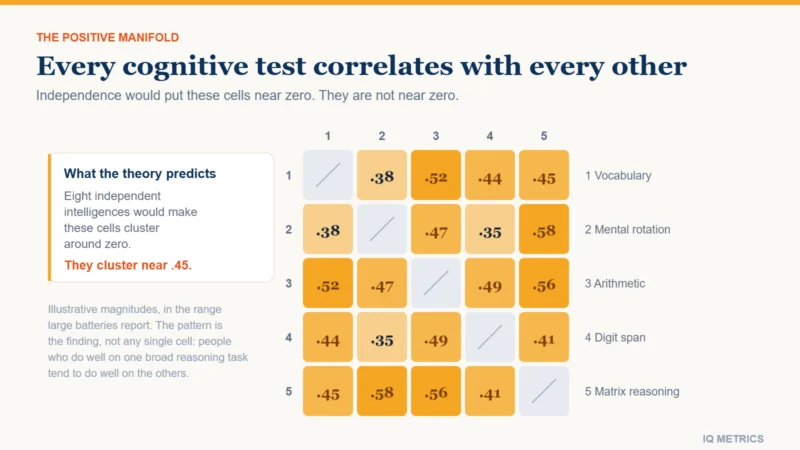 Research & Evidence
Gardner's Multiple Intelligences
Gardner's multiple intelligences theory is one of the most influential ideas in education and almost entirely absent from the tests psychologists use. That gap is not stubbornness. It comes down to one stubborn statistical finding, one missing instrument, and a real insight the theory carries.
 Understanding IQ
Is Intelligence limited to IQ?
As we explore the fascinating world of intelligence, we will uncover the truth about IQ and the limitations of the human intellect. Beyond traditional measures of intellect, this article explores a wider range of aptitudes that impact our perception and engagement with the natural world.
 Research & Evidence
Myopia and IQ
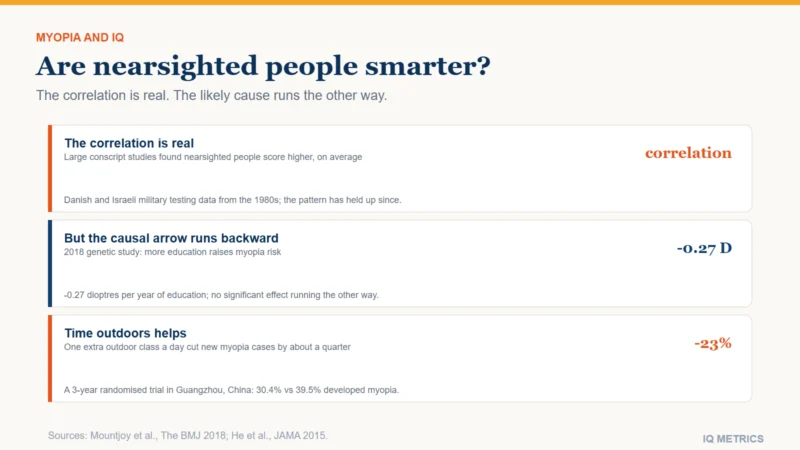
Myopia and IQ: are nearsighted people really smarter? A 2018 genetic study of 68,000 people found the causal arrow runs from more education to more myopia, not the other way around. See the historical studies, the genetics behind the link, and why time outdoors helps.