





Myopia and IQ: Are Nearsighted People Really Smarter?
Myopia and IQ: are nearsighted people really smarter? A 2018 genetic study of 68,000 people found the causal arrow runs from more education to more myopia, not the other way around. See the historical studies, the genetics behind the link, and why time outdoors helps.

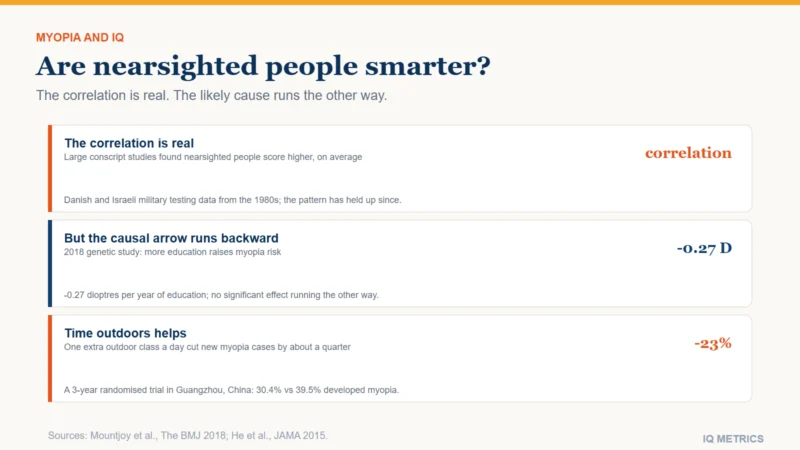
The link between myopia and IQ is real: people who are nearsighted (myopic) score a few points higher on intelligence tests and complete more years of education, on average, than people with normal vision — a finding repeated in large studies since the 1980s. It does not mean blurry distance vision makes anyone smarter. The best current evidence, a 2018 genetic study of nearly 68,000 people, found the arrow points the other way: more years spent in education causally increases the odds of becoming myopic, most likely through more reading and near-work and less time outdoors, while myopia itself showed no significant effect on educational attainment. This guide covers the historical studies behind the myopia-IQ link, the genetic evidence for what actually causes what, why time outdoors matters, and why the world is getting more nearsighted.
- The correlation is real. Large military-conscript studies from the 1980s found nearsighted young men scored higher on intelligence tests than their normally-sighted peers.
- The likely cause runs backward from the popular story. A 2018 Mendelian-randomisation study found each extra year of education raises myopia risk (about −0.27 dioptres per year), with no significant reverse effect of myopia on education.
- Time outdoors helps. A randomised trial in China cut childhood myopia by roughly a quarter just by adding one outdoor class period a day.
- Myopia is becoming much more common worldwide, projected to affect around half the global population by 2050, up from about 28% in 2010.
The correlation: where the myopia-IQ link comes from
The association between nearsightedness and cognitive test performance is not a fringe claim; it goes back to large studies of military conscripts, who in some countries take both a vision exam and an intelligence test as part of the same screening. A review of this literature in the Journal of Ophthalmology (Verma and Verma, 2015) describes two of the largest: a study of 15,834 Danish conscripts found myopic men scored higher on intelligence testing than non-myopic men, a difference the review reports as roughly 7 IQ points; a study of 157,748 Israeli conscripts aged 17 to 19 found myopia associated with both higher test scores and more years of education, and the association strengthened with the severity of the myopia. Both are observational studies of young men from a specific era and testing system, not a random sample of everyone, so treat the exact point differences as illustrative rather than universal.
Two explanations, and a decisive way to tell them apart
Two explanations for the correlation have competed for decades. One is behavioural: children who read more and spend more time on close-up schoolwork are exposed to more near-work, which is a known myopia risk factor, and are also the children most likely to do well on a cognitive test — near-work would then be a common cause of both, not evidence that either one causes the other. The other is genetic: an older study by Cohn, Cohn and Jensen (1988) compared gifted children with their own non-gifted siblings and found significantly more myopia in the gifted group, which the authors read as evidence of shared genetics (pleiotropy) rather than shared behaviour. More recent genome-wide association work from the CREAM Consortium has found genetic loci where refractive error interacts with educational attainment, evidence that at least part of the story does run through shared genes, alongside the behavioural path.
A study cannot easily tell these two explanations apart with correlation alone, which is why the 2018 study below matters: it used genetics to test the direction of causation directly, rather than just the existence of a link.
What a 2018 genetic study found: education causes myopia, not the other way around
Mountjoy and colleagues, publishing in The BMJ in 2018, used data from 67,798 UK Biobank participants and a technique called Mendelian randomisation, which uses genetic variants linked to a trait as a kind of natural experiment to test which way a causal arrow points. Their result: each additional year of education increased myopic refractive error by about 0.27 dioptres (95% confidence interval 0.17 to 0.37, a very strong statistical result). Tested in the other direction, each additional dioptre of myopia was associated with just 0.008 fewer years of education, a result with a confidence interval crossing zero and not statistically significant. The authors’ own conclusion was direct: more time in education is a causal risk factor for myopia. Myopia causing more education was not supported.
| Direction tested | Effect | Statistical significance |
|---|---|---|
| More education, then myopia | -0.27 D per year of education (95% CI -0.37 to -0.17) | Highly significant (P = 4x10 -8) |
| More myopia, then education | -0.008 years of education per dioptre (95% CI -0.041 to 0.025) | Not significant (P = 0.6) |
That is the opposite emphasis from how the finding often gets repeated. The honest reading is not “nearsighted people are smarter” but “people who spend longer in education are more likely to become nearsighted,” with no good evidence running the other way. See also our guides to is IQ genetic and eye colour and IQ for two other traits people have tried to link to intelligence, with very different results.
Why time outdoors matters
If near-work is the behavioural link, then time spent away from close-up tasks should help, and a randomised trial backs that up directly. He and colleagues, publishing in JAMA in 2015, added one 40-minute outdoor class period per day to the school schedule of first-graders in 12 schools in Guangzhou, China, for three years, against 12 comparison schools with no change. Myopia had developed in 30.4% of the intervention group by the end of the study, against 39.5% of the comparison group, a roughly one-quarter reduction in new cases from one extra outdoor period a day. Nothing in that result requires less studying, only more time outdoors alongside it, which is consistent with light exposure, not merely a break from books, being the protective factor most researchers now point to.
Where would your own score land?
Take the IIF-certified assessment and get your score with the scale it was measured on, the percentile it corresponds to and the confidence range around it — the three figures most online tests leave out.
Find your IQ score now! →A fast-rising, worldwide trend
Myopia has been becoming more common for decades, and the trend line is steep. A widely cited 2016 analysis in Ophthalmology (Holden and colleagues) estimated that myopia affected about 28% of the world’s population, roughly 2 billion people, in 2010, and projected that share to reach roughly 50%, about 4.8 billion people, by 2050. High myopia, the more severe form that carries greater risk of other eye conditions, was estimated at about 4% (227 million people) in 2010, projected to reach roughly 10% (938 million) by 2050. More schooling, more screen-based near-work and less unstructured outdoor time in childhood are the leading explanations researchers give for the trend, which fits the causal direction the 2018 genetic study found.
A different but equally surprising IQ correlate
Myopia is not the only ordinary trait people have tried to link to intelligence. Our guide to creativity and IQ covers another one, the long-debated claim that intelligence and creative ability stop correlating above a certain score — a claim that, like the myopia story, turns out to be less clean than the popular version once you check the largest studies.
Quick answers
- Are nearsighted people smarter? They score a few points higher on cognitive tests on average in several large studies, but the best evidence says this is not because myopia causes higher intelligence.
- Does myopia cause high IQ, or does high IQ cause myopia? Neither, precisely. The strongest causal evidence says more years of education causally increases myopia risk; it found no significant effect of myopia on educational attainment.
- Why are nearsighted people associated with higher test scores? Likely because more reading and near-work, both a myopia risk factor and a habit common among high scorers, plus some shared genetic factors, sit behind both.
- Does reading more cause myopia? Extended near-work is one established risk factor; reduced time outdoors is another, and a randomised trial found extra outdoor time reduced new cases by roughly a quarter.
- Is myopia becoming more common? Yes. A 2016 projection put it at roughly 28% of the world in 2010, rising to roughly 50% by 2050.
The bottom line
Nearsighted people really do score somewhat higher on cognitive tests in several large studies, but the best causal evidence available, a 2018 genetic study of nearly 68,000 people, points from education to myopia rather than from myopia to intelligence. More time spent reading and studying, and less time outdoors, is the more likely story behind both. Protecting a child’s eyesight and supporting their education are not in tension: the same research that explains the myopia-IQ correlation is also the evidence base for encouraging outdoor time alongside schoolwork, not instead of it.
Sources
- Mountjoy, E. et al. (2018): education and myopia, assessing the direction of causality by Mendelian randomisation, The BMJ, 361:k2022.
- He, M. et al. (2015): effect of time spent outdoors at school on the development of myopia among children in China, a randomised clinical trial, JAMA, 314(11):1142-1148.
- Holden, B.A. et al. (2016): global prevalence of myopia and high myopia and temporal trends from 2000 through 2050, Ophthalmology, 123(5):1036-1042.
- Verma, A. and Verma, A. (2015): a novel review of the evidence linking myopia and high intelligence, Journal of Ophthalmology, 2015:271746.
- Cohn, S.J., Cohn, C.M. and Jensen, A.R. (1988): myopia and intelligence, a pleiotropic relationship?, Human Genetics, 80:53-58.
Keep reading
All articles →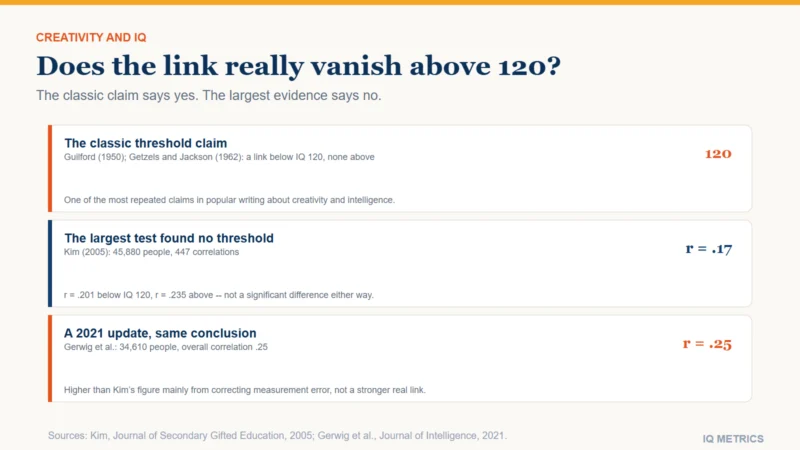 Understanding IQ
Creativity and IQ
Creativity and IQ correlate only weakly. The largest meta-analysis ever run on the question, covering 45,880 people, found no significant threshold at IQ 120, just a modest overall link of about .17 to .25. See what the strongest evidence shows, and why the classic claim does not hold up.
 Research & Evidence
Eye Color and IQ
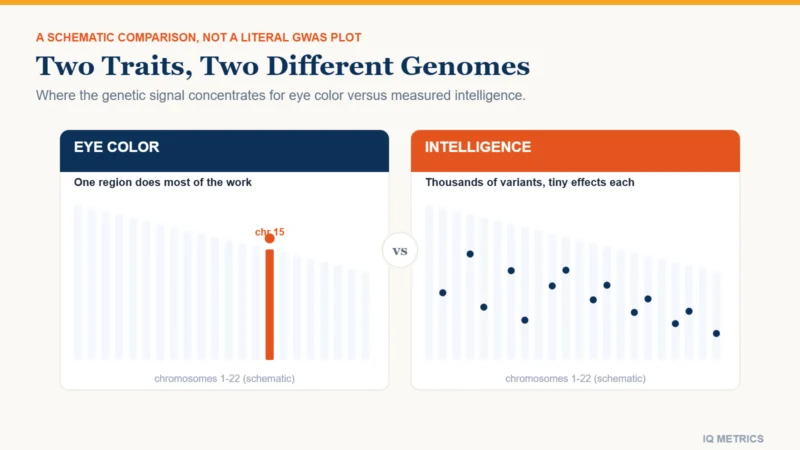
There is no credible study linking eye color to IQ, and the chromosome region that determines eye color has never turned up in a genome-wide study of intelligence. Here is what the genetics actually says, where the pattern people cite really comes from, and how it compares to a correlate that does have real evidence behind it.
 Research & Evidence
Is IQ Genetic?
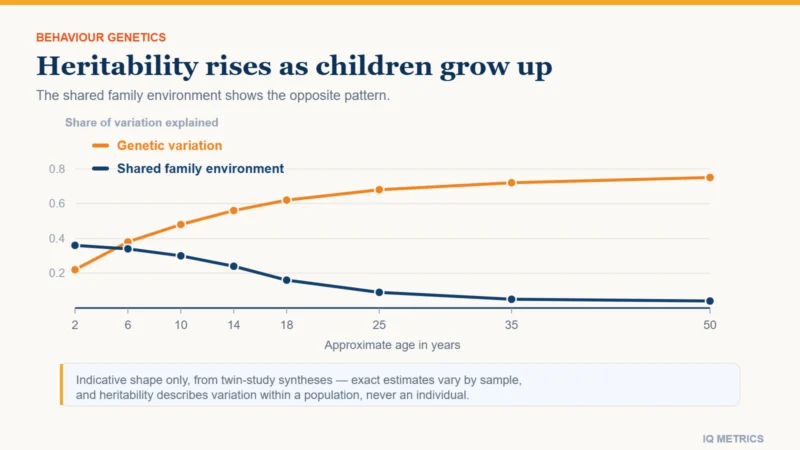
Heritability estimates for IQ rise from roughly 0.4 in childhood to 0.7 or higher in adulthood, which sounds decisive until you know what heritability measures. Here is what twin and adoption studies actually show, and the four conclusions people draw from them that the statistic does not support.