



What Is a Good SHL Test Score? Percentiles, Norm Groups and IQ
SHL says it sets no passing score and its support team cannot give you your result. What its own reports show is a percentile against a named comparison group, with T and Sten scores derived from it.


What you need to know
- SHL does not publish a pass mark. Its candidate support says it does not set any passing scores and that the employer sees the results, so a good score is the employer's own minimum, set against a comparison group the employer chooses.
- An SHL result is a percentile against a named, dated comparison group, with a T-score (mean 50, SD 10) and a Sten score (mean 5.5, SD 2). Every trio in the sample reports we read, such as 87th percentile, T 61, Sten 8, matches a normal curve, so T and Sten add nothing beyond the percentile.
- Each candidate gets a different set of questions, and SHL's own report says hit rate does not map directly to percentile: a lower hit rate can give a higher percentile. So a count of correct answers cannot be turned into a result.
- Prep-site cut-offs (50th to 70th percentile, 50th to 60th, top 20 per cent) cite no SHL document and disagree. SHL's samples call the 46th to 68th percentile average and the 76th and 87th above average. The SHL fact sheets and sample reports we read never use the word IQ.
There is no single good SHL score. SHL says it does not set passing scores, its support team cannot give you your result, and what an employer receives is a percentile against a named comparison group, with a T-score and a Sten score derived from it. The 50th-to-70th-percentile targets in circulation come from test-preparation sites that cite no SHL document. This guide sets out what SHL's own fact sheets, sample reports and support articles say, checks its reported scores against a normal curve, and explains why an SHL result is not an IQ.
Which SHL ability tests are there, and how long do they take?
SHL sells a family of ability tests under the Verify name, and its fact sheets list a different question count and time limit for each. The generation matters, because fact sheets for tests with near-identical names give different counts.
- Verify Interactive Numerical Reasoning: up to 10 questions, 18 minutes
- Verify Interactive Deductive Reasoning: up to 12 questions, 18 minutes
- Verify Interactive Inductive Reasoning: up to 15 questions, 18 minutes
- Verify Interactive G+: up to 24 questions, 36 minutes
- Verify Interactive Numerical Calculation: up to 12 questions, 10 minutes
- Verify G+ (multiple choice): 30 questions, 10 for each of three abilities, up to 36 minutes
- Verify Numerical Ability: up to 16 questions, 20 minutes
- Verify Verbal Ability: up to 18 questions, 15 minutes
- Verify Checking: 50 questions, 5 minutes
The Interactive fact sheets say those tests use computer-adaptive technology, which shortens testing time. SHL's older sample reports show different counts: a 2018 report has the candidate attempting 24 inductive, 18 numerical and 30 verbal questions. A count quoted from one generation does not describe another, so check which test your employer has actually sent. The skills involved, interpreting numerical data and evaluating written passages, are ones our numerical and verbal IQ tests cover in general terms.
How is an SHL test scored?
The score an employer sees is a percentile. SHL's sample report puts it plainly: a percentile of 50 means the person did better than 50 per cent of the people in the comparison group. The group is named on the report and carries a year, for example Interactive G+ General Composite (INT) v1, Verify G Plus General Population (INT) 2016, General Population 2006 for numerical and verbal reasoning, and General Population 2007 for inductive. Two levels appear in the samples, Graduate/University and Operational. SHL adds a T-score, a standardised score with a mean of 50 and a standard deviation of 10, and a Sten score on a 10-point scale with a mean of 5.5 and a standard deviation of 2, and says both are provided for users trained to interpret them.
We checked the printed scores against a normal curve, and they match. Every percentile, T-score and Sten trio in the SHL sample reports we read is what a normal-curve conversion gives: 28th percentile, T 44, Sten 4; 46th, T 49, Sten 5; 50th, T 50, Sten 6; 63rd, T 53, Sten 6; 68th, T 55, Sten 6; 87th, T 61, Sten 8. So T and Sten add no information beyond the percentile. They re-express it, using the same arithmetic as our guide to z-scores. SHL rounds a Sten of 5.5, the exact middle, up to 6, which is why a 50th percentile prints as Sten 6.
- Sten 1: below the 2.3rd percentile
- Sten 2: 2.3rd to 6.7th
- Sten 3: 6.7th to 15.9th
- Sten 4: 15.9th to 30.9th
- Sten 5: 30.9th to 50th
- Sten 6: 50th to 69.1st
- Sten 7: 69.1st to 84.1st
- Sten 8: 84.1st to 93.3rd
- Sten 9: 93.3rd to 97.7th
- Sten 10: above the 97.7th
Those bands are our arithmetic from SHL's stated mean and standard deviation, and they show why Sten 5 to 6 covers roughly the 31st to the 69th percentile. One more warning comes from SHL itself. Its Verify ability report lists a hit rate, the share of attempted questions answered correctly, next to the percentile, and says that because each candidate receives a different set of items there is no direct correlation between hit rate and percentile: someone with a lower hit rate may achieve a higher percentile. In the 2018 sample, 83 per cent (15 of 18) on numerical reasoning came with the 87th percentile and 67 per cent (16 of 24) on inductive reasoning with the 67th, each against its own comparison group. So "I got 15 right" cannot be turned into a result.
What is a good SHL score?
SHL's candidate support says: "SHL doesn't set any passing scores for tests." It advises asking the recruiter or the company you sat the assessment for. The employer chooses both the comparison group and the cut-off. SHL's sample reports do describe percentiles in words: the 28th percentile is called below average, the 46th to the 68th average, and the 76th and 87th above average. Those are wordings in sample reports, not a published rule, but they show where SHL's own text puts average, a wide band around the middle, with above average starting somewhere between the 68th and 76th percentile.
Test-preparation sites give firmer numbers, and they disagree. CareerTestPrep says most employers set their cut score between the 50th and 70th percentile and suggests aiming for the 70th, on the basis of candidate reports and industry data. Intervyo gives a 50th to 60th standard cut-off for general corporate schemes and a 70th to 85th target for top-tier employers. JobTestPrep's UK site says that being in the top 20 per cent of your norm group should be enough to pass, and gives its own experience as the basis. None cites an SHL document. A fourth prep site, Reasoning Campus, cites SHL's support page and says no single percentile can honestly be called a universally good SHL score.
The practical reading is the one SHL's own report gives. A percentile is a rank within a group, so the same performance can land at different percentiles against different comparison groups, and the number that decides your result is the employer's minimum for the role. Ask the recruiter what it is.
Can an SHL result be turned into an IQ?
Not by SHL. The words IQ and intelligence do not appear in the SHL fact sheets and sample reports we read. Its sample report says cognitive ability is the most effective single predictor of future performance in many jobs, while adding that many other factors matter too, and the Interactive G+ fact sheet says candidates receive a score on each specific ability and a general ability score. That general score is SHL's nearest thing to g, but it is reported as a percentile, not an IQ.
A percentile can be put on the IQ scale, mean 100 and standard deviation 15, with the same arithmetic our score converter uses. That gives the translations below. They are standard-score translations, not IQs, because the comparison group is whatever SHL or the employer chose. We could not find the size or make-up of the Verify comparison groups in the documents we could open, and a percentile against applicants says nothing about where you stand among everyone. Our guides to the CCAT and the Wonderlic make the same point about those tests.
- 16th percentile: T 40, Sten 3.5, IQ scale 85
- 31st percentile: T 45, Sten 4.5, IQ scale 92.5
- 50th percentile: T 50, Sten 5.5, IQ scale 100
- 69th percentile: T 55, Sten 6.5, IQ scale 107.5
- 84th percentile: T 60, Sten 7.5, IQ scale 115
- 97.7th percentile: T 70, Sten 9.5, IQ scale 130
An SHL result is a percentile against a named group, and SHL says it sets no passing score: the number that matters is your employer's minimum.
What is the SHL verification test?
SHL's 2018 sample report explains that a result from a test taken without supervision can be confirmed by a shorter Verification Test. The report says the verification test is shorter than the original, must be given in a supervised setting, and decides whether the original result is Verified or Not Verified. A Verified result can be used with confidence, SHL says, and giving a supervised verification test is the most consistent way to check the original result and strongly recommended. The final decision on how to confirm and use results, it adds, should follow the employer's own policies.
We could not find how SHL compares the two results, how long the verification test is, or what employers do after a Not Verified result. The 2019 Interactive sample reports we read list other ways to check a result and leave the verification line out, so do not assume every SHL test comes with one. Our guides to AI agents and proctored hiring tests and the practice effect cover why unsupervised tests invite this check.
How long do SHL results take, and can you see them?
SHL's support articles say the recruiter receives your results once you have completed all the assessments listed on your assessment home screen, and that results are not processed until they are all done. SHL support cannot give you the results: the employer is the controller of your personal data, so SHL cannot give feedback on candidate results, though it can confirm whether you completed the tests. How long the employer takes to look is the employer's business; one prep-site page puts rolling review at two to five business days, which describes employer review and is not an SHL figure.
The one report you can see is from SHL's practice site, and it is a different thing: it gives your score as a percentage of the questions you answered correctly, not the percentile an employer sees. SHL says extra test time needs the employer's approval and that a calculator is allowed unless you are told otherwise. We found no SHL statement on how long a result stays valid or how many retakes are allowed, and the claims of 12 months and no retakes on prep sites are unsourced.
How should you use an SHL result?
Three habits help. Ask the recruiter which comparison group your percentile is measured against and whether a minimum applies to the role. Read Sten and T-scores as another way of stating the same percentile. And keep the result in proportion: SHL's own report stresses that cognitive ability is one predictor among many, and employers are expected to check that a cut score does not screen out one group at a much higher rate, as our guides to whether IQ tests are legal for hiring and the four-fifths rule explain.
Where would your own score land?
Want a result on the standard IQ scale, with its percentile? Take the IQ Metrics test.
Find your IQ score now! →SHL's tests place you within a group the employer chose. The IQ Metrics test reports a score on the standard IQ scale and its percentile, and the percentile calculator translates between the two. Our guide to what a cognitive test score predicts at work covers the wider evidence, and our guide to the Watson-Glaser test covers another test used by graduate employers. The Predictive Index Cognitive Assessment reports a scaled score from 100 to 450 and has dropped percentiles from its software; see our guide to what a good PI score is.
Common questions
What is a good SHL score?
There is no universal good SHL score. SHL says it does not set passing scores, so a good score is the minimum percentile your employer sets against its chosen comparison group. SHL's sample reports call roughly the 46th to 68th percentile average and the 76th and above above average.
How are SHL tests scored?
SHL reports a percentile against a named comparison group, with a T-score (mean 50, standard deviation 10) and a Sten score (mean 5.5, standard deviation 2). A percentile of 50 means you did better than half of that group.
How long do SHL results take?
SHL says the recruiter receives your results once you have completed all the assessments on your home screen. How quickly the employer reviews them is up to the employer, and SHL support cannot provide your results.
Can you see your SHL score?
Not from SHL. Its support team says the employer controls the results and SHL cannot provide them. The practice site gives a report as a percentage of questions answered correctly, which is not the percentile an employer sees.
Sources for this story
- SHL Verify Interactive Report, sample (February 2019) — SHL
- SHL Verify Interactive G+ Report, sample (April 2019) — SHL
- SHL Verify Ability Test Report v2.0, sample (September 2018) — SHL
- SHL candidate support articles: pass marks, results and practice reports — SHL Support
- SHL Verify product fact sheets (2018 to 2022) — SHL
- What is a good SHL score? (2026) — CareerTestPrep
Corrections: spotted an error? Email corrections@iqmetrics.org and we will update this story and note the change here.
Related stories
All news →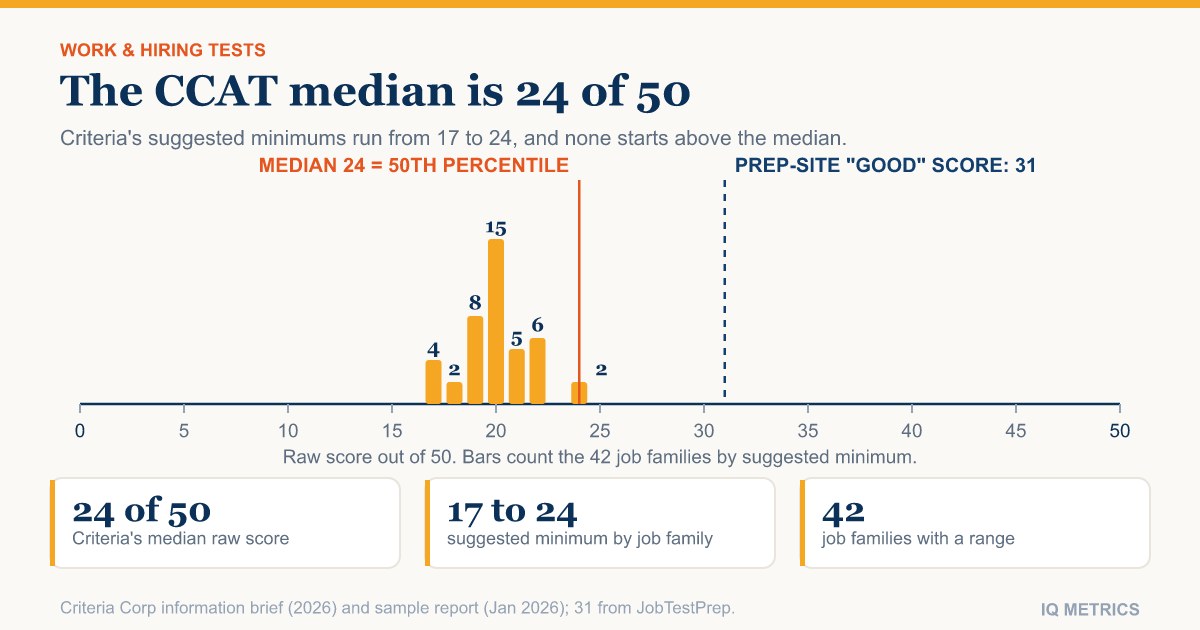
What Is a Good CCAT Score? Average, Range and the IQ Question
Criteria publishes a median of 24 out of 50 and suggested minimums that run from 17 to 24 by job. The 30-plus targets and IQ tables that circulate online appear on prep sites, not in the Criteria documents we read.
What a Cognitive Ability Test at Work Actually Predicts
Aptitude tests are among the better-studied hiring tools, and for decades the headline validity figures were quoted with more confidence than the corrections behind them deserved. A 2022 reanalysis pulled those numbers down.

What Is a Good Predictive Index Cognitive Assessment Score?
PI scores run from 100 to 450, and its own blog says the average of 250 is about 20 of 50 questions right. PI says it is not a test you pass or fail, no longer shows percentiles, and does not measure IQ.
Read the research.
Then find your own number.
Our IIF-certified assessment reports your score with its scale, percentile and confidence range — and a breakdown of the cognitive domains behind it.
Start IQ Test →