



What Is a Good CCAT Score? Average, Range and the IQ Question
Criteria publishes a median of 24 out of 50 and suggested minimums that run from 17 to 24 by job. The 30-plus targets and IQ tables that circulate online appear on prep sites, not in the Criteria documents we read.

What you need to know
- Criteria's 2026 information brief reports a normative sample of 106,740 adults, a median CCAT score of 24 out of 50 and a standard deviation of 7.00. Criteria's product page gives a mean of 24.2 and a standard deviation of 8.58 from 985 people. Its sample report puts a raw 24 at the 50th percentile.
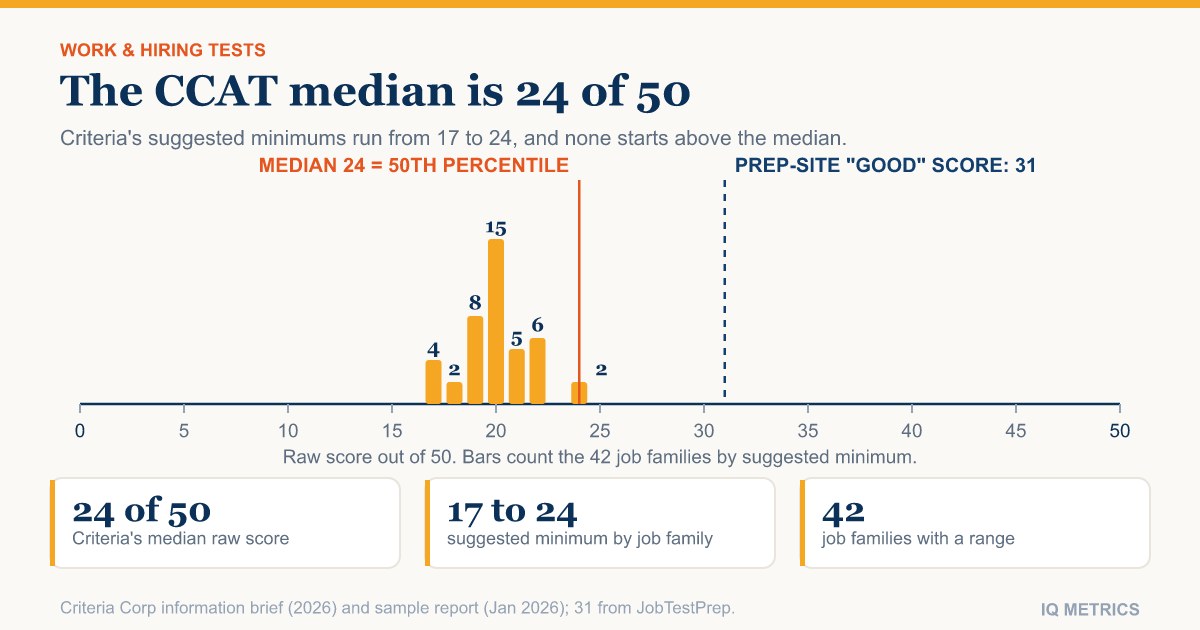
- There is no universal passing score. Criteria's sample report lists suggested minimums for 42 job families: 17 for customer service, retail and sales representatives, 20 for software development and management, 22 for engineering and medicine, 24 for legal and data analytics. Employers can set their own.
- Criteria's documents never use the word IQ. They report correlations of .78 with the Wonderlic (34 people) and .55 with the Minicog battery (355 people) but no Wechsler comparison, so any CCAT-to-IQ table is a third party's estimate.
- Prep-site tables disagree with Criteria and with each other: one puts a raw 24 at the 32nd percentile, another at the 50th. On a normal curve with Criteria's median and SD of 7.00, a 30 is about the 80th percentile, or about the 76th with the product page's SD of 8.58.
There is no single good CCAT score. Criteria Corp, which publishes the Criteria Cognitive Aptitude Test, reports a median of 24 correct answers out of 50, and the suggested minimums in its own sample report run from 17 to 24 depending on the job. Advice to aim for the 30s comes from test-prep sites; we found none in Criteria's own documents. This guide sets out what Criteria publishes, where the figures in circulation disagree with it, and why a CCAT result is not an IQ.
What is the CCAT and how is it scored?
The CCAT is a pre-employment test of what Criteria calls cognitive aptitude. Its candidate page says it has 50 questions, a 15-minute limit and three kinds of question: verbal, maths and logic, and spatial reasoning. That is 18 seconds a question. The same page says there is no penalty for wrong answers, so a guess when time runs short costs nothing.
The result is a raw score, the number of questions answered correctly out of 50, plus a percentile. Criteria says employers are sent both, the percentile being how you did "compared to everyone else who's taken the test", and its score report adds a percentile for each of the three areas. Our guide to the OnlineJobs.ph hiring test covers the format in more detail, and our timed IQ test shows how a hard time limit changes the feel of a test.
What is the average CCAT score?
Criteria says the average test taker gets 24 questions right, and its current information brief gives the detail. The normative group, the people whose scores define the percentiles, is 106,740 adults aged 18 and over: job applicants and current employees from hundreds of companies. The median score is 24 and the standard deviation is 7.00. The standard deviation is the typical distance of a score from the middle; on a bell curve about two-thirds of people fall within one of it, which here means roughly 17 to 31 correct.
Criteria's own product page gives different figures: a mean of 24.2, a median of 24 and a standard deviation of 8.58, from a sample of 985 people. The two documents agree on the middle and disagree on the spread, and the spread decides how far a score such as 30 sits above the crowd. Criteria's sample report agrees on the middle: a raw 24 is a percentile rank of 50, meaning the candidate scored "better than 50%" of the people who have taken the test.
Criteria does not publish a table that converts each raw score to a percentile. Its score report draws the raw score on a normal curve, so treating scores as normally distributed gives the estimates below, once for each published standard deviation.
- Raw 17: about the 16th percentile (SD 7.00) or the 21st (SD 8.58)
- Raw 20: about the 28th or the 32nd
- Raw 24: the 50th in both
- Raw 28: about the 72nd or the 68th
- Raw 30: about the 80th or the 76th
- Raw 35: about the 94th or the 90th
- Raw 40: about the 99th or the 97th
- Raw 45: the 99th or higher in both
These are our calculations, not Criteria's. They carry two cautions: real scores only approximate a normal curve, and the percentile is a rank among people who take the CCAT, who are job seekers and employees, not among the whole population. Our guide to z-scores shows the arithmetic, and the percentile calculator does the same sum on the IQ scale.
What is a good or passing CCAT score?
Criteria does not set a pass mark. Its information brief describes suggested score ranges for roles, based on large samples of applicants and employees, and says employers can build their own from their own data. The sample report, dated January 2026, lists suggested ranges for 42 job families, and Criteria says they are calculated from more than 700,000 CCAT assessments. Every range runs from a minimum up to the top score of 50, so the minimum is the number that matters.
- Minimum 24: Data Analytics and Statistics; Legal
- Minimum 22: Analyst; Engineering; Finance Manager; Medicine and Healthcare; Science and Research; Senior and Executive Leadership
- Minimum 21: HR Manager; IT and Computing Systems; Marketing and Product; Nursing; Project Manager
- Minimum 20: 15 families, including Accounting, Education, Management, Sales Manager and Software Development
- Minimum 19: Art and Design; Customer Service Manager; Emergency and Protective; Medical Assistance; Office and Administrative Support; Paralegal and Legal Support; Production Manager / Supervisor; Sales / Account Executive
- Minimum 18: Plant Operator; Store Manager
- Minimum 17: Customer Service Representative; Retail Sales; Sales Representative; Service Technician
Only two of the 42 families have a suggested minimum equal to the median of 24. The most common minimum, 20, sits near the 28th percentile on our estimate, and the lowest, 17, near the 16th. No suggested range starts above 24. That sits awkwardly with what prep sites say. JobTestPrep states that a score of around 31 "is generally considered good" and puts a candidate in the top 20 per cent. PrepCCAT's table puts a 24 at the 32nd percentile and a 30 at the 56th, which contradicts Criteria's own 50th percentile for a 24, and although it says its values rest on published norming data, it does not name the data.
Employers can set higher bars than Criteria suggests, and some do. Hack Reactor, a coding school, wrote in 2022 that it compares each score with the suggested range Criteria provides, that "as long as your score falls anywhere within that range, you pass", and that it had seen an approximately 80% pass rate since it began requiring the test. So the number to find out is your prospective employer's range, not a percentile from a table.
Is a CCAT score an IQ? Can you convert it?
No. The words IQ, Wechsler, WAIS and WISC appear in none of the Criteria documents we read: the information brief, the score report guide and the sample report. Criteria calls the CCAT a measure of cognitive aptitude, "often referred to as general intelligence or g", and reports its scores as a raw count and a percentile against its own norm group, not on an IQ scale. GMAC reports the GMAT the same way, as percentiles among test takers with no IQ conversion; see GMAT score to IQ.
What Criteria does publish are correlations with other tests. Among 34 people who took both the CCAT and the Wonderlic Personnel Test, the correlation was .78; among 355 who took both the CCAT and the Minicog Rapid Assessment Battery, it was .55. Those are substantial links but small samples, and neither test is a Wechsler scale, so nothing there lets anyone read a CCAT score as an IQ. Criteria also reports that the CCAT correlated .33 with training-period performance in 745 sales representatives and .44 with supervisor ratings in 42 social workers. A correlation of .33 accounts for about 11 per cent of the variation and .44 for about 19 per cent, which is the sort of evidence covered in our piece on what a cognitive ability test at work predicts.
If you still want a rough picture, a percentile can be put on the IQ scale, which has a mean of 100 and a standard deviation of 15. A raw 30 is about the 80th percentile among CCAT takers with an SD of 7.00, which on the IQ scale is about 113; a 35 is about 124 and a 40 about 134. With the SD of 8.58 the same scores come out at about 110, 119 and 128. That is a standard-score translation, not an IQ, because the reference group is applicants and employees, and nobody can say whether that group scores above or below the general population. For a UK test that reports bands from Low to High, see our guide to the Thomas GIA.
Criteria publishes the middle and the spread of CCAT scores, never an IQ, so any CCAT-to-IQ table is someone's arithmetic, not Criteria's.
How does the CCAT compare with the Wonderlic?
Both are timed, 50-question tests of general mental ability used in hiring, and Criteria's brief reports the .78 correlation above. The practical differences are the clock, 15 minutes for the CCAT against 12 for the Wonderlic cognitive block, and the reporting: the current Wonderlic test no longer gives a single cognitive number, while the CCAT still reports a raw score and a percentile. Because each is scored against its own norm group, a raw score from one cannot be read across to the other. Our guides to a good Wonderlic score and to Wonderlic score to IQ take the same approach.
Does practice raise a CCAT score?
Some, and Criteria has built in a check. Its score report guide says a result is marked invalid when the system decides a candidate has taken a particular version of the CCAT before, judging by the speed and accuracy of the responses: a candidate who moves through too quickly and without error is treated as already familiar with the test. More generally, our guide to the practice effect puts a second sitting at around a quarter of a standard deviation higher on average. Practising on different material is the safer route. Our numerical, verbal and spatial tests use the same three kinds of question, though not CCAT items, and our Wonderlic practice test gives a 12-minute timed run.
What should you do with a CCAT result?
Three habits help. Ask the employer whether a suggested range or a cut score applies to the role, because that number, not the percentile, decides the outcome. Ask which group the percentile compares you with. And keep the result in proportion: employers are expected to check that a cut score does not screen out one group at a much higher rate, as our guides to whether IQ tests are legal for hiring and the four-fifths rule explain.
Where would your own score land?
Want a score that comes with its scale? Take the IQ Metrics test and see your IQ with its percentile.
Find your IQ score now! →A CCAT score is a data point in one employer's decision, measured against a norm group of job seekers, not a rank in the general population. The IQ Metrics test reports a score on the standard IQ scale, and the score converter translates between published scales when a test has norms to convert with. Our guide to professional IQ tests shows where hiring tests sit among them. SHL's Verify tests report a percentile against a named comparison group rather than a raw score, as our guide to what a good SHL score is explains, and our guide to the Watson-Glaser test covers the critical thinking test used in law-firm hiring. The Predictive Index Cognitive Assessment is another 12-minute employer test with no public pass mark; see our guide to what a good PI score is.
Common questions
What is a good CCAT score?
There is no universal good score. Criteria reports a median of 24 out of 50, and the suggested minimums in its sample report run from 17 to 24 by job family, with 20 the most common. Employers can set their own range.
What is the average CCAT score?
Criteria's information brief gives a median of 24 out of 50 and a standard deviation of 7.00 for a norm group of 106,740 adults. Criteria's product page gives a mean of 24.2 and a standard deviation of 8.58 from a sample of 985.
How many questions is the CCAT and how long does it take?
The CCAT has 50 questions and a 15-minute limit, in three kinds: verbal, maths and logic, and spatial reasoning. Criteria says there is no penalty for wrong answers.
Can you convert a CCAT score to an IQ?
Not officially. Criteria reports a raw score and a percentile against its own norm group and publishes no IQ conversion, so any CCAT-to-IQ table is a third party's estimate.
Sources for this story
- Criteria Cognitive Aptitude Test (CCAT) information brief (PDF, 2026) — Criteria Corp
- Criteria Cognitive Aptitude Test (CCAT) product page — Criteria Corp
- CCAT score report guide (PDF) — Criteria Corp
- Sample CCAT candidate score report with suggested score ranges by position (PDF, January 2026) — Criteria Corp
- CCAT candidate page: question types, timing and scoring — Criteria Corp
- The CCAT: why we use it and how you can prepare (4 December 2022) — Hack Reactor
Corrections: spotted an error? Email corrections@iqmetrics.org and we will update this story and note the change here.
Related stories
All news →
What Is a Good Wonderlic Score? By Job and NFL Position
Wonderlic says its current test has no universal good score. The numbers people quote, from 20 as average to 26 for NFL tackles, come from the older number-correct test and a 1984 book.
What a Cognitive Ability Test at Work Actually Predicts
Aptitude tests are among the better-studied hiring tools, and for decades the headline validity figures were quoted with more confidence than the corrections behind them deserved. A 2022 reanalysis pulled those numbers down.

Average IQ of Software Engineers: What the Research Actually Measured
Pages say the average software engineer has an IQ of 120 or 130, but we found no study that measured it. A 2026 coding-puzzle study, a 2021 code-comprehension study and O*NET's ability ratings show what has been measured instead.
Read the research.
Then find your own number.
Our IIF-certified assessment reports your score with its scale, percentile and confidence range — and a breakdown of the cognitive domains behind it.
Start IQ Test →