


Are Night Owls Smarter? What the Chronotype Studies Show
The famous study behind the claim measured a vocabulary score in teenagers and self-reported bedtimes years later, and found a gap of about 7 minutes per 15 IQ points. Larger studies show a small link at most, and test timing can change a score more than chronotype does.

What you need to know
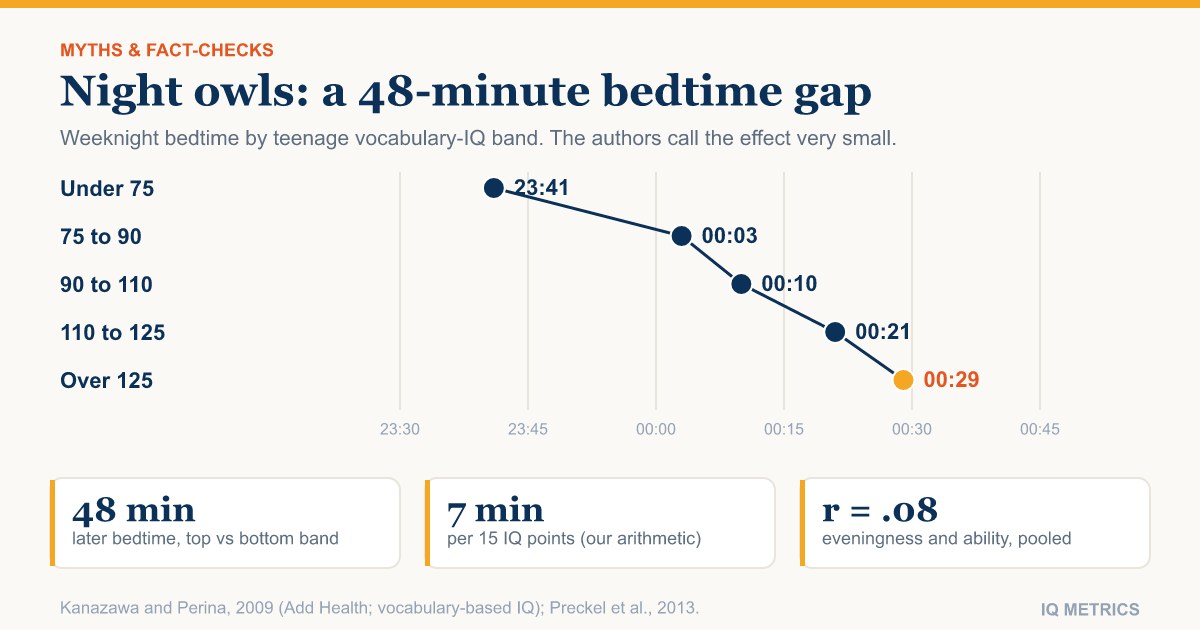
- The 2009 paper behind "night owls are more intelligent" measured intelligence with a vocabulary test taken in adolescence and sleep with self-reported bedtimes at ages 18 to 28. People in the top band (over 125) went to bed at 00:29 on weeknights against 23:41 in the bottom band (under 75), about 7 minutes per 15 IQ points after controls (our arithmetic). The authors call the effect size and explained variance "very small".
- A meta-analysis summarised by its own authors found eveningness correlated r = .08 with cognitive ability and morningness r = -.04, yet eveningness correlated r = -.14 with academic achievement and morningness r = .16. Owls may score a hair higher on ability tests and still earn lower grades.
- The largest recent study, of 26,820 UK Biobank participants aged 53 to 86, found evening types scored 0.135 and 0.075 standard deviations above morning types in two cohorts, with intermediate types nearly as high. It is cross-sectional, rests on one self-report question and did not adjust for education, so it cannot show that being an owl raises cognition.
- Test timing matters at least as much as chronotype. In 198 students, evening types did clearly worse on a crystallized-intelligence test at 8:00 (Cohen's d = .94 between the extreme groups) but not in the afternoon, and an earlier adolescent study reported a 6-point IQ-estimate difference when test time and body clock mismatched.
No. Night owls are not reliably smarter than early birds. Large studies find a small link between later sleep timing and cognitive test scores, and the best-known study behind the headlines used a vocabulary test and self-reported bedtimes rather than IQ and a body-clock measure. Whether you are an owl or a lark matters less for an IQ test than when in the day you sit it.
Where does the "night owls are smarter" claim come from?
Most coverage traces back to Satoshi Kanazawa and Kaja Perina, who published "Why night owls are more intelligent" in Personality and Individual Differences in 2009. They used Add Health, a US study that interviewed 20,745 adolescents in 1994 to 1995 and followed 15,197 of them in 2001 to 2002, when they were 18 to 28. Intelligence came from the Peabody Picture Vocabulary Test, converted to an IQ metric, taken in adolescence. Sleep came from four self-reported times: wake-up and bedtime on days with a fixed schedule and on days without one.
Two details are rarely repeated. The direction tested was adolescent vocabulary score predicting adult bedtime, not late bedtime predicting a higher score. And about one in five bedtime answers (20.2% on weeknights) were given as noon or half past noon, which the authors treated as a midnight mix-up and recoded. The paper also admits the vocabulary test is "a valid measure of verbal intelligence, not general intelligence", and that it has no direct chronotype measure. For why vocabulary behaves like a proxy for general ability, see our piece on vocabulary size and IQ.
How big is the night-owl gap in that study?
By the paper's weeknight figures, average bedtime rose with childhood IQ band:
- Very dull (under 75): 23:41
- Dull (75 to 90): 00:03
- Normal (90 to 110): 00:10
- Bright (110 to 125): 00:21
- Very bright (over 125): 00:29
That is 48 minutes between the top and bottom bands, and the two top bands did not differ significantly from each other on weeknights. After controls for age, sex, race, education, earnings, religion and hours worked, each IQ point was linked to 0.008 hours of later weeknight bedtime. Multiplied by 15, that is about 7 minutes per standard deviation of IQ, our arithmetic from the paper's coefficient. A standardised coefficient of .04 means IQ accounts for roughly 0.2% of the variation in bedtime, and the effect on weekend wake-up time was not significant. The authors describe the effect size and the explained variance as "very small".
Their explanation, the Savanna-IQ interaction hypothesis, says more intelligent people adopt evolutionarily novel habits, and they offer the lack of nocturnal activity in an encyclopedia of traditional cultures as evidence that night life is novel. That is an interpretation of the pattern, not something the data test.
What do larger and newer studies show?
An earlier study by Roberts and Kyllonen (1999), of 420 US Air Force recruits, also found evening types more likely to have higher intelligence scores. Later authors note that the group was skewed toward morningness, since recruits had spent six weeks on a uniform sleep schedule, and that its tests were given at different times of day. We read only its abstract.
The most useful summary is the 2011 meta-analysis by Preckel and colleagues, whose numbers we take from the same authors' 2013 paper. Eveningness correlated r = .08 with cognitive ability and morningness r = -.04, both small. For academic achievement the signs flip: morningness r = .16 across 13 studies and eveningness r = -.14 across 6. An r of .08 explains under 1% of the variance, so the ability edge for owls is tiny.
The biggest recent dataset is UK Biobank. West and colleagues at Imperial College London analysed 26,820 people aged 53 to 86 in 2024. On a global score from tests of reasoning, pairs matching, reaction time and prospective memory, evening types scored 0.135 standard deviations above morning types in one cohort (10,067 people) and 0.075 in the other (16,753), and intermediate types were close behind (0.106 and 0.063). On the usual scale that is roughly 2 and 1 IQ points, our arithmetic and not the authors', and these are mixed cognitive tests rather than an IQ test. The gap is as much about morning types scoring lowest as about owls scoring highest. The study is cross-sectional, uses one self-report question for chronotype and did not adjust for education, so it cannot say that being an owl causes better scores.
Smaller 2025 and 2026 papers point both ways, and we read only their abstracts. A 2026 study of 75 young adults in Experimental Brain Research found early chronotypes had shorter reaction times and fewer errors, especially in the morning. A 2025 study of 666 people found evening types reported more everyday memory lapses.
Night owls are not reliably smarter: the studies show a tiny link at most, and it depends on the test, the age and the hour.
Why do night owls often get lower grades?
Grades reward showing up on time and other habits as well as ability. In a 2013 study of 272 German school students, eveningness predicted lower grade-point averages even after controlling for cognitive ability, conscientiousness and motivation, and chronotype was unrelated to cognitive ability in that sample. A 2014 study of undergraduates at Semmelweis University in Hungary (grades available for 247 of 753) found social jetlag, the gap between school-day and days-off sleep timing, lowered weekly average grades during term but not in the exam period, when students set their own hours. And when Seattle delayed its high-school start by nearly an hour, students slept a median 34 minutes longer and median grades rose 4.5% (Dunster and colleagues, 2018). That study covers all teenagers, not only owls, but it shows how much of a grade gap can be schedule rather than ability.
Does the time of day change an IQ-test score?
It can, mostly when your sitting clashes with your body clock. The synchrony effect is the idea that people perform best at their preferred time of day. In a 2023 study, Jankowski and colleagues tested 198 final-year students at 8:00 or around 13:00. Morning types beat evening types on a crystallized-intelligence test in the morning class (R² = .11, Cohen's d = .94, comparing the extreme groups) and not in the afternoon (d = .11). They saw no significant effect for fluid intelligence. An earlier adolescent study, by Goldstein and colleagues in 2007, found the opposite split: a synchrony effect on fluid measures, and a composite of Block Design, Digit Span and Vocabulary that worked out as a 6-point difference in IQ estimates between matched and mismatched times.
The two studies disagree on which ability is affected, and both are small, but the practical message is the same: sit a timed test when you are alert. Our pieces on sleep loss and test performance and on caffeine and test performance show other conditions that move a score, and our guide to what affects IQ test results and the page on sleep and IQ cover the rest. Repeat sittings matter too, as we explain in the practice effect on cognitive tests.
What does the claim get wrong?
- It says night owls have higher IQs, but the famous study used a vocabulary test, and its authors say it measures verbal, not general, intelligence
- It treats late bedtime as the cause, but the study predicted adult bedtime from adolescent score, and the UK Biobank work is cross-sectional
- It implies a big gap, but the effect sizes are very small: r = .08, 7 minutes per 15 IQ points, 0.075 to 0.135 SD
- It overlooks grades, where larks have the edge (r = .16 versus r = -.14)
- It forgets test time: evening types did worse on an 8:00 test in one study, which says nothing about their ability at their best hour
A fair summary is that chronotype and cognition are weakly related, in a direction that depends on the measure. If you are an owl, it does not predict a higher IQ, and if you are a lark, it does not predict a lower one. For comparison with other popular claims, read our fact-checks on the breakfast question and on zodiac signs and IQ.
What should you do before an IQ test?
- Pick a time you are normally alert, and avoid sitting a timed test at your sleepiest hour
- Sleep your usual amount the night before rather than trying to shift your body clock
- Treat any score as a range, not a point, using the margin of error in your report
- Do not read a single result as a verdict on whether you are a morning or evening thinker
Where would your own score land?
Want a score on the standard IQ scale, with a percentile and a full report? Take the IQ Metrics test at a time when you are alert, and read it against the bell curve.
Find your IQ score now! →To see how your own result sits in the population, take the IQ Metrics test, then check it on the IQ bell curve or the IQ percentile calculator.
Common questions
Are night owls smarter than early birds?
Not reliably. A 2011 meta-analysis found eveningness correlated r = .08 with cognitive ability, which explains under 1% of the variance, and r = -.14 with academic achievement. A 2024 UK Biobank study found evening types scoring 0.075 to 0.135 standard deviations higher than morning types, in a cross-sectional design.
Do night owls have a higher IQ?
The best-known study found a small link between a teenage vocabulary score and later self-reported bedtime, about 7 minutes per 15 IQ points after controls. It measured verbal, not general, intelligence and no chronotype scale, so it does not show a higher IQ in night owls.
Does the time of day affect an IQ test score?
It can when your sitting clashes with your body clock. In one study of 198 students, evening types did clearly worse on a crystallized test at 8:00 (d = .94 between extreme groups) but not in the afternoon. The studies disagree on which ability shows the effect.
Do night owls get worse grades?
On average, yes. A meta-analysis found eveningness correlated r = -.14 with achievement, and a German school study found eveningness predicted lower grades after controlling for cognitive ability. Schedules explain part of this: Seattle's later school start was followed by 4.5% higher median grades.
Sources for this story
- Why night owls are more intelligent. Personality and Individual Differences, 47(7), 685-690 (2009) — Kanazawa and Perina
- Morningness-eveningness and educational outcomes: the lark has an advantage over the owl at high school. British Journal of Educational Psychology, 83, 114-134 (2013), which also summarises the 2011 meta-analysis — Preckel, Lipnevich, Boehme, Brandner, Georgi, Konen, Mursin and Roberts
- Sleep duration, chronotype, health and lifestyle factors affect cognition: a UK Biobank cross-sectional study. BMJ Public Health (2024) — West, Wong, Park, Lee, Ekanayake Mudiyanselage, Liu and Ma
- Time of day, intellectual performance, and behavioral problems in morning versus evening type adolescents (2007); Chronotype, time of day, and performance on intelligence tests in the school setting. Journal of Intelligence, 11(1), 13 (2023) — Goldstein and colleagues; Jankowski, Diaz-Morales and Vollmer
- Social jetlag negatively correlates with academic performance in undergraduates. Chronobiology International (2014); Sleepmore in Seattle. Science Advances, 4(12), eaau6200 (2018) — Haraszti and colleagues; Dunster and colleagues
- Morningness-eveningness and intelligence: early to bed, early to rise will likely make you anything but wise! Personality and Individual Differences, 27(6), 1123-1133 (1999), abstract — Roberts and Kyllonen
Corrections: spotted an error? Email corrections@iqmetrics.org and we will update this story and note the change here.
Related stories
All news →Sleep Loss Changes Test Scores. Which Scores Depends on the Test
A bad night does not lower intelligence. It reliably lowers the things a timed test happens to measure most closely — sustained attention, working memory and speed — while leaving vocabulary and general knowledge comparatively intact.
Does Caffeine Improve Test Performance? Not the Reasoning Part
Caffeine reliably lifts alertness, vigilance and reaction time, most of all in people who are tired. Evidence that it improves reasoning in rested, habitual drinkers is far weaker — and a disputed but substantial share of what it appears to add is a deficit the absence of the last cup created.

Does a Photographic Memory Mean a High IQ? What the Research Shows
Eidetic imagery is found in some children and almost no adults, and it is not photographic. World Memory Championship competitors scored high-average on IQ-type tests, and their feats came from a method anyone can learn.
Read the research.
Then find your own number.
Our IIF-certified assessment reports your score with its scale, percentile and confidence range — and a breakdown of the cognitive domains behind it.
Start IQ Test →