



McKinsey Solve: Is It an IQ Test? What McKinsey Says and What Prep Sites Claim
McKinsey calls Solve a gamified assessment of problem-solving, says no preparation is needed, and publishes no pass mark, score scale or reliability figure. Its 2021 FAQ gave 70 minutes and a percentile range; the 2025 FAQ gives neither. Prep sites fill the gap with game names and timings McKinsey does not print.


What you need to know
- McKinsey's own pages describe Solve as a gamified assessment of problem-solving, say there is no need to prepare, and say results are weighed together with the rest of an application. None of the McKinsey Solve pages we read uses the words IQ, intelligence or cognitive ability, and none gives a pass mark or score scale.
- McKinsey's Solve FAQs changed. The August 2021 version said the game was valid for 70 minutes and that candidates could be told their score and, on request, a percentile range expressed as a quartile. The September 2024 and August 2025 versions say the length is in the invitation email and carry no sentence on sharing a score.
- The only public validity numbers we found come from a 2017 pilot of 527 McKinsey candidates: five construct scores correlated 0.43 to 0.71 with passing McKinsey's old multiple-choice test. The model was fitted to that same pass outcome, and no reliability or job-performance figures were given.
- Prep-site figures (65, 80 or 85 minutes; Redrock Study 35 minutes; which games are retired) are not McKinsey's. The two sites we read disagree on whether Ecosystem Management is still used, and Sea Wolf is the only game name we found on a McKinsey page.
McKinsey Solve is one of the most searched hiring assessments, with suggestions such as "mckinsey solve game 2026" and "mckinsey solve test results", and most of what has been written about it comes from firms that sell preparation. We went to the primary sources instead: McKinsey's careers pages (the interviewing and integrity pages show a last-modified date of 6 October 2026), its Solve FAQs from 2021, 2024 and 2025, three McKinsey blog posts, a conference paper by Imbellus and McKinsey on the pilot, and Roblox's filing with the US Securities and Exchange Commission. The short answer to "is it an IQ test" is that McKinsey does not say, and that what it publishes is thinner than the preparation industry implies.
What does McKinsey say Solve is?
The Solve page on mckinsey.com calls it a gamified assessment created to showcase your problem-solving abilities. The interviewing page says it tests your natural problem-solving abilities. A July 2025 post by the firm's game-based innovation lab says Solve measures analytical thinking and problem-solving as an additional data point in recruiting, that it goes to around 300,000 early-career candidates a year, and names one game: Sea Wolf, in which candidates select and evaluate microbes to clean up contaminated sites. On preparation the firm is consistent: there is no need to prepare. On use of the result it is equally clear: performance is considered together with the rest of the application, and the FAQ answers "No" when asked whether Solve alone decides.
- No applications, websites, AI tools or pre-prepared notes, no recording or screenshots, and no help from others
- Breaches can lead to exclusion, a rescinded offer, restrictions on future applications or legal action
- Candidates may be asked at random to take an extra task in person or to explain their logic
- PC or Mac only, in English, Spanish, Portuguese or Japanese, with the length stated in the invitation email
The ban on AI tools matters because unsupervised online tests are open to candidate-side AI; our report on AI agents and proctored hiring tests covers how employers respond. McKinsey's Solve page states its ban in plain terms.
What has McKinsey stopped saying?
Three versions of the Solve FAQ are public. The August 2021 document said the game was valid for 70 minutes, that outside companies offer coaching but it is not necessary, and that candidates could be given the score they achieved and, on request, a percentile range expressed as a quartile benchmarked against other applicants, though not the maximum score. The September 2024 and August 2025 versions give no minutes, saying the length is outlined in the invitation email, and contain no sentence about sharing a score or percentile range. The 2025 version keeps the no-preparation line, and none of the three says anything on pass marks.
We cannot say the policy changed, only that the wording did. But anyone quoting "70 minutes" or "you can request your quartile" is quoting a 2021 document, and every minute figure now in circulation comes from somewhere else.
Where did Solve come from?
McKinsey says it began working with the start-up Imbellus in 2016, and that the game replaced an in-person, pen-and-paper multiple-choice test. A pilot ran in London in November 2017. McKinsey's January 2018 post counts 520 candidates, its May 2020 post says 500 users, and the Imbellus paper says 527, three counts for one pilot. The 2020 post says the final product was ready for deployment in fall 2019 and that more than 15,000 people in 30 countries had played by then. UCLA's CRESST centre helped identify the skills to measure, according to the 2018 post.
Roblox's quarterly report for the period ended 31 March 2021 says it completed the acquisition of substantially all of the assets of Imbellus on 30 November 2020, a software company that had developed simulation-based cognitive assessments, and values the acquired technology at $11.7 million. McKinsey's 2025 post says its game-based innovation lab became part of the firm when McKinsey acquired Imbellus. Both statements are on the record; neither source explains how both can be true, so we say only that Roblox bought Imbellus's assets and that McKinsey describes the lab as arising from an Imbellus acquisition.
The firm describes what Solve is for. It does not publish what a score is.
What does the only public validity evidence show?
A paper titled "Constructing Cognitive Profiles for Simulation-Based Hiring Assessments" by Rebecca Kantar and colleagues at Imbellus and Keith McNulty of McKinsey is the only source we found with numbers. We could read it only as a copy hosted on a third-party server; it prints no venue and its text places it in 2018, so treat its provenance as unverified. It describes the 2017 pilot: 527 McKinsey candidates, three scenarios, 60 minutes. Scores were mapped to five constructs (critical thinking, decision-making, metacognition, situational awareness and systems thinking) and correlated with passing McKinsey's multiple-choice Problem-Solving Test.
- Situational awareness: r = 0.71
- Systems thinking: r = 0.67
- Critical thinking: r = 0.65; metacognition: r = 0.63
- Decision-making: r = 0.43
Our reading is that these figures are a weaker check than they look. The paper says it fitted a LASSO logistic regression to predict passing the first cognitive screen and kept 26 of 81 item scores. Candidates sat the Problem-Solving Test before the optional game, so that screen is very probably the same test, which would mean the scores were chosen using the outcome they were then correlated with. The pilot was also optional and low-stakes, since candidates were told the game would not affect their recruitment. The paper reports no test-retest or internal-consistency figures and no link to later job performance, and we found none on any McKinsey page. The game went into use in 2019, and the 2025 post speaks of a new version piloted from January 2025 with more than 60,000 people, so nothing here describes today's tasks.
Is Solve an IQ test?
Not by McKinsey's own description, and not by the definition we use. An IQ is a score placed on a scale with a stated mean and standard deviation, against a named norm group, with a published reliability; our guide to how IQ tests work sets that out. Solve publishes no scale, no norm group and no reliability. The Imbellus paper contrasts its approach with traditional standardised cognitive assessments, which it says mainly evaluate content mastery, processing speed and memory, and says its assessments are designed to discount memory and processing speed. It also describes what most cognitive ability tests measure as reasoning, perception, memory, verbal and mathematical ability. At the same time the paper calls its output cognitive profiles and Roblox's filing calls Imbellus products cognitive assessments. A fair summary is a cognitive assessment of problem-solving behaviour whose scoring is not disclosed. How it relates to IQ has not been published.
That matters for the usual argument about cognitive tests in hiring, which rests on validity studies of conventional ability tests; the figures are in our report on what hiring tests measure. Vendors such as SHL and Thomas GIA report results against named norm groups, and the legal side of cognitive testing is covered in are IQ tests legal for hiring. For a score against a PI norm, see what a good Predictive Index score is.
What do prep sites claim that McKinsey does not print?
Prep sites such as Management Consulted (page dated 5 August 2026) and IGotAnOffer (13 August 2026) describe game line-ups and timings: 65 minutes for two games and 80 or 85 for three, Redrock Study at 35 minutes, Sea Wolf at about 30. They disagree with each other. Management Consulted lists Ecosystem Management as the most common game; IGotAnOffer says it is not used anymore, that Redrock replaced the Plant Defense game completely in 2023, and that a third scenario, Sustainable Futures Lab, began rolling out in March 2026. Of all these names, Sea Wolf is the only one we found on a McKinsey page. Neither site prints a pass rate or a retake rule, and McKinsey does not either. Treat all of it as unverified, and treat your invitation email as the only authority on your own assessment.
- Use the length and tasks in your invitation email, not a prep site
- Do not use AI tools, notes or help: McKinsey lists the consequences
- Treat any pass mark, "score needed" or percentile claim as unverified
- Compare scores only within a test that states its norm group
Where would your own score land?
Want a reasoning score tied to a named norm group, with a percentile and a full breakdown? Take the IQ Metrics test and see where your result falls on the same curve used throughout this site.
Find your IQ score now! →Our IQ Metrics test reports a percentile among people, and the IQ percentile calculator shows what any score means as a rank. To practise the kind of reasoning that structured assessments lean on, try our logical reasoning test.
Common questions
Is McKinsey Solve an IQ test?
McKinsey does not call it one. Its pages describe a gamified assessment of problem-solving and none uses the words IQ or intelligence. No scale, norm group or reliability figure is published, which an IQ score requires. The Imbellus paper and Roblox's filing both call the underlying work cognitive assessment, so it is a cognitive measure with undisclosed scoring.
What is a good McKinsey Solve score or pass mark?
McKinsey publishes none. It says Solve is considered together with the rest of an application and does not decide candidacy alone. A 2021 FAQ said candidates could be told their score and, on request, a quartile range; the 2024 and 2025 FAQs we read do not repeat that. Any pass mark you see online is unverified.
Can you prepare for McKinsey Solve?
McKinsey says there is no need to prepare, and that the game needs no business knowledge or gaming experience, with an untimed tutorial at the start of each task. Prep sites sell practice, but no public evidence shows it raises scores. Its only named game on McKinsey pages is Sea Wolf.
Can you use AI or notes in McKinsey Solve?
No. McKinsey's Solve page bars applications, websites, AI tools and pre-prepared notes, bars recording and screenshots, and expects candidates to work alone. Breaches can lead to exclusion, a rescinded offer, restrictions on future applications or legal action. Candidates may also be asked at random to complete a task in person or explain their logic.
Sources for this story
- Solve, McKinsey's assessment game (careers page, read 9 October 2026) — McKinsey & Company
- Solve FAQs: August 2021, September 2024 and August 2025 versions — McKinsey & Company
- From apprenticeship in space to selecting microbes: meet McKinsey's game-based innovation lab (9 July 2025) — McKinsey & Company
- Innovating recruiting through online gaming (May 2020) and Build a reef? Save a species? (January 2018) — McKinsey & Company
- Constructing Cognitive Profiles for Simulation-Based Hiring Assessments (pilot of 527 candidates; copy hosted by a third party, venue unverified) — Imbellus and McKinsey & Company
- Form 10-Q for the quarter ended 31 March 2021, note on the Imbellus acquisition — Roblox Corporation (SEC)
Corrections: spotted an error? Email corrections@iqmetrics.org and we will update this story and note the change here.
Related stories
All news →Hiring Tests Assumed the Candidate Was Alone. That Assumption Is Gone
Frontier models now operate a computer well enough to sit an assessment alongside a candidate. Across 19,368 AI-led interviews, 38.5 per cent were flagged for AI assistance.

The OnlineJobs.ph IQ Test: What Hiring Tests Measure and What They Don’t
OnlineJobs.ph’s own test pages could not be opened for this article, so this piece covers what can be checked: how the cognitive tests employers use are built and scored, why a score is not an IQ, and what research says a score predicts.
What Is a Good Thomas GIA Score? Percentiles and IQ
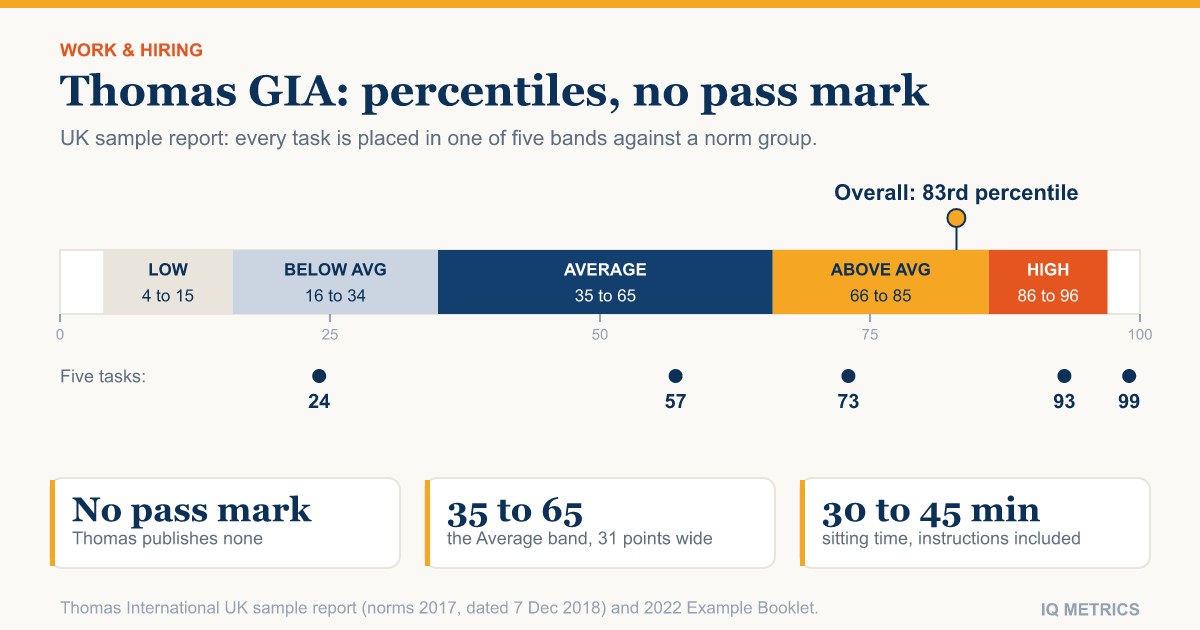
Thomas International's GIA has five timed tasks and reports percentiles against a UK norm group, with no pass mark. Its report calls the overall percentile an estimate of general intelligence, yet Thomas publishes no IQ conversion, no norm size and no reliability figure.
Read the research.
Then find your own number.
Our IIF-certified assessment reports your score with its scale, percentile and confidence range — and a breakdown of the cognitive domains behind it.
Start IQ Test →