



What Is a Good Thomas GIA Score? Percentiles and IQ
Thomas International's GIA has five timed tasks and reports percentiles against a UK norm group, with no pass mark. Its report calls the overall percentile an estimate of general intelligence, yet Thomas publishes no IQ conversion, no norm size and no reliability figure.

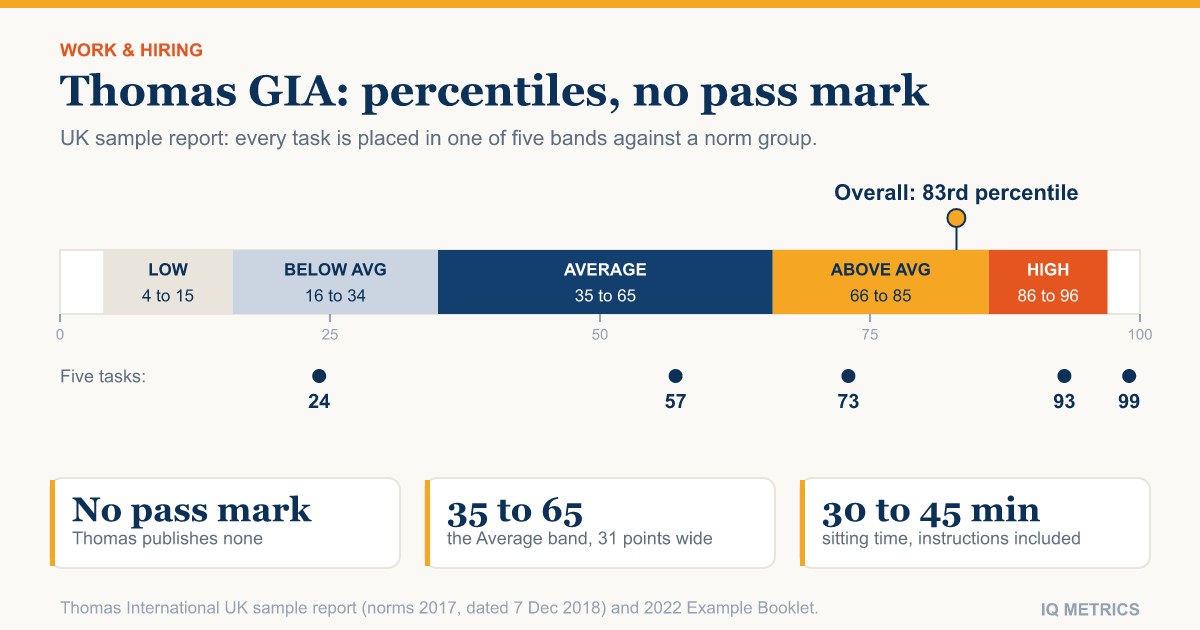
What you need to know
- The Thomas GIA (General Intelligence Assessment, which Thomas now also calls the Aptitude assessment) has five timed tasks: Reasoning, Perceptual Speed, Number Speed & Accuracy, Word Meaning and Spatial Visualisation. Each task lasts 2 to 5 minutes and Thomas says the sitting, instructions included, takes 30 to 45 minutes. It publishes no item total: in its UK sample report one candidate completed 53, 54, 17, 40 and 14 questions across the five tasks.
- There is no pass mark. Results are percentiles against a norm group, grouped in the report as Low (4 to 15), Below Average (16 to 34), Average (35 to 65), Above Average (66 to 85) and High (86 to 96). Thomas's own interviewer notes warn employers that a low score is "in many cases" not a failure and that one test should not disqualify a person.
- Wrong answers cost points, and the cost differs by task. In the UK sample report the adjusted score equals right answers minus 1.0 per wrong answer in Reasoning, 0.25 in Perceptual Speed and 0.5 in each of the other three tasks, and a Spanish sample agrees wherever its candidate made errors (our arithmetic). Prep sites that say the deductions are for slowness are wrong on this point.
- Thomas's report calls the overall percentile an estimate of general intelligence, and its product page calls the test a measure of "the part of your IQ that defines learning agility", but it publishes no GIA-to-IQ table. The headline score in the UK sample is a T-score of 60 (the General Trainability Index) at the 83rd percentile. We found no published norm-group size, reliability coefficient or BPS review document.
The Thomas GIA is an employer-set test, so there is no single good score: the report gives a percentile and a band, and each employer decides what it wants. Candidates who search for a pass mark, an average or an IQ equivalent will not find one from Thomas International, which makes the test a useful case of a hiring assessment that reports a lot and publishes very little. This guide sets out what Thomas does say in its own documents, what it does not, and how to read a result.
What is the Thomas GIA?
The GIA is Thomas International's cognitive ability test for recruitment and development. Thomas's January 2024 technical summary calls it the Aptitude assessment, "also known as" the GIA, and says it is derived from several tests originally released in 1992, after six years of research and development. The summary says it measures "general intelligence (cognitive ability) and trainability", meaning how quickly a person picks up new skills. It is answered in a browser with a mouse only; the 2022 candidate booklet says there is no need for a keyboard, and Thomas's candidate page says it will not run on tablets or smartphones, only on a desktop computer or laptop.
Candidates complete five tasks, each with 8 practice items first:
- Reasoning: simple deductive verbal reasoning, such as who is heavier or stronger than another person, with the statement disappearing before the question appears
- Perceptual Speed: four pairs of letters; count how many pairs match, treating capitals and small letters as the same
- Number Speed & Accuracy: find the highest and lowest of three numbers, then say which is numerically further from the remaining one
- Word Meaning: three words; click the odd one out
- Spatial Visualisation: pairs of rotated symbols; count how many pairs show the same symbol rather than a mirror image
Each task lasts 2 to 5 minutes, and Thomas says the whole series, instructions included, should last 30 to 45 minutes; its product page says "just 45 minutes". Thomas gives no total number of items. A prep site's claim of 130 to 160 questions in all is not on any Thomas page we read, and the sample report shows one candidate completing 178 questions across the five tasks. For practice with the same kinds of item on this site, see our numerical, verbal and spatial IQ tests, and our guide to timed IQ tests.
How is the Thomas GIA scored?
Thomas's UK sample report (dated 7 December 2018, marked "United Kingdom Norms: 2017") prints one table per candidate. For each task it shows questions done, right, wrong and an adjusted score, and a percentile ranking against the norm group:
- Reasoning: 53 done, 52 right, 1 wrong, adjusted 51, percentile 93
- Perceptual Speed: 54 done, 42 right, 12 wrong, adjusted 39, percentile 24
- Number Speed & Accuracy: 17 done, 16 right, 1 wrong, adjusted 15.5, percentile 57
- Word Meaning: 40 done, 39 right, 1 wrong, adjusted 38.5, percentile 99
- Spatial Visualisation: 14 done, 13 right, 1 wrong, adjusted 12.5, percentile 73
- Overall percentile: 83, a weighted combination of the five whose weights Thomas does not publish
Two things stand out. First, wrong answers are deducted. Dividing the gap between right answers and the adjusted score by the number of wrong answers gives 1.0 for Reasoning, 0.25 for Perceptual Speed and 0.5 for each of the other three. A Spanish sample report from 2012 gives the same weights for Reasoning, Perceptual Speed and Spatial Visualisation, the three tasks where its candidate made errors. This is our arithmetic, since Thomas does not state the rule in words in the documents we read. Guessing is therefore penalised, most heavily in Reasoning.
Second, the count of questions done is not the score. The candidate who answered the most questions (54, in Perceptual Speed) is at the 24th percentile, because 12 were wrong, and the one who answered the fewest (14, in Spatial Visualisation) is at the 73rd. The tasks have different norms, so you cannot compare them with each other, but the pattern shows why a raw question count tells you little.
What is a good Thomas GIA score?
Thomas publishes no pass mark and no average raw score in any document we read. The report prints a five-band key on every task: 4 to 15 Low, 16 to 34 Below Average, 35 to 65 Average, 66 to 85 Above Average and 86 to 96 High, with the report text using labels such as Very Low and Top 3% at the extremes. The "Average" band is wide: it covers 31 percentile points, so a 38th and a 62nd percentile are both average.
The wording follows the band edge, not the exact percentile. An overall 83rd percentile is described as "above average, in the top 34% of the Norm range", where 34 is simply 100 minus 66, the bottom of the band. A candidate at the 83rd percentile has beaten 83% of the norm group, and a reader who sees "top 34%" may take it to mean much less. Employers set their own cut-offs, and Thomas's interviewer notes tell them not to rely on a single test: in the report's words a "low" score is "in many cases" not a failure, and the interview should avoid giving the impression that one test was enough to disqualify the person.
The Thomas GIA gives a percentile and a band but no pass mark, so a good score is whatever the employer says it is.
Is the Thomas GIA an IQ test?
Thomas's wording shifts with the document. The sample report says the overall percentile "is an estimate of the candidate's general intelligence, reflecting both fluid and crystallised intelligence". The 2024 technical summary says the assessment measures general intelligence and trainability, and it brands the combined result the General Trainability Index (GTI). The product page describes the test as assessing fluid intelligence, "the part of your IQ that defines learning agility". Yet no document we read converts a GIA result to an IQ score, and the UK sample report's headline number is a T-score (mean 50, standard deviation 10): a GTI of 60 beside an overall percentile of 83.
If the norm group were the general population, the bands would map onto the IQ scale as below. This is our arithmetic on a normal curve, not a Thomas table, and the real norm group is labelled only "United Kingdom Norms: 2017", with its size and make-up unstated, so treat it as an illustration of scale only. You can check any other percentile with our IQ percentile calculator or the IQ score converter.
- 16th percentile (bottom of Below Average): about IQ 85
- 35th percentile (bottom of Average): about IQ 94
- 50th percentile: IQ 100
- 65th percentile (top of Average): about IQ 106
- 86th percentile (bottom of High): about IQ 116
- 97th percentile (Top 3%): about IQ 128
The sample report's 83rd percentile would sit near IQ 114 on that curve. That does not make it an IQ of 114, because a percentile in an unspecified norm group and a percentile in the whole population are different comparisons, which is the same caveat we raised for SHL scores and for CCAT scores.
How well does the Thomas GIA predict job performance?
Thomas's 2024 summary lists a handful of employer studies. In one professional services firm, people who later left had lower overall scores than those who stayed (d = .44, a small effect). In one large bank, staff hitting performance targets scored higher (d = .95, large). Among 165 members of the armed forces, scores correlated with training performance at r = .30 to .51, which the summary calls moderate, and a larger study of 2,400 military trainees is described as moderate with no coefficient given. A telecoms graduate study found higher scorers more likely to be promoted (d = .80).
The limits matter. The summary does not name the employers or date the studies, and the first two have small samples (the retention study implies about 64 people). The claim that general cognitive ability predicts job performance is cited to a review that the summary itself labels as not specific to this test. We found no reliability coefficient (alpha, test-retest or split-half) in any Thomas page or PDF we read, and no norm tables or full technical manual. Thomas's product page says the test is "independently audited by the British Psychological Society", but we could not find a BPS test review document that sets out what was audited. For a wider view of what cognitive tests predict at work, read our guide to cognitive ability tests at work, and for a comparison with another vendor's scoring see the Predictive Index cognitive score.
Practice, retakes and adjustments: what Thomas says
Thomas supplies a candidate Example Booklet that shows each task with sample questions, and the candidate page strongly recommends reading it. It advises a quiet environment, a desktop or laptop with a mouse, and working as quickly and as accurately as possible, noting that speed and accuracy are equally important. The page adds that all parts load before the test begins, so a dropped internet connection should not disrupt it, and that work computers may block it because of security settings. If you need an adjustment, the booklet tells you to contact the organisation that sent the invitation, so that reasonable adjustments are in place before you start. It also asks left-handed candidates to tell the organisation if they want the mouse buttons reversed. A game-based alternative with no published norm group is McKinsey Solve; see McKinsey Solve: is it an IQ test.
We found no Thomas rule on retakes, extended time, proctoring or cheating. The only mention of a retest is in the interviewer notes, which say a complete re-test is a possibility where there are doubts that the person understood the instructions, provided it does not give an unfair advantage to someone who is initially a low scorer for other reasons. We found no adverse-impact statistics, so for how employers are expected to check fairness, see the four-fifths rule and whether IQ tests are legal for hiring.
What should a candidate do?
- Read the Example Booklet first; each real task also starts with 8 practice items
- Answer accurately, especially in Reasoning, where a wrong answer costs a full point in the sample reports
- Use a quiet room and a mouse, and ask the employer about adjustments before the invitation window closes
- Do not look for an IQ number in the result: the report gives percentiles and a T-score, not an IQ
- Ask the employer how the result will be used; the interviewer notes say it should be weighed with experience, education and interview evidence
Where would your own score land?
Want a score you can read on the standard IQ scale, with a percentile and a full report? Take the IQ Metrics test, and see how it compares with a hiring assessment.
Find your IQ score now! →To see how your own results compare with the population, take the IQ Metrics test and read the result against the IQ bell curve. If you are preparing for several employer tests, our guide to IQ tests for job interviews and the Wonderlic practice test cover common formats.
Common questions
What is a good Thomas GIA score?
Thomas publishes no pass mark. Scores are percentiles against a norm group, and its sample report calls 35 to 65 Average, 66 to 85 Above Average and 86 to 96 High. Each employer sets its own cut-off, and Thomas tells interviewers not to treat a low score as a failure.
How many questions and how long is the Thomas GIA?
Thomas gives no item total. It has five tasks of 2 to 5 minutes each, with 8 practice items per task, and says the sitting including instructions and practice takes 30 to 45 minutes. A prep-site figure of 130 to 160 questions is not on any Thomas page we read.
Is the Thomas GIA an IQ test?
Thomas says its overall percentile estimates general intelligence and describes the test as measuring cognitive ability and trainability, but it reports percentiles and a T-score (the General Trainability Index), not an IQ. We found no official conversion to an IQ score.
Does the Thomas GIA penalise wrong answers?
Yes. In Thomas's UK sample report the adjusted score equals right answers minus a penalty per wrong answer: 1.0 in Reasoning, 0.25 in Perceptual Speed and 0.5 in each of the other three tasks. This is our arithmetic, and it is tied to errors, not to slowness.
Sources for this story
- The science behind the Aptitude assessment (V1, 4 January 2024) — Thomas International
- GIA Sample Report, United Kingdom Norms: 2017 (dated 7 December 2018), including Interviewer Notes — Thomas International
- GIA Example Booklet (2022 edition) for candidates taking the Thomas GIA online — Thomas International
- GIA Sample Report in Spanish, Norms: 2011 (dated 13 March 2012) — Thomas International
- General Intelligence Assessment (GIA) product page, read 5 October 2026 — Thomas International (thomas.co)
Corrections: spotted an error? Email corrections@iqmetrics.org and we will update this story and note the change here.
Related stories
All news →
What Is a Good Predictive Index Cognitive Assessment Score?
PI scores run from 100 to 450, and its own blog says the average of 250 is about 20 of 50 questions right. PI says it is not a test you pass or fail, no longer shows percentiles, and does not measure IQ.

What Is a Good SHL Test Score? Percentiles, Norm Groups and IQ
SHL says it sets no passing score and its support team cannot give you your result. What its own reports show is a percentile against a named comparison group, with T and Sten scores derived from it.

McKinsey Solve: Is It an IQ Test? What McKinsey Says and What Prep Sites Claim
McKinsey calls Solve a gamified assessment of problem-solving, says no preparation is needed, and publishes no pass mark, score scale or reliability figure. Its 2021 FAQ gave 70 minutes and a percentile range; the 2025 FAQ gives neither. Prep sites fill the gap with game names and timings McKinsey does not print.
Read the research.
Then find your own number.
Our IIF-certified assessment reports your score with its scale, percentile and confidence range — and a breakdown of the cognitive domains behind it.
Start IQ Test →