
Why Smart People Make Bad Decisions: IQ Is Not Rationality
Everyone knows someone brilliant who keeps making terrible calls. That is not a paradox; it is a measurement gap. Intelligence tests and rationality tests load on different things, and several of the best-studied thinking errors turn out to be almost completely independent of how high you score.
Smart people make bad decisions because intelligence and rationality are not the same trait, and no standard IQ test measures the second one. A high score tells you a great deal about how quickly someone spots a pattern, holds information in mind and reasons through an unfamiliar problem. It tells you much less about whether they will check their own assumptions, update on evidence that embarrasses them, or notice when a confident intuition is simply wrong.
Keith Stanovich, the cognitive scientist who has spent the longest on this gap, coined a deliberately awkward word for it: dysrationalia, the inability to think and behave rationally despite adequate intelligence. The point of the word is that the condition is common rather than exotic. Below is what the research actually shows about which errors track cognitive ability, which ones do not, and what that means for the number on your own score report.
Intelligence tests and rationality tests measure different things
An IQ battery is built to capture reasoning power under standard conditions: novel problems, clear rules, a defined right answer, and an examiner telling you exactly when to start thinking. Those conditions strip out the thing that makes real decisions hard. In life nobody announces that a question is a trick, nobody supplies the relevant base rate, and nothing signals that this is the moment to stop trusting the answer that arrived instantly.
Rationality, in the technical sense used by decision researchers, is about whether your beliefs track reality and your choices track your goals. Stanovich, Richard West and Maggie Toplak spent years building an instrument for it — the Comprehensive Assessment of Rational Thinking, published in 2016 — precisely because no existing intelligence test did the job. Their headline finding is not that the two are unrelated. It is that the association is moderate, which leaves an enormous number of people who are strong on one and weak on the other.
This is the same distinction that makes the limits of IQ as a measure worth taking seriously, and it is why our page on IQ versus personality treats traits such as conscientiousness and open-minded thinking as separate inputs rather than as by-products of ability.
The three-second question that separates them
Shane Frederick’s Cognitive Reflection Test, published in 2005, is three questions long and still one of the sharpest demonstrations in the field. The famous item: a bat and a ball cost $1.10 together, the bat costs $1.00 more than the ball, so how much does the ball cost?
The answer that arrives immediately is ten cents. It is wrong — that would make the bat $1.10 and the total $1.20. The ball costs five cents. Frederick found that large numbers of students at highly selective universities missed at least one of the three items, and those were not failures of arithmetic. Practically everyone who missed it could do the algebra on request. They simply never checked, because the intuitive answer did not feel like a guess.
That is the whole mechanism in miniature. Cognitive reflection is related to intelligence, but it predicts reasoning performance over and above it — it captures a disposition to interrupt yourself, and a disposition is not a capacity.
The biases a high score does not protect you from
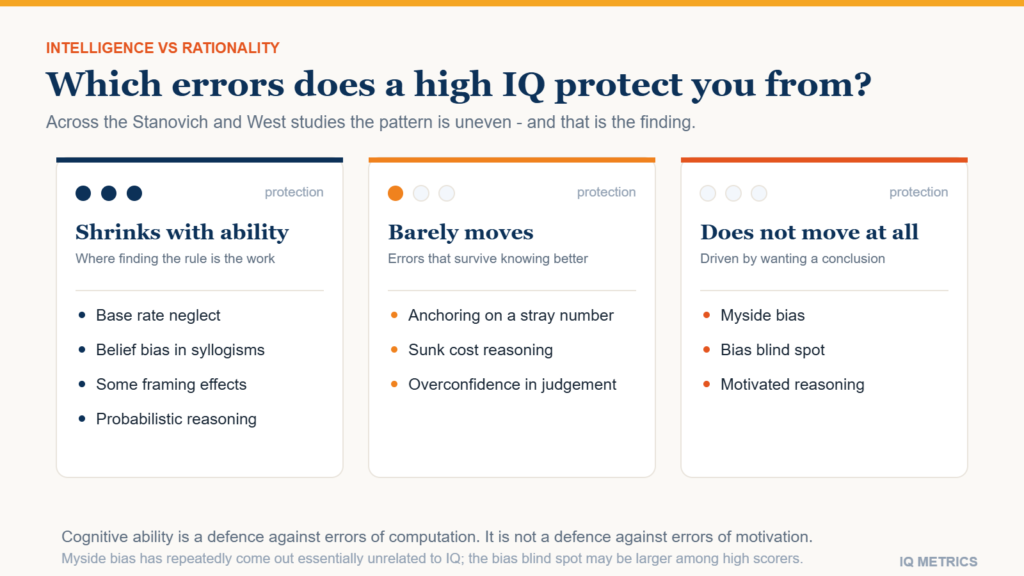
If intelligence were a general defence against thinking errors, every documented bias would shrink as ability rises. Stanovich and West tested that directly across a long series of studies, and the pattern is uneven in a way that is far more interesting than a clean result would have been.
- Errors that do shrink with ability: base rate neglect, some framing effects, belief bias in syllogisms and several probabilistic reasoning problems — roughly, the ones where spotting the correct rule is the hard part.
- Errors that barely move: anchoring on an irrelevant number, sunk cost reasoning in several forms, and overconfidence in your own judgement.
- Errors that do not move at all: myside bias — evaluating evidence more generously when it supports a position you already hold. Stanovich’s group has reported myside bias effects that are essentially unrelated to cognitive ability across multiple samples.
Myside bias is the one worth sitting with. It is not a gap in knowledge or a lapse in computation, which is why more computing power does not close it. It is a bias in what gets scrutinised, and the decision about what to scrutinise is made before the reasoning starts.
When ability makes the reasoning worse
A handful of findings go further than mere independence. In a 2012 paper on the bias blind spot — the tendency to see distortions in other people’s thinking but not your own — West, Meserve and Stanovich found the blind spot was if anything larger among participants with higher cognitive ability. Being good at reasoning gives you more confidence in your reasoning, and confidence is exactly what the blind spot runs on.
Dan Kahan’s work on politically charged questions points the same way. On topics where a group identity is at stake, higher numeracy and science literacy have been associated with more polarisation between groups rather than less. The best explanation on offer is unflattering and mundane: sharper reasoners are better at constructing the case they already wanted to reach. The skill is real; it is simply pointed at justification rather than at truth. This literature is contested and the effects are modest, but the direction has appeared often enough to take seriously.
Where would your own score land?
Take the IIF-certified assessment and get your score with the scale it was measured on, the percentile it corresponds to and the confidence range around it — the three figures most online tests leave out.
Mindware: the part of rationality you can learn
Stanovich splits rational thinking failures into two kinds, and the split is genuinely useful. Some failures come from a processing default — going with the first answer and never overriding the intuition. Others come from missing mindware: you never acquired the rule, so there was nothing available to override it with.
Missing mindware is the encouraging half, because rules can be taught to anyone at any level of ability — and teaching is the one environmental input with genuinely strong evidence behind it, as our article on whether school raises IQ sets out. The four rules that pay for themselves quickest:
- Ask for the base rate. A test that is 95 per cent accurate for a condition affecting one person in a thousand still returns far more false positives than true ones.
- Consider the opposite. Explicitly writing down why your conclusion might be wrong is one of the few debiasing techniques that keeps working when it is retested.
- Separate the decision from the outcome. A good call can lose and a reckless one can win. Judging only by results teaches you the wrong lesson a large share of the time.
- Name the falsifier in advance. Deciding what evidence would change your mind, before you see any, is the cheapest available guard against myside bias.
What this means for your own score
None of this makes intelligence testing less useful. Cognitive ability remains one of the better-validated predictors in applied psychology, and understanding what an IQ score really means is worth doing properly. The correction is narrower than it first sounds: a score is a measurement of reasoning capacity, not a certificate of good judgement, and it was never designed to be one.
It also reframes a question people ask constantly. Whether you can raise your IQ is genuinely difficult and the honest answer is heavily qualified. Whether you can improve your decisions is not difficult at all — mindware is learnable, checking is a habit, and neither depends much on where you started. That gap is the most practical thing in this whole literature.
The same separation explains why IQ and emotional intelligence keep getting confused: both are real, both matter, and neither is a subset of the other. Speed of thought is a third thing again, which is why processing speed deserves its own treatment. If you want the capacity side measured properly first, our free IQ test gives you a normed score in about twenty minutes — then treat the judgement side as separate work.
The short version
- Intelligence and rationality are related but distinct; the tests measure different constructs.
- Errors that depend on spotting a rule shrink with ability. Errors that depend on wanting a conclusion mostly do not.
- Myside bias is close to independent of IQ, and the bias blind spot may be worse among high scorers.
- The learnable part — base rates, considering the opposite, separating decisions from outcomes — is available at every ability level.
The reason clever people make bad decisions is not that their intelligence failed them. It is that intelligence was never the thing being tested at that moment, and nobody told them.
Keep reading
 Understanding IQ
Processing Speed and IQ
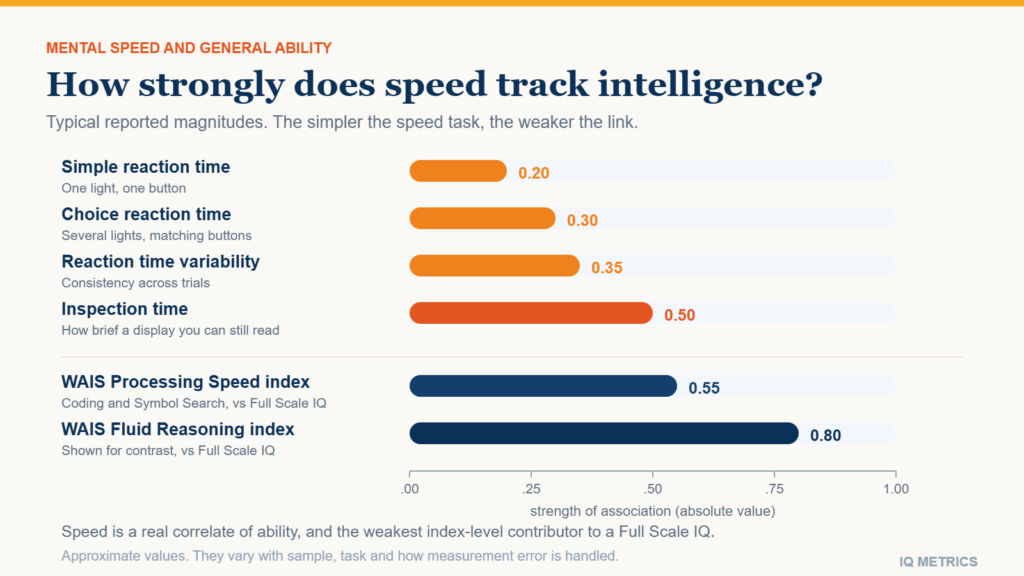
Fast thinkers are assumed to be smart thinkers, and there is a real finding underneath the stereotype: people who score higher on IQ tests do respond faster on tasks with no reasoning content at all. But the link is weaker than the folklore, and on a professional battery the speed index is the least g-loaded.
 Mind & Everyday Life
IQ vs EQ
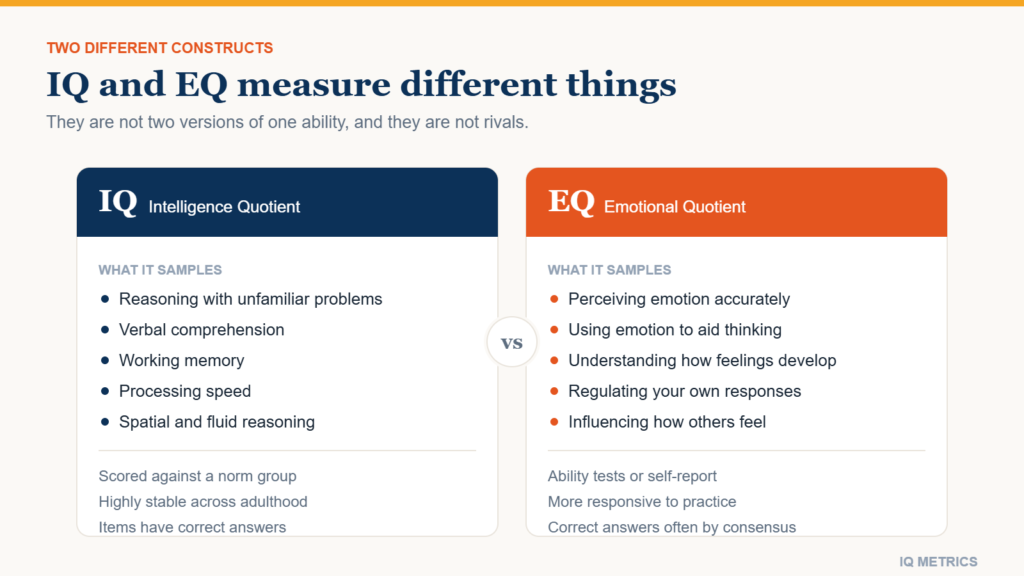
IQ measures reasoning; EQ measures how well you read and manage emotion. They are different constructs, measured in different ways, with different amounts of evidence behind them. Here is what each one actually predicts, which is easier to change, and where the popular claim that EQ matters more comes from.
 Understanding IQ
Is Intelligence limited to IQ?
As we explore the fascinating world of intelligence, we will uncover the truth about IQ and the limitations of the human intellect. Beyond traditional measures of intellect, this article explores a wider range of aptitudes that impact our perception and engagement with the natural world.