IIF Certified Assessment
Start IQ Test
IIF Certified Assessment
No IQ number qualifies anyone for US disability benefits on its own. Social Security writes 70 and 75 into its intellectual-disorder listing, but each sits inside a three-part test, and a rule many pages still describe was removed in 2017.
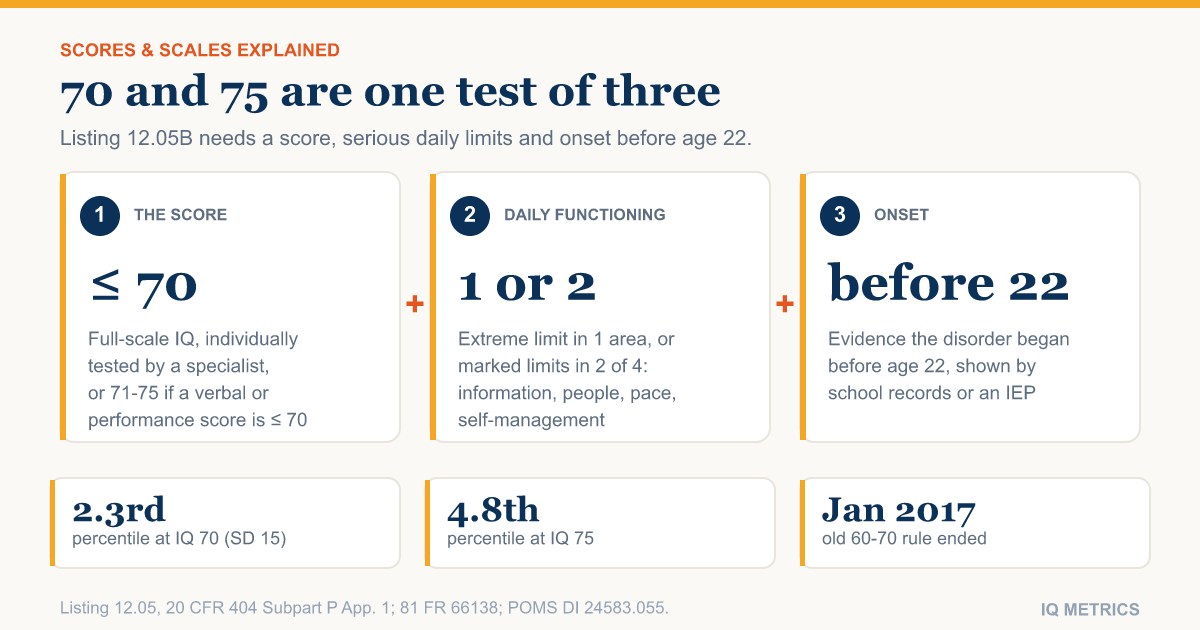
Does a low IQ qualify you for disability benefits? Not by itself. In the United States the Social Security Administration (SSA) writes two IQ numbers into its intellectual-disorder listing, 70 and 75, but each sits inside a three-part test: a qualifying score, serious limits in daily mental functioning, and evidence that the condition began before age 22. This explainer walks through the rule as it stands in the Code of Federal Regulations (text current to 16 September 2026), corrects a rule that many pages still describe, and notes how two other countries handle the question.
SSA decides many adult claims by checking whether a medical condition meets a “listing” in its Blue Book, published as Appendix 1 to Subpart P of 20 CFR Part 404. The listing for intellectual disorder, 12.05, can be met in one of two ways. The usual route, 12.05B, has three parts that must all be present:
SSA defines a “marked” limitation as being seriously limited in functioning independently, appropriately, effectively and on a sustained basis in that area, and an “extreme” limitation as not being able to function in the area on that basis. It also says that no single piece of information, test results included, can establish the degree of limitation in an area of mental functioning. The score is one of three things SSA must find, not a pass mark.
SSA specifies a test with a mean of 100 and a standard deviation of 15, given individually by a qualified specialist. On that scale an IQ of 70 is exactly two standard deviations below the mean, the 2.3rd percentile, roughly 1 person in 44. An IQ of 75 is 1.67 standard deviations below, the 4.8th percentile, about 1 in 21, so the 71 to 75 band holds about 2.5% of people. On a scale with a standard deviation of 16, as some older Stanford-Binet editions used, the same scores land at the 3.0th and 5.9th percentiles, which is why the required scale matters. Check any score on the percentile calculator, and see how the two scales differ in our explainer on SD 15 versus SD 16.
The 71 to 75 route was added in the 2016 revision, and the preamble says SSA “partially adopted” commenters’ recommendations. In effect it gives a limited allowance for the fact that a score just above 70 can come from a true score at or below it, but only when a part score on the same test is 70 or below. SSA’s internal manual, the Program Operations Manual System (POMS DI 24583.055), fills in the detail. “Accompanied by” means the verbal or performance score must come from the same administration of the same test, so scores from different tests cannot be combined. A “comparable” score is one that measures the same type and scope of intelligence under another name. And abbreviated tests such as the WASI cannot establish listing 12.05.
Social Security lets an IQ of 75 count only if a part score on the same test is 70 or below, and it does not let anyone adjust a score for measurement error.
Every IQ score is an estimate. SSA’s manual says a person’s true score is expected to lie “within approximately 3 to 5 points” above and below the reported score, and then tells adjudicators to consider only the obtained score: not to raise or lower it on the assumption that it falls within the standard error of measurement. That is the opposite of how the Supreme Court treated scores in death-penalty cases. In Hall v. Florida (2014) the Court held that scores should be read “not as a single fixed number but as a range,” noting that a score of 71 reflects a range between 66 and 76 with 95% confidence. The idea is explained in our piece on IQ margin of error, and the death-penalty rulings appear in the guide to an IQ of 70.
For years, listing 12.05C counted “a valid verbal, performance, or full scale IQ of 60 through 70 and a physical or other mental impairment imposing an additional and significant work-related limitation of function.” The older rules used the lowest of the three scores. SSA removed it in “Revised Medical Criteria for Evaluating Mental Disorders” (81 Federal Register 66138, published 26 September 2016), effective 17 January 2017. The preamble says commenters called the proposed version unnecessary, that SSA adopted their comments, and that the final rules “do not include a listing 12.05C.” The new criteria apply to new applications and to claims pending on or after that date.
Yet some law-firm and information pages still present the old rule as current, and some invent extra pathways that the listing does not contain. The listing has only two routes, A and B, and B needs extreme limitation in one area or marked limitation in two. If a page says an IQ of 60 to 70 plus another impairment meets the listing, it is describing a rule that has not applied to new claims since January 2017. Check the date on any advice you read against that one.
A score above 75 falls outside listing 12.05B. “Borderline intellectual functioning,” the band just above intellectual disability, is evaluated under a different listing, 12.11 for neurodevelopmental disorders, which has no IQ criterion. Missing a listing does not end a claim. SSA’s general test is whether a medically determinable impairment keeps a person from doing “any substantial gainful activity” for at least 12 months. If no listing is met, SSA assesses what the person can still do, called residual functional capacity, and weighs it against past work and then age, education and work experience. Our guide to what an IQ of 85 means covers the range just above the listing.
Both. Social Security Disability Insurance (SSDI) requires enough work credits to be insured. Supplemental Security Income (SSI) requires being 65 or older, blind or disabled, and having income and resources below the limits SSA sets. An adult whose disability began before age 22 may also qualify for child’s benefits on a parent’s Social Security record as a “disabled adult child.” Children are assessed under a separate listing, 112.05, for ages 3 to 18, with the same IQ options but no age-22 element; for child SSI the standard is “marked and severe functional limitations” lasting at least 12 months.
An online test, ours included, cannot support a disability claim: SSA requires an individually administered test from a qualified specialist. What a tool can do is show where a score sits on the curve.
Find your IQ score now! →So: does low IQ qualify for disability benefits? A score of 70 or below is one of three things SSA must find, not a pass mark; a score of 71 to 75 counts only with a part score of 70 or below on the same test; and a score above 75 falls to the general work-capacity test. The rules also changed in 2017, so check dates when reading advice online. For more on reading the numbers, see how to read an IQ test report and full-scale IQ versus index scores, and to see where a score of your own sits on the curve, try the IQ test.
Not on its own. Social Security listing 12.05B needs a full-scale IQ of 70 or below, extreme limitation in one (or marked limitation in two) of four areas of daily mental functioning, and evidence that the condition began before age 22.
Not any more. That rule, listing 12.05C, has not applied to new claims since 17 January 2017, when SSA’s revised mental-disorder listings took effect.
A full-scale score of 71 to 75 counts only if a verbal or performance score on the same test is 70 or below. A score above 75 falls outside listing 12.05B, though a claim can still succeed through SSA’s general work-capacity assessment.
For listing 12.05B, yes: an individually administered standardized test given by a qualified specialist, not a self-taken online test. Listing 12.05A covers people who cannot take a standardized test at all.
Only through the built-in 71 to 75 route. SSA’s manual says the true score is expected within about 3 to 5 points of the reported score, but adjudicators are told not to raise or lower an obtained score for that reason.
Corrections: spotted an error? Email corrections@iqmetrics.org and we will update this story and note the change here.
Every properly built test publishes a standard error of measurement alongside the score. On a mean-100, standard-deviation-15 scale it is large enough that a reported 104 and a reported 111 are not reliably different results.
A Full-Scale IQ is an average of several narrower index scores, and when those indexes disagree by enough, the average describes none of them well.
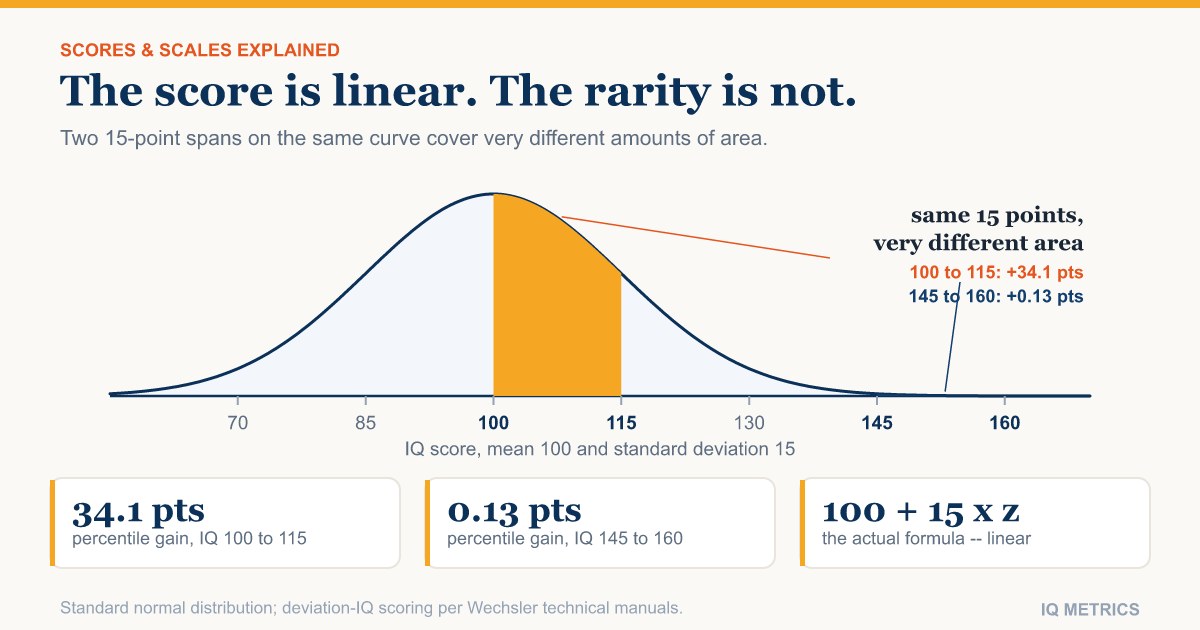
Deviation IQ is a straight-line transform of the bell curve — not an exponential or logarithmic one. The confusion comes from somewhere else: the rarity behind each score, which is sharply nonlinear.
Our IIF-certified assessment reports your score with its scale, percentile and confidence range — and a breakdown of the cognitive domains behind it.
Start IQ Test →