



Scores & Scales Explained
What a specific number means on a specific scale, why every score needs a confidence range, and how the scales convert.

DAS-II Scores Explained: GCA, Cluster Scores, T Scores and Classification Ranges
The DAS-II reports a General Conceptual Ability (GCA) score with a mean of 100 and a standard deviation of 15, and subtest T scores with a mean of 50 and a standard deviation of 10. There is no DAS-3: the newest edition is the 2023 Normative Update for ages 7 to 17, and Pearson prints two different score ranges.

GMAT Score to IQ: The Focus Percentile Chart and Why It Is Not an IQ
There is no official GMAT-to-IQ conversion: GMAC says its scores have not been equated with other tests. What it publishes is a percentile among GMAT test takers, 97.5 for a Focus total of 705, a self-selected pool of 93,196 exams in a year.

MCAT Score to IQ: What the AAMC Percentile Can and Cannot Tell You
Online calculators turn a 500 into an IQ of 100. The AAMC says its percentiles only compare you with other test takers, a group already filtered by college and ambition. No study has calibrated the modern MCAT against an intelligence test, so here is the 2026-27 percentile table and the arithmetic that shows why.

ACT Score to IQ: What the 2026-27 National Ranks Do and Do Not Say
ACT's new national ranks put a composite of 27 at the 89th percentile of ACT-tested graduates. That is not the 89th percentile of everyone, and by ACT's own table the headline average fell mostly because of who sits the test.

HSPT Scores Explained: Percentiles, Composites and the Cognitive Skills Quotient
The HSPT gives each of five subtests a 200 to 800 standard score and a national percentile, adds three composites, and reports a Cognitive Skills Quotient on an IQ-style scale. Its publisher sets no pass mark and says the quotient is not limited to innate ability.

WISC-6 Release Date: What Pearson Has Said and What Is Still Unknown
Pearson is still standardizing the sixth edition of the Wechsler children's scale and has published no release date, sample size or score structure. Its own notices show a research edition with new subtests, a $100 bonus to fill the last gaps, and timelines that do not agree.

ISEB Common Pre-Test Scores Explained: SAS, Percentiles and IQ
The ISEB Pre-Tests report a Standardised Age Score with an average of 100, but the comparison group is independent-school applicants, there is no pass mark, and ISEB does not send results to parents. An SAS is not an IQ, and ISEB publishes no conversion.

Stanford-Binet 5 (SB5) Scores Explained: Ranges and Factors
The SB5 reports a Full Scale IQ across five factors for anyone from age 2 to 85 and older, on the same mean-100, standard-deviation-15 scale as the Wechsler tests. See the real score ranges, what one district actually requires for its gifted program, and why a sixth edition already changes what "current" means.
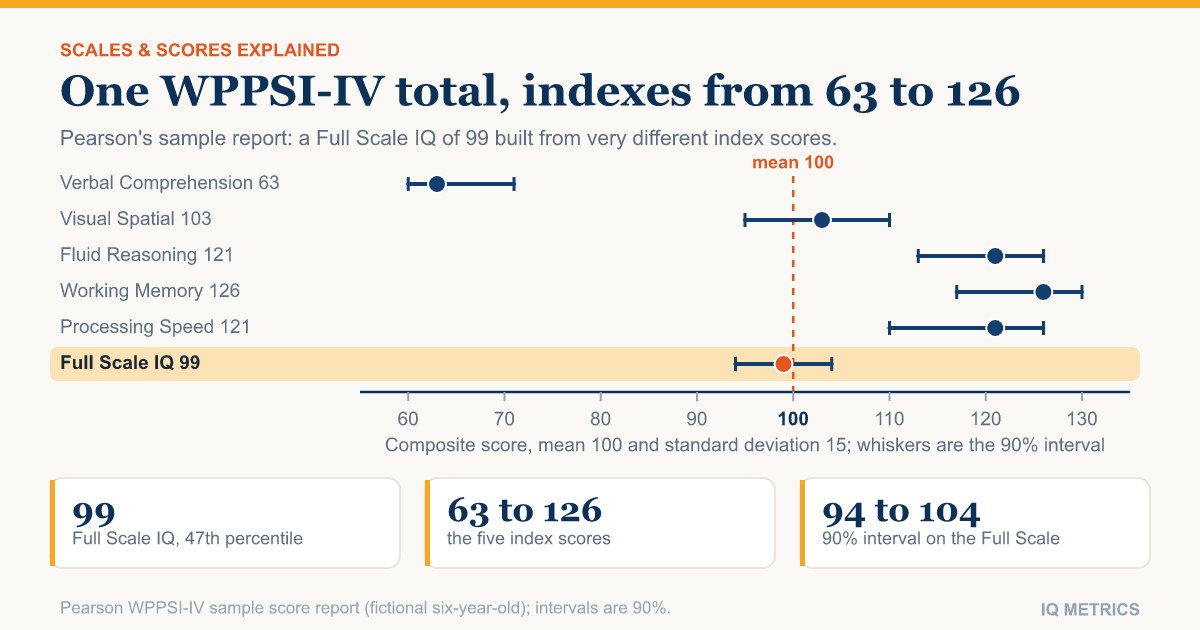
WPPSI-IV Scores Explained: Score Ranges, Composites and IQ
Pearson's WPPSI-IV covers ages 2:6 to 7:7 and reports composites on the familiar 100-and-15 scale. Its sample report shows a Full Scale IQ of 99 built from indexes that run from 63 to 126, and no public table says what score is gifted.

WAIS-5 vs WAIS-IV: Index Scores, Subtests and Score Ranges Explained
The WAIS-IV gives four index scores and a Full Scale IQ built from 10 subtests. The WAIS-5 gives five indexes, 15 ancillary ones and an FSIQ built from just seven subtests. Here is what changed, what each number means, and what the score descriptions can and cannot tell you.

Specific Abilities vs g: What New Reviews Actually Weigh
Does a subtest or index score on an IQ test tell you anything beyond the single full-scale number? Recent reviews reach different answers, largely because they ask the question with different statistical methods.

IQ Z-Score: Formula, Table and Worked Examples
An IQ z-score counts how many standard deviations a score sits from 100, which is what lets you compare scores from different tests. Here are the formula, worked answers for an IQ of 75 and 120, a z-table, a percentile for every IQ from 70 to 145, and the point where the table stops being data.

Low IQ and Disability Benefits: What the Score Rules Actually Say
No IQ number qualifies anyone for US disability benefits on its own. Social Security writes 70 and 75 into its intellectual-disorder listing, but each sits inside a three-part test, and a rule many pages still describe was removed in 2017.

Is IQ Linear or Logarithmic? How the Scale Actually Works
Deviation IQ is a straight-line transform of the bell curve — not an exponential or logarithmic one. The confusion comes from somewhere else: the rarity behind each score, which is sharply nonlinear.

What a 110 IQ Means: Percentile, Rarity and Is It Good?
A 110 IQ is the 74.8th percentile: about 1 person in 4 scores this high. The WISC-V and Stanford-Binet 5 call it High Average, the Woodcock-Johnson IV still calls it Average, and the margin of error runs straight across the line between them.

Deviation IQ vs. Ratio IQ: Why the Old Formula Was Replaced
The first IQ scores came from dividing mental age by chronological age. The formula worked reasonably well for children and produced nonsense for adults — which is exactly why every major test replaced it.
The Ceiling on an IQ Test: Why Scores Stop Near 160
A score of 160 is four standard deviations above average — about one person in 31,560. The sample the score is measured against holds roughly 2,200 people, which is why the top of the table is calculated rather than observed.
Full-Scale IQ vs. Index Scores: What's the Real Difference
A Full-Scale IQ is an average of several narrower index scores, and when those indexes disagree by enough, the average describes none of them well.
An IQ Score Is a Range, Not a Number: The Margin of Error
Every properly built test publishes a standard error of measurement alongside the score. On a mean-100, standard-deviation-15 scale it is large enough that a reported 104 and a reported 111 are not reliably different results.
IQ Standard Deviation 15 vs 16: Why One Percentile Has Three Numbers
Wechsler scales use a standard deviation of 15, older Stanford-Binet forms used 16, and the Cattell scales use 24. One standing prints as three different numbers — and one printed 140 is a one-in-260 result on one of those scales and a one-in-21 result on another.

Mensa IQ Requirement: The Score You Need on Each Accepted Test
Mensa admits at the 98th percentile of a supervised, properly normed test. American Mensa's own table turns that into 130 on the Wechsler scales, 132 on the CogAT, OLSAT and NNAT2, and 148 on the Cattell. Old SAT and ACT scores can still count; newer ones cannot.
What an IQ of 120 Means, and What It Does Not
On the scale most modern tests use, 120 sits around the 91st percentile. Change the scale and the same number moves. Add the measurement error every test carries and it stops being a point at all.
Written to be checked, not just clicked
Every number carries its scale
An IQ figure is meaningless without the scale it was measured on and the range around it. Every story here reports all three, or says plainly that the source did not.
Sources are listed, not implied
Each story ends with the studies, datasets and documents it draws on, named and attributed, so you can go and read them yourself.
We correct in public
Spotted an error? Write to corrections@iqmetrics.org. Corrections are made on the story and noted at the bottom of it — never quietly.
Read the research.
Then find your own number.
Our IIF-certified assessment reports your score with its scale, percentile and confidence range — and a breakdown of the cognitive domains behind it.
Start IQ Test →