



What was Carl Friedrich Gauss’ IQ?
He predates the test by eighty years.
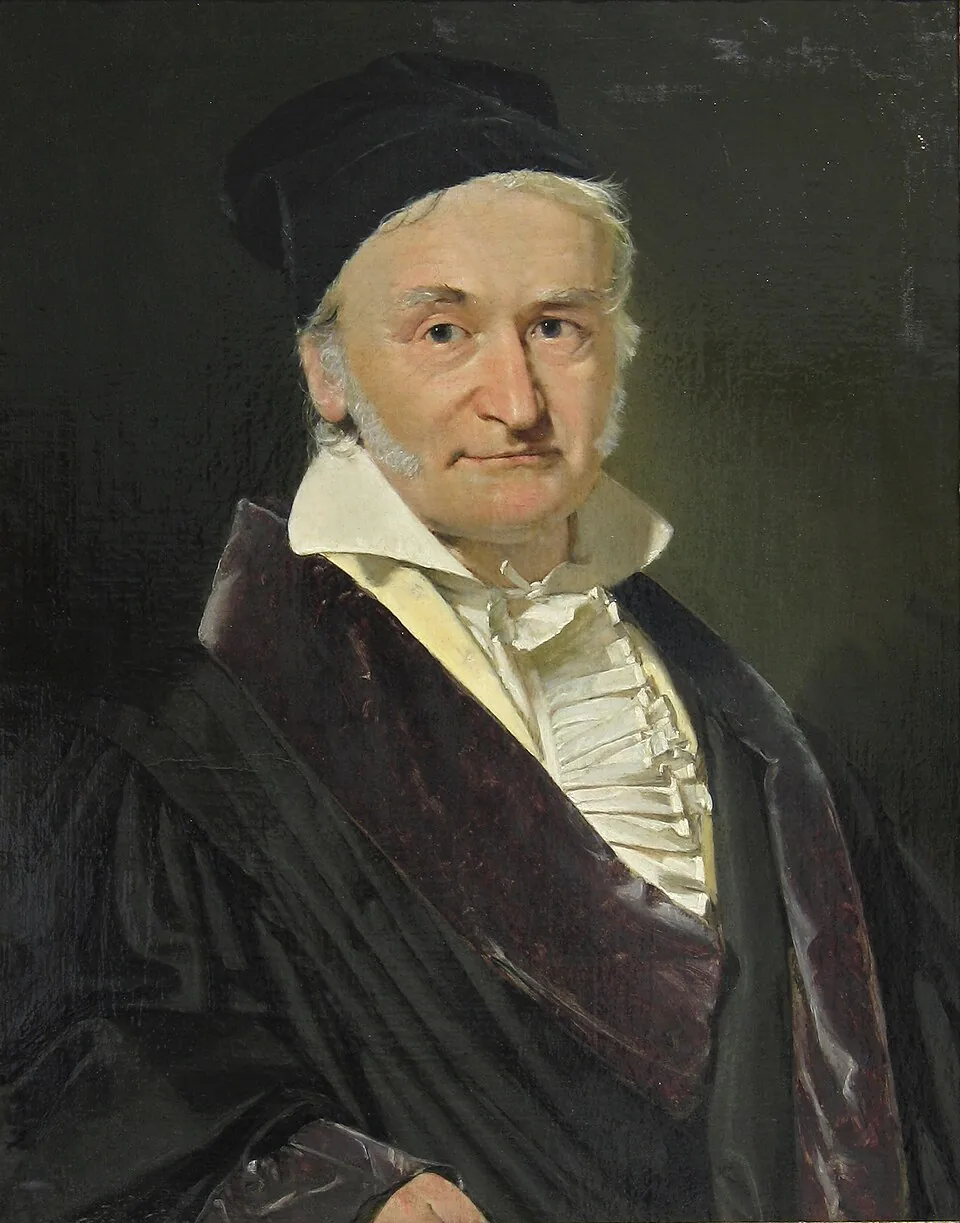
Standardized IQ testing did not exist until roughly 1905, fifty years after Gauss died — nothing could have measured him. He does not even appear in the 1926 Cox study that anchors most other pre-testing estimates on this site. The 250–300 figures attached to his name have no traceable source at all.
Carl Friedrich Gauss’ estimated IQ
- His own mathematical diary records, at nineteen, the proof that a regular seventeen-sided polygon is constructible with compass and straightedge — a problem untouched since antiquity.
- A doctorate from the University of Helmstedt in 1799 for a new proof of the Fundamental Theorem of Algebra, followed in 1801 by Disquisitiones Arithmeticae and the orbital calculation that relocated the lost dwarf planet Ceres.
- Four decades as director of the Göttingen Observatory, spanning number theory, astronomy, geodesy and, with Wilhelm Weber, the physics of magnetism.
No historiometric study we could find — including Catharine Cox’s 1926 survey of three hundred historical figures, the method that anchors several other pre-1850 estimates on this site — appears to include Gauss individually. This range reflects the documented record, not a scored estimate against peers.
- Born
- 30 April 1777, Brunswick
- Died
- 23 February 1855, Göttingen
- Field
- Mathematics, astronomy, physics
- Education
- University of Göttingen; doctorate, University of Helmstedt, 1799
- Known for
- Disquisitiones Arithmeticae, the Ceres orbit calculation, the normal distribution
- Canonical IQ
- Predates IQ testing by decades; no figure applies
What an IQ of 170–190 actually means
Set the claim aside for a moment. If someone genuinely scored in this range, here is what that would represent.
Average is 100 by construction, and about two-thirds of people fall between 85 and 115. Take the test to place your own score on this scale.
| Score range | Classification | Share of people | What it indicates |
|---|---|---|---|
| 85 – 114 | Average | ~68% | The range most people fall into. |
| 115 – 129 | Above average | ~13.6% | Roughly one person in seven. |
| 130 – 144 | Gifted | ~2% | The threshold most high-IQ societies use. |
| Above 144 | Highly gifted | ~0.1% | Figures above this range are extrapolated from the curve rather than measured. |
Percentages are approximate and describe a normal distribution. The same number means different things on tests with different standard deviations.
Thirty questions gives you a measured position on this exact scale — your score, your percentile and the ability breakdown behind it.
Find out in 30 minutes →Who Carl Friedrich Gauss was
Carl Friedrich Gauss was born in 1777 in Brunswick, in what is now Germany, to a family of modest means. A stipend from the Duke of Brunswick sent him to the Collegium Carolinum and then the University of Göttingen. He left in 1798 without a diploma, but the University of Helmstedt awarded him a doctorate the following year for a new proof of the Fundamental Theorem of Algebra.
In 1801 he published Disquisitiones Arithmeticae, a foundational text in number theory, and calculated the orbit that let astronomers relocate the dwarf planet Ceres after it had been lost from view — the achievement that made him famous outside mathematics. He became director of the Göttingen Observatory in 1807, a post he held until his death.
Later work spanned a geodesic survey of the Kingdom of Hanover, for which he invented the heliotrope, and a collaboration with physicist Wilhelm Weber on terrestrial magnetism. He died in Göttingen in 1855, still active in research.
 By Elora Mercer, Celebrity Research WriterFigures checked by Leon Falkner, Data & Research Analyst
Reviewed by Aarav Vardhan, Editor-in-Chief · Last reviewed August 2026

Carl Friedrich Gauss: the documented record
The estimate above rests on this record. Every entry here is a matter of public fact, which is more than can be said for the number itself.
- 1792Enters the Collegium Carolinum on the Duke of Brunswick’s stipend.
- 1796At nineteen, proves the regular 17-gon is constructible; begins his mathematical diary.
- 1799Awarded a doctorate by the University of Helmstedt.
- 1801Publishes Disquisitiones Arithmeticae; calculates the orbit that relocates Ceres.
- 1807Becomes director of the Göttingen Observatory.
- 1818Begins the geodesic survey of the Kingdom of Hanover.
- 1831Begins his collaboration with Wilhelm Weber on magnetism.
- 1855Dies in Göttingen.
Where the 250–300 figure came from
Following a claim back to its first appearance is the part almost nobody does — and it is what most people are actually asking.
Gauss is a useful case for what this site is trying to do, because the inflation here is not really about a number — it is about a story. The most repeated Gauss anecdote is that his primary-school teacher, hoping to occupy the class, assigned the sum of 1 to 100, and Gauss produced the answer almost instantly by pairing terms. The near-contemporary source for this — Sartorius von Waltershausen’s 1856 memoir, written the year after Gauss died — says only that he was given “the summation of an arithmetic series” and solved it at once. No numbers, no pairing method, no dialogue.
Every vivid detail usually repeated — the specific numbers 1 to 100, the pairing trick, the phrase “Ligget se” — was added by later writers between 1877 and 1955. E. T. Bell’s popular 1937 book Men of Mathematics, the version many people actually encountered, invents an entirely different and more complicated sum and is flagged by historians of mathematics as unreliable precisely for this kind of embellishment. The core fact — a child solved a problem his teacher expected to take an hour — is credible. Its famous specifics are not verifiable.
Compare Srinivasa Ramanujan, another mathematician whose legend outran the documentary record, and Isaac Newton, who sits at a similar range here for the same reason: an achievement record strong enough that no invented number was ever needed to make the case.
How we read a number →His own record of the 17-gon construction; the primary source for the exact date.
Near-contemporary memoir by a Göttingen colleague; source of the summation anecdote in its original, numberless form.
Biographical and career chronology.
Traces the summation anecdote through its successive embellishments, 1877–1955.
The historiometric study several other pre-testing figures on this site draw on. Gauss does not appear to be among its subjects.
No source has ever been traced for this figure.
No study, test or named methodology is cited by any page publishing this number.
The sources behind our estimate
The figures that circulate for Carl Friedrich Gauss, what we were able to confirm, and where the two diverge.
Figures of 250 to 300 circulate on “highest IQ in history” lists and social-media posts, often placing Gauss above every other name on the same list.
Gauss died in 1855; the first usable IQ test, the Binet-Simon scale, dates to 1905. No number was ever measured. The one serious academic attempt to retroactively score historical geniuses — Catharine Cox’s 1926 study of three hundred subjects born 1450–1850 — does not appear to include Gauss by name in its published results. The 250–300 figures cite no study, no method and no source of any kind.
One end of this spread is what the documented record supports. The other end is what “highest IQ ever” lists need a name to hold.
Want a number that does hold up? Every figure on this page is somebody’s claim. Take the 30-question test and get a percentile you can check rather than a figure you have to trust.
Carl Friedrich Gauss — frequently asked
What was Carl Friedrich Gauss’s IQ?
No figure applies. He died in 1855, decades before IQ testing existed, and does not appear in the one major historiometric study — Cox, 1926 — that estimates other pre-testing figures on this site.
Where does the “250–300” figure for Gauss come from?
No traceable source. It appears on “highest IQ in history” lists with no study, test or method cited.
Did young Gauss really sum 1 to 100 instantly?
The core event is credible — a near-contemporary 1856 memoir says he solved a summation problem his teacher expected to take an hour. The famous specifics (the numbers, the pairing trick, the exact dialogue) were added by writers between 1877 and 1955, most notably a popular 1937 account now considered unreliable.
What is Gauss actually known for?
Foundational work in number theory (Disquisitiones Arithmeticae), the orbital calculation that relocated Ceres, four decades directing the Göttingen Observatory, and, with Wilhelm Weber, early work on terrestrial magnetism.
Why estimate a range if no test could ever apply?
Because the question is searched regardless, and the answers online are invented. Our range reflects the strength of a documented achievement record, explicitly not a measurement.
How does Gauss compare to other historical figures on this site?
Similar in kind to Isaac Newton and Srinivasa Ramanujan — achievement records strong enough that no invented number should have been necessary, even though one exists anyway.
How does my IQ compare with Carl Friedrich Gauss?
You can find out in about fifteen minutes. The IQ Metrics assessment is 30 questions, scored on the same 100-mean scale used throughout this page, so your result and the estimate above are at least expressed in the same units — one measured, one inferred. Once you have a number, the leaderboard shows where it would sit, and how we score and norm it explains the benchmarking.
Where does this estimate come from?
From the documented record rather than a test — the method is named above and set out in full under how we read a number. Compare it against the other historical profiles, starting with Isaac Newton.
- Take the 30-question IQ test — get a measured score and percentile of your own
- Average IQ by country — how the scale behaves across populations
- How IQ Metrics scores its assessment — the method behind our own number
- More on how IQ testing works — reliability, error and what a score can and cannot say
- More historical profiles — same field, same method
More historical
Portrait by Jacques-Louis David (1812), via Wikimedia Commons, public domain. · Photograph by Marie-Lan Nguyen, public domain. Background removed for the portrait above. · Photograph by John Jabez Edwin Mayall (1875), public domain. Background removed for the portrait above.


An estimate is an inference.
Yours can be measured.
Thirty questions, scored against general-population benchmarks. Your score, your percentile, your ability breakdown and a printable IIF certificate.
Find your IQ score now! →