IQ Metrics
IIF Certified Assessment Start IQ Test
IIF Certified Assessment

Brainpower Unleashed: Unconventional Ways to Increase Your IQ

Brainpower Unleashed: Unconventional Ways to Increase Your IQ

“How can I increase my IQ?” is a question which is asked very often and several professionals recommend conventional methods like puzzles, mental exercises, and a nutritious diet, but what if I tell you that we have some out of the box methods that can help us increase our IQ. Embarking on a journey of cognitive enhancement by increasing your IQ, this discourse presents a series of unconventional techniques which can be used to increase IQ and boost intellectual capacity. These methods help us really understand all the amazing things our minds can do that most of us haven’t even discovered yet. Let’s begin exploring them:

The Power of Lucid Dreaming:

Lucid dreaming opens the door to a realm where you are not bound by the constraints of reality. In this fantasy world, you can fly, meet celebrities, and explore uncharted territories—all within the landscape of your own mind. Yet, the magic of lucid dreaming extends far beyond mere dreamscapes.

Imagine finding yourself in a complex situation at work that demands creative problem-solving. Your mind, sharpened by lucid dreaming, starts to recognize the dream-like nature of the problem. Just like in your dreams, you take control, manipulate variables, and arrive at a novel solution. In this instance, lucid dreaming has equipped you with a unique approach to real-world problem-solving.

The Mindful Art of Doodling:

Let’s journey into the world of doodling (The act of subconsciously writing or drawing things while engaged in meetings, phone calls or classes), often dismissed as mere scribbles on paper. However, beneath the seemingly aimless lines lies a practice that engages your brain in a profound way. Now imagine you are sitting in a lecture, your pen dancing on the margins of your notebook, seemingly detached from the classroom. Little do you know that your mind is in a state of deep focus and still soaking in the information around you.

Doodling becomes a powerful tool as you translate this focus into your daily life. In a high-pressure meeting, your hand instinctively starts to doodle. While your conscious mind is engaged in the discussion, your doodles act as a parallel stream of thought. In the end, your seemingly idle scribbles reveal a creative solution to the problem at hand.

The Science of Brainwave Entrainment:

The concept of brainwave entrainment is using sounds or lights to help your brain get into a certain mood, like feeling relaxed or focused, like listening to music while working or studying. This tangible technique synchronizes your brainwaves with specific frequencies, altering your state of consciousness. Imagine you’re preparing for a crucial exam, and you need to absorb a massive amount of information.

By engaging in brainwave entrainment, you enhance your ability to concentrate deeply. As your brainwaves align with the frequency that promotes focused learning, you dive into your study materials with unparalleled clarity. Your retention improves, and you grasp complex concepts effortlessly. This real-life example demonstrates the practicality of an unconventional method in the face of academic and professional challenges.

Unlocking Quantum Mind Power:

Quantum mind power is like using special science techniques to make our thinking extremely creative. It takes ideas from a science called quantum physics, which deals with tiny things that we cannot see and uses them to help us think in really unique ways. This might sound a bit tricky, but it’s actually very beneficial. Trying to think like this can instantly start boosting our brainpower and IQ.

For instance, imagine you are trying to choose a new project at work, and it’s hard to decide. Using quantum mind power, you think in a new way, like imagining all the different paths each project could take, not just ‘good’ or ‘bad’. This helps you visualise what will happen when you go down each path and also helps you develop a brilliant idea that nobody else thought of, making your choice stand out.

Embark on Memory Palaces:

Memory palaces are like creating a map of secret rooms in your mind, where each room holds unforgettable information. Think of it as building your detective’s den, similar to the famous fictional detective Sherlock Holmes, who uses his “mind palace” to remember clues and solve cases. Imagine you’re prepping for an important talk. You arrange all your key points in different ‘rooms’ of your memory palace.

As you begin your presentation, you mentally walk through these rooms, easily recalling each point. This boosts your confidence, and you deliver a smooth, impressive talk. Your audience, including colleagues and bosses, is amazed. Memory palaces aren’t just memory tricks; they are a smart strategy to enhance how your brain works and even increases your IQ.

In this journey of cognitive enhancement, we have witnessed how unconventional methods can help boost IQ scores and also act as portals to uncharted territories within your brain. They offer you cognitive enhancement and the chance to experience life through a new lens.

At IQ Metrics, we believe that intelligence knows no bounds. Our certified IQ tests are designed to help individuals from all walks of life explore their cognitive potential. Your journey to IQ enhancement begins here. Discover your cognitive prowess and unlock the power of unconventional methods to boost your IQ.

Embrace a brighter, more intelligent future!
Gifted Cutoff Scores

Gifted Cutoff Scores

Most gifted programmes draw their line at an IQ of

Stereotype Threat and Test Scores

Stereotype Threat and Test Scores

Few findings in psychology have been cited as widely, or

Nutrition and IQ

Nutrition and IQ

The evidence on diet and intelligence looks contradictory until you

Decoding Intelligence: The 5 Ground-breaking Theories Shaping Modern IQ Testing

Decoding Intelligence: The 5 Ground-breaking Theories Shaping Modern IQ Testing

Several innovative hypotheses have developed in our pursuit of understanding the intricacies of the human mind, influencing how we gauge intelligence. Insights into how these ideas shape our knowledge of intelligence and cognitive capacities are provided in this blog’s examination of them. People of all ages, from students to working professionals, can benefit greatly from the deep understanding of cognitive capacities offered by these theories. To show how these theories can be applied in real-world situations, we go into them here.

The Core of Intellect: Spearman’s Theory of General Intelligence (g-factor)

Spearman’s ‘g-factor’ posits that a single factor underlies different cognitive abilities. Consider Sarah, a project manager, whose ability to quickly grasp complex concepts and manage diverse tasks showcases a strong ‘g-factor’. This general intelligence plays a crucial role in her ability to adapt to different job roles and solve a variety of problems. On the other hand, in daily life, a high ‘g-factor’ is evident when someone can efficiently plan a family budget or swiftly learn a new skill. It is extremely beneficial to test this general intelligence through tasks that challenge various cognitive skills, providing insights into one’s adaptability and problem-solving capabilities across different domains of life.

Dynamic Duo of Intellect: Fluid and Crystallized Intelligence (Cattell-Horn Theory)

The Cattell-Horn Theory distinguishes between “fluid intelligence” – the ability to solve new problems, and “crystallized intelligence” – the use of learned knowledge and experience. Fluid intelligence is crucial when facing novel situations, like adapting to technological advancements or devising creative solutions under pressure. Crystallized intelligence, meanwhile, is reflected in tasks that require expertise or historical understanding, such as a lawyer utilizing legal precedents. IQ tests assess both, helping individuals understand their capacity for both innovative problem-solving and applying accumulated knowledge, which is essential in career development and making informed decisions in daily life.

A Spectrum of Skills: Primary Mental Abilities (Thurstone)

Thurstone’s theory highlights diverse mental abilities like verbal, numerical, and spatial skills. In real life, this diversity is evident when someone excels in specific tasks – like a writer crafting compelling narratives (verbal ability) or an engineer solving complex spatial problems (spatial ability). IQ tests include aspects of these abilities, enabling individuals to identify their strengths and potential areas for growth. By understanding their primary mental abilities, people can tailor their educational and career choices to align with their innate skills, leading to more satisfying and successful professional paths.

Understanding Mind Mechanics: Information Processing Approach

The Information Processing Approach isn’t confined to academics; it extends its influence into various professions. Consider Hana, a diligent university student, and Sam, a visionary architect. Hana, as a sequential thinker, thrives in her academic pursuits by meticulously organizing her study materials and approaching each subject methodically. On the other hand, Sam, a holistic thinker, envisions entire architectural structures, considering all elements simultaneously, a valuable skill in his profession. These cognitive styles significantly impact their performance, be it in academics or architecture. IQ tests at IQ Metrics delve into these processing styles, offering Hana and Sam insights to fine-tune their approaches, enhancing their efficiency, problem-solving abilities, and communication skills, whether in university or the professional world.

Beyond Words: Raven’s Progressive Matrices

Raven’s matrices assess abstract reasoning, a skill vital in both professional and personal contexts. In the workplace, abstract reasoning enables innovative thinking and strategic planning, while in personal life, it helps in understanding complex societal issues or in planning long-term goals. Our tests include these types of questions, helping individuals understand their capacity for abstract thinking, which is crucial for roles requiring high levels of creativity and strategic thought.

Intelligence theories lay out a road map for furthering our theoretical and practical understanding of the mind. When trying to make sense of these mental capacities, intelligence testing is crucial. It offers a detailed picture of one’s intellectual capabilities and where they might use some work. This can help pupils with their academic decisions and study techniques. Career growth and workplace practises might be influenced by this for professionals. In one’s daily life, knowing one’s cognitive profile might help in solving problems and making better decisions. Here at IQ Metrics, we understand the game-changing potential of these kinds of discoveries. Based on these notions, our examinations serve as more than just evaluations; they are instruments for intellectual and personal development.

Gifted Cutoff Scores

Gifted Cutoff Scores

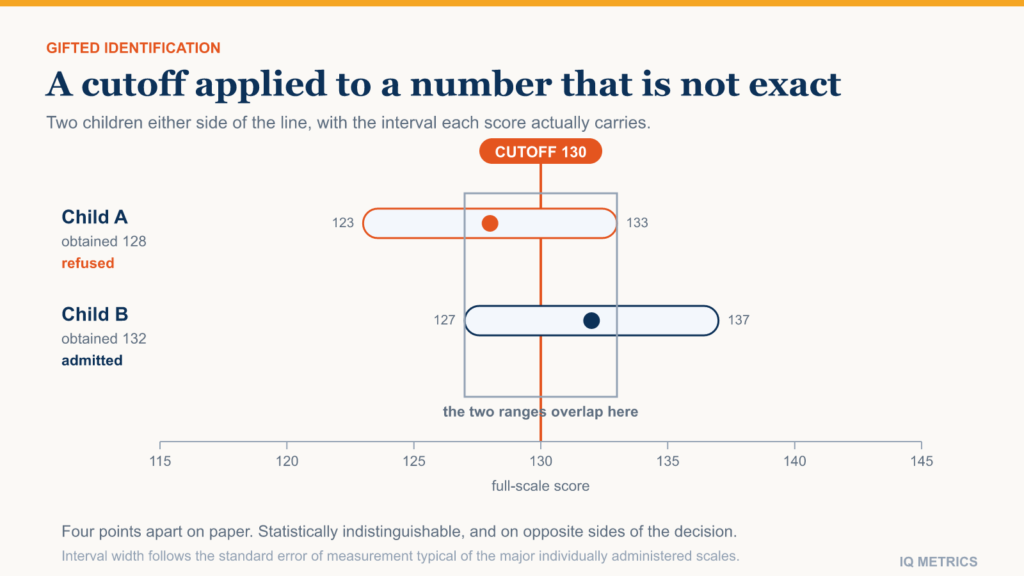
Most gifted programmes draw their line at an IQ of

Stereotype Threat and Test Scores

Stereotype Threat and Test Scores

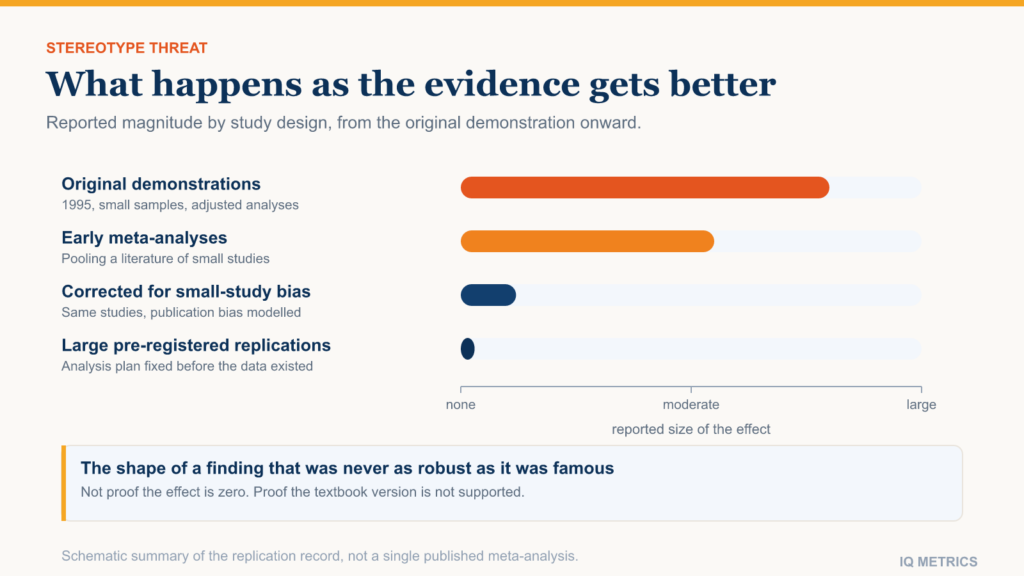
Few findings in psychology have been cited as widely, or

Nutrition and IQ

Nutrition and IQ

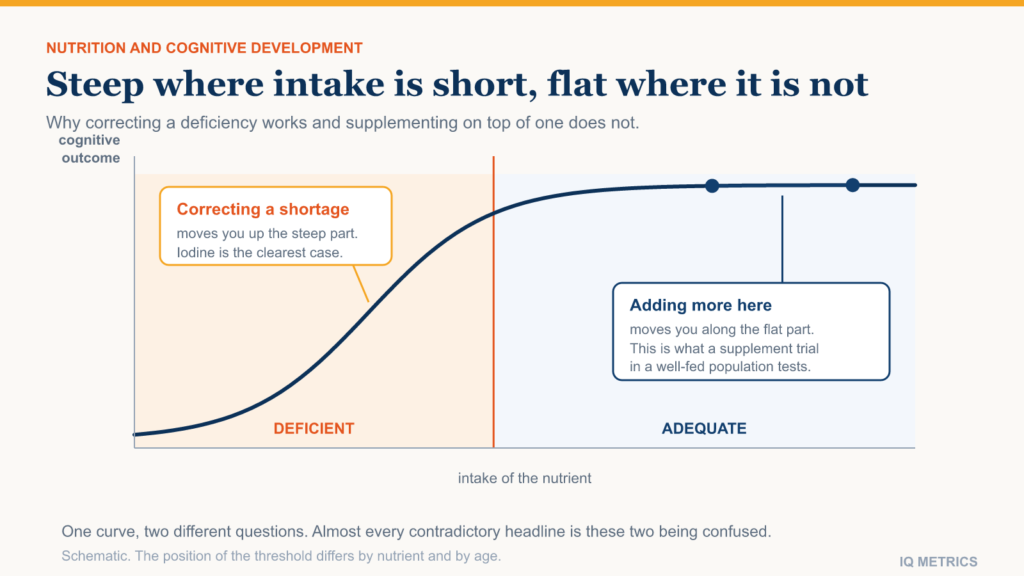
The evidence on diet and intelligence looks contradictory until you