IQ vs EQ: What Each One Measures and Why You Need Both
IQ measures reasoning; EQ measures how well you read and manage emotion. They are different constructs, measured in different ways, with different amounts of evidence behind them. Here is what each one actually predicts, which is easier to change, and where the popular claim that EQ matters more comes from.
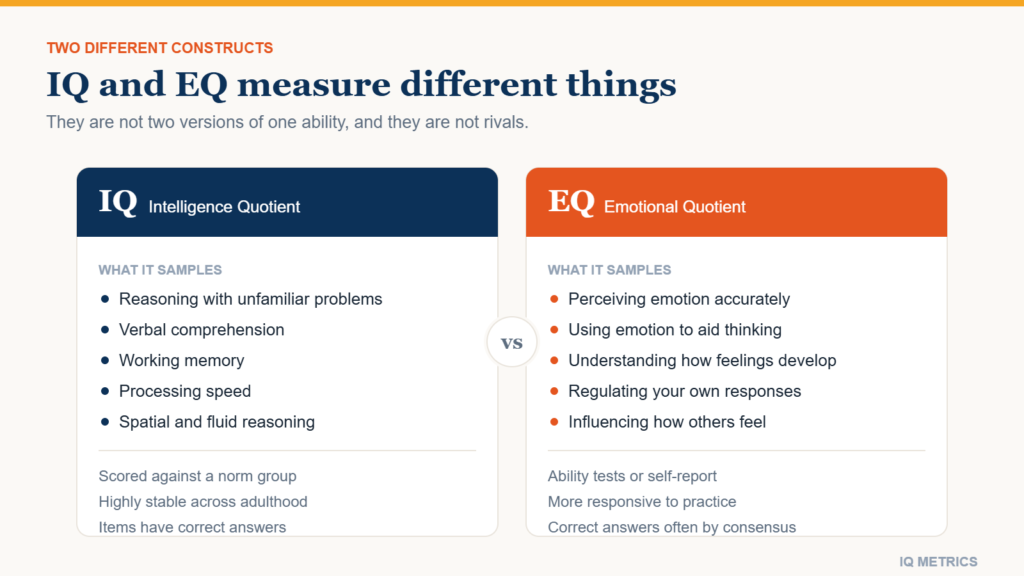
“IQ gets you hired, EQ gets you promoted” is one of the most repeated lines in workplace writing, and like most memorable lines it is partly true and partly a simplification that hides the interesting detail. IQ and EQ are not two versions of the same thing, and they are not rivals. They measure different capacities, they are measured by very different methods, and the quality of evidence behind them is not equal.
This article sets out what each one is, how each is assessed, what each actually predicts, and which of the two you can realistically change.
What IQ measures
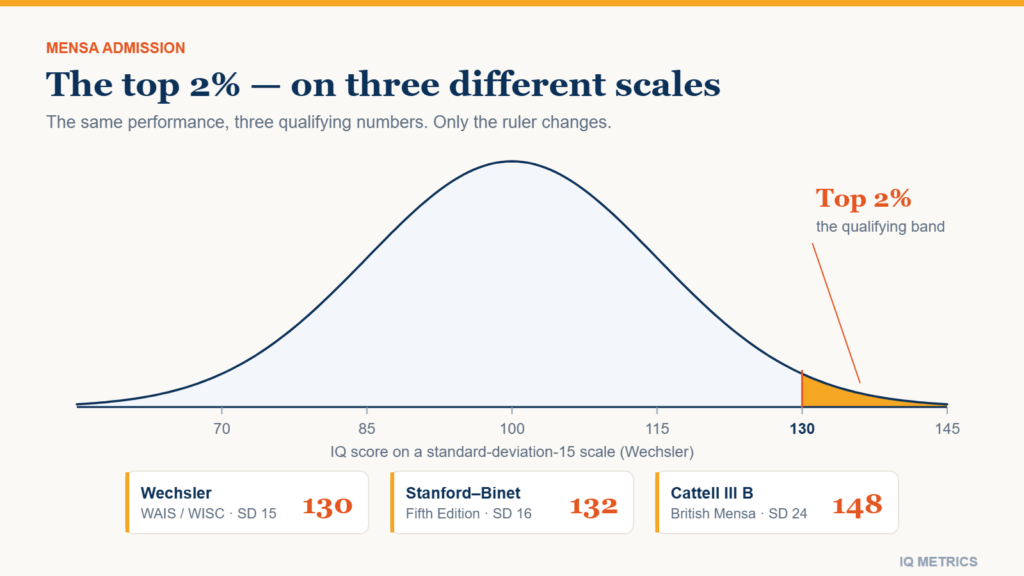
IQ, or intelligence quotient, is a standardised measure of reasoning ability. A modern test samples several distinct capacities — verbal comprehension, perceptual or fluid reasoning, working memory and processing speed — and combines them into a single composite score scaled so that the population average is 100.
The score is not a count of correct answers. It is a position: a statement of how far your performance sits from the average of a norm group of people your own age. That is why the same raw performance yields different numbers on different scales, and why the IQ bell curve is the right mental picture for what a score means. If the concept is new, our explainer on what an intelligence quotient is covers the foundations.
What IQ deliberately does not measure is knowledge. A good test avoids anything you could revise for, because the target is how well you handle a problem you have never encountered, not how much you have accumulated.
What EQ measures
EQ, or emotional quotient, refers to emotional intelligence: the ability to perceive emotion accurately, to use emotion to assist thinking, to understand how emotions develop and combine, and to regulate emotion in yourself and others.
The concept was introduced in the academic literature by Peter Salovey and John Mayer in 1990 and reached a mass audience through Daniel Goleman’s 1995 book. Those two origins matter, because they produced two rather different ideas that share a name — a tightly defined ability model on one side and a much broader popular bundle of traits and habits on the other.
The four-branch model
- Perceiving emotion — reading emotional signals in faces, voices and situations, including your own.
- Using emotion — harnessing mood to support reasoning, judgement and creativity.
- Understanding emotion — knowing how emotions escalate, blend and change over time, and what causes them.
- Managing emotion — regulating your own responses and influencing those of other people.
Read as a list, these look like personality. Read as abilities, they are things you can be measurably better or worse at, which is what makes the ability model testable in a way the popular version is not.
IQ vs EQ at a glance
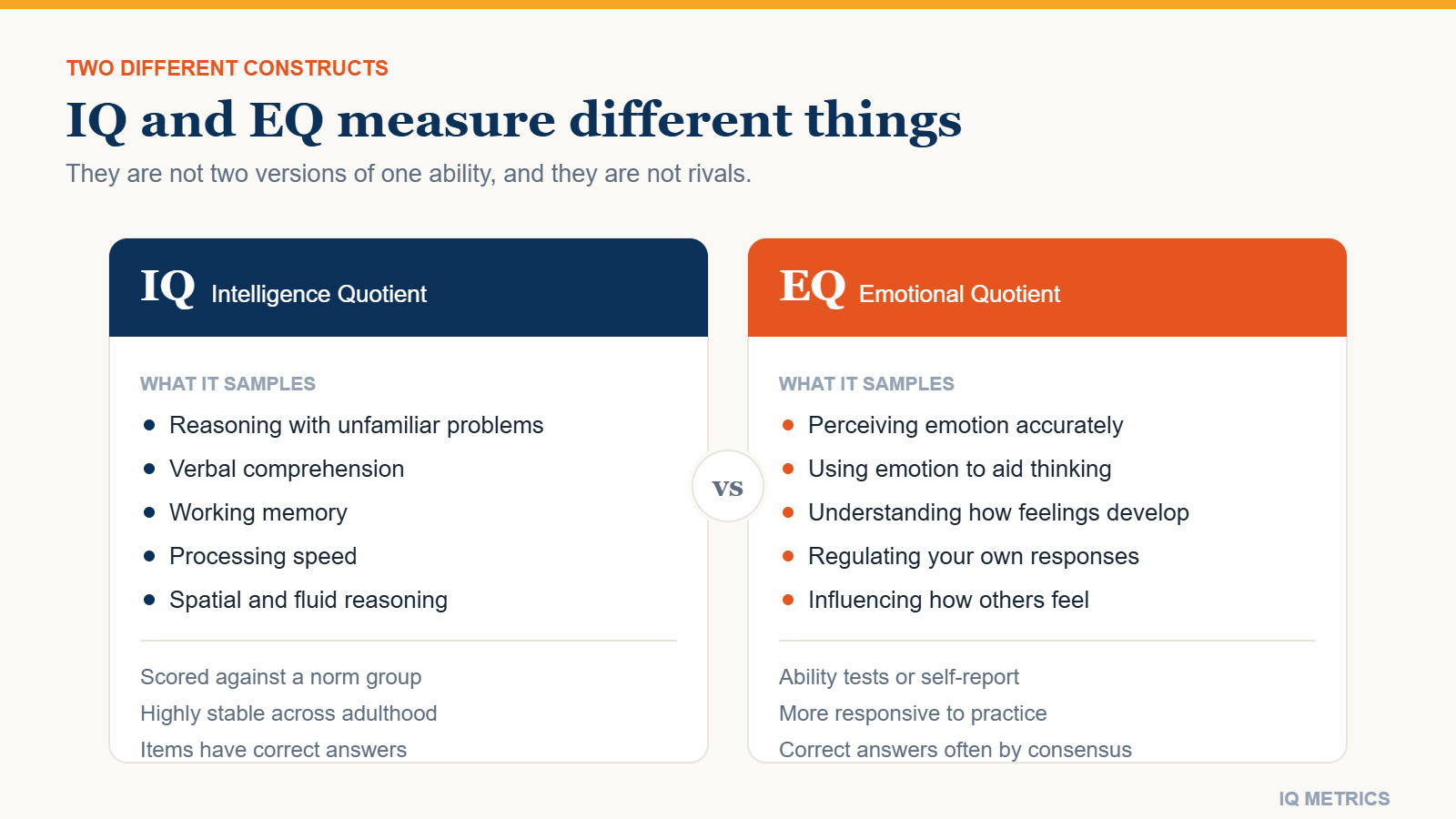
The two constructs differ on almost every dimension that matters: what they sample, how stable they are, how they are scored, and how confident we can be in the measurement.
- What is sampled — IQ samples reasoning under time pressure; EQ samples emotional perception, understanding and regulation.
- Stability — IQ is highly stable across adulthood; EQ is generally more responsive to experience and deliberate practice.
- Measurement quality — IQ tests have close to a century of psychometric development behind them; EQ measurement is younger and much less settled.
- Scoring — IQ items have objectively correct answers; many EQ instruments do not, which is the central difficulty in the field.
How each one is measured
Measuring IQ
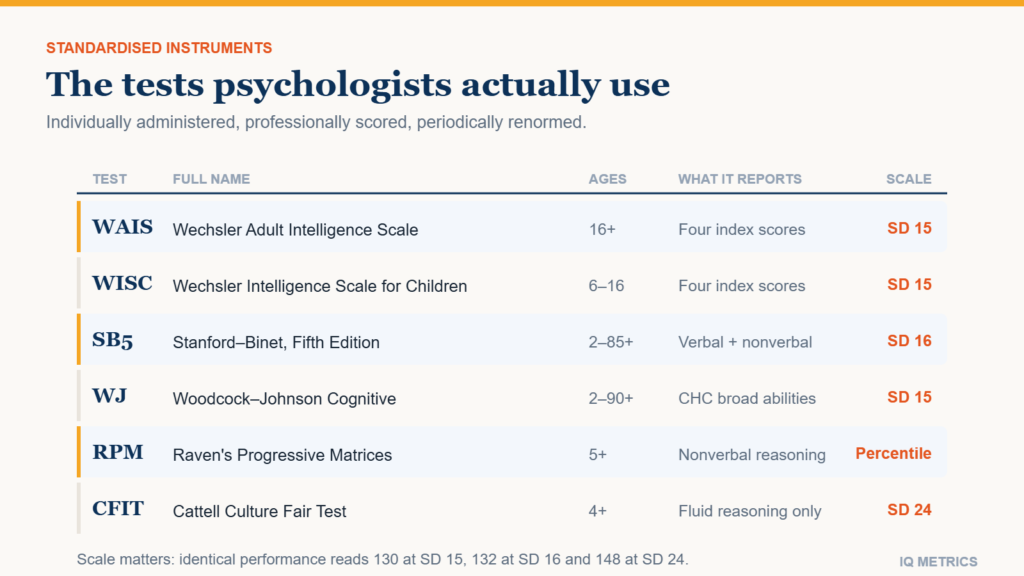
Individually administered tests such as the Wechsler scales and the Stanford-Binet are the reference standard. They are delivered one-to-one by a trained administrator, take one to two hours, and report a composite score alongside index scores and a confidence interval. The methodology is mature and the reliability figures are high and publicly documented. Our guide to the professional IQ tests compares the major instruments.
Measuring EQ, which is a harder problem
EQ instruments split into two families, and the split is the reason the field is contested.
Ability tests, such as the MSCEIT, present emotional problems with scored answers — identify the emotion in this face, judge which action would best regulate this feeling. They behave like tests. The difficulty is deciding what counts as the correct answer, which is usually settled by consensus or expert judgement rather than by fact.
Self-report questionnaires, such as the EQ-i and the many quizzes derived from it, ask you to rate your own emotional skills. They are quick and popular, and they have an obvious structural weakness: someone with poor emotional perception is precisely the person least equipped to rate their own emotional perception accurately. Self-report EQ scores also correlate substantially with ordinary personality traits, which raises the question of how much new ground they cover.
Where would your own score land?
Take the IIF-certified assessment and get your score with the scale it was measured on, the percentile it corresponds to and the confidence range around it — the three figures most online tests leave out.
Which one predicts success better?
This is where the popular claim needs unpacking. Across the research literature, measured cognitive ability is one of the more consistent predictors of academic attainment and of performance in cognitively demanding work, and its predictive power tends to increase with job complexity.
Emotional intelligence shows its clearest value in roles built around interpersonal demand — leadership, negotiation, care work, teaching, client-facing and team-based work — and in outcomes such as team cohesion and conflict handling that a reasoning test was never designed to touch.
The honest summary is that they predict different things, and the sensible question is not which is larger but which is relevant to the situation in front of you. Neither explains most of the variance in anyone’s life; motivation, opportunity, health, circumstance and luck do enormous work that neither construct captures. We explored that wider point in is intelligence limited to IQ.
Can you raise either one?
This is the most practically useful difference between them.
IQ is comparatively resistant to change in adulthood. Scores improve modestly with test familiarity, and they can be depressed by poor sleep, illness, stress or anxiety — which means removing those things can raise a measured score without changing the underlying ability at all. Our article on the factors that affect IQ test results covers what genuinely moves a number.
Emotional skills are more trainable. Perceiving emotion accurately, pausing before reacting, naming what you feel, and reading a room are all capacities that improve with deliberate attention and feedback. Whether that improvement shows up on an EQ test is a separate question from whether it shows up in your relationships, and the second one is the one worth optimising for.
Where "EQ matters more than IQ" comes from
The claim traces largely to popular writing from the mid-1990s, where figures attributing the large majority of workplace success to emotional intelligence were widely quoted. Those figures were considerably stronger than the peer-reviewed evidence supported at the time, and stronger than it supports now.
There is a second, more subtle reason the claim feels true. In selective environments — a competitive university course, a demanding profession — everyone present has already cleared a cognitive bar. Within that narrowed range, differences in reasoning ability explain less of what separates people, and interpersonal skill explains relatively more. The observation is real; the generalisation from it to the whole population is not.
How to use both
Treat them as answering different questions. If you want to know how you handle novel reasoning problems under time pressure, that is an IQ question, and it deserves a properly normed test that reports its scale, your percentile and a confidence range rather than a bare number. If you want to know why a conversation went badly or why a team is not functioning, no IQ score will help you.
If you are curious about the first, our IQ test reports all three figures, and the percentile calculator will show you what any score means as a rank. Just do not expect either to tell you how good you are at reading a room — that was never what they were built to measure.
Keep reading
 Understanding IQ
Is Intelligence limited to IQ?
As we explore the fascinating world of intelligence, we will uncover the truth about IQ and the limitations of the human intellect. Beyond traditional measures of intellect, this article explores a wider range of aptitudes that impact our perception and engagement with the natural world.
 Research & Evidence
Is IQ Genetic?
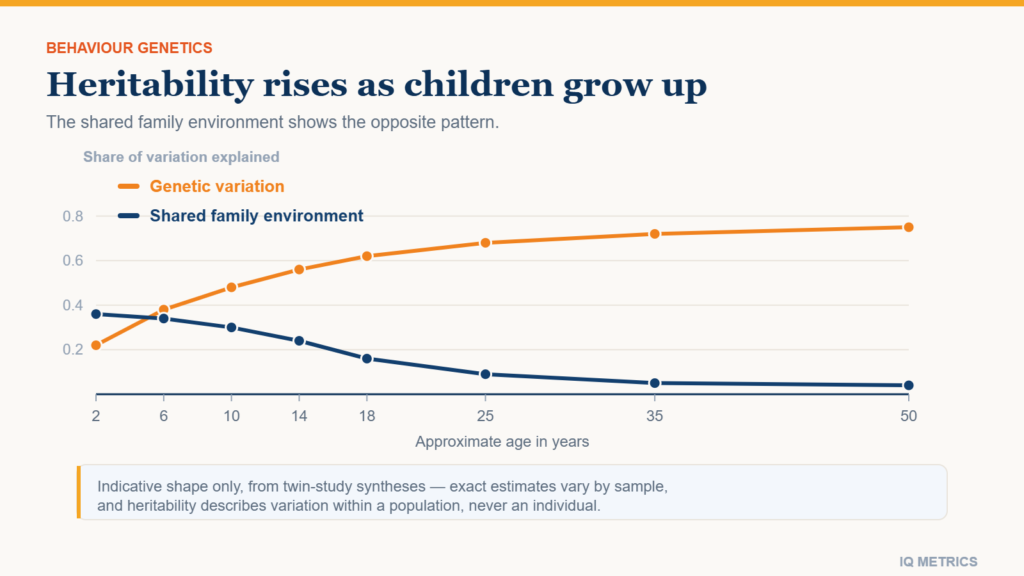
Heritability estimates for IQ rise from roughly 0.4 in childhood to 0.7 or higher in adulthood, which sounds decisive until you know what heritability measures. Here is what twin and adoption studies actually show, and the four conclusions people draw from them that the statistic does not support.
 Scores & Scales
Mind Matters: The Surprising Link Between Emotions and IQ Test Scores
In your journey towards intellectual excellence, remember: understanding and managing your emotions is as important as sharpening your cognitive abilities. Embrace this holistic approach, and you are bound to not only excel in IQ tests but also thrive in life’s myriad challenges.