IIF Certified Assessment
Start IQ Test
IIF Certified Assessment
No study has ever found a real link between star sign and measured intelligence. The pattern some people half-remember is either astrology's own vagueness at work, or a mix-up with a genuine, unrelated finding about relative age.
“What's the smartest zodiac sign” gets searched often enough that a straight answer is worth giving before anything else: there isn't one, and there is no mechanism by which there could be. The position of the sun, moon and planets at your birth has no established causal pathway to your neurons, and no study meeting ordinary scientific standards has found one.
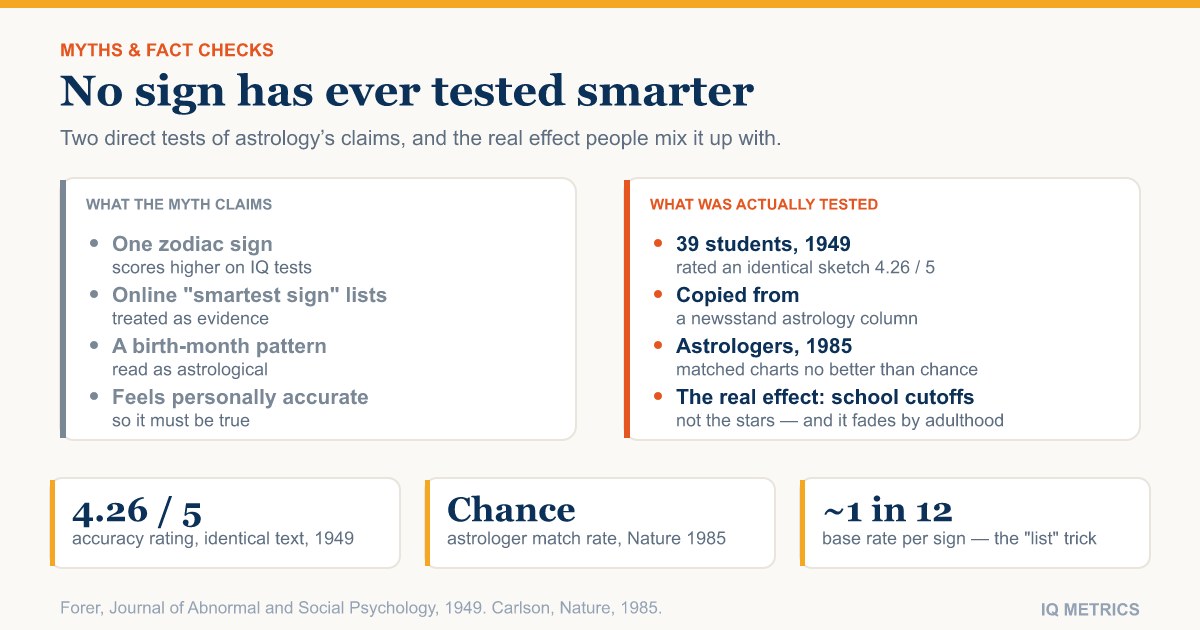
There has not been much research specifically pairing zodiac sign with IQ scores, for the same reason nobody runs trials on whether your street address predicts your reflexes — there is no plausible mechanism to test. What does exist is decades of research testing astrology's predictive claims more broadly, and it has not gone well for astrology. In one of the best-known tests, published in Nature in 1985, researcher Shawn Carlson had professional astrologers match real birth charts to the correct personality profiles out of a set that included decoy profiles, under conditions the astrologers themselves helped design. The astrologers could not do better than chance.
Forer gave 39 students an identical personality sketch and told each one it was written just for them. They rated its accuracy at 4.26 out of 5 — and Forer had copied it out of a newsstand astrology book.
That demonstration is the single most useful fact for understanding why zodiac-trait claims feel true. In 1949, psychologist Bertram Forer gave a personality test to 39 students, then a week later handed every one of them the identical write-up, describing it as a personalized result generated just for them. He had assembled it from a newsstand astrology column. Students rated how well it described them personally at an average of 4.26 out of 5, on a 5-point scale. The effect now carries his name — the Forer effect, also called the Barnum effect after showman P. T. Barnum — and it is the same mechanism at work whenever a horoscope, a personality quiz or a psychic reading feels uncannily accurate: the description is vague and universally flattering enough to fit almost anyone who reads it.
Even granting astrology's premises for the sake of argument, the calendar dates most horoscopes use have a further problem: they describe where the sun sat against the zodiac constellations roughly two thousand years ago, when the system was fixed. Earth's axis slowly wobbles over a roughly 26,000-year cycle, called precession, so the sun's actual position against the background stars on any given calendar date has drifted by nearly a full constellation since then. Western tropical astrology keeps the original fixed dates rather than the sky's current alignment, which is an internally consistent convention for a symbolic calendar system — but it is one more reason nobody should expect a physical trait like measured cognitive ability to track it.
There is a genuine, well-studied relationship between birth timing and test scores — it just has nothing to do with the stars. Children born just before their school system's enrollment cutoff date start school as the youngest, and therefore least developmentally mature, students in their grade. Tested at the same age as older classmates, they score lower on average, an effect researchers call the relative-age effect. We covered the mechanism in more detail in our piece on relative age and IQ test scores.
The confusion is easy to see coming. A school cutoff date sorts children into a “born in these months score lower” pattern, which superficially resembles “born under this sign scores lower.” But the mechanism is entirely different: it is about a specific school system's calendar cutoff, which varies by country and even by district, and about the age at which a child happens to sit a test — not about which zodiac sign spans those birth months. The effect also shrinks and mostly disappears as children age into adulthood, which a fixed astrological trait, by definition, would not do.
A properly built IQ test does not compare you to everyone who has ever taken it — it compares you only to a reference sample of people close to your own age, sometimes in bands as narrow as a few months for young children. That norming process is explained in more detail on our how IQ tests work page. It exists precisely to prevent a birth-timing effect from leaking into the score: a child's raw performance becomes a percentile against same-age peers, not against a full school-year class that can include children up to a year older. Sort a set of properly normed adult IQ scores by birth month, and the relative-age effect visible in raw classroom comparisons has already been engineered out.
Put the two things together and the appeal of a zodiac-IQ ranking makes sense without needing any real effect behind it. A generic, flattering description read into a birth month (the Forer effect) gets false confirmation from the one relative-age pattern that seemed to hold up, and the two get reported together as though they support each other. Neither one does. This is the same pattern our piece on IQ and personality type found when checking whether MBTI type predicts IQ: a system built to sort people into flattering, broadly applicable categories will always produce plausible-sounding stories after the fact, and none tested so far have produced a real, replicated score difference.
The only way to find out where your own reasoning actually stands is a properly normed test scored against a current reference sample — not the month you were born in.
Find your IQ score now! →So: there is no smartest zodiac sign, because the question assumes a mechanism that has been tested directly and found absent. The birth-month pattern that occasionally surfaces in casual data is a school-calendar artifact with a well-understood cause, fades by adulthood, and is exactly what age-based norming in a real IQ test is designed to remove. If you want to see where your own reasoning stands, take a properly normed IQ test and read the result as a percentile on our percentile calculator — not sorted by birth month.
No. No peer-reviewed study has found a reliable link between zodiac sign and measured IQ, and there is no known mechanism by which the timing of a birth relative to the stars could affect cognitive ability. Rankings that circulate online are built from self-selected quiz data or lists of famous people, neither of which is evidence of a real difference.
Because none of them are measuring anything real. Different sites pull from different small, self-selected samples or different celebrity lists, so the “winning” sign changes depending on which unreliable source you check — which is itself a sign that no underlying effect is being measured.
Indirectly, through school timing rather than astrology. Children born just before their school's enrollment cutoff are the youngest in their grade and score lower on tests taken at that age — a relative-age effect that fades by adulthood and has nothing to do with zodiac sign. Properly age-normed IQ tests are specifically designed to cancel this effect out.
The Forer effect, also called the Barnum effect, is the tendency to rate a vague, generically flattering personality description as personally accurate. In the original 1949 demonstration, 39 students each rated an identical description — copied from a newsstand astrology book — as an accurate personal profile. It explains why horoscopes and zodiac personality types can feel uncannily accurate without having any real predictive power.
Corrections: spotted an error? Email corrections@iqmetrics.org and we will update this story and note the change here.
Two children born eleven months apart can land in the same school year, and the younger one reliably tests lower on cognitive and achievement measures for reasons that have nothing to do with ability and mostly fade by adulthood.
Analyses that compare siblings inside the same family do find a firstborn advantage on measured intelligence — roughly one to two points on a mean-100, standard-deviation-15 scale. It is real, its size is disputed, and it is no larger than the error on a single test.
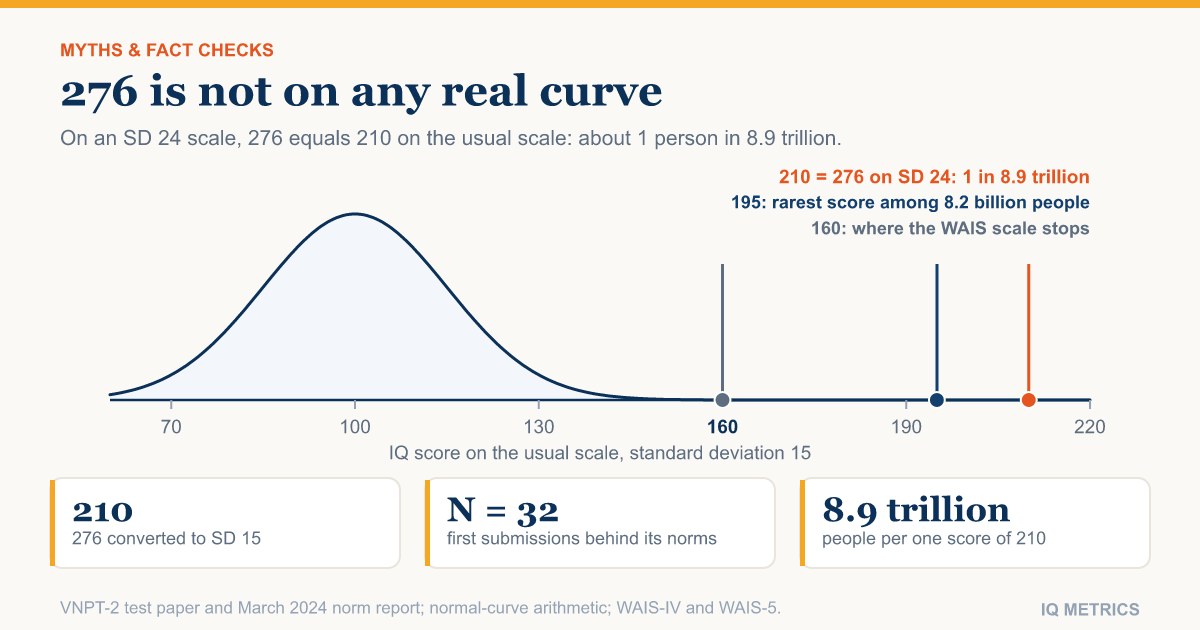
YoungHoon Kim is widely described as having the world's highest IQ, 276. The number comes from a perfect score on a 32-question, untimed online test that allows internet use, normed on 32 test takers and stated on a scale with a standard deviation of 24. Here is what that score can and cannot mean.
Our IIF-certified assessment reports your score with its scale, percentile and confidence range — and a breakdown of the cognitive domains behind it.
Start IQ Test →