



WPPSI-IV Scores Explained: Score Ranges, Composites and IQ
Pearson's WPPSI-IV covers ages 2:6 to 7:7 and reports composites on the familiar 100-and-15 scale. Its sample report shows a Full Scale IQ of 99 built from indexes that run from 63 to 126, and no public table says what score is gifted.

What you need to know
- The WPPSI-IV covers ages 2:6 to 7:7 in two bands. Composite scores have a mean of 100 and a standard deviation of 15 and subtest scores a mean of 10 and a standard deviation of 3, according to an independent Buros review; Pearson's sample reports match a normal curve on that scale.
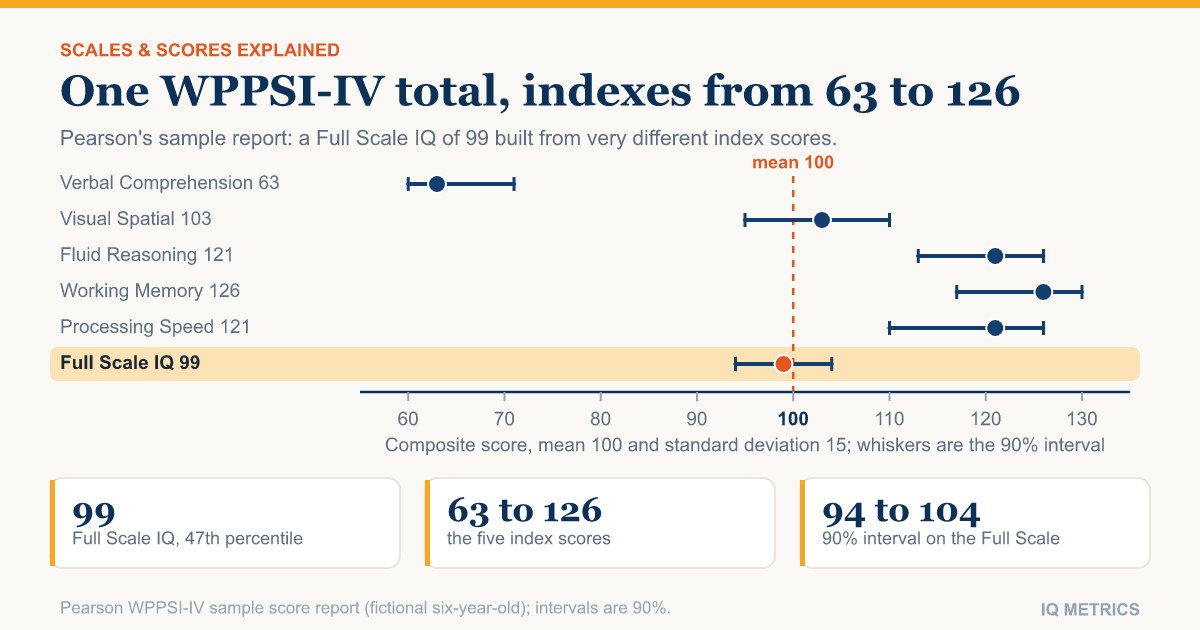
- Pearson's sample report for a fictional six-year-old gives a Full Scale IQ of 99 (47th percentile, interval 94 to 104) from indexes that run from Verbal Comprehension 63 to Working Memory 126, a 63-point spread the total does not show.
- Pearson prints descriptor labels (Extremely Low at 63, Borderline at 73, Average from 90 to 108, High Average at 118, Superior from 121 to 128) but the cut-point table is in a sold manual, and we found no public gifted cut-off.
- The norms come from a 2012 sample of 1,700 children matched to the US census; a Buros review reports Full Scale IQ consistency of .95 to .96 and test-retest reliability above .90 in 172 children.
The WPPSI-IV reports a Full Scale IQ and up to five index scores on a scale with a mean of 100 and a standard deviation of 15, for children aged 2 years 6 months to 7 years 7 months. A score of 100 is average for the child's age, about two-thirds of children score between 85 and 115, and a 130 is the 97.7th percentile. Pearson does not publish a gifted cut-off, and its sample report shows why one number can hide a lot: a Full Scale IQ of 99 sitting on indexes that run from 63 to 126.
What is the WPPSI-IV and who takes it?
The Wechsler Preschool and Primary Scale of Intelligence, Fourth Edition, is Pearson's intelligence test for young children, dated 2012. It has two age bands, 2:6 to 3:11 and 4:0 to 7:7, each with its own record form. Pearson's brochure gives 30 to 45 minutes for the core subtests in the younger band and 45 to 60 minutes in the older one. The test is on paper, is given by a qualified examiner at Pearson's Qualification Level C, and is scored by hand or on Pearson's Q-global platform. Pearson's store page lists determining admittance eligibility for private schools among its uses.
It is not the same product as our own online test for young children. Our IQ test for ages 4 to 7 covers the same age band with a different test, and our guide to IQ testing for children explains how the two kinds differ.
What do the WPPSI-IV composites and index scores measure?
The subtests and indexes depend on the child's age. The brochure lists 15 subtests in all.
- Ages 2:6 to 3:11: Full Scale, plus Verbal Comprehension (Receptive Vocabulary, Information), Visual Spatial (Block Design, Object Assembly) and Working Memory (Picture Memory, Zoo Locations)
- Ages 4:0 to 7:7: Full Scale, plus Verbal Comprehension (Information, Similarities), Visual Spatial (Block Design, Object Assembly), Fluid Reasoning (Matrix Reasoning, Picture Concepts), Working Memory (Picture Memory, Zoo Locations) and Processing Speed (Bug Search, Cancellation)
- Ancillary indexes: Vocabulary Acquisition, Nonverbal and General Ability at both ages, and Cognitive Proficiency only at 4:0 to 7:7
So the youngest children get no Fluid Reasoning or Processing Speed index, and not every subtest counts toward the total: in Pearson's sample report for a six-year-old, the Full Scale IQ is built from six subtests. Our guides to WISC-V index scores and WAIS-IV and WAIS-5 index scores cover the same family at older ages, and CHC theory explains the abilities behind the index names.
What are the WPPSI-IV score ranges?
Composite scores have a mean of 100 and a standard deviation of 15, and subtest scaled scores a mean of 10 and a standard deviation of 3 with a range of 1 to 19, according to an independent review by Canivez in the Buros Mental Measurements Yearbook. Pearson's public files never state the mean and spread in words, but its sample report bears them out: the percentile ranks match a normal curve on that scale, so a 99 is the 47th percentile and a 126 the 96th.
- A composite of 70: about the 2nd percentile
- 85: about the 16th
- 100: the 50th
- 115: about the 84th
- 120: about the 91st
- 125: about the 95th
- 130: about the 97.7th, one child in 44
- 145: about the 99.9th, one child in 741
The descriptor labels are Pearson's. In its two sample reports, a 63 is labelled Extremely Low, 73 Borderline, 82 and 83 Low Average, 90 to 108 Average, 118 High Average and 121 to 128 Superior. The full table of cut-points sits in the technical manual, which is sold rather than published, so we cannot give the exact edges: the examples show the labels, not the boundaries. Our percentile calculator gives the percentile for any score on this scale.
What does a WPPSI-IV score report look like?
Pearson's sample report for a fictional six-year-old shows the layout: each composite with a percentile rank, a 90 per cent confidence interval and a descriptor.
- Verbal Comprehension 63: 1st percentile, interval 60 to 71, Extremely Low
- Visual Spatial 103: 58th percentile, interval 95 to 110, Average
- Fluid Reasoning 121: 92nd percentile, interval 113 to 126, Superior
- Working Memory 126: 96th percentile, interval 117 to 130, Superior
- Processing Speed 121: 92nd percentile, interval 110 to 126, Superior
- Full Scale IQ 99: 47th percentile, interval 94 to 104, Average
The Full Scale IQ of 99 is what a parent would call average, and it describes none of the child's indexes: they run 63 points from lowest to highest. That is why psychologists read the pattern, and why our guide to full-scale IQ against index scores warns against reading the total alone.
A WPPSI-IV Full Scale IQ of 99 can sit on indexes that run from 63 to 126, so the total is the least informative line on the page.
The report also tests the gaps. It compares each index with the mean of the five, 106.8, and every pair of indexes, and it reports the General Ability Index of 82 against the Full Scale IQ of 99, a 17-point gap against a critical value of 4.03. The verbal-to-visual gap of 40 points is set against a critical value of 12.81 and a base rate of 0.7 per cent. The intervals use the standard error of estimation, so they sit unevenly around extreme scores: the 126 has an interval of 117 to 130. The Full Scale's interval of 94 to 104 is the score plus or minus about five, with a standard error of measurement of 3.00, and our guide to IQ score margin of error explains how to read it.
How reliable are WPPSI-IV scores, and how old are the norms?
Pearson's brochure describes a standardisation sample of 1,700 children aged 2:6 to 7:7, matched to US census figures on sex, race and ethnicity, parent education and region for each age group. Independent reviews by Canivez in the Buros yearbook report nine age groups, with 200 children each from 2:6 to 6:11 and 100 from 7:0 to 7:7, internal consistency of .95 to .96 for the Full Scale IQ, test-retest reliability above .90 in 172 children retested after an average of 23 days, and agreement between scorers of .96 to .99. A second Buros review gives a lower composite range of .86 to .94, so we cite the first by name.
These norms date from 2012, so a child in 2026 is compared with children of that generation. Our piece on the Flynn effect and expiring norms explains why the age of a norm sample matters, and our guide to regression to the mean covers why a very high or very low score tends to sit closer to average when retested.
What WPPSI-IV score is gifted?
Pearson publishes no single gifted cut-off. Its store page says gifted children were included in the norm sample so that very high scores are represented, and Buros reports that the gifted group scored appreciably higher than matched controls, without giving figures. We found no named programme document that quotes an exact WPPSI cut-off, so we cannot cite one. Programmes set their own, and the arithmetic is public: a Full Scale IQ of 130 is the 97.7th percentile, one child in 44, and 120 is the 91st. For ages 2:6 to 6:11 the DAS-II Early Years battery is another option; see DAS-II scores explained.
A cut-off should say which composite it applies to, whether the Full Scale, the General Ability Index or a single index, and which edition of the test. The same number on a different scale means something different, as our guide to CogAT and NNAT scores shows, and our piece on universal screening for gifted programmes covers how districts set thresholds. See also our reference on gifted cut-off scores and our guide to how rare a high IQ score is.
What should parents ask about a WPPSI-IV result?
Ask which composite the school or programme will use, and ask to see the confidence interval printed beside it. Ask whether the child was tested at the top or bottom of an age band, since the two bands have different subtests. And read the profile, not just the total: the gaps between indexes are usually more informative than the Full Scale IQ. Our score converter translates between scales when a report uses a different one, and our page on the IQ bell curve shows where each percentile sits.
Where would your own score land?
Curious how a score looks on the IQ scale? Take the IQ Metrics test and see your score with its percentile.
Find your IQ score now! →A WPPSI-IV score is a range on a mean-100, SD-15 scale, read best as a profile. The IQ Metrics test reports a score on the same scale with its percentile beside it, so the number always comes with its context.
Common questions
What is the WPPSI-IV score range?
Composite scores such as the Full Scale IQ have a mean of 100 and a standard deviation of 15, and subtest scaled scores a mean of 10 and a standard deviation of 3, according to an independent Buros review. Pearson's sample reports label 63 Extremely Low, 73 Borderline, 82 Low Average, 90 to 108 Average, 118 High Average and 121 to 128 Superior.
What ages does the WPPSI-IV cover?
Ages 2 years 6 months to 7 years 7 months, in two bands, 2:6 to 3:11 and 4:0 to 7:7, with different subtests and composites in each.
What WPPSI-IV score is gifted?
Pearson publishes no gifted cut-off and programmes set their own. On the test's scale a Full Scale IQ of 130 is the 97.7th percentile, about one child in 44, and 120 is the 91st.
Is the WPPSI-IV a real IQ test?
Yes. It is a Wechsler intelligence scale given by a qualified examiner, and its Full Scale IQ is reported as an IQ score on a scale with a mean of 100 and a standard deviation of 15.
Sources for this story
- WPPSI-IV brochure (PDF) — Pearson Assessments
- WPPSI-IV score report: sample for a six-year-old (PDF) — Pearson Assessments
- WPPSI-IV interpretive report: sample (PDF) — Pearson Assessments
- Wechsler Preschool and Primary Scale of Intelligence, Fourth Edition: product page — Pearson Assessments
- Review of the Wechsler Preschool and Primary Scale of Intelligence, Fourth Edition (Canivez, Mental Measurements Yearbook) — Buros Center for Testing
Corrections: spotted an error? Email corrections@iqmetrics.org and we will update this story and note the change here.
Related stories
All news →
WISC-V Index Scores Explained: Ranges, Descriptors and GAI
A WISC-V report gives a Full Scale IQ and five index scores on a mean-100, SD-15 scale: 40 to 160 for the FSIQ and 45 to 155 for the indexes. Here is what each index contains, what the descriptors mean, how the GAI and CPI differ, and why the FSIQ is not an average.
Full-Scale IQ vs. Index Scores: What's the Real Difference
A Full-Scale IQ is an average of several narrower index scores, and when those indexes disagree by enough, the average describes none of them well.

DAS-II Scores Explained: GCA, Cluster Scores, T Scores and Classification Ranges
The DAS-II reports a General Conceptual Ability (GCA) score with a mean of 100 and a standard deviation of 15, and subtest T scores with a mean of 50 and a standard deviation of 10. There is no DAS-3: the newest edition is the 2023 Normative Update for ages 7 to 17, and Pearson prints two different score ranges.
Read the research.
Then find your own number.
Our IIF-certified assessment reports your score with its scale, percentile and confidence range — and a breakdown of the cognitive domains behind it.
Start IQ Test →