



The Breakfast Question: Does It Really Reveal Low IQ?
A viral social-media test claims that answering a hypothetical breakfast question the wrong way proves low IQ. The claim traces to a single anonymous 2021 internet post with no named study behind it, though the psychology it distorts is real.


What you need to know
- The breakfast question traces to a June 2021 anonymous post on 4chan's /pol/ board describing an unnamed, unpublished IQ study on prison inmates. No researcher, institution, or data has ever been produced.
- The viral question, 'How would you have felt if you had not eaten breakfast?', is presented as a trap: answering 'But I did eat breakfast' supposedly proves the responder cannot process a hypothetical.
- Genuine research on this exact problem is nearly a century old. Psychologist Alexander Luria found that unschooled adults in 1930s Central Asia often refused to reason from purely hypothetical premises, not from low intelligence, but because their culture treated a claim's truth as something to check against direct experience.
- Modern research on conditional reasoning shows that how a question is worded changes whether people answer it the intended way, so a single ambiguous social-media riddle cannot reliably measure anyone's IQ.
A question about breakfast is circulating online as supposed proof of low IQ: only someone with poor reasoning skills, the claim goes, would answer 'But I did eat breakfast' instead of engaging with the hypothetical being asked. The claim has a specific, traceable origin, and it is not a study.
Where does the breakfast question actually come from?
According to origin research compiled by Know Your Meme, the claim traces to a single anonymous post on 4chan's /pol/ board on June 15, 2021. The poster claimed to have worked as a graduate student on an IQ research team that tested inmates at San Quentin State Prison, and said that inmates who scored low on IQ tests would answer the hypothetical question 'How would you have felt if you had not eaten breakfast?' with 'But I had breakfast this morning', failing, by the story's own logic, to engage with a hypothetical premise. No researcher, institution, publication, or dataset has ever been attached to the story. It went viral on Twitter/X starting around January 2023, well over a year after the original post, as a shorthand insult for calling someone unintelligent.
Is there real psychology behind struggling with hypothetical questions?
The underlying phenomenon the meme distorts is genuine and much older. In the early 1930s, the psychologist Alexander Luria studied unschooled adults in remote parts of Central Asia and found that many resisted reasoning from purely hypothetical premises in logic problems, for example refusing to answer a syllogism about the color of bears in the far north because they had never been there and had no personal way to check the claim. Luria's conclusion, laid out in his later book on cultural and social foundations of cognitive development, was not that these adults were less intelligent, but that formal schooling and literacy teach a specific habit: treating a stated premise as true for the sake of argument, independent of real-world experience. People without that schooling reasoned differently, not worse.
Luria's unschooled adults were not failing to think. They were declining to treat an untested claim as true just because someone said it, which is not an unreasonable habit outside a logic classroom.
So does getting the breakfast question wrong mean anything?
Not reliably. Developmental psychologists since Jean Piaget have documented that comfortably handling pure hypotheticals is a specific skill that develops with age and practice, not a fixed trait present from birth. Separately, research on conditional reasoning, the psychology of if-then logic problems, has repeatedly found that small changes in how a question is worded change whether people answer it the way the question-setter intended. Irrelevant real-world knowledge, ambiguous phrasing and social context all pull answers away from pure logical form, in people at every ability level. A single ambiguous riddle, shared with no scoring key, no answer distribution and no comparison group, cannot isolate any of that.
What does a real reasoning-test item look like?
Actual IQ tests do not use gotcha riddles. They use items that are standardized, so every test-taker sees the same wording under the same conditions, timed consistently, and normed against a large reference sample so a raw answer converts to a percentile with a known margin of error. Raven's Progressive Matrices, one of the most widely used nonverbal reasoning tests, is a good example of what that looks like in practice; see our explainer on how Raven's matrices scores work. A viral post with no named author has none of those properties.
Why do gotcha 'IQ tests' like this keep spreading?
The format is built for social media rather than for measurement. It is short enough to screenshot, it lets whoever shares it feel like the smart one, and it invites an audience to sort friends and strangers into 'gets it' and 'does not get it' in a single reply. None of that requires the underlying claim to be true, and a claim built around insulting whoever fails it has little incentive to be checked, since checking it only weakens the insult. The same shape shows up in chain messages claiming 'only 2 percent can solve this' and in puzzle images claiming a specific reply proves genius; the tell is the same each time, an extraordinary claim about intelligence with no named source, no scoring key and no comparison group behind it.
This is not the only viral IQ tell that falls apart on inspection
The breakfast question sits alongside other confidently shared claims that do not survive a check of their source, including the idea that people who overestimate their own ability must have a specific kind of low intelligence, which turns out to be a more nuanced story; see our piece on whether the Dunning-Kruger effect is real.
Where would your own score land?
Want a real measure instead of a viral riddle? Take the IQ Metrics test and see your score explained with an actual percentile and margin of error.
Find your IQ score now! →For a properly normed alternative to a social-media riddle, take the IQ test and learn how IQ tests work.
Common questions
Does the breakfast question reveal low IQ?
No. The claim traces to a single anonymous, unverifiable 2021 internet post with no named researcher, institution, or data behind it, not a real study.
Where did the breakfast question come from?
It originated in a June 2021 post on 4chan's /pol/ board, where an anonymous poster claimed to have tested prison inmates' IQ using a hypothetical breakfast question, and it went viral on Twitter/X starting around January 2023.
Is there real science about people struggling with hypothetical questions?
Yes. Research going back to psychologist Alexander Luria's 1930s fieldwork found that adults without formal schooling often resisted reasoning from purely hypothetical premises, a pattern tied to literacy and schooling rather than intelligence.
What does a real IQ test question look like, compared to a viral riddle?
Real test items are standardized, normed against a large reference sample, and scored with a known margin of error, properties a single unsourced social-media riddle has none of.
Sources for this story
- The Breakfast Question: origin documentation, 4chan post dated June 15, 2021 — Know Your Meme
- Luria, A.R., Cognitive Development: Its Cultural and Social Foundations — Harvard University Press, 1976
Corrections: spotted an error? Email corrections@iqmetrics.org and we will update this story and note the change here.
Related stories
All news →
Is the Dunning-Kruger Effect Real? What the IQ Data Actually Shows
In the famous 1999 study, students who scored at the 12th percentile guessed they ranked at the 62nd. When researchers later tested the effect against measured IQ, with statistics built to avoid a well-known trap, most of it disappeared. Not quite all of it.
Raven's Progressive Matrices: What the Score Actually Is
The test returns a raw count of correct items, not an IQ. Everything the number means arrives later, from a norm table that expires faster than almost any other test's.
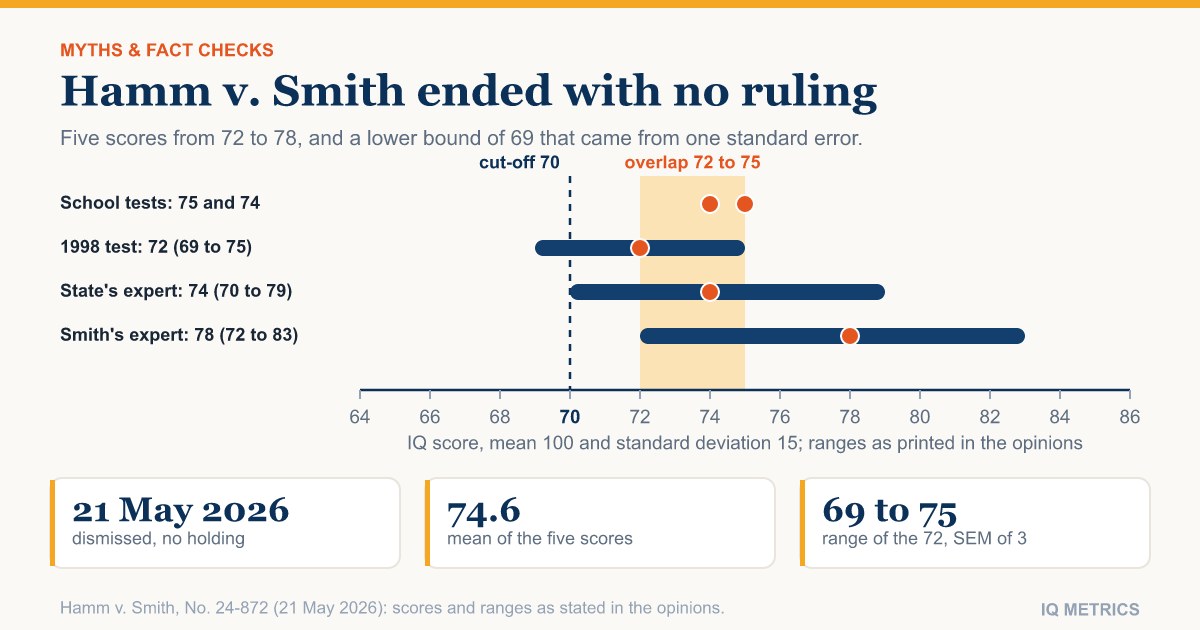
Hamm v. Smith Decision: What the Court Left Open on Multiple IQ Scores
The Supreme Court took Hamm v. Smith to say how courts should weigh several IQ scores near 70, then dismissed it on 21 May 2026 without a holding. The opinions still lay out five scores, an SEM of 3 and two views of a lower bound of 69.
Read the research.
Then find your own number.
Our IIF-certified assessment reports your score with its scale, percentile and confidence range — and a breakdown of the cognitive domains behind it.
Start IQ Test →