





IQ and Happiness: What the Research Actually Shows
IQ and happiness are almost unrelated at the individual level, though smarter countries do report higher average happiness. What the research actually finds, why national comparisons mislead, and what predicts happiness better than IQ.

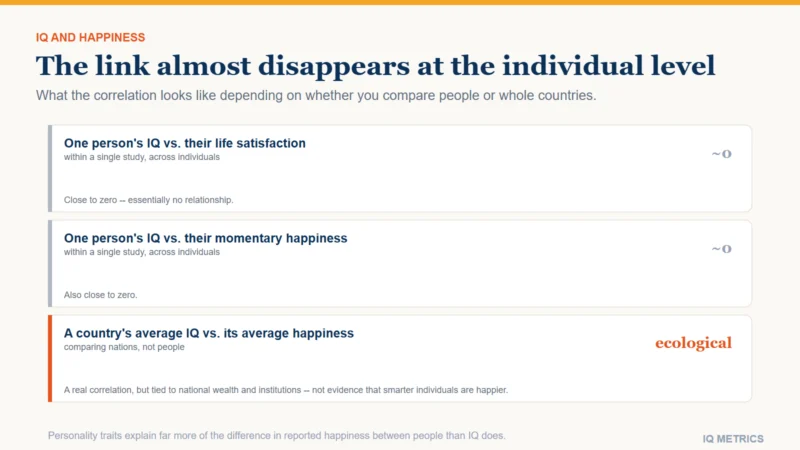
Barely at all, once the comparison is between actual people rather than whole countries. Across individual-level studies, IQ correlates with self-reported happiness and life satisfaction at close to zero — far weaker than personality traits such as extraversion. A separate, much-discussed finding that smarter countries report higher average happiness is real, but it describes nations, not people, and it leans heavily on wealth and institutions rather than individual intelligence. This article covers what the individual-level research actually finds, why national comparisons mislead, what predicts happiness better than IQ, and whether very high intelligence carries any special burden.
- Individual level: IQ’s correlation with momentary happiness and with life satisfaction both sit close to zero in the published literature.
- National level: average IQ correlates more strongly with average happiness across countries, but this reflects shared wealth and institutions, not smarter individuals being happier.
- What matters more: personality traits, especially extraversion and neuroticism, explain far more of the difference in happiness between people than IQ does.
- Emotional intelligence tracks life satisfaction more closely than cognitive IQ does.
What does the research actually find, person by person?
Reviews of the individual-level literature report correlations near zero between IQ and both momentary happiness and overall life satisfaction — in some analyses, close enough to zero that the relationship is best described as no meaningful link at all. That cuts against two opposite folk beliefs at once: that being smarter makes you happier, and the “ignorance is bliss” idea that it makes you less so. Neither holds up when the comparison is between individual people rather than groups or nations. See IQ versus EQ for how emotional and cognitive intelligence diverge on exactly this kind of outcome.
Why country-level comparisons are misleading
A separate body of research finds that countries with a higher average IQ tend to report higher average happiness, and this pattern is statistically real. But it is an ecological correlation: it describes nations, not the people inside them. Wealthy countries with strong institutions tend to score higher on both measures for reasons that have little to do with any one resident’s intelligence — better childhood nutrition and schooling lift average test performance, while economic security, healthcare and safety nets lift average reported happiness. Concluding from this that a smarter person within any given country is happier than their less able neighbour would be a mistake — the same kind of error the site’s coverage of country IQ rankings warns against for a different national comparison.
What predicts happiness better than IQ
Personality accounts for far more of the variation in reported happiness than intelligence does. Extraversion associates positively with happiness; neuroticism associates negatively and often more strongly than any cognitive measure. Emotional intelligence, the ability to recognise and manage emotions in yourself and others, tracks life satisfaction more closely than IQ does in the same studies. Strong social relationships and a sense of purpose also outperform raw cognitive ability as predictors, which is consistent with the broader well-being literature associated with researchers such as Ed Diener.
Does being very smart make you less happy?
There is no strong, consistent population-level evidence for a “too smart to be happy” effect. Some clinical and anecdotal writing about profoundly gifted people discusses social friction or a mismatch between intellectual and emotional development at a young age, but that is a different claim from a general happiness deficit, and it is not well supported by large population data. The honest summary is that the evidence for either direction — smarter people being happier or unhappier — is thin at the individual level, and neither claim should be overstated.
How researchers actually measure this
“Happiness” covers at least two different things in this research, and studies that blur them produce different-looking answers. Momentary happiness is measured by asking people how they feel right now, sometimes repeatedly through the day (a method called experience sampling). Life satisfaction is a slower, more reflective judgment, usually a single question asking someone to rate their life as a whole. IQ’s near-zero correlation shows up on both measures individually, which matters: it is not that IQ misses a fleeting mood but tracks a deeper sense of a life well lived, or the other way around. Neither version of “happiness” moves much with cognitive test scores once other factors are held constant.
Where would your own score land?
Take the IIF-certified assessment and get your score with the scale it was measured on, the percentile it corresponds to and the confidence range around it — the three figures most online tests leave out.
Find your IQ score now! →Does the picture change by life domain?
It shifts slightly for satisfaction with specific domains, such as a job, rather than life as a whole. Where a role demands complex reasoning, a good match between a person’s cognitive ability and the job’s demands associates with somewhat higher job satisfaction — being significantly under-matched or over-matched for a role’s cognitive demands can each create friction. That is a narrower, more mechanical finding than a general claim about IQ and happiness, and it fits the indirect, fit-dependent pathway described below rather than any direct effect of intelligence on mood. See growth mindset and intelligence for a related look at how mindset, not raw ability, shapes how people respond to demanding work.
Where IQ helps indirectly
IQ does relate to happiness through an indirect path: higher scores associate with more years of education and access to more stable, better-paid work, and both of those associate with modestly higher reported life satisfaction. But the effect runs through education and income, not through intelligence itself, and it is small once those factors are accounted for. See socioeconomic status and IQ and does IQ predict school success? for the size of those links on their own.
Why this surprises people
The near-zero individual-level finding runs against a common assumption that ability and satisfaction should move together, so it is worth asking why they do not. One likely reason is adaptation: people tend to settle back toward a personal baseline level of well-being after most life changes, good or bad, a pattern researchers call hedonic adaptation, and there is no obvious reason a higher IQ would exempt someone from it. Another is that happiness research consistently finds relative comparisons matter more than absolute standing — how someone is doing next to their own reference group, not their raw score on any test. A third is simply that intelligence measures a narrow set of cognitive skills, while life satisfaction depends on health, relationships, security and meaning, none of which a reasoning test was ever designed to capture.
Quick answers
- Does a high IQ make you happier? Not directly. Individual-level studies find close to no relationship.
- Are smart people more likely to be depressed? There is no strong, consistent evidence for this at the population level.
- Do smarter countries have happier people? Average IQ and average happiness correlate across countries, but this reflects national wealth and institutions, not individual intelligence.
- What predicts happiness better than IQ? Personality traits, especially extraversion and low neuroticism, emotional intelligence, and social relationships.
- Is life satisfaction the same as momentary happiness? No. One is a reflective judgment about life as a whole, the other a snapshot of how someone feels right now, and IQ correlates weakly with both, separately.
The bottom line
IQ and happiness are almost unrelated once you look at individual people rather than whole countries. Personality, emotional intelligence and relationships explain far more of who reports a satisfying life than a cognitive test score does, and the one place IQ does help — through education and income — is an indirect and modest path, not a direct one. The country-level finding is real, but it belongs to nations, not to any individual reading this, and it should never be used to draw conclusions about a specific person.
Sources
- Clearer Thinking: a review of the individual-level literature on IQ, happiness and life satisfaction.
- A study published in the journal Intelligence: country-level analysis finding that national aggregate IQ predicts national happiness, moderated by individualism–collectivism — an ecological, not individual, result.
Keep reading
All articles →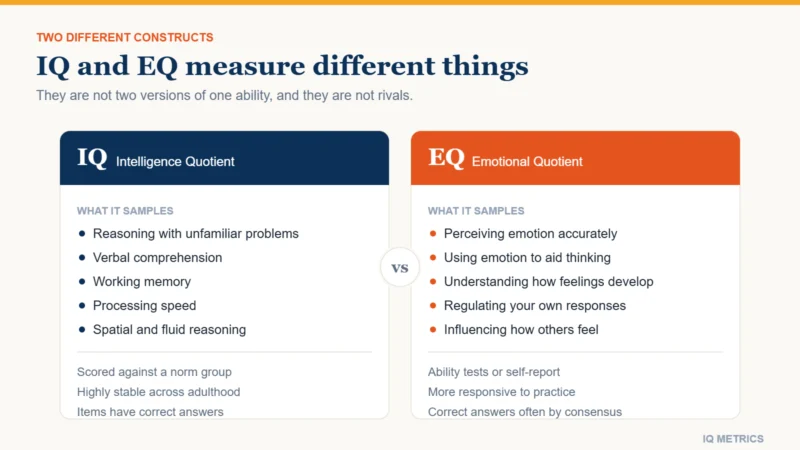 Mind & Everyday Life
IQ vs EQ
IQ measures reasoning; EQ measures how well you read and manage emotion. They are different constructs, measured in different ways, with different amounts of evidence behind them. Here is what each one actually predicts, which is easier to change, and where the popular claim that EQ matters more comes from.
 Research & Evidence
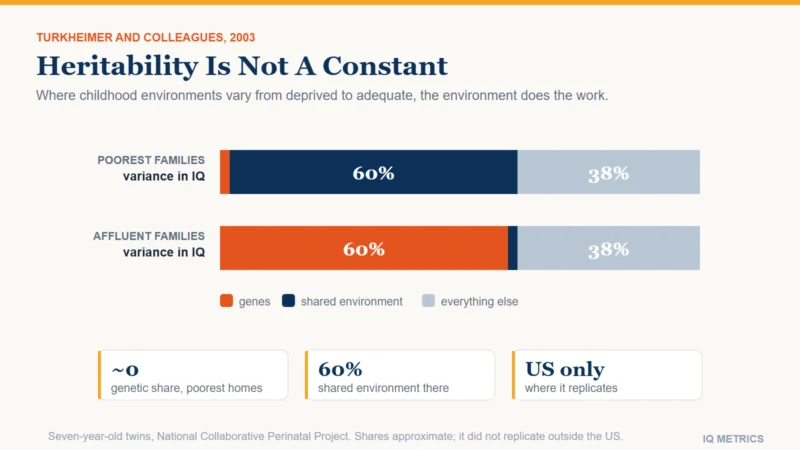
Socioeconomic Status and IQ
Family circumstances track IQ scores, and the relationship is stranger than a simple gap. In the poorest families studied, genes explained almost none of the variation in childhood scores and shared environment explained most of it. In affluent families the pattern reversed. Here is what that finding does and does not support.
 Research & Evidence
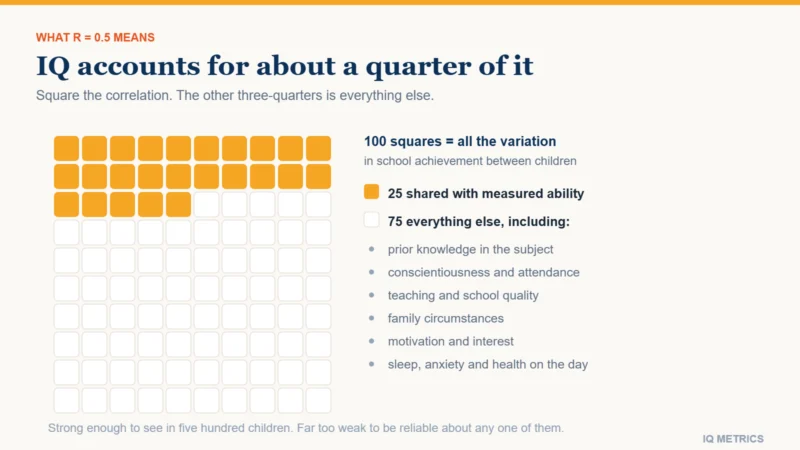
Does IQ Predict School Success?
IQ predicts school achievement better than any other single measure psychologists have found, and still leaves roughly three-quarters of the variation unexplained. Both halves of that sentence get ignored by somebody. Here are the actual correlations, what they mean for one child, and what accounts for the rest.