





Can an IQ Test Detect Dementia? What Actually Screens for It
A standard IQ test cannot diagnose dementia; it has no personal baseline and was not built to screen for decline. How the MMSE and the more sensitive MoCA compare, why a normal score can hide early decline, and what actually helps catch it.

Not reliably, and that is not what a standard IQ test is built to do. An IQ test such as the WAIS–IV compares you with people your own age at one point in time; it has no personal baseline to check you against, so it cannot by itself tell whether your thinking has changed. The tools clinicians actually use to screen for dementia, the Mini-Mental State Examination (MMSE) and the Montreal Cognitive Assessment (MoCA), are shorter, scored differently, and built specifically to catch the kind of change that dementia causes. This article covers how those tools differ from an IQ test, why a single score cannot diagnose decline, why decline can hide behind a normal-looking result, and what actually helps catch it early.
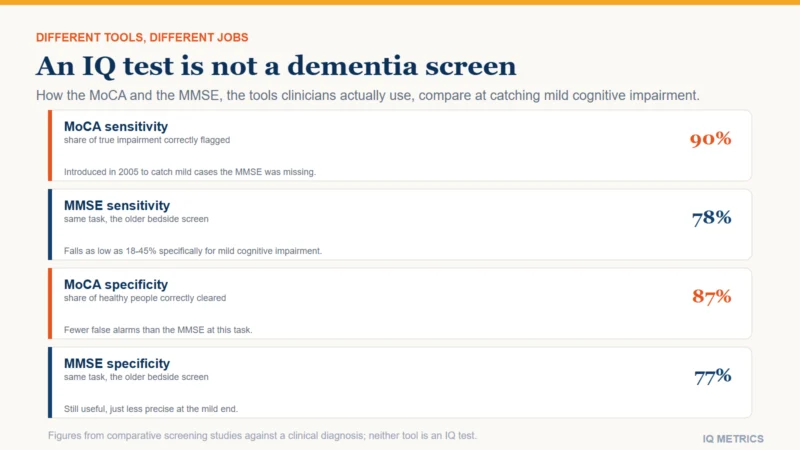
- MoCA sensitivity: about 90% for detecting cognitive impairment, against about 78% for the older MMSE.
- Mild cases: the MMSE catches only about 18 to 45% of mild cognitive impairment; the MoCA, introduced in 2005 to fix exactly this gap, catches about 90%.
- No baseline, no diagnosis: a single score has nothing of yours to compare against, only a population norm.
- Hidden decline: vocabulary and general knowledge resist damage longer than reasoning speed does, so early decline can sit behind a score that still looks typical.
What is the difference between an IQ test and a dementia screen?
An IQ test such as the WAIS–IV or the Stanford–Binet 5 takes 60 to 90 minutes, covers several domains of reasoning, and is normed against thousands of people the same age. It exists to describe a profile of ability, usually once. The MMSE and the MoCA take 10 to 15 minutes, are scored out of 30, and exist for a single purpose: to flag people who may need a fuller work-up for cognitive impairment. Neither is a substitute for the other. How IQ tests work covers what a full battery actually measures.
| Tool | Purpose | Typical length | Who gives it |
|---|---|---|---|
| IQ test (e.g. WAIS-IV) | Measure overall cognitive ability against same-age peers | 60 to 90 minutes | A psychologist |
| MMSE | Screen for possible cognitive impairment | ~10 minutes | Any trained clinician |
| MoCA | Screen for possible impairment, more sensitive to mild changes | ~10 to 15 minutes | Any trained clinician |
MMSE versus MoCA: why the newer test catches more
A comparative study reported the MoCA at about 90.2% sensitivity and 87.2% specificity for detecting cognitive impairment, against 78.4% sensitivity and 76.9% specificity for the MMSE. The gap is largest at the mild end: the MMSE identifies only about 18 to 45% of mild cognitive impairment cases, while the MoCA catches roughly 90%. The MoCA was introduced in 2005 specifically to close this gap, because the MMSE tends to look normal in people, especially highly educated ones, who are already experiencing real but subtle decline.
Why a single IQ score cannot diagnose decline
A score tells you your rank against peers at one moment. It says nothing about whether you have changed unless it is compared against your own earlier result. Clinicians who need to know this estimate a person’s premorbid, or pre-decline, ability using measures such as word-reading tests, which resist early decline better than most other tasks, and compare current performance against that estimate. Without a personal baseline, a below-average score could reflect lower lifelong ability, less formal education, anxiety, fatigue, or a mismatch between the test’s norms and the person’s background — not decline at all.
Why decline can hide behind a “normal” score
Cognitive ability is not one thing. Crystallised abilities, such as vocabulary and general knowledge, hold up well into old age and even through early dementia. Fluid abilities, such as processing speed, working memory and novel reasoning, tend to decline earlier and faster. See fluid versus crystallised intelligence, processing speed and IQ and memory and IQ. A test that leans heavily on vocabulary and stored knowledge can therefore look reassuring even as reasoning and speed are already slipping. Researchers call the cushion that education and lifelong ability provide against showing clinical symptoms “cognitive reserve”: two people with the same underlying brain changes can perform very differently on a test, and the person with more reserve can mask the problem for longer.
Normal aging and dementia are not the same thing
Some cognitive slowing is a normal, expected part of getting older and is not by itself a sign of dementia. Processing speed tends to decline gradually from early adulthood onward in almost everyone, and a strictly timed test format can penalise that ordinary slowing even when reasoning ability itself is intact. IQ and age covers how ability shifts across a normal lifespan, which is a different pattern from the kind of accelerating, multi-domain decline that dementia produces. The distinction matters in practice: an older adult who simply works more slowly on a clock-driven test is not showing the same thing as someone whose memory, orientation and problem-solving are all declining together over a period of months.
This is also why premorbid-ability estimation matters clinically. Tools such as a word-reading test ask someone to pronounce irregularly spelled words, a skill that draws on long-stored knowledge and resists decline even after real cognitive impairment has begun. Comparing current performance on more demanding tasks against that kind of preserved-skill estimate gives clinicians a rough personal baseline in the many cases where no earlier test result exists to compare against directly.
Where would your own score land?
Take the IIF-certified assessment and get your score with the scale it was measured on, the percentile it corresponds to and the confidence range around it — the three figures most online tests leave out.
Find your IQ score now! →What actually helps catch cognitive decline early
- A validated screen such as the MMSE or, preferably, the MoCA, as a first step rather than a general IQ test.
- Serial testing against a person’s own earlier results over months or years, not a single test at one point in time.
- Informant reports from family or friends about real-world changes, such as missed appointments, getting lost on familiar routes or new trouble managing money, which often surface before formal testing does.
- A full clinical work-up, including history, a physical exam and often blood tests, to rule out reversible causes such as thyroid problems or a vitamin B12 deficiency before assuming decline is permanent.
If you are worried about your memory, or a family member’s
See a doctor for a proper screen rather than relying on an online IQ test to reassure or alarm yourself; IQ test accuracy covers what any unsupervised online test can and cannot tell you. One more reason a single number misleads: taking the same test repeatedly tends to raise scores through familiarity alone, a retest effect that can mask a genuine decline if nobody is tracking the pattern over time.
Quick answers
- Can an IQ test diagnose dementia? No. It has no personal baseline to compare against and was not built for screening.
- What test do doctors actually use? Usually the MMSE or the MoCA, followed by a fuller clinical work-up if either flags a concern.
- Can someone with early dementia still score “normal” on a cognitive test? Yes, especially if the test leans on vocabulary and general knowledge, which resist decline longest.
- Is the MoCA better than the MMSE? For mild impairment, yes: about 90% sensitivity against roughly 78% for the MMSE.
- Does a low IQ score mean dementia? No. A low score can reflect many things besides decline; only a comparison with a personal baseline can suggest change.
The bottom line
Standard IQ tests were not built to catch dementia, and a single score cannot tell you whether your thinking has changed. The MMSE and, more sensitively, the MoCA exist for that job, and even they work best alongside informant reports, a full clinical work-up and, where possible, a comparison against a personal baseline rather than a population norm. If memory or thinking is a real concern, that conversation belongs with a doctor, not an online quiz.
Sources
- American Academy of Family Physicians (AFP, 2022): Mini-Cog, IQCODE, MoCA and MMSE for the prediction of dementia in primary care.
- Nasreddine and colleagues (2005), Journal of the American Geriatrics Society: the original validation of the Montreal Cognitive Assessment as a brief screening tool for mild cognitive impairment.
Keep reading
All articles →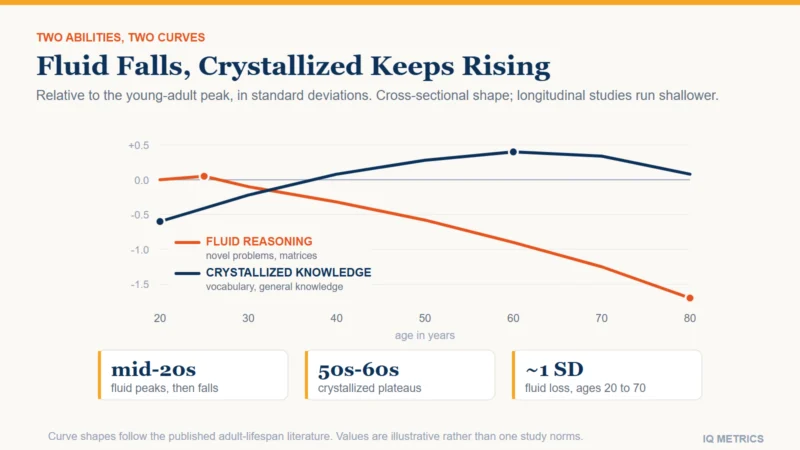 Understanding IQ
Fluid vs Crystallized Intelligence
Fluid intelligence is what you use on a problem you have never seen before. Crystallized intelligence is everything you have already banked. The distinction has survived eighty years of factor analysis because the two halves genuinely behave differently, and the clearest proof is what happens to each one as you get older.
 Understanding IQ
Memory and IQ
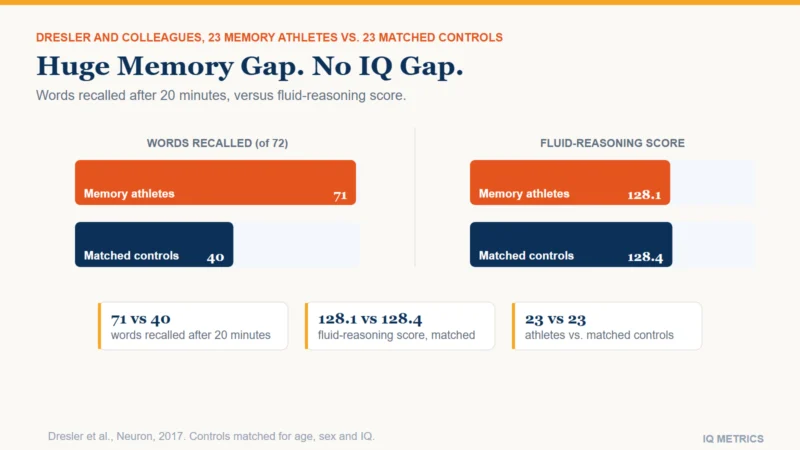
The world's best memory athletes can memorize 71 shuffled words in twenty minutes. Their IQ scores are not measurably different from a matched control group who could only manage 40. If a spectacular memory is not the same thing as a high IQ, what actually is the difference?
 Understanding IQ
Processing Speed and IQ
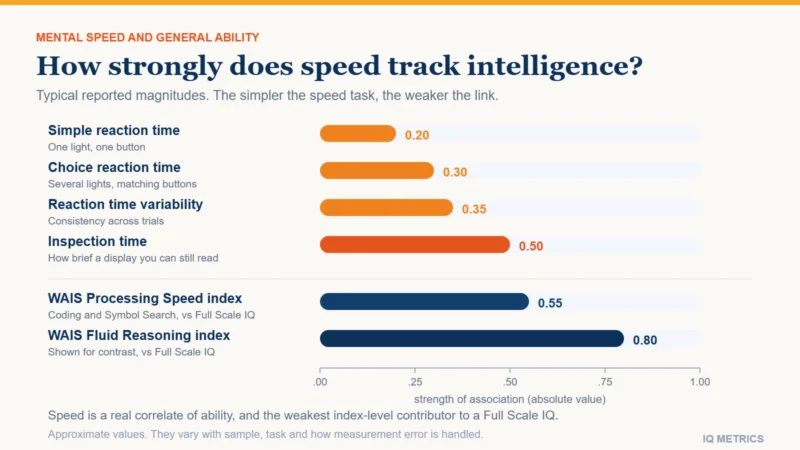
Fast thinkers are assumed to be smart thinkers, and there is a real finding underneath the stereotype: people who score higher on IQ tests do respond faster on tasks with no reasoning content at all. But the link is weaker than the folklore, and on a professional battery the speed index is the least g-loaded.