





Growth Mindset and Intelligence: What the Trials Found
The claim that believing intelligence is malleable makes you achieve more is one of the most widely taught ideas in education, and one of the most heavily contested in the research literature. Three waves of evidence have now landed. Here is what each found, and the question none of them actually answered.

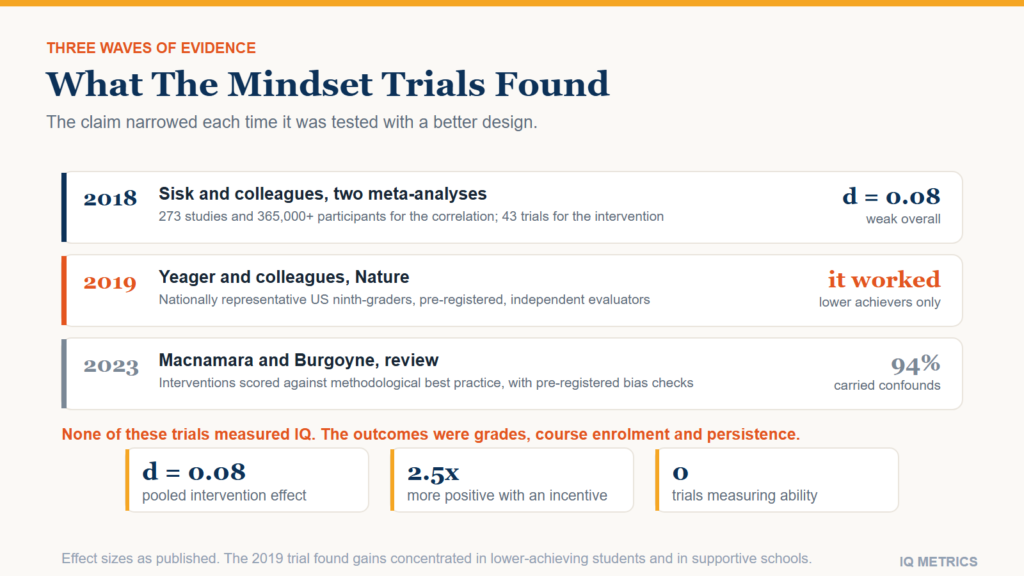
The growth mindset claim is that believing intelligence can be developed leads people to work differently and therefore achieve more. It has been taught in schools worldwide for two decades. The evidence, taken as a whole, supports a much narrower version than the one that got taught: pooled across trials the effect on achievement is small, in one large national experiment it was real but concentrated in specific students and specific schools, and a 2023 review found the literature itself carries serious bias.
There is also a question that gets quietly skipped in almost every popular account, and it matters more here than anywhere else on this site: no growth mindset trial has measured IQ. Not one. What follows separates what was tested from what is claimed.
What the claim actually is
Carol Dweck’s framing distinguishes a fixed mindset, in which ability is a trait you have a fixed amount of, from a growth mindset, in which ability develops through effort and strategy. The predicted mechanism is about response to difficulty: someone who reads a failure as evidence of a limit withdraws, while someone who reads it as evidence that the approach needs changing persists. The intervention is usually short — often under an hour online — and teaches the brain-as-malleable idea directly.
It is worth being precise about the claim, because the popular version drifts. The research claim is that mindset affects behaviour under difficulty and therefore achievement. It is not that believing you can get smarter makes you smarter, which is a much stronger claim that nobody set out to test.
The first meta-analysis found a weak effect
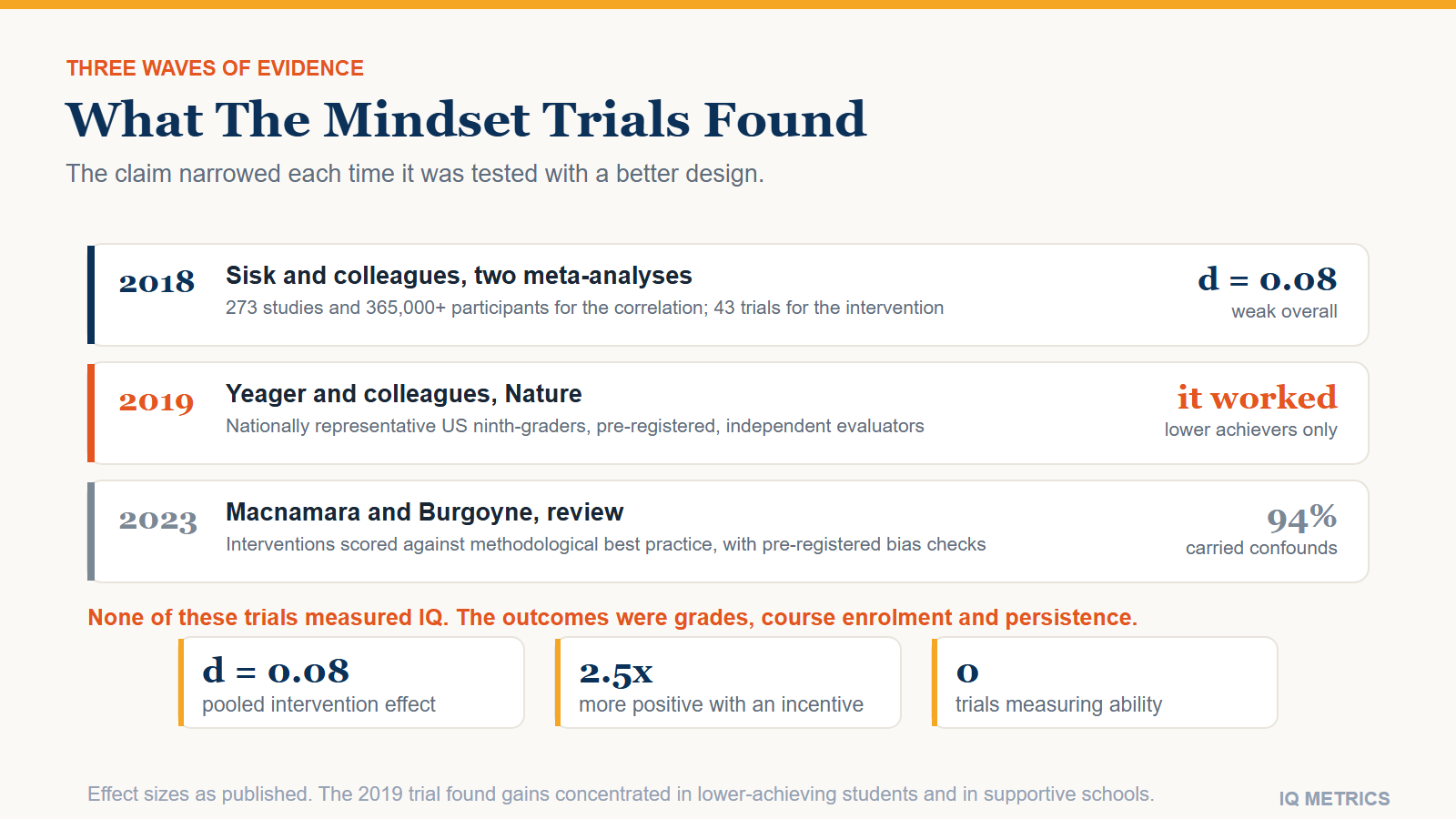
In 2018 Victoria Sisk and colleagues ran two meta-analyses. The first pooled 273 studies with over 365,000 participants to ask how strongly mindset correlates with academic achievement. The second pooled 43 intervention studies with over 57,000 participants to ask whether teaching a growth mindset changes achievement. Both effects were weak. The intervention effect came out at d = 0.08 — statistically distinguishable from zero given the sample size, and small enough that it would be invisible in any individual classroom.
The moderator analysis was more interesting than the headline. Effects were larger for students who were academically at risk and for students from low socioeconomic backgrounds. That is a coherent pattern rather than noise: an intervention that addresses a belief can only help someone whose belief was the obstacle, and a student already doing well was probably not held back by thinking ability was fixed. It also predicts that universal rollouts will underperform targeted ones, which is roughly what happened.
The national experiment, and where it worked
The strongest single piece of evidence is the National Study of Learning Mindsets, published in Nature in 2019 by David Yeager and a large team. It is the study to take seriously: a nationally representative sample of United States ninth-graders, randomised, pre-registered, with the analysis plan set in advance and independent evaluators. The design was built to settle the question rather than to confirm it.
It found a real effect, and found it in a specific place. Grades improved among lower-achieving students, and enrolment in advanced mathematics rose. Among students already doing well, little changed. The effect also depended on the school: it held where peer norms supported taking on academic challenge and faded where they did not. A one-hour online exercise cannot sustain a behaviour that a student’s environment discourages, which is a finding about the limits of cheap interventions generally.
So the honest summary of the strongest study is not "growth mindset works" or "growth mindset failed". It is that a well-designed version produced a modest, targeted improvement in grades for the students who needed it, in schools that reinforced it.
Where would your own score land?
Take the IIF-certified assessment and get your score with the scale it was measured on, the percentile it corresponds to and the confidence range around it — the three figures most online tests leave out.
Find your IQ score now! →The 2023 review found bias in the literature
Macnamara and Burgoyne then examined the intervention literature against a set of methodological best practices, and the results are the reason for caution about the wider field rather than about any one trial.
- 94 percent of the growth mindset interventions reviewed carried confounds — the treatment group got something other than the mindset message that the control group did not.
- Authors with a known financial interest in mindset training were about two and a half times as likely to report positive effects.
- Higher-quality studies were less likely to show a benefit, which is the signature pattern of an effect that shrinks as methods improve.
That last point is the serious one. A real effect usually holds up or sharpens under better methods. An effect that fades as designs tighten is more consistent with bias in the weaker studies than with a robust phenomenon, and it is the same pattern that deflated the brain-training literature.
A quieter problem runs underneath all of it: measurement. Mindset is usually captured by a handful of self-report items asking whether you agree that intelligence is fixed. Whether agreeing with those statements corresponds to how a person actually behaves when a problem gets hard is not well established, and different studies operationalise the construct differently. When the definition, the measure and the intervention all vary between studies, a pooled effect size is harder to interpret than the single number suggests — a point subsequent commentaries have pressed on both sides of the dispute.
Does any of this change an IQ score?
There is no evidence that it does, and almost no evidence either way, because the outcome measures in this literature are grades, course enrolment and task persistence. Cognitive ability was not the dependent variable in the trials that matter, so anyone citing growth mindset as a route to a higher IQ is extrapolating well past the data.
A weaker version is defensible. Beliefs about ability plausibly affect how someone approaches a test — whether they persist on a hard item or give up on it — and effort on the day is a genuine source of variation in scores. That would be an effect on measured performance rather than on underlying ability, which is the same distinction that applies to stereotype threat and to test anxiety. Both belong to the set of factors that move a result without moving the ability behind it.
What survives the criticism
Stripped of the oversell, several things stand. Targeted interventions for struggling students have the best support and the clearest mechanism, and the students they help most overlap substantially with the ones whose circumstances constrain them in the first place — the pattern described in the evidence on socioeconomic status. Context matters: the same message lands differently depending on whether the environment supports acting on it. And a short, cheap intervention producing any measurable change in grades is not nothing, provided nobody sells it as a substitute for teaching.
What does not survive is the strong version: that mindset is a major determinant of achievement, that a one-hour exercise transforms outcomes for everyone, or that it touches cognitive ability. That version was always more popular than it was supported, and it is a useful case study in how a modest finding becomes a movement — the same trajectory as several of the persistent myths about the brain.
What to do with this
If you are a student or a parent, the defensible takeaway is modest and still worth having: treating difficulty as information about strategy rather than as a verdict on capacity is a better response, and it is most valuable for someone who has been struggling. Just do not expect it to substitute for the things with larger effects, most obviously time in education itself.
If the underlying question is how much of ability is fixed, the evidence sits across three articles rather than one: what heritability actually means, how far practice takes you, and what moves a score. And if you want a measurement rather than a belief about yourself, a properly normed test is the shortest route to one.
Keep reading
All articles →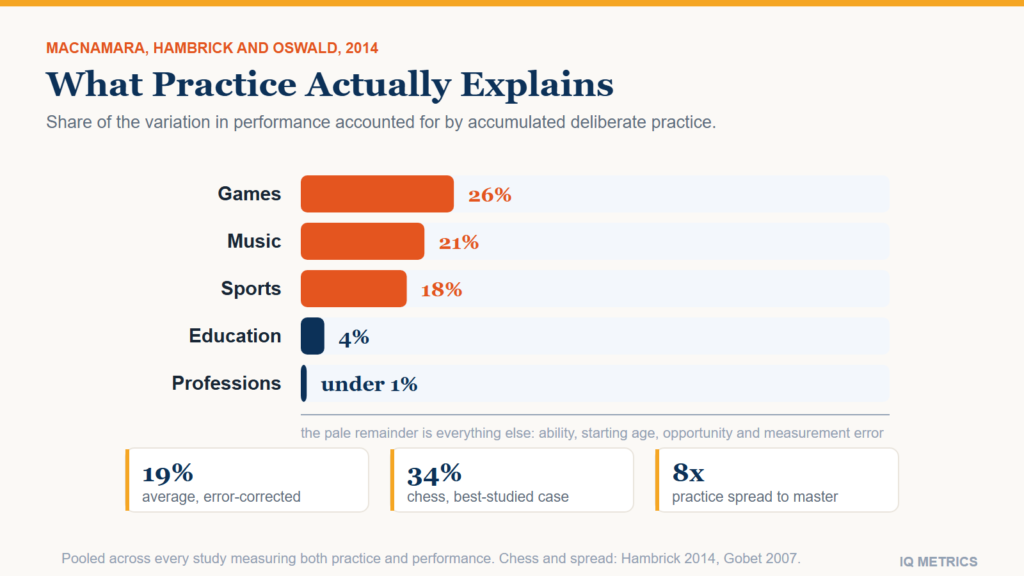 Research & Evidence
Talent vs Practice
The 10,000-hour rule made a strong claim: expert performance is built by practice, not given by talent. When researchers pooled the studies that had actually measured it, practice explained about a quarter of the difference between people in games and almost none in professional work. Here is what fills the rest of the gap.
 Research & Evidence
Socioeconomic Status and IQ
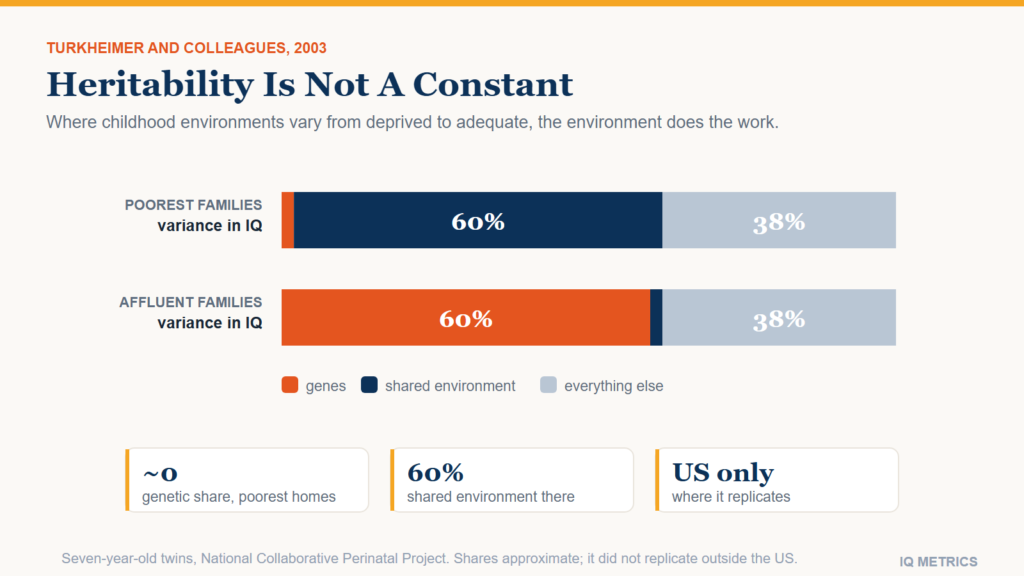
Family circumstances track IQ scores, and the relationship is stranger than a simple gap. In the poorest families studied, genes explained almost none of the variation in childhood scores and shared environment explained most of it. In affluent families the pattern reversed. Here is what that finding does and does not support.
 Taking a Test
Stereotype Threat and Test Scores
Few findings in psychology have been cited as widely, or held up as poorly, as stereotype threat. The original experiments were elegant and the idea is intuitive. Two decades of replication attempts have left a much smaller and more uncertain effect than the textbook version suggests.