





Height and IQ: How Strong Is the Correlation, Really?
Height and IQ correlate at about 0.1 to 0.2, a real but small link. What twin studies say about where it comes from, how much is childhood nutrition, and why it means nothing for judging any one person.

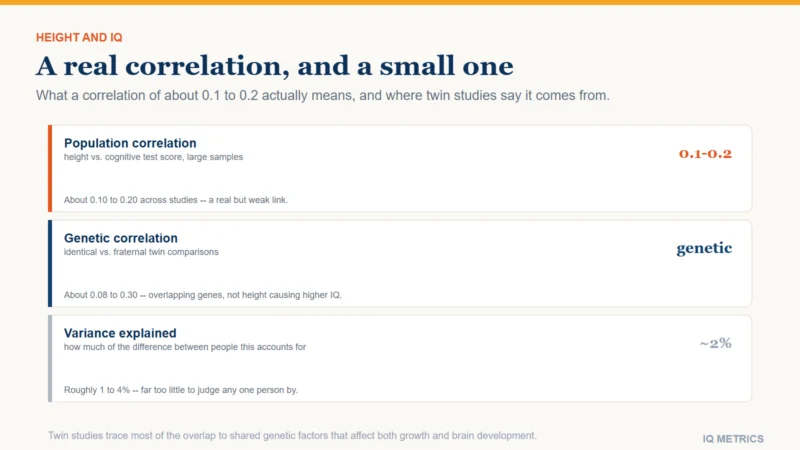
There is a real correlation between height and IQ, but it is small, it is not causal in any simple sense, and it is nowhere near strong enough to say anything about one particular person. Across large studies the correlation runs about 0.10 to 0.20 — taller groups average a few points higher on cognitive tests than shorter groups — and twin studies trace most of it to genes that affect both traits together, not to height itself changing the brain. This article covers how strong the link really is, what twin studies show about where it comes from, how much of it is really childhood nutrition, and what it does not mean for any one person.
- Population correlation: about 0.10 to 0.20 between height and cognitive test scores across large studies.
- Genetic correlation: about 0.08 to 0.17 in the largest twin analysis — overlapping genes, not height causing higher IQ.
- Historical confound: childhood nutrition and socioeconomic status once inflated cruder estimates; modern twin designs still find a genetic link after controlling for this.
- Practical size: a correlation this small explains only about 1 to 4% of the variation between people — not useful for judging any one individual.
How strong is the height-IQ correlation, really?
A correlation of 0.10 to 0.20 is real but modest. Squaring it gives the share of variation it explains: roughly 1 to 4%. In practical terms, two large groups that differ by several inches in average height might differ by only two or three IQ points on average, with enormous overlap between them — most short people in any real room will outscore most tall people, and vice versa. A correlation this size says something true about large populations and says essentially nothing about any single person you might meet.
For comparison, a correlation of 0.5 or higher is generally considered strong in psychology, and even IQ’s correlation with something as directly related as school grades typically runs closer to 0.5. A height-IQ correlation of 0.1 to 0.2 sits well below that, in the range researchers usually call small: worth studying because it is consistent and replicable across many samples, not because it is large enough to act on for any practical purpose.
Where does the link come from? What twin studies show
The clearest evidence comes from behaviour-genetic designs that compare identical twins, who share all their genes, with fraternal twins, who share about half. Keller and colleagues (2013) combined Australian and United States twin samples and estimated the genetic correlation between height and intelligence at about 0.08 in men and 0.17 in women, with overlapping genetic factors accounting for roughly half of the total phenotypic correlation. That points to genes that happen to influence both body growth and brain development — not a “tallness gene” that separately causes higher intelligence. See is IQ genetic? for how twin designs work more generally.
Is it really just childhood nutrition and wealth?
Partly, historically. Poor nutrition, chronic illness and poverty in childhood can stunt both height and cognitive development together, and cruder observational studies that cannot separate genetic and environmental causes have overstated the link this way. But twin and family designs, which hold shared environment relatively constant, still detect a genetic correlation, so the link is not purely a nutrition artefact, at least in the wealthier-country samples most twin studies draw on. Nutrition and socioeconomic status still matter for both traits, especially in disadvantaged settings; see nutrition and IQ and socioeconomic status and IQ. The honest summary combines both findings rather than choosing one: environment can widen or narrow the gap between shorter and taller groups, while genetics appears to set much of the underlying correlation even where nutrition is not a limiting factor.
Does being taller cause a higher IQ?
No established mechanism shows that growing taller improves cognitive ability, and correlation is not causation here any more than anywhere else. Keller and colleagues measured the other candidate mechanism directly: how people actually pair off. Smarter women partnered with taller men at a correlation of about 0.18, and smarter men partnered with taller women at about 0.11. Pairing by height and pairing by intelligence, repeated over generations, can concentrate both traits together in descendants even with no direct biological link between them. Their conclusion was that shared genetics and assortative mating each account for roughly half of the genetic overlap, not that one explanation replaces the other. See assortative mating and IQ for how this pairing effect works for other traits too.
Does the link hold up throughout life, or just in adults?
Separate twin cohorts that have followed the same people from childhood through to adulthood report the height-cognition association at multiple points along that span, not only once growth is complete. That consistency across development is part of what points researchers toward a shared genetic cause rather than, say, adult height itself somehow influencing adult cognition after the fact. It does not mean the correlation is fixed or identical at every age; different studies sampling different age ranges report figures anywhere in the 0.10 to 0.20 band, and the exact number moves with the population studied and the cognitive tasks used.
Where would your own score land?
Take the IIF-certified assessment and get your score with the scale it was measured on, the percentile it corresponds to and the confidence range around it — the three figures most online tests leave out.
Find your IQ score now! →How this compares with other physical correlates of IQ
Height is one of several physical measurements researchers have checked against cognitive test scores, and it holds up better than most. Head circumference and, more directly, brain volume also show modest positive correlations with IQ, in a similar small-but-real range, while some other proposed physical correlates do not replicate consistently at all; IQ and testosterone covers one case where four real studies point in four different directions rather than settling on one answer. Set against that background, height’s correlation with IQ is unusually stable across studies, which is exactly why the genetic explanation has held up so well: a real, replicable, small effect is a different thing from either a large effect or a fragile one that disappears when someone else tries to reproduce it.
What this does not mean for any one person
Within any height group there is enormous variation in IQ, and within any IQ group there is enormous variation in height. A correlation of 0.1 to 0.2 has no diagnostic or predictive value for a single individual — it is a population-level pattern, not a rule, in the same way the site’s coverage of IQ and testosterone treats other small and inconsistent biological correlates.
Quick answers
- Are taller people smarter? On average, very slightly — a correlation of about 0.1 to 0.2, not a rule for individuals.
- Why do tall people sometimes seem more competent? Partly a separate social-perception bias in how height is judged, distinct from actual test performance.
- Does nutrition explain the height-IQ link? Partly, historically, but twin studies still find a genetic component after accounting for shared environment.
- Is the height-IQ link causal? No established causal mechanism exists; shared genetics and possibly assortative mating are the leading explanations.
- Does the correlation hold in every country? The size varies by sample, but a small positive correlation has been reported across a range of populations rather than being unique to one country or dataset.
- Should a short person worry this predicts a lower IQ? No. The variation within any height group swamps the average difference between groups; the correlation says nothing reliable about a single person.
- Do adult height and childhood height correlate with IQ the same way? Broadly yes; the association shows up at multiple points across development in the twin data, not only once adult height is reached.
The bottom line
Height and IQ correlate at about 0.1 to 0.2, a real but small link that twin studies trace mostly to shared genetic factors rather than height itself changing the brain. It explains only a few percent of the variation between people and says nothing useful about any one individual’s intelligence.
Sources
- Keller and colleagues (2013), PLoS Genetics: the genetic correlation between height and IQ, shared genes or assortative mating, using twin and spousal data.
- Multiple population studies converge on a phenotypic correlation of about 0.10 to 0.20 between height and cognitive test scores.
Keep reading
All articles →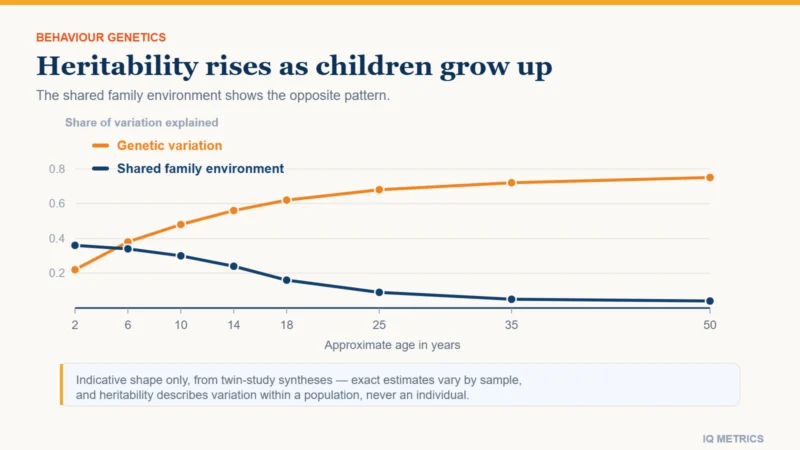 Research & Evidence
Is IQ Genetic?
Heritability estimates for IQ rise from roughly 0.4 in childhood to 0.7 or higher in adulthood, which sounds decisive until you know what heritability measures. Here is what twin and adoption studies actually show, and the four conclusions people draw from them that the statistic does not support.
 Research & Evidence
Assortative Mating and IQ
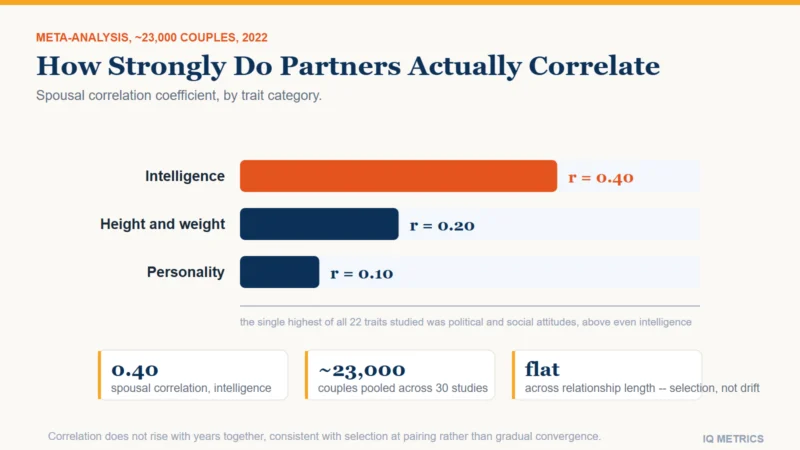
Married and long-term partners score more alike on IQ than on almost any other trait psychologists measure, personality included. The correlation is about 0.40, it shows up before the relationship starts, and it has real downstream effects on how heritability studies get interpreted.
 Research & Evidence
Socioeconomic Status and IQ
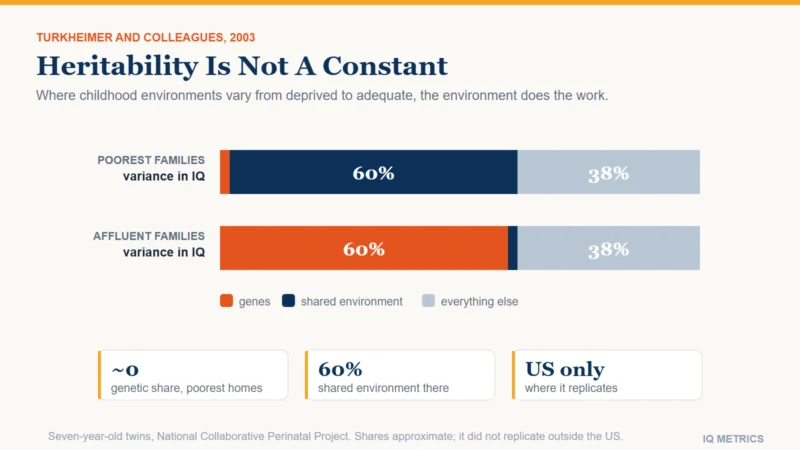
Family circumstances track IQ scores, and the relationship is stranger than a simple gap. In the poorest families studied, genes explained almost none of the variation in childhood scores and shared environment explained most of it. In affluent families the pattern reversed. Here is what that finding does and does not support.