





IQ and Testosterone: Is There a Graph That Holds Up?
A popular online chart claims a clean link between testosterone and IQ. Real studies disagree with each other on direction and size, and the most rigorous test found no effect at all. What the actual research says, and why the meme persists.

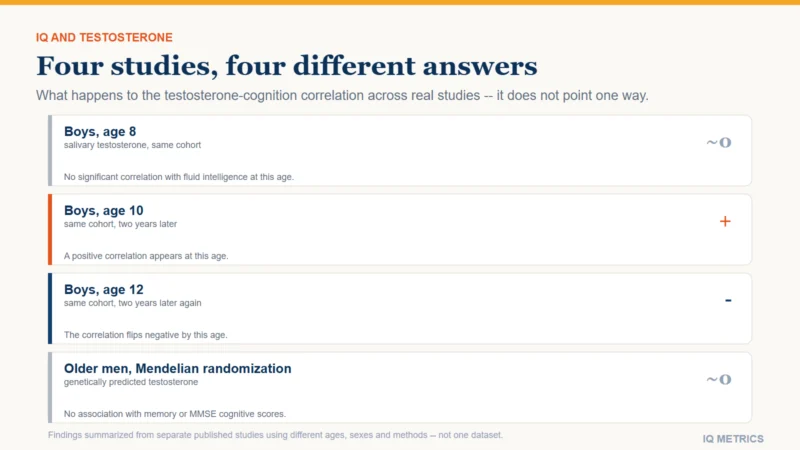
No graph of IQ and testosterone shows a stable straight line, and we found no study that does. In 166 Chinese boys the link was none at age 8, positive at 10 and negative at 12 (Shangguan and Shi, 2009), and in 4,212 older men genetically predicted testosterone showed no clear link to memory or screening-test scores (Zhao and colleagues, 2016). Adult studies disagree on direction, so one clean line cannot summarise them.
Is there a testosterone vs IQ graph that shows a real link?
Not one that holds up. Searches such as testosterone vs IQ graph, testosterone vs IQ chart, IQ vs testosterone graph, testosterone and IQ graph, IQ testosterone graph or testosterone IQ graph all expect one line, rising or falling. The studies do not draw one: results change with age, sex, the test used and how testosterone was measured. The table puts the numbers of six studies side by side, as each abstract reports them.
| Study | Who | What was compared | What it found |
|---|---|---|---|
| Shangguan and Shi (2009) | 166 Chinese boys: 49 aged 8, 54 aged 10, 63 aged 12 | Salivary testosterone and a fluid intelligence test (Cattell Culture Fair) | No significant correlation at 8, a positive one at 10, a negative one at 12 |
| Ostatníková and colleagues (2007) | 284 children aged 6 to 9: 107 gifted (IQ above 130), 100 average, 77 mentally challenged (IQ below 70) | Salivary testosterone across the three IQ groups | Boys of average IQ had higher testosterone than both other groups; no differences in girls |
| Wolf and Kirschbaum (2002) | 30 men (average age 69) and 38 women (average age 68) | Sex hormone levels and five cognitive tests | Men: one significant link, testosterone and verbal fluency, r = -0.38. Women: testosterone and verbal memory, r = .33 |
| Muller and colleagues (2005) | 400 men aged 40 to 80 | Testosterone and memory, processing speed, executive function and the MMSE | Curved links overall, suggesting an optimal level; a straight link (higher testosterone, better scores) only in the oldest age group |
| Thilers and colleagues (2006) | 1,107 men and 1,276 women aged 35 to 90 | The unbound share of testosterone and visuospatial, fluency and memory tasks | Men: higher levels went with better visuospatial, semantic and episodic memory scores. Women: a negative link with verbal fluency, the only significant one |
| Zhao and colleagues (2016) | 4,212 older Chinese men | Genetically predicted testosterone and delayed 10-word recall and MMSE scores | Recall: -0.02 points per nmol/L (95% CI -0.06 to 0.02). MMSE: 0.06 (95% CI -0.002 to 0.12) |
Read the last column and the signs differ: positive, negative, curved or absent, depending on age, sex and the test. The IQ and testosterone correlation is not one number but several, with different signs. The one study built to separate cause from effect, the last row, found no clear link.
What does the one causal test of testosterone and cognition show?
Zhao and colleagues (Scientific Reports, 2016) used Mendelian randomization, which relies on gene variants that shift testosterone levels. Genes are fixed at conception, so the design is less open to confounding and to reverse causation (cognition affecting hormones) than a simple comparison, and the authors chose it for that reason. They built a genetic score from three variants in 289 young Chinese men from Hong Kong and applied it to 4,212 older Chinese men from the Guangzhou Biobank Cohort Study.
Predicted testosterone was not associated with delayed 10-word recall (-0.02 points per nmol/L of testosterone, 95% confidence interval -0.06 to 0.02) or with Mini-Mental State Examination (MMSE) scores (0.06, 95% CI -0.002 to 0.12). Both intervals include zero, so the data are compatible with no effect. The authors conclude that their findings do not support a protective effect of testosterone on cognition in older men.
Two limits matter. A recall test and a dementia screening test are not IQ tests, so this study speaks to cognition in older age, not to IQ itself. And the genetic score explained 4.1% of the variance in testosterone, which the authors call typical for this design.
Does testosterone raise or lower IQ in children?
It depends on the age group, in the one study that compared ages. Shangguan and Shi (Psychoneuroendocrinology, 2009) collected saliva from 166 boys among 1,600 children who had taken the Cattell Culture Fair Intelligence Test, a measure of fluid intelligence: 49 boys aged 8, 54 aged 10 and 63 aged 12. Salivary testosterone showed no significant correlation with the test at 8, a significant positive correlation at 10 and a significant negative correlation at 12.
These were three different groups of boys, not one group followed over time, so the pattern is a comparison across ages. The abstract gives the direction of each correlation, not its size, and the full text is behind a paywall. The authors add that the link was much stronger when salivary testosterone was above 14 pg/ml, and they conclude that it changes from late childhood to early adolescence with the timing of puberty.
A second study (Ostatníková and colleagues, Neuropsychologia, 2007) compared salivary testosterone across IQ groups in 284 prepubertal children aged 6 to 9: 107 intellectually gifted (IQ above 130), 100 of average intelligence and 77 mentally challenged (IQ below 70). Boys of average intelligence had significantly higher testosterone than both other groups, which did not differ from each other. Girls showed no differences. That is the opposite of a “more testosterone, more IQ” pattern, though it is one sample of children aged 6 to 9.
Do adults show an inverted-U link between testosterone and IQ?
Some studies suggest a curve, but it is not an IQ curve and it is not stable. Muller and colleagues (Neurology, 2005) tested 400 men aged 40 to 80 on memory, processing speed, executive function and the MMSE. They found curved associations between testosterone and memory and processing speed, which suggest an optimal level, but once the men were split into four age decades only the oldest group showed a link, and it was a straight one: higher testosterone, better scores.
Other adult studies point different ways. In 1,107 men aged 35 to 90, higher levels of the unbound share of testosterone went with better visuospatial, semantic and episodic memory scores, with a larger benefit at older ages (Thilers and colleagues, 2006). In 30 older men, the only significant link was negative: testosterone and verbal fluency, r = -0.38 (Wolf and Kirschbaum, 2002).
Processing speed, one of the abilities Muller tested, is also what reaction-time tests capture: see average reaction time by age and what it says about IQ, and IQ and age for how scores change over a lifetime.
Why do the studies disagree?
- Different ages. The samples run from boys aged 8 to adults aged 90, and in the studies that compared ages the link changed with age (Shangguan and Shi, 2009; Muller et al., 2005).
- Different outcomes. One study used a fluid intelligence test; the others used memory tasks, verbal fluency, processing speed or the MMSE. None of the adult studies above used a full IQ test.
- Different group sizes. They range from 30 men to 4,212, and small samples swing widely.
- Time of day. In men aged 30 to 40, testosterone was 20 to 25% lower at 4 pm than at 8 am (Brambilla and colleagues, 2009; 66 men). A single sample is a snapshot of a level that moves during the day.
- Correlation is not cause. Most of these studies compare levels and scores at one point in time, which cannot say which came first or rule out a third factor.
Where would your own score land?
Take the IIF-certified assessment and get your score with the scale it was measured on, the percentile it corresponds to and the confidence range around it — the three figures most online tests leave out.
Find your IQ score now! →Does testosterone affect IQ differently in men and women?
Possibly, and the studies mix the sexes in different ways. From puberty on, circulating testosterone in men is more than 15 times that of women (Handelsman and colleagues, 2018), so an all-male, an all-female and a mixed sample each answer a different question. Before puberty there is no such gap, and in girls aged 6 to 9 Ostatníková found no differences by IQ group. Among adults, Thilers found a positive link for men and a negative one for women (only verbal fluency reached significance).
For what brain scans show about male and female brains at different ages, see male vs female brain development, and for IQ scores themselves see IQ tests and gender differences.
Is prenatal testosterone a different question?
Yes. Prenatal studies measure testosterone before birth, for example in amniotic fluid, and ask what that early exposure did to the developing brain. The studies above measured levels in saliva or blood during childhood or later, or used a genetic score, so they say nothing about prenatal exposure.
Why does the IQ and testosterone chart keep circulating?
A chart with one clean line is easier to share than a table of studies that disagree, and none of the studies here supports a single stable line. For a link with far more evidence behind it, see Is IQ genetic? and our news piece on twin studies and IQ heritability.
Quick answers
- Is there a correlation between testosterone and IQ? Not a stable one. Studies find none, a positive link, a negative link or a curve, depending on age, sex and the test (see the table above).
- Does testosterone affect IQ? The one causal test we found, a Mendelian randomization study of 4,212 older men, found no clear effect on memory or MMSE scores (Zhao and colleagues, 2016).
- Does high testosterone mean high IQ? No. In children aged 6 to 9, boys of average intelligence had higher testosterone than gifted or mentally challenged boys (Ostatníková and colleagues, 2007).
- Is there a graph of IQ vs testosterone? We found no study whose data make one stable line. The table above gives each study’s numbers.
- Is the link between testosterone and IQ an inverted U? One study of 400 men found curved links with memory and speed, but a straight link in the oldest age group explained them (Muller and colleagues, 2005).
- Does testosterone lower IQ? In some groups the link is negative (boys aged 12; verbal fluency in 30 older men), in others positive or absent, so none of these studies shows a consistent lowering effect.
The bottom line
No study reviewed here supports a simple, stable link between testosterone and IQ. The link changes sign with age in boys, differs between the sexes in adults, and the one genetic test of cause found no clear effect on memory or MMSE scores. A chart that draws one clean line describes a relationship these studies do not show. To see how your own reasoning scores, take the IQ test.
Sources
- Shangguan, F. and Shi, J. (2009): puberty timing and fluid intelligence, testosterone and intelligence in 8- to 12-year-old Chinese boys (Psychoneuroendocrinology).
- Ostatníková, D. et al. (2007): intelligence and salivary testosterone levels in prepubertal children (Neuropsychologia).
- Wolf, O.T. and Kirschbaum, C. (2002): endogenous estradiol and testosterone levels and cognitive performance in older women and men (Hormones and Behavior).
- Muller, M. et al. (2005): endogenous sex hormone levels and cognitive function in aging men, is there an optimal level? (Neurology).
- Thilers, P.P., Macdonald, S.W. and Herlitz, A. (2006): testosterone and cognitive performance in a population-based study of 35 to 90 year-old men and women (Psychoneuroendocrinology).
- Zhao, J.V. et al. (2016): a Mendelian randomization study of testosterone and cognition in men (Scientific Reports).
- Brambilla, D.J. et al. (2009): the effect of diurnal variation on clinical measurement of serum testosterone in men (Journal of Clinical Endocrinology and Metabolism).
- Handelsman, D.J., Hirschberg, A.L. and Bermon, S. (2018): circulating testosterone and sex differences in athletic performance (Endocrine Reviews).
Keep reading
All articles →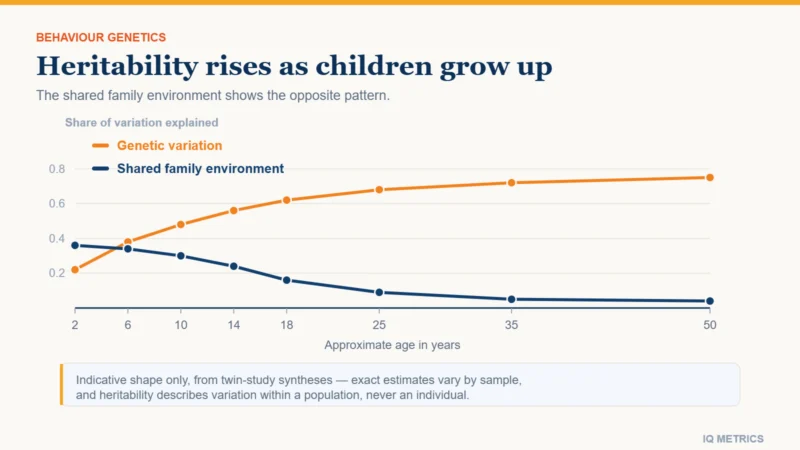 Research & Evidence
Is IQ Genetic?
Heritability estimates for IQ rise from roughly 0.4 in childhood to 0.7 or higher in adulthood, which sounds decisive until you know what heritability measures. Here is what twin and adoption studies actually show, and the four conclusions people draw from them that the statistic does not support.
 Research & Evidence
IQ Tests and Gender Differences: Fact or Fiction?
The idea that men perform better on IQ tests that evaluate cognitive abilities has helped spread this idea.
 Research & Evidence
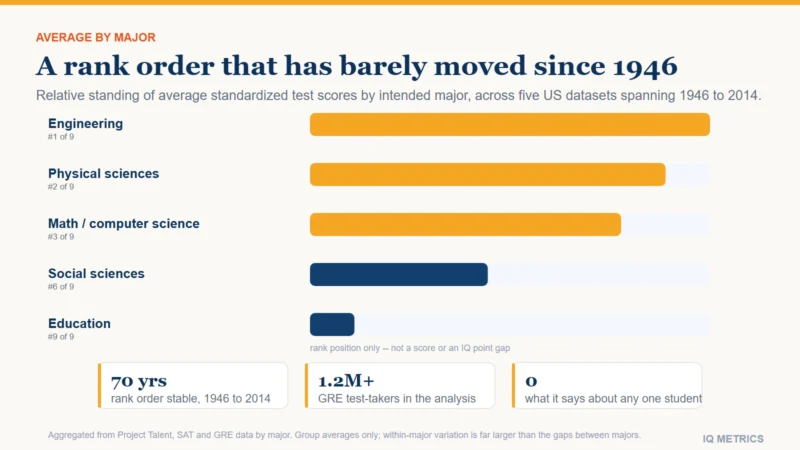
Average IQ by College Major
Average test scores really do differ by college major, and the rank order has barely moved in 70 years. What a landmark cross-dataset analysis found, why SAT and GRE scores are not IQ scores, and what the ranking cannot tell you about one student.