





Is IQ Genetic? What Twin Studies Actually Show
Heritability estimates for IQ rise from roughly 0.4 in childhood to 0.7 or higher in adulthood, which sounds decisive until you know what heritability measures. Here is what twin and adoption studies actually show, and the four conclusions people draw from them that the statistic does not support.

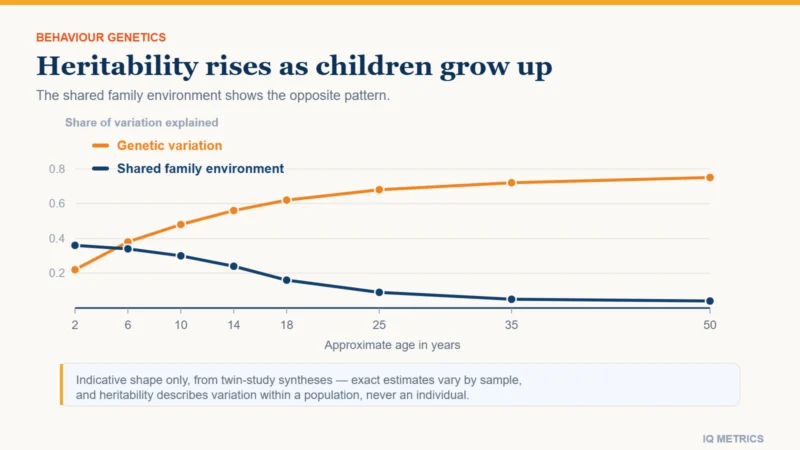
Ask whether intelligence is genetic and you will get two confident answers, both wrong. One says it is essentially fixed at conception. The other says it is entirely a product of upbringing and opportunity. The research supports neither, and the reason is that the central statistic in this field — heritability — does not mean what almost everyone assumes it means.
This article explains what heritability actually measures, what twin and adoption studies have found, why the figure changes with age, and the four conclusions people routinely draw from it that it does not license.
The short answer
Genes influence measured intelligence substantially, and so does environment, and the two are not separable in the way the question implies. Across twin, adoption and family studies, heritability estimates for IQ typically run from around 0.4 in childhood to 0.7 or higher in adulthood.
That last part surprises people, because the intuition runs the other way: surely genetic influence is strongest early and gets diluted by life? The data say the opposite, and the explanation is one of the more interesting findings in the field.
What heritability actually means
Heritability is probably the most misunderstood statistic in psychology. It is a property of a population, not a person. It tells you what proportion of the variation in a trait, within a particular group living in a particular set of environments, is statistically associated with genetic variation between them.
That has an immediate and counterintuitive consequence. A heritability of 0.6 does not mean 60% of your IQ came from your genes and 40% from your upbringing. The question "how much of your height came from your genes?" has no answer — you would not exist without both. Heritability answers a different question entirely: why do people in this group differ from each other?
It is also not a constant of nature. Heritability is measured in a specific population at a specific time, and it moves when the environment changes. If every child in a society received an identical education, environmental variation would shrink and measured heritability would rise — not because genes became more powerful, but because there was less environmental difference left to explain anything.
The evidence: twins, adoptions and families
Three research designs do most of the work here, and their value is that they pull genetic and environmental similarity apart in different ways.
Identical versus fraternal twins
Identical twins share essentially all their DNA; fraternal twins share about half, the same as ordinary siblings. Both kinds of twin pairs typically grow up in the same home at the same time. If identical pairs resemble each other more closely on cognitive tests than fraternal pairs do — and they consistently do — the difference points to genetic influence.
The classic objection is fair: identical twins may also be treated more alike, which would inflate the estimate. This is why the design is never used alone.
Twins reared apart
The rarest and most informative design follows identical twins separated early and raised in different households. Any resemblance cannot come from a shared upbringing. These studies have consistently found substantial similarity in cognitive test scores.
They also carry real limitations worth stating: separated twins are few, adoption agencies have historically placed children in relatively similar homes, and some pairs had contact before testing. The findings are informative, not decisive on their own.
Adoption studies
Adoption compares children with the families they share genes with and the families they share a home with. The recurring finding is striking. In childhood, adopted children resemble their adoptive families noticeably. By adulthood, that resemblance has faded substantially, while resemblance to biological relatives has held or grown.
That single pattern is the strongest evidence for both halves of the picture: the family environment demonstrably matters while you are living in it, and its measurable effect on test scores does not persist the way people expect.
Why heritability rises with age
The increase in heritability from childhood to adulthood is a robust finding, sometimes called the Wilson effect after the researcher who documented it. It is genuinely counterintuitive, and the leading explanation is not that genes switch on over time.
The favoured account is that people increasingly select and shape their own environments as they gain independence. A young child's surroundings are chosen for them. An adult chooses what to read, what work to pursue, who to spend time with and which problems to engage with — and those choices are partly influenced by their own dispositions. Small initial differences get amplified by the environments they lead people to seek out, so genetic influence appears to grow when what is really growing is the correlation between people and their circumstances.
The mirror image is that the measurable effect of the shared family environment on IQ tends towards small values by adulthood in many Western samples. This is one of the more contested findings in the field, and it is frequently overstated. It does not mean parenting is irrelevant — it means that, among families within the range these studies sampled, differences between those families explain less of the remaining variation in adult test scores than most people expect.
Where would your own score land?
Take the IIF-certified assessment and get your score with the scale it was measured on, the percentile it corresponds to and the confidence range around it — the three figures most online tests leave out.
Find your IQ score now! →Heritability depends on the environment it is measured in
This is the finding that most complicates any simple reading. Several studies, particularly in the United States, have reported that heritability of cognitive ability is lower in more deprived environments and higher in more affluent ones.
The interpretation is intuitive once stated. Where material and educational conditions vary enormously, those conditions explain much of why children differ, and genetic variation explains proportionally less. Where conditions are more uniformly adequate, environment explains less of the difference and genetic variation explains more.
Replication has been mixed, and the effect appears more consistently in the United States than in countries with stronger social safety nets — which is itself informative. Heritability is not a fixed property of a trait. It is a description of a population under particular conditions.
What molecular genetics has and has not found
Twin studies infer genetic influence indirectly. Genome-wide association studies look at DNA directly, and the results have reframed the discussion.
There is no "intelligence gene". Cognitive ability is highly polygenic: influenced by a very large number of genetic variants, each with an effect far too small to matter individually. Polygenic scores that add these variants up do predict cognitive and educational outcomes at better than chance, but they currently explain only a modest fraction of the variation — well below what twin studies estimate, a gap sometimes called missing heritability.
Two limitations matter for anyone reading a headline about this. These scores are population-level statistical tools with weak predictive power for any individual, and they have been derived largely from participants of European ancestry, so they transfer poorly to other populations. They are research instruments, not a test of anyone's potential.
Four things heritability does not mean
Most of the trouble in this area comes from four inferences that feel natural and are not valid.
- It does not mean fixed. Poor eyesight is highly heritable and corrected with glasses. Phenylketonuria is entirely genetic and managed with diet. High heritability describes the source of variation, not the availability of intervention.
- It does not apply to individuals. Heritability is a population ratio. There is no meaningful sense in which 60% of one person's score is genetic.
- It says nothing about differences between groups. Heritability measured within a population carries no information about the causes of average differences between populations. Identical seed sown in rich and poor soil produces height differences that are entirely environmental, however heritable height is within each field. This point is not a caveat; it is a mathematical fact about what the statistic measures, and our article on country IQ rankings covers why the data cannot support the conclusions often drawn from them.
- It does not set a ceiling. Average test performance rose substantially across the twentieth century, far too quickly for genetic change to explain, which by itself proves the environment can move scores at population scale.
So what actually moves an individual score?
Genetics is not something you can act on. Several other things are, and they are worth separating into two groups.
The first group changes your measured score without touching the underlying ability: sleep, illness, anxiety, unfamiliarity with the test format, and the conditions on the day. These effects are real and sometimes large, which is exactly why a single result should never be treated as definitive. Our article on the factors that affect IQ test results goes through them.
The second group plausibly affects cognitive development itself, and is concentrated early: nutrition, health, education, and a stimulating environment in childhood. The honest summary for adults is that no intervention has been shown to produce large, lasting increases in general cognitive ability, however many products claim otherwise.
The useful way to hold all this
Genes and environment are not two competing forces splitting a fixed quantity between them. They interact continuously: dispositions shape the environments people seek, those environments develop abilities further, and the resulting differences feed back into the next set of choices. Heritability is a summary of one population at one moment, not a verdict on anyone.
It is also worth remembering what the score itself is. An IQ result is a position relative to a norm group, reported on a particular scale with a margin of error around it — not a fixed personal constant. If you want to see where yours sits, our IQ test reports the scale it was measured on, the percentile it corresponds to and the confidence range around it, and the IQ bell curve shows how any score maps onto the distribution. What it will not tell you — what nothing can tell you — is how much of that number you inherited.
Keep reading
All articles → Research & Evidence
What are the Factors that Affect the Results of an IQ Test?
When you take an IQ test, do you ever find yourself wondering why certain people do better than others? It turns out that your IQ can be affected by a lot of different things. Discover the hidden meaning of these characteristics and how they affect your intelligence in this essay
 Mind & Everyday Life
IQ vs EQ
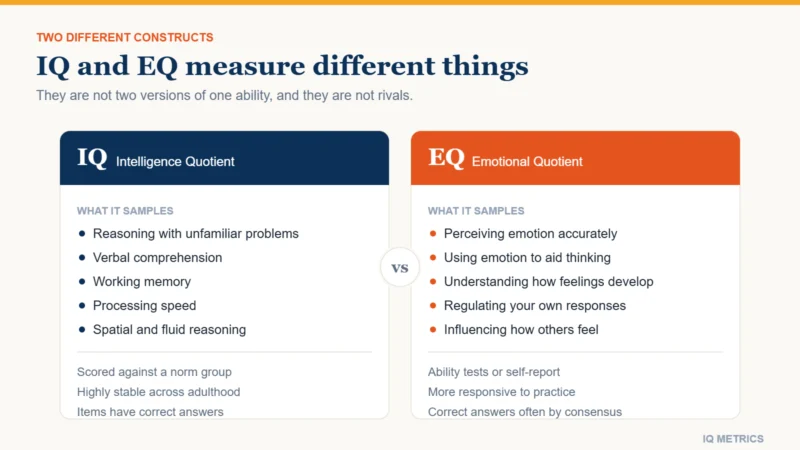
IQ measures reasoning; EQ measures how well you read and manage emotion. They are different constructs, measured in different ways, with different amounts of evidence behind them. Here is what each one actually predicts, which is easier to change, and where the popular claim that EQ matters more comes from.
 Understanding IQ
Is Intelligence limited to IQ?
As we explore the fascinating world of intelligence, we will uncover the truth about IQ and the limitations of the human intellect. Beyond traditional measures of intellect, this article explores a wider range of aptitudes that impact our perception and engagement with the natural world.