Which universities produce the most prize-winning scientists?
Where did the winners of the Nobel, Fields, Abel, Turing, Wolf, Lasker, Kavli and Breakthrough prizes study? We traced the first degree and the doctorate of 1,571 winners from 1901 to the 2026 laureates. Seven charts, every winner in the CSV.
By Leon Falkner, Data & Research Analyst · Reviewed by Aarav Vardhan, Editor-in-Chief · Published 23 October 2026 · 12 min read
About this study
- Report type
- Data study from public records
- Data
- Nobel Prize API; Wikidata; the official lists of 17 other prize categories; Wikipedia for missing degrees
- Covers
- 1,571 winners of 21 prize categories (1,893 awards)
- Years
- 1901-2026, including the 2026 winners
- Licence
- CC BY 4.0 (our tables and CSV); Nobel and Wikidata data CC0
- Version
- 2026.10
- Sources
- 14
Harvard is the university where the most winners of the top science prizes studied: 142 of 1,571 Nobel, Fields, Abel, Turing, Wolf, Lasker, Kavli and Breakthrough winners from 1901 to 2026 earned a first degree or doctorate there, ahead of Cambridge (101), Berkeley (81) and MIT (80). Harvard also awarded the most doctorates.
01 Key findings
- Harvard leads: 142 of 1,571 winners of 21 top prize categories (1901-2026) earned a first degree or doctorate there, ahead of Cambridge (101), Berkeley (81) and MIT (80).IQ Metrics analysis, 2026
- Harvard awarded the most doctorates (107, against 65 at Cambridge); for first degrees Cambridge and Harvard are level (64 and 59). The top 10 universities awarded 42.0% of the doctorates we could place, against 26.4% of first degrees.IQ Metrics analysis of 1,208 first degrees and 1,189 doctorates
- Since 2000, MIT is second: 62 of the 742 winners of 2000-2026 studied there, against 88 at Harvard and 48 at Berkeley.IQ Metrics analysis, 2026
- Women won 16.9% of awards in 2020-2026 (47 of 278), against 2.6% before 2000 and 6.5% of all 1,891 awards since 1901.Nobel Prize API; Wikidata
- Most winners stay in one country to study: 15.0% of the 986 with both degrees placed took the doctorate abroad; later, 23% of Nobel laureates did their prize work outside the country of their first degree.IQ Metrics analysis; Nobel Prize API
02 Statistics to quote
Top-prize winners, 1901-2026, who earned a first degree or doctorate at Harvard, the most of any university.
IQ Metrics, 2026Winners who took their first degree at Cambridge and at Harvard, the two leaders for first degrees.
IQ Metrics, 2026Winners with a Harvard doctorate, against 65 with one from Cambridge.
IQ Metrics, 2026Awards that went to women in 2020-2026 (47 of 278), up from 2.6% before 2000.
IQ Metrics, 2026Median age of winners when the prize was announced (1,877 awards with a known age).
IQ Metrics, 2026Nobel laureates whose prize-winning work was in another country than their first degree (135 of 582).
IQ Metrics, 2026A Harvard doctorate is the most common credential among top-prize scientists. For the first degree, Cambridge is level with Harvard: the first degree and the doctorate tell two different stories.
Leon Falkner, IQ Metrics Research
03 Which universities have produced the most prize-winning scientists?
Harvard, by a wide margin. Of the 1,571 people who won one of 21 top prize categories in science, mathematics, computing, medicine and economics between 1901 and 2026, 142 earned a first degree or a doctorate at Harvard, followed by Cambridge (101), Berkeley (81) and MIT (80), then Princeton (65) [1] [3]. We count where winners studied, not where they worked: a professor who joined Harvard after winning does not count for Harvard.
Universities where the most top-prize winners studied
Winners who earned a first degree or a doctorate there; each winner counts once per university. Of 1,571 winners of 21 prize categories, 1901-2026. Short names; full names in Table 1.
Source: IQ Metrics analysis; prize lists from the Nobel Prize API [1] and the official prize sites [5] [6] [7] [8] [9] [10] [11]; education from Wikidata [3] and Wikipedia [4]
Data table
| label | value |
|---|---|
| Harvard | 142 |
| Cambridge | 101 |
| Berkeley | 81 |
| MIT | 80 |
| Princeton | 65 |
| Chicago | 50 |
| Caltech | 49 |
| Columbia | 49 |
| Yale | 43 |
| Stanford | 40 |
| Oxford | 34 |
| Paris (to 1970) | 29 |
| Cornell | 26 |
| Wisconsin | 25 |
| Johns Hopkins | 21 |
Embed this chart
Paste this HTML into your page: it carries the numbers and the credit link to this figure.
The list is mostly American and British. Of the top 15, 12 are in the United States and 2 in the United Kingdom; the highest-placed university elsewhere is the old University of Paris (split in 1970), at number 12. The prizes counted here are listed in the prize table.
04 Do prize winners study where they earn their doctorate?
Often not, and it changes the ranking. For doctorates Harvard is far ahead: 107 winners earned theirs there, against 65 at Cambridge and 62 at MIT. For first degrees Cambridge and Harvard are level: 64 and 59 on all the evidence, 36 and 46 when only degrees recorded in Wikidata or the infobox are counted (the rest come from article text and single-university records, see the method). Doctorates are also more concentrated: the top 10 universities account for 42.0% of the doctorates we could place and 26.4% of the first degrees.
First degree or doctorate? Where the same universities shine
Winners per university by the degree they earned there: the 15 universities of Figure 1 and the next five. A winner with both degrees from one university counts in both.
Winners, 1901-2026 (1,208 with a first degree placed, 1,189 with a doctorate placed)
Source: IQ Metrics analysis of 1,571 prize winners, 1901-2026 [1] [3] [4]
Data table
| university | First degree (bachelor's or equivalent) | Doctorate (PhD or equivalent; MD where it was the only one) |
|---|---|---|
| Harvard University | 59 | 107 |
| University of Cambridge | 64 | 65 |
| UC Berkeley | 30 | 62 |
| MIT | 30 | 62 |
| Princeton University | 20 | 49 |
| University of Chicago | 25 | 37 |
| Caltech | 26 | 27 |
| Columbia University | 26 | 35 |
| Yale University | 20 | 25 |
| Stanford University | 11 | 30 |
| University of Oxford | 19 | 24 |
| University of Paris (to 1970) | 12 | 23 |
| Cornell University | 11 | 17 |
| University of Wisconsin | 9 | 19 |
| Johns Hopkins University | 4 | 18 |
| Hebrew University of Jerusalem | 16 | 9 |
| Moscow State University | 17 | 10 |
| New York University | 11 | 12 |
| Kyoto University | 16 | 11 |
| University of Göttingen | 9 | 14 |
Embed this chart
Paste this HTML into your page: it carries the numbers and the credit link to this figure.
Some universities are first-degree feeders. City College of New York, a public college, gave 14 winners their first degree and 1 their doctorate. Moscow State University (17 first degrees), Kyoto (16) and the Hebrew University of Jerusalem (16) play the same role in their countries. Graduate schools such as MIT, Princeton and Stanford show the opposite pattern.
The 50 universities with the most top-prize winners
| Harvard University | US | 142 | 59 | 107 | 42 | 58 | 124 |
| University of Cambridge | UK | 101 | 64 | 65 | 33 | 29 | 75 |
| UC Berkeley | US | 81 | 30 | 62 | 17 | 37 | 74 |
| MIT | US | 80 | 30 | 62 | 24 | 46 | 67 |
| Princeton University | US | 65 | 20 | 49 | 13 | 34 | 53 |
| University of Chicago | US | 50 | 25 | 37 | 10 | 17 | 39 |
| Caltech | US | 49 | 26 | 27 | 14 | 11 | 40 |
| Columbia University | US | 49 | 26 | 35 | 8 | 8 | 38 |
| Yale University | US | 43 | 20 | 25 | 12 | 15 | 38 |
| Stanford University | US | 40 | 11 | 30 | 7 | 23 | 34 |
| University of Oxford | UK | 34 | 19 | 24 | 11 | 16 | 27 |
| University of Paris (to 1970) | France | 29 | 12 | 23 | 2 | 8 | 16 |
| Cornell University | US | 26 | 11 | 17 | 5 | 10 | 21 |
| University of Wisconsin | US | 25 | 9 | 19 | 2 | 8 | 17 |
| Johns Hopkins University | US | 21 | 4 | 18 | 0 | 5 | 15 |
| Hebrew University of Jerusalem | Israel | 20 | 16 | 9 | 11 | 5 | 10 |
| Moscow State University | Russia | 20 | 17 | 10 | 15 | 9 | 10 |
| New York University | US | 19 | 11 | 12 | 6 | 6 | 10 |
| Kyoto University | Japan | 17 | 16 | 11 | 9 | 8 | 13 |
| University of Göttingen | Germany | 16 | 9 | 14 | 1 | 3 | 8 |
| University of Illinois | US | 16 | 7 | 10 | 3 | 3 | 12 |
| University of Tokyo | Japan | 16 | 12 | 12 | 9 | 8 | 13 |
| LMU Munich | Germany | 15 | 7 | 12 | 2 | 3 | 6 |
| McGill University | Canada | 15 | 12 | 6 | 7 | 3 | 12 |
| UCLA | US | 15 | 9 | 11 | 6 | 9 | 15 |
| University of Michigan | US | 15 | 10 | 8 | 7 | 4 | 15 |
| Carnegie Mellon University | US | 14 | 8 | 8 | 4 | 6 | 10 |
| City College of New York | US | 14 | 14 | 1 | 4 | 0 | 12 |
| ETH Zurich | Switzerland | 14 | 11 | 6 | 0 | 1 | 7 |
| Sorbonne University | France | 14 | 2 | 13 | 2 | 11 | 12 |
| University of Toronto | Canada | 14 | 12 | 6 | 7 | 3 | 11 |
| Leiden University | Netherlands | 13 | 9 | 8 | 1 | 2 | 5 |
| University of Vienna | Austria | 13 | 8 | 11 | 1 | 2 | 12 |
| Humboldt University of Berlin | Germany | 12 | 3 | 9 | 0 | 1 | 7 |
| University of Pennsylvania | US | 12 | 5 | 9 | 1 | 3 | 10 |
| University of Edinburgh | UK | 11 | 4 | 8 | 3 | 6 | 7 |
| Q219563 | US | 10 | 4 | 7 | 1 | 4 | 4 |
| University of Minnesota | US | 10 | 6 | 7 | 1 | 2 | 5 |
| Washington University in St. Louis | US | 10 | 5 | 7 | 2 | 2 | 8 |
| Brandeis University | US | 9 | 6 | 3 | 6 | 3 | 8 |
| Rutgers University | US | 9 | 6 | 3 | 2 | 2 | 4 |
| Saint Petersburg State University | Russia | 9 | 8 | 4 | 4 | 3 | 6 |
| University of Copenhagen | Denmark | 9 | 7 | 6 | 2 | 2 | 3 |
| University of Geneva | Switzerland | 9 | 4 | 8 | 2 | 6 | 5 |
| University of Rochester | US | 9 | 3 | 8 | 1 | 4 | 7 |
| Case Western Reserve University | US | 8 | 4 | 4 | 2 | 1 | 8 |
| King’s College London | UK | 8 | 5 | 6 | 3 | 4 | 6 |
| University College London | UK | 8 | 4 | 5 | 2 | 3 | 5 |
| University of London | UK | 8 | 3 | 5 | 1 | 2 | 4 |
| University of Manchester | UK | 8 | 8 | 3 | 1 | 0 | 7 |
Source: IQ Metrics analysis of 1,571 winners, 1901-2026. Winners: a first degree or a doctorate there (counted once). 2000+: winners of a prize in 2000-2026. Last column: only degrees recorded in Wikidata or the infobox, or checked by hand (a lower, stricter count). Today’s university names. Sort any column; the CSV has every winner.
05 Which universities lead this century?
Harvard again, and MIT has moved up to second. Among the 742 people who won a prize in 2000-2026, 88 studied at Harvard, 62 at MIT, 48 at Berkeley and 47 at Cambridge. MIT’s share of all winners rose from 5.1% to 8.4%, mostly through doctorates (46 since 2000). The largest falls are Columbia University (3.1% to 1.9%) and the old University of Paris (split in 1970) (1.8% to 1.2%).
Share of all winners who studied there: all years against 2000-2026
Percent of winners who earned a first degree or doctorate at each of the 15 leading universities. Left: all 1,571 winners since 1901. Right: the 742 who won a prize in 2000-2026. Coloured: a change of 1.5 points or more.
Source: IQ Metrics analysis [1] [3] [4]
Data table
| university | 1901-2026 | 2000-2026 |
|---|---|---|
| Harvard University | 9 | 11.9 |
| University of Cambridge | 6.4 | 6.3 |
| UC Berkeley | 5.2 | 6.5 |
| MIT | 5.1 | 8.4 |
| Princeton University | 4.1 | 6.1 |
| University of Chicago | 3.2 | 3.1 |
| Caltech | 3.1 | 3.2 |
| Columbia University | 3.1 | 1.9 |
| Yale University | 2.7 | 3.5 |
| Stanford University | 2.5 | 3.9 |
| University of Oxford | 2.2 | 2.7 |
| University of Paris (to 1970) | 1.8 | 1.2 |
| Cornell University | 1.7 | 2 |
| University of Wisconsin | 1.6 | 1.2 |
| Johns Hopkins University | 1.3 | 0.7 |
Embed this chart
Paste this HTML into your page: it carries the numbers and the credit link to this figure.
06 How has the ranking changed over the decades?
European universities led the first decades of the Nobel Prize: the University of Paris in the 1900s, Berlin and Munich in the 1910s, Cambridge (with Copenhagen) in the 1920s, then Cambridge in the 1930s, 1950s and 1960s. Harvard has led every decade since the 1970s, level with MIT in 2020-2026. Over four eras, Harvard climbs from 15th to first and MIT from outside the top 20 to second, while Cambridge slips from first to fourth. The shift follows the rise of American science in the mid-20th century, and most of the prizes counted here began when American universities were already strong: the Turing Award in 1966, the economics prize in 1969, the Wolf Prizes in 1978, the Abel Prize in 2003, the Kavli Prizes in 2008 and the Breakthrough Prizes in 2012.
How the 10 leading universities ranked in four eras
Each era ranks universities by the winners whose first prize fell in it and who earned a first degree or doctorate there (1 = most; ties share a rank): 1901-1939 (129 winners), 1940-1969 (236 winners), 1970-1999 (512 winners), 2000-2026 (694 winners). Not drawn: ranked below 20. Before 1936 the only prizes were the Nobels.
Source: IQ Metrics analysis [1] [3] [4]
Data table
| university | 1901-1939 | 1940-1969 | 1970-1999 | 2000-2026 |
|---|---|---|---|---|
| Harvard University | 8 | 2 | 1 | 1 |
| University of Cambridge | 1 | 1 | 2 | 4 |
| UC Berkeley | 6 | 3 | 3 | |
| MIT | 9 | 7 | 2 | |
| Princeton University | 8 | 2 | 9 | 4 |
| University of Chicago | 2 | 6 | 9 | |
| Caltech | 9 | 5 | 8 | |
| Columbia University | 8 | 2 | 4 | 11 |
| Yale University | 16 | 8 | 11 | 7 |
| Stanford University | 13 | 6 |
Embed this chart
Paste this HTML into your page: it carries the numbers and the credit link to this figure.
The leading university in each decade
| Decade | Winners | Most studied at | Next |
|---|---|---|---|
| 1900s | 33 | Paris (to 1970) (3) | 5 universities (2) |
| 1910s | 23 | Humboldt (Berlin) and LMU Munich (2) | 14 universities (1) |
| 1920s | 33 | Cambridge and Copenhagen (3) | 5 universities (2) |
| 1930s | 40 | Cambridge (4) | Göttingen and Vienna (3) |
| 1940s | 45 | Columbia and Johns Hopkins (4) | Harvard, Berkeley and Cambridge (3) |
| 1950s | 105 | Cambridge (6) | Harvard (5) |
| 1960s | 86 | Cambridge (11) | Princeton and Chicago (5) |
| 1970s | 160 | Harvard (12) | Columbia (11) |
| 1980s | 186 | Harvard (18) | Berkeley (11) |
| 1990s | 166 | Harvard (13) | Berkeley (11) |
| 2000s | 190 | Harvard (28) | MIT and Berkeley (13) |
| 2010s | 308 | Harvard (36) | MIT (27) |
| 2020-2026 | 196 | Harvard (23) | MIT (21) |
Source: Winners whose first prize in these lists fell in the decade, counted at the universities where they earned a first degree or doctorate; ties shown together; short names (full names in Table 1)
Ranks in the early decades rest on small numbers (33 winners in the 1900s, against 308 in the 2010s), so a single winner can move a university several places.
07 Do future prize winners move abroad to study?
Less than you might think, at least for the doctorate. Of 986 winners whose first degree and doctorate we could both place, 148 (15.0%) earned the doctorate in a different country. The largest single move is from Canada to the United States (26 winners). Countries are today’s: a German university that is now in Poland counts as Poland.
Where winners took their first degree, and where they earned their doctorate
986 winners with both degrees placed, by the country the university is in today. Most stayed: 85% earned the doctorate in the same country. Hover or tap a ribbon.
Source: IQ Metrics analysis; country of each university from Wikidata [3]
Data table
| from | to | winners |
|---|---|---|
| United States | United States | 523 |
| United States | United Kingdom | 6 |
| United States | Germany | 1 |
| United States | France | 2 |
| United States | Other countries | 6 |
| United Kingdom | United States | 11 |
| United Kingdom | United Kingdom | 95 |
| United Kingdom | Germany | 1 |
| United Kingdom | Other countries | 1 |
| Canada | United States | 26 |
| Canada | United Kingdom | 3 |
| Canada | Other countries | 13 |
| Japan | United States | 3 |
| Japan | Japan | 37 |
| Germany | United States | 2 |
| Germany | Germany | 36 |
| France | United States | 2 |
| France | France | 29 |
| Other countries | United States | 53 |
| Other countries | United Kingdom | 15 |
| Other countries | Germany | 4 |
| Other countries | France | 3 |
| Other countries | Russia | 18 |
| Other countries | Other countries | 96 |
Embed this chart
Paste this HTML into your page: it carries the numbers and the credit link to this figure.
The bigger move comes later. 23% of Nobel laureates in the sciences and economics did their prize-winning work in a different country from their first degree; for laureates working in the United States it was 88 of 344 (26%) [1]. Migration of laureates has been studied in detail by others (see our comparison); this table keeps to what the degree data add.
Nobel laureates whose first degree was in another country than their prize work
| Country of the prize work | Laureates | First degree abroad | Share |
|---|---|---|---|
| United States | 344 | 88 | 26% |
| United Kingdom | 68 | 11 | 16% |
| Germany | 36 | 8 | 22% |
| France | 22 | 2 | 9% |
| Switzerland | 17 | 6 | 35% |
| Japan | 16 | 0 | 0% |
| All countries | 582 | 135 | 23% |
Source: Laureates in the sciences and economics whose first degree we could place. Country of the prize work: the first affiliation at the award in the Nobel Prize API [1]. The six countries with the most laureates are shown.
08 How many top-prize winners are women?
Few, but more since 2000. Women won 122 of the 1,891 awards whose winner’s sex is recorded (6.5%). Before 2000 the share was 2.6% (26 of 983); in 2020-2026 it was 16.9% (47 of 278). The Nobel prizes in the sciences and economics have gone to women 30 times in 769 awards.
Share of awards that went to women, by prize and decade
Percent of the awards in each cell won by women, by decade from the 1960s (all years before 1960 in one column). Blank: the prize was not given then. Small cells swing a lot: a Fields Medal decade has 8 to 16 awards.
Source: Sex from the Nobel Prize API [1] and Wikidata [3], checked against article pronouns; IQ Metrics analysis
Data table
| prize | Before 1960 | 1960s | 1970s | 1980s | 1990s | 2000s | 2010s | 2020-26 |
|---|---|---|---|---|---|---|---|---|
| Nobel Physics | 1 | 6 | 0 | 0 | 0 | 0 | 4 | 11 |
| Nobel Chemistry | 3 | 7 | 0 | 0 | 0 | 4 | 4 | 17 |
| Nobel Medicine | 1 | 0 | 4 | 13 | 5 | 15 | 8 | 12 |
| Nobel Economics | 0 | 0 | 0 | 0 | 5 | 5 | 6 | |
| Fields Medal | 0 | 0 | 0 | 0 | 0 | 0 | 8 | 25 |
| Abel Prize | 0 | 9 | 0 | |||||
| Turing Award | 0 | 0 | 0 | 0 | 12 | 6 | 0 | |
| Wolf Prizes | 5 | 2 | 4 | 2 | 4 | 23 | ||
| Lasker Awards | 4 | 0 | 2 | 7 | 8 | 4 | 11 | 14 |
| Kavli Prizes | 0 | 28 | 28 | |||||
| Breakthrough Prizes | 11 | 17 | ||||||
| All 21 prizes | 2 | 2 | 2 | 4 | 3 | 5 | 10 | 17 |
Embed this chart
Paste this HTML into your page: it carries the numbers and the credit link to this figure.
The newest prizes have the highest shares: Kavli Prizes, 21 of 83 awards; Breakthrough Prizes, 22 of 166 awards. The Abel Prize has gone to one woman, Karen Uhlenbeck, in 2019.
09 How old are scientists when they win?
About 60. The median age when the prize was announced is 60 across 1,877 awards, from 23 to 97. Nobel laureates have grown older: the median was 50 in 1901-1959, 59 in 1960-1999 and 68 in 2000-2026 [1]. The Fields Medal is the exception: it goes only to mathematicians under 40 [5].
Age when the prize was announced, by prize
Box: the middle half of winners; line: the median; whiskers: the youngest and the oldest. Per award, so a person who won two prizes counts twice. The Fields Medal goes only to mathematicians under 40.
Age in years when the prize was announced (Nobel: October; other prizes: their year, within a year). Dotted line: median of all 1,877 awards with a known age, 60.
Source: Birth dates from the Nobel Prize API [1] and Wikidata [3]; IQ Metrics analysis
Data table
| prize | n | low | q1 | median | q3 | high |
|---|---|---|---|---|---|---|
| Nobel Physics | 231 | 25 | 46 | 56 | 68 | 96 |
| Nobel Chemistry | 202 | 35 | 50 | 58 | 68 | 97 |
| Nobel Medicine | 235 | 31 | 50 | 58 | 68 | 86 |
| Nobel Economics | 101 | 46 | 61 | 67 | 72 | 90 |
| Fields Medal | 68 | 27 | 33 | 36 | 38 | 40 |
| Abel Prize | 29 | 63 | 72 | 76 | 80 | 90 |
| Turing Award | 81 | 36 | 50 | 57 | 69 | 82 |
| Wolf Prizes | 336 | 34 | 58 | 64 | 71 | 89 |
| Lasker Awards | 355 | 31 | 49 | 58 | 67 | 94 |
| Kavli Prizes | 79 | 47 | 58.5 | 68 | 74 | 95 |
| Breakthrough Prizes | 160 | 23 | 54.8 | 62 | 68 | 88 |
Embed this chart
Paste this HTML into your page: it carries the numbers and the credit link to this figure.
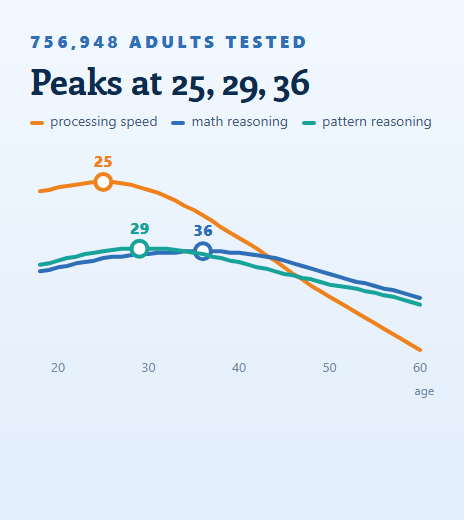
Women and men win at similar ages: a median of 63 for women and 60 for men. For when different thinking skills peak, see our study At what age is your brain sharpest?
10 Where did the 2026 winners study?
The 2026 Nobel prizes are presented in Stockholm on 10 December 2026. The eight laureates in the sciences and economics took their doctorates at seven institutions; both economics laureates, Robert E. Hall and Michael Woodford, at MIT [2]. Across all 47 people who won one of the 21 categories in 2026 (with the Turing Award announced that March), MIT awarded the most doctorates (4), and 10 earned theirs outside the country where they took their first degree. The table links each winner to the official announcement.
The 47 winners of 2026 and where they studied
| Prize | Winner (official page) | First degree | Doctorate |
|---|---|---|---|
| Nobel Physics | Francis Halzen | Catholic University of Leuven (to 1968) | KU Leuven |
| Nobel Chemistry | Henri B. Kagan | Chimie ParisTech | Collège de France |
| Nobel Chemistry | Kenso Soai | University of Tokyo | University of Tokyo |
| Nobel Medicine | Georg Nagel | University of Konstanz | Goethe University Frankfurt |
| Nobel Medicine | Karl Deisseroth | Harvard University | Stanford University |
| Nobel Medicine | Peter Hegemann | not found | Max Planck Institute of Biochemistry |
| Nobel Economics | Michael Woodford | University of Chicago | MIT |
| Nobel Economics | Robert E. Hall | UC Berkeley | MIT |
| Fields Medal | Hong Wang | Peking University | MIT |
| Fields Medal | Jacob Tsimerman | University of Toronto | Princeton University |
| Fields Medal | John Pardon | Princeton University | Stanford University |
| Fields Medal | Yu Deng | MIT | Princeton University |
| Abel Prize | Gerd Faltings | University of Münster | University of Münster |
| Turing Award (2025 award, announced 2026) | Charles Henry Bennett | Brandeis University | Harvard University |
| Turing Award (2025 award, announced 2026) | Gilles Brassard | Université de Montréal | Cornell University |
| Wolf Physics | Immanuel F. Bloch | University of Bonn | LMU Munich |
| Wolf Physics | Jun Ye | Shanghai Jiao Tong University | University of Colorado Boulder |
| Wolf Chemistry | David Klenerman | University of Cambridge | University of Cambridge |
| Wolf Chemistry | Pascal Mayer | University of Strasbourg | University of Strasbourg |
| Wolf Chemistry | Shankar Balasubramanian | University of Cambridge | University of Cambridge |
| Wolf Mathematics | David Kazhdan | Moscow State University | Moscow State University |
| Wolf Mathematics | Joseph Bernstein | Moscow State University | Moscow State University |
| Wolf Medicine | Charles S. Zuker | Pontifical Catholic University of Valparaíso | MIT |
| Lasker Basic | Emmanuel Mignot | Paris Cité University | Sorbonne University |
| Lasker Basic | Masashi Yanagisawa | University of Tsukuba | University of Tsukuba |
| Lasker Clinical | Kunihiro Hattori | University of Osaka | University of Osaka |
| Lasker Clinical | Takehisa Kitazawa | University of Tokyo | University of Tsukuba |
| Lasker Clinical | Tomoyuki Igawa | University of Tokyo | University of Tokyo |
| Kavli Astrophysics | Amina Helmi | National University of La Plata | Leiden University |
| Kavli Astrophysics | Rodrigo Ibata | University of Bristol | University of Cambridge |
| Kavli Astrophysics | Vasily Belokurov | Moscow State University | University of Oxford |
| Kavli Nanoscience | Allan H. MacDonald | St. Francis Xavier University | University of Toronto |
| Kavli Nanoscience | Eva Andrei | Tel Aviv University | Rutgers University |
| Kavli Nanoscience | Pablo Jarillo-Herrero | University of Valencia | Delft University of Technology |
| Kavli Neuroscience | Christine Holt | University of Sussex | King’s College London |
| Kavli Neuroscience | Erin Schuman | University of Southern California | Princeton University |
| Kavli Neuroscience | Kelsey C. Martin | Harvard University | Yale University |
| Kavli Neuroscience | Oswald Steward | University of Colorado Boulder | University of California, Irvine |
| Breakthrough Physics | David J. Gross | Hebrew University of Jerusalem | UC Berkeley |
| Breakthrough Life Sciences | Albert Maguire | Princeton University | Harvard University (MD) |
| Breakthrough Life Sciences | Bryan Traynor | University College Dublin | University College Dublin |
| Breakthrough Life Sciences | Jean Bennett | Yale University | UC Berkeley |
| Breakthrough Life Sciences | Katherine A. High | Harvard University | University of North Carolina at Chapel Hill (MD) |
| Breakthrough Life Sciences | Rosa Rademakers | University of Antwerp | University of Antwerp |
| Breakthrough Life Sciences | Stuart H. Orkin | MIT | Harvard University (MD) |
| Breakthrough Life Sciences | Swee Lay Thein | Universiti Malaya | not found |
| Breakthrough Mathematics | Frank Merle | École normale supérieure, Paris | Sorbonne University |
Source: Winners checked on each official prize site, 2026-10-23; Nobel doctorates as the Nobel press releases state them [2]; other degrees from this study’s records and our checks. The 2026 Wolf Prize in Agriculture and the Lasker-Koshland Special Achievement Award had not been announced.
11 Do prize winners have a high IQ?
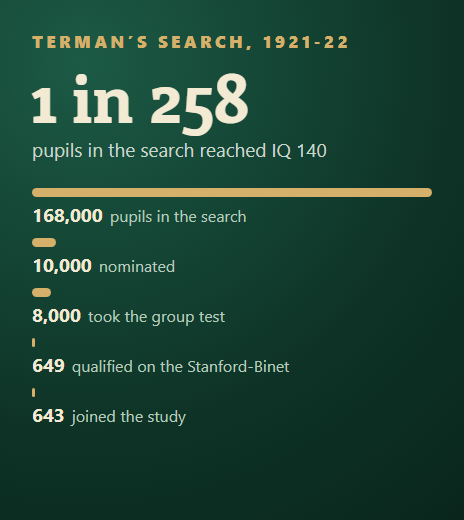
For almost all of them nobody knows: very few were ever tested, and fewer published a score. Our news story on the IQ of Nobel Prize winners separates the few measured scores from the guesses. The most famous test of the question, Lewis Terman’s study of 1,528 high-IQ children, produced no Nobel laureate and missed William Shockley, who won the physics prize in 1956: see our study of Terman’s gifted children.
See where you stand
Prize winners are a tiny, highly selected group. Our IQ test reports where you stand against adults today, with a confidence range and a percentile.
Take the IQ test12 How is this different from other university rankings?
Earlier rankings looked at the Nobel Prize alone, at one degree, or at where winners worked. Jonathan Wai and Stephen Hsu ranked first-degree universities per undergraduate for Nobel, Fields and Turing winners of 1966-2013, with Caltech first [12]; a 2016 Nature analysis did the same for Nobel winners of 1901-2015 and put the École normale supérieure first [13]. Times Higher Education counted where Nobel winners of 2000-2014 worked when they won, with Stanford first [14]. This study covers 21 prize categories, runs to the 2026 winners, counts first degrees and doctorates separately, and publishes every row so any number can be checked.
Other rankings of universities by prize winners
| Ranking | Prizes and years | What it counts | Top of its list |
|---|---|---|---|
| Wai and Hsu, reported by Quartz (2015) [12] | Nobel, Fields Medal, Turing Award, 1966-2013 | Winners per undergraduate (where they took their first degree) | Caltech |
| Clynes, Nature (2016) [13] | Nobel physics, chemistry, medicine, economics, 1901-2015 | Winners per undergraduate, 81 institutions with 3 or more alumni winners | École normale supérieure, Paris |
| Times Higher Education (2015) [14] | Nobel (no literature or peace), 2000-2014 | Where winners worked when they won, weighted | Stanford |
| This study (2026) | 21 categories: Nobel, Fields, Abel, Turing, Wolf, Lasker, Kavli, Breakthrough; 1901-2026 | Winners by first degree and by doctorate, counted separately; every row public | Harvard University |
Source: As cited in each row
13 For university press offices: how can you cite these numbers?
Universities may quote any number on this page for their own institution, on news pages, “facts and figures” pages, alumni magazines and library guides. Please link to this page and say which degree the number counts.
- Suggested wording: “64 winners of the Nobel and other top science prizes earned their first degree at the University of Cambridge (IQ Metrics Research, 2026).” Replace the number, the degree and the university with your own row.
- Your row: sort the top-50 table, or open the CSV (Get the data) and filter the
first_degree_institutionordoctorate_institutioncolumn for your university. Every winner is listed by name. - What counts: a first degree (bachelor’s or equivalent) or a doctorate earned at the university. Faculty, postdocs and visitors do not count, so our numbers are lower than “affiliated laureates” counts on many university websites.
- Names are today’s: colleges and medical schools count for their university (Trinity College for Cambridge, Harvard Medical School for Harvard), and merged institutions count for the university they became.
- Spotted a missing or wrong degree? Send it through the contact page with a source; we correct the data and note the change in the version history.
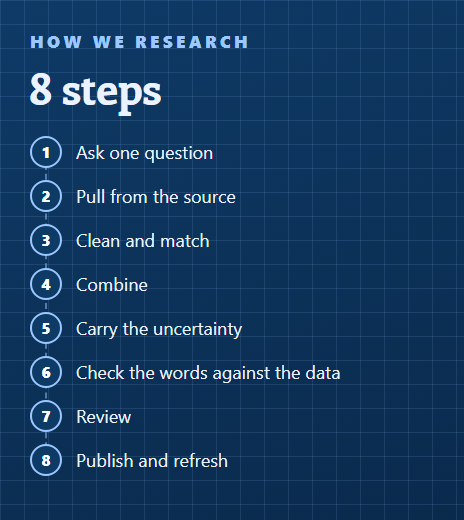
14 How was this study built?
- 01
List the winners
Nobel laureates come from the Nobel Prize API, the Nobel Foundation’s own data [1]. The other 17 categories come from Wikidata [3], checked name by name against each prize’s official list on 2026-10-23 [5] [6] [7] [8] [9] [10] [11]: 59 missing winners added, 44 wrong years corrected and 24 entries removed (mostly members of prize-winning collaborations and awards outside these categories).
- 02
Find where each winner studied
Wikidata’s “educated at” records, with their degree and dates, then the education line of the English Wikipedia infobox, which usually names the degree next to each university [3] [4]. Where neither names the degree, we read the article’s sentences that pair a degree with a university (“received his PhD from …”). High schools and lycées are left out.
- 03
Separate the two degrees
First degree: the bachelor’s, or its local equivalent (Diplom, licence, laurea, a first medical degree). Doctorate: the first research doctorate; a Doctor of Medicine counts only when it was the only one. A winner with one university and no degree recorded is counted there for the first degree only, and flagged as inferred.
- 04
Use today's names
Colleges, faculties and medical schools roll up to their university, and dissolved institutions to their successor (Victoria University of Manchester to the University of Manchester). The University of Paris, split into 13 universities in 1970, keeps its own name; so does the Catholic University of Leuven before its 1968 split.
- 05
Check
Each winner’s sex was checked against the pronouns in their Wikipedia article, and every age at the award under 27 or over 95 by hand. 72 winners drawn at random, and all 47 winners of 2026, were looked up in prize pages, university pages and CVs, academy memoirs and dissertation records: 92 of the 105 degrees the check could settle were right (88%), and every error it found was corrected (table below).
- 06
Publish the data
One row per award in a CSV under CC BY 4.0, with the source of every degree (recorded, text, inferred, checked). Our standards are on the methods page.
Where each placed degree came from, and how often it was right
| Source of the fact | First degree | Doctorate | Right in the random check |
|---|---|---|---|
| Recorded: a degree named next to the university in Wikidata or the Wikipedia infobox | 676 | 784 | 40 of 43 |
| From the article text: “received a PhD from …” | 253 | 252 | 30 of 39 |
| Inferred: only one university in the record (first degree only) | 246 | 0 | 14 of 15 |
| Doctor of Medicine was the only doctorate | 0 | 119 | 8 of 8 |
| Checked by hand against prize, university or academy pages | 33 | 34 | |
| Not placed | 363 | 382 | 27 of 34 hold a degree we could not place |
Source: Winners, 1901-2026 (1,571 in all). Random check: 72 winners drawn from every row, looked up in sources independent of Wikipedia and Wikidata, scored before any correction; the errors it found were then fixed.
How complete the education records are, by prize
| Prize | Winners | First degree placed | Doctorate placed |
|---|---|---|---|
| Nobel Physics | 230 | 173 (75%) | 179 (78%) |
| Nobel Chemistry | 200 | 155 (78%) | 156 (78%) |
| Nobel Medicine | 235 | 167 (71%) | 158 (67%) |
| Nobel Economics | 101 | 91 (90%) | 88 (87%) |
| Fields Medal | 68 | 46 (68%) | 61 (90%) |
| Abel Prize | 29 | 26 (90%) | 28 (97%) |
| Turing Award | 81 | 81 (100%) | 68 (84%) |
| Wolf Prizes | 338 | 277 (82%) | 276 (82%) |
| Lasker Awards | 353 | 239 (68%) | 245 (69%) |
| Kavli Prizes | 83 | 69 (83%) | 69 (83%) |
| Breakthrough Prizes | 165 | 138 (84%) | 141 (85%) |
| All 21 categories | 1,571 | 1,208 (77%) | 1,189 (76%) |
Source: A winner can hold several prizes, so the prize rows add up to more than the total.
The 21 prize categories counted
| Nobel Prize in Physics | 1901-2026 | 231 | 230 | 5 | [1] |
| Nobel Prize in Chemistry | 1901-2026 | 202 | 200 | 8 | [1] |
| Nobel Prize in Physiology or Medicine | 1901-2026 | 235 | 235 | 14 | [1] |
| Prize in Economic Sciences in Memory of Alfred Nobel | 1969-2026 | 101 | 101 | 3 | [1] |
| Fields Medal | 1936-2026 | 68 | 68 | 3 | [5] |
| Abel Prize | 2003-2026 | 29 | 29 | 1 | [6] |
| ACM A.M. Turing Award | 1966-2025 | 81 | 81 | 3 | [7] |
| Wolf Prize in Physics | 1978-2026 | 74 | 74 | 2 | [8] |
| Wolf Prize in Chemistry | 1978-2026 | 65 | 65 | 3 | [8] |
| Wolf Prize in Mathematics | 1978-2026 | 70 | 70 | 1 | [8] |
| Wolf Prize in Medicine | 1978-2026 | 68 | 68 | 10 | [8] |
| Wolf Prize in Agriculture | 1978-2025 | 61 | 61 | 5 | [8] |
| Albert Lasker Basic Medical Research Award | 1946-2026 | 174 | 174 | 7 | [9] |
| Lasker-DeBakey Clinical Medical Research Award | 1946-2026 | 166 | 164 | 11 | [9] |
| Lasker-Koshland Special Achievement Award in Medical Science | 1994-2025 | 19 | 19 | 3 | [9] |
| Kavli Prize in Astrophysics | 2008-2026 | 24 | 24 | 5 | [10] |
| Kavli Prize in Nanoscience | 2008-2026 | 28 | 28 | 4 | [10] |
| Kavli Prize in Neuroscience | 2008-2026 | 31 | 31 | 12 | [10] |
| Breakthrough Prize in Fundamental Physics | 2012-2026 | 62 | 62 | 2 | [11] |
| Breakthrough Prize in Life Sciences | 2013-2026 | 87 | 87 | 20 | [11] |
| Breakthrough Prize in Mathematics | 2015-2026 | 17 | 17 | 0 | [11] |
Source: Individual winners only: prizes given to organisations or to whole collaborations (for example the 2025 Breakthrough Prize to four CERN experiments) count only the people the prize site names. Checked against each official list on 2026-10-23.
What this study cannot tell you
- Education is not recorded for everyone: we placed a first degree for 77% of winners and a doctorate for 76%, and the gaps are larger for the early decades and for winners outside the English-speaking world, so their universities are under-counted.
- Part of the data comes from article text and from inference, which are less exact than a recorded degree: in the random check, 30 of 39 article-text degrees were right, against 40 of 43 recorded ones. Wrong ones tend to name a famous university where the winner did a later degree or worked. The CSV flags each fact’s source. Counting only recorded degrees keeps the same five universities at the top overall, with Harvard first, but puts Harvard ahead of Cambridge for first degrees (46 to 36).
- Counts favour large and old universities. We do not divide by the number of graduates; per-student rankings exist [12] [13] and give different leaders.
- A prize does not measure a university’s teaching. Winners studied decades before they won, so these numbers describe universities as they were then as much as today.
- Prizes that go to teams count only the people named. The members of collaborations that shared Breakthrough Prizes are not counted: the 2025 physics prize alone went to 13,508 researchers of four CERN experiments [11].
- Sex is as the Nobel Prize API and Wikidata record it (checked against each article’s pronouns, one record corrected); 2 winners have none recorded and are left out of the shares of women.
Sources
- Nobel Prize Outreach. Nobel Prize API 2.1: laureates in physics, chemistry, physiology or medicine and economic sciences, 1901-2026. 2026. api.nobelprize.org/2.1/laureatesCC0 (data)
- Nobel Prize Outreach. Press releases for the 2026 Nobel prizes in physics, chemistry, physiology or medicine, and economic sciences. 2026. www.nobelprize.org/prizes/physics/2026/press-releaseFacts cited
- Wikimedia Foundation. Wikidata: award received (P166), educated at (P69) with academic degree (P512), sex, date of birth; query of 2026-10-23. 2026. query.wikidata.orgCC0
- Wikimedia Foundation. English Wikipedia: education lines of biography infoboxes and article sentences naming a degree, revisions of 2026-10-23. 2026. en.wikipedia.orgCC BY-SA 4.0 (facts only; no text reused)
- International Mathematical Union. Fields Medal: list of medallists, 1936-2026. 2026. www.mathunion.org/imu-awards/fields-medalFacts cited
- Norwegian Academy of Science and Letters. The Abel Prize laureates, 2003-2026. 2026. abelprize.noFacts cited
- Association for Computing Machinery. A.M. Turing Award winners by year, 1966-2025, and the 2025 award release (18 March 2026). 2026. amturing.acm.org/byyear.cfmFacts cited
- Wolf Foundation. Wolf Prize laureates in physics, chemistry, mathematics, medicine and agriculture, 1978-2026. 2026. wolffund.org.il/the-wolf-prizeFacts cited
- Lasker Foundation. Lasker Award winners: basic, clinical and special achievement awards, 1946-2026. 2026. laskerfoundation.org/winnersFacts cited
- Kavli Prize. Kavli Prize laureates in astrophysics, nanoscience and neuroscience, 2008-2026. 2026. www.kavliprize.orgFacts cited
- Breakthrough Prize Foundation. Breakthrough Prize laureates in fundamental physics, life sciences and mathematics, 2012-2026. 2026. breakthroughprize.org/Laureates/1Facts cited
- Swarthmore College. Swarthmore among best schools for forging advancements in science, study shows (on Wai and Hsu's analysis in Quartz, "These 25 schools are responsible for the greatest advances in science"). 2015. www.swarthmore.edu/news-events/swarthmore-among-best-schools-forging-advancements-science-study-showsFacts cited
- Springer Nature. Clynes, T. Where Nobel winners get their start. Nature 538, 152. doi:10.1038/nature.2016.20757. 2016. doi.org/10.1038/nature.2016.20757Facts cited
- Times Higher Education. Top 10 universities for producing Nobel prizewinners. 2015. www.timeshighereducation.com/top-10-universities-producing-nobel-laureatesFacts cited
Version history
- 2026.1023 October 2026First release, with the 2026 winners.
Leon Falkner, Data & Research Analyst. Leon owns the arithmetic on IQ Metrics: the percentile tables, the score converter and the figures in everyone else's drafts. On the research desk Leon pulls the data, builds each index and writes the method. More about Leon.
Questions
Which university has the most Nobel Prize winners?
Counting where laureates studied, Harvard: 69 of the 765 people who won a Nobel Prize in physics, chemistry, medicine or economics (1901-2026) earned a first degree or doctorate there, ahead of the University of Cambridge (59). Counts of "affiliated" laureates, which include professors, are higher and differ by university.
Which university produces the most prize-winning scientists?
Harvard, with 142 of 1,571 winners of 21 top prize categories from 1901 to 2026 holding a first degree or doctorate from it. Cambridge is second (101) and level with Harvard for first degrees (64 and 59).
Where did most Fields Medal winners study?
Princeton University awarded the most doctorates to Fields medallists (8 of 68), followed by Harvard University (5). For first degrees, Moscow State University leads (5).
How many Nobel Prize winners in science are women?
Women have received 30 of the 769 Nobel prizes in physics, chemistry, physiology or medicine and economic sciences awarded from 1901 to 2026. Marie Curie won two of them.
How old are Nobel Prize winners?
In 2000-2026 the median Nobel laureate in the sciences and economics was 68 when the prize was announced, against 50 in 1901-1959. The oldest, John Goodenough, was 97 (chemistry, 2019).
Share it, cite it, download it
You may reuse everything on this page under CC BY 4.0: in articles, reports, lessons and posts. The one condition is credit to IQ Metrics with a link to this page.
Cite this study
Version 2026.10. Citing the version lets readers find the exact numbers.
Archived copy with a DOI: 10.5281/zenodo.23589566 (report PDF and data on Zenodo).
Falkner, L. (2026). Which universities produce the most prize-winning scientists? (Version 2026.10) [Data set]. IQ Metrics Research. https://iqmetrics.org/research/universities-with-the-most-prize-winners/ (DOI: 10.5281/zenodo.23589566)
Falkner, Leon. "Which universities produce the most prize-winning scientists?" IQ Metrics Research, 23 Oct. 2026, iqmetrics.org/research/universities-with-the-most-prize-winners/. DOI: 10.5281/zenodo.23589566.
Falkner, Leon. "Which universities produce the most prize-winning scientists?" IQ Metrics Research. October 23, 2026. https://iqmetrics.org/research/universities-with-the-most-prize-winners/. DOI: 10.5281/zenodo.23589566.
@misc{iqmetrics2026universitieswiththemostprizewinners, author = {Falkner, Leon}, title = {Which universities produce the most prize-winning scientists?}, institution = {IQ Metrics}, year = {2026}, version = {2026.10}, doi = {10.5281/zenodo.23589566}, url = {https://iqmetrics.org/research/universities-with-the-most-prize-winners/} }
Source: Leon Falkner, "Which universities produce the most prize-winning scientists?" IQ Metrics Research, version 2026.10, https://iqmetrics.org/research/universities-with-the-most-prize-winners/ (DOI 10.5281/zenodo.23589566)
Embed the top 10
Paste this into your page or post. It lists the ten universities and credits the source.
Get the data
One row per award: 1,893 awards to 1,571 people in 21 prize categories, 1901-2026, with the winner’s first-degree and doctorate university (today’s name and country), age at the award, sex, and the source of each degree.
| Column | What it holds |
|---|---|
prize_key, prize, year | The prize category and the year it is named for (Turing: the award year; the 2025 award was announced in March 2026) |
winner, wikidata_id | The winner's name as the official list gives it, and the Wikidata item |
sex, birth_year, age_at_award | Sex as recorded; age when the prize was announced (Nobel: 1 October; others: 1 July of the award year) |
first_degree_institution, first_degree_country | Where the first degree (bachelor's or equivalent) was earned, today's name and country |
first_degree_source | recorded (a degree named in Wikidata or the infobox), text (from the article text), inferred (only one university known), manual (checked by hand), not found |
doctorate_institution, doctorate_country, doctorate_source | The first research doctorate; doctorate_source md = a Doctor of Medicine was the only doctorate |
nobel_affiliation_country | Nobel laureates: country of the first affiliation at the award, from the Nobel Prize API |
education_sources, wikipedia_revision | Which sources named the person's universities, and the article revision read |
For journalists, researchers and teachers
Everything on this page may be quoted, charted and republished with credit. No embargo, no permission needed, no sign-up. If you need a number that is not here, ask.
Summary you can paste
Plain news style. Edit freely; keep the credit.
An IQ Metrics Research study traced where 1,571 winners of 21 top science prize categories (Nobel, Fields, Abel, Turing, Wolf, Lasker, Kavli and Breakthrough), 1901-2026, took their first degree and their doctorate. Harvard leads with 142 winners, ahead of Cambridge (101), Berkeley (81) and MIT (80). Cambridge (64) and Harvard (59) lead for first degrees; Harvard awarded the most doctorates (107). Since 2000, MIT ranks second. Women won 16.9% of awards in 2020-2026, against 2.6% before 2000. The median winner was 60 when the prize was announced. Every winner is listed in an open CSV. Source: IQ Metrics Research, https://iqmetrics.org/research/universities-with-the-most-prize-winners/
Angles for a story
- Nobel week: the 2026 laureates receive their prizes in Stockholm on 10 December (where they studied).
- First degree vs doctorate: Cambridge is level with Harvard for first degrees, far behind for doctorates (Figure 2).
- The 21st-century shift: MIT second since 2000 (Figure 3).
- From Europe to America: who ranked first in each decade (Figure 4).
- Women in top science prizes, decade by decade (Figure 6).
- Your university’s own number, for alumni and “facts and figures” pages (how to cite).
Quotes you can use
Attributable as written, with the name and title. For a different angle or a quote on a specific figure, ask through the contact page.
A Harvard doctorate is the most common credential among top-prize scientists. For the first degree, Cambridge is level with Harvard: the first degree and the doctorate tell two different stories.
Leon Falkner, Data & Research Analyst, IQ Metrics ResearchCity College of New York, a public college that charged no tuition for most of the last century, is one of the great first-degree schools of prize-winning science.
Leon Falkner, Data & Research Analyst, IQ Metrics ResearchPrize winners mostly take both degrees in one country. The big move comes later, when they go where the laboratories are.
Leon Falkner, Data & Research Analyst, IQ Metrics Research
Files
- CSV of every award, one row per winner and prize, with the source of each degree (CC BY 4.0)
- Every figure as a print-ready PNG: use the Image button under each figure
- Share images for social media in three sizes, with the credit line built in
- Citations in APA, MLA, Chicago, BibTeX and plain text
Terms, contact and corrections
Credit: “IQ Metrics Research, Universities With the Most Prize Winners 2026” with a link to this page. On air or in print, “IQ Metrics” and the page address are enough.
Data credit: prize lists from the Nobel Prize API [1] and the prize organisations; education from Wikidata [3] and Wikipedia [4]; the counts, rankings and checks are ours.
Contact: the research team, through the contact page. Corrections are made on this page with a dated note in the version history.
Please say which degree a number counts (first degree, doctorate or either); “affiliated laureates” counts on university websites include faculty and are not comparable.