





Why No IQ Test Can Reliably Score You Above 160
Two different numbers get used as "the top of the scale," 145 and 160, and they come from two different kinds of limit. One is a statement about population statistics; the other is about what a specific test manual will actually compute.

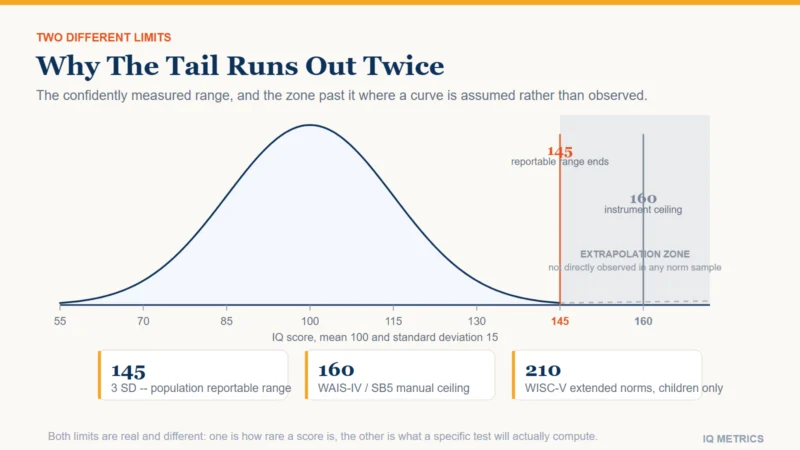
No current IQ test can reliably score you above roughly 160, and the reasons split into two genuinely different limits that get conflated constantly. One is a statistical fact about how rare extreme scores are in any real population; the other is a mechanical fact about what a specific test’s norm tables will actually compute, regardless of population size. Knowing which one you are looking at changes what a very high number on a report should be taken to mean.
This site’s own breakdown of the IQ bell curve already states the first limit plainly: the reportable range runs out around 145, and anything past it is described there as extrapolation. What follows is the mechanism behind that statement, the second, different limit sitting behind the number 160, and how the two relate.
Two different numbers, two different reasons
145 is a population-statistics boundary. On the standard deviation-15 scale, 145 sits three standard deviations above the mean, the point past which roughly 99.7% of the population has already been accounted for. Above it, an individual score corresponds to a rarity — on the order of one person in several hundred to several thousand, and the exact percentile assigned that far out depends heavily on the precise shape assumed for the tail of the distribution, which nobody has ever measured directly because there are not enough extremely rare people in any single standardisation sample to measure it from.
160 is a different kind of limit entirely: an instrument ceiling. The WAIS-IV and the Stanford-Binet Fifth Edition, the two most widely used individually administered tests, both cap their standard Full Scale IQ near 160, and their manuals provide no calculation at all for a raw score above the test’s hardest items. That is not a statement about the population; it is a statement about the test. Even a hypothetical person far more capable than anyone in the norm sample would still top out at the same number, because the test simply runs out of harder questions to ask them.
Why sample size is the real constraint
A standardisation sample for a major test typically runs into the low thousands of people, carefully balanced for age, sex and other demographics so that the middle of the distribution is measured with real precision. That is more than enough people to pin down what "average" looks like, and plenty to characterise the range most test-takers actually fall into. It is nowhere near enough to characterise a score that only one person in several thousand reaches. A norm sample of 2,000 people would be expected to contain zero individuals at the rarity a 160 implies under a normal distribution, which means the test cannot empirically verify what that end of the scale should look like — it can only extrapolate the shape of the curve outward from where it actually has data, and trust that the distribution keeps behaving the way the model assumes.
Why the manual just stops
Every subtest on a modern IQ test has a fixed set of items ordered roughly by difficulty. A test-taker who answers every item correctly, including the hardest ones, has hit what psychometricians call a ceiling effect: the test cannot distinguish that person from someone hypothetically even more capable, because there was nothing harder left to ask. The raw score still converts to a scaled score through the norm tables, but that scaled score is capped at whatever the hardest available item supports — it cannot extrapolate past the edge of what the test actually measured.
This also means the reliability of a score is not constant across the range. The standard error of measurement — the margin of uncertainty around any reported score — is smallest near the middle of the distribution, where the norm sample is largest and the item set is best calibrated, and grows toward both tails. A reported 160 carries a substantially wider confidence interval than a reported 100, even though both are presented as single, clean numbers on a report.
Where would your own score land?
Take the IIF-certified assessment and get your score with the scale it was measured on, the percentile it corresponds to and the confidence range around it — the three figures most online tests leave out.
Find your IQ score now! →Extended norms: the workaround, and its limits
Test publishers have addressed the ceiling problem for specific instruments through extended norms — not simply adding harder questions, but statistically remodelling the upper end of the scale using a separately recruited, targeted sample of unusually high-ability test-takers combined with the standard norm group. Pearson’s WISC-V Extended Norms is the clearest example, statistically extending the reportable composite range up to a Full Scale IQ of 210. That extension applies to the WISC-V, a children’s instrument — not to the adult WAIS-IV, which as of today still stops at its standard ceiling in ordinary clinical use.
Extended norms are a real statistical solution, not a workaround in the dismissive sense, but they only exist where a publisher has invested in building them for a specific test. A report from an instrument without an extended-norm supplement will still simply stop at its ordinary ceiling, and a clinician working with a potentially profoundly gifted child needs to know, ahead of time, which instrument actually has the extended tables built for it.
What "off the charts" should make you skeptical of
Outside a clinical setting, a claimed score comfortably above 160 is one of the more reliable signs that a result did not come from a properly normed, ceiling-aware instrument. A short online quiz built for a general audience is normed, if it is normed at all, against a sample built to characterise ordinary scores accurately, not the extreme right tail, so a headline result of "175" or higher from that kind of test is telling you more about the scoring formula than about the test-taker. The same caution applies in reverse to a very low reported score from an untested source: the further either end of the scale you look, the more the specific instrument and its norm sample matter, and the less a bare number can be trusted on its own.
Where the very high numbers in circulation come from
Numbers like "228," which have circulated in reference books and media coverage of certain public figures for decades, do not come from any test administration capable of producing them — no standardised instrument has ever reported a score in that range, for exactly the ceiling reasons described above. Figures like that originate from retrospective estimation methods applied to historical biographical material — childhood achievements, ages at which milestones were reached — run through a formula, not from a person sitting a test with a documented ceiling anywhere near that high. It is one of a handful of durable public misunderstandings about intelligence testing covered in more detail in our piece on brain myths.
What a high-range report should actually say
In practice, psychologists assessing a potentially profoundly gifted child or adult choose instruments specifically for their documented upper range rather than assuming any test will do, and a competent report will say plainly when a score has hit a ceiling rather than presenting a capped number as a precise measurement. High-IQ societies with unusually demanding thresholds handle this the same way: they specify which tests and which scores they accept, generally requiring supervised administration of an instrument with documented norms at that level, rather than accepting any test’s raw maximum at face value. It is a stricter version of the same principle behind Mensa’s own admission requirements and ordinary gifted-programme cutoffs: the number only means what it claims to mean when the instrument behind it is named.
And because scores this extreme are rare enough that two very high-scoring parents do not straightforwardly produce a child at the same extreme, a single very high number — a child’s, an adult’s, or a historical figure’s — is almost always better read as "very high, with real uncertainty about exactly how high" than as a precise point on an infinite scale. If you want your own number, on an instrument with known, stated limits, a properly normed test is where to start; for how the ordinary part of the scale works, the score converter and the full range breakdown cover everything below the ceiling this article is about.
Keep reading
All articles →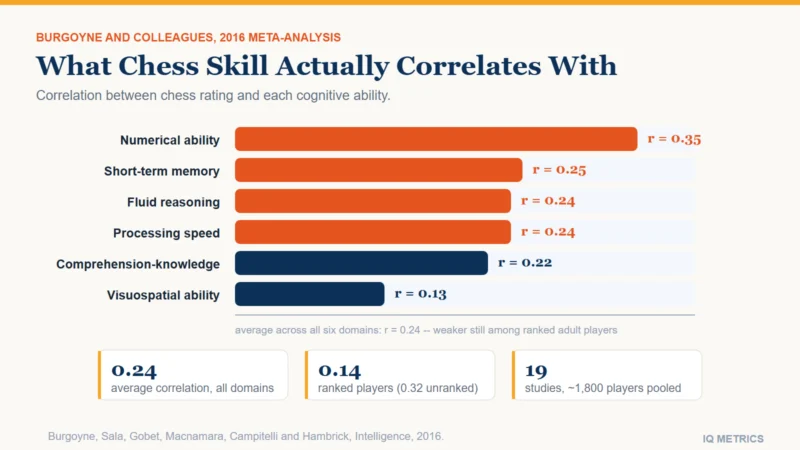 Research & Evidence
Chess Ratings and IQ
Chess has a reputation as a proxy for raw intelligence. The best available meta-analysis puts the real correlation at a modest 0.24, and it gets noticeably weaker once you look only at ranked, adult tournament players.
 Research & Evidence
Assortative Mating and IQ
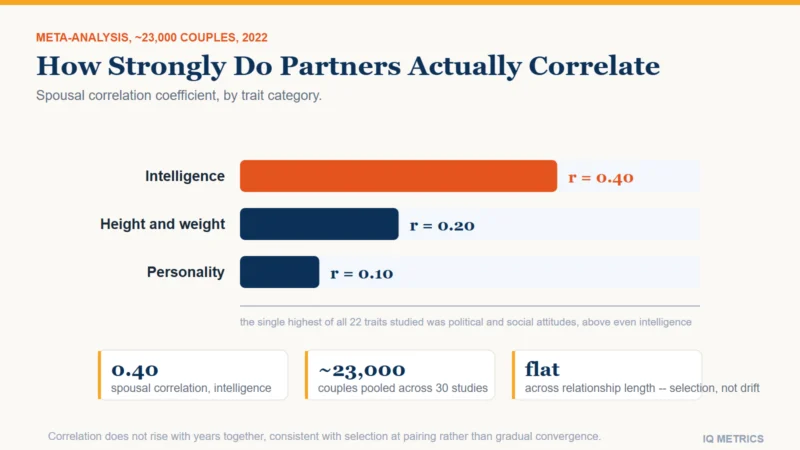
Married and long-term partners score more alike on IQ than on almost any other trait psychologists measure, personality included. The correlation is about 0.40, it shows up before the relationship starts, and it has real downstream effects on how heritability studies get interpreted.
 Scores & Scales
Ranges of IQ Level
Discover the different ranges of IQ level with comprehensive IQ testing information. Learn about IQ scores and range interpretations to enhance your knowledge.