





Breastfeeding and IQ: What the Only Randomized Trial Found
The largest randomized trial ever run on breastfeeding found a genuine IQ advantage at age six -- about six points on full-scale IQ. By age sixteen, the gap on most measures had shrunk close to zero. Here is what the trial actually measured, and why it still beats every observational study that came before it.

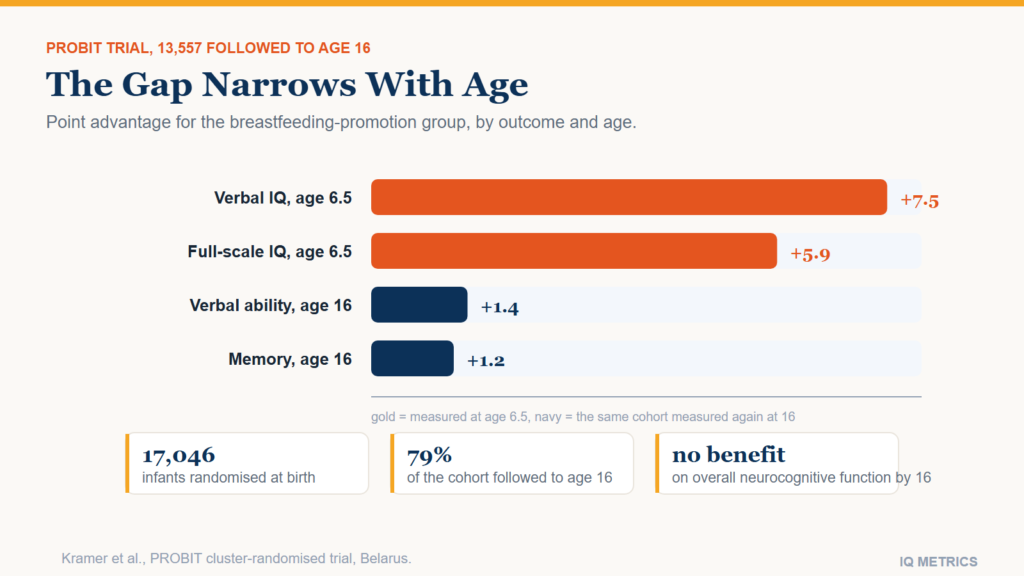
A little, and mostly early. The best evidence comes from a single randomized trial in Belarus that followed 17,046 infants from birth: at age 6.5 the breastfeeding-promotion group scored about 6 points higher on full-scale IQ and 7.5 points higher on verbal IQ. By age 16, most of that gap had narrowed to somewhere between nothing and a point and a half, depending which measure you look at.
That shrinking pattern is not a flaw in the study. It is the most informative part of it, and it is the reason this article leads with a single randomized trial most people have never heard of, rather than the much larger pile of observational studies on breastfeeding and IQ that came before it and that this trial was specifically designed to improve on.
Why this question needed a randomized trial
You cannot ethically assign babies to be breastfed or formula-fed, so almost every study on this topic before the 1990s was observational: researchers compared children whose mothers happened to breastfeed against children whose mothers happened not to, and measured IQ later. The problem is obvious once you say it plainly — mothers who breastfeed for longer tend, on average, to have more education, higher incomes and higher IQ scores themselves, all of which independently predict a child’s IQ. An observational study cannot cleanly separate "breastfeeding raised this child’s IQ" from "the kind of mother who breastfeeds also tends to have a smarter child regardless."
This is not a small confound to wave away. Maternal education and IQ are among the strongest known predictors of a child’s own IQ, and breastfeeding rates and duration both rise steeply with maternal education across almost every population they have been measured in. An observational study that does not fully strip that relationship back out is, in effect, partly measuring maternal IQ and reporting it as a breastfeeding effect.
The Promotion of Breastfeeding Intervention Trial (PROBIT) solved this the only ethical way available: it randomized the promotion, not the milk. Thirty-one maternity hospitals and clinics across Belarus were randomly assigned to either adopt the WHO/UNICEF Baby-Friendly Hospital practices, which substantially raise breastfeeding rates and duration, or continue standard care. Every mother still chose how she fed her own child. What the randomization controls for is everything else — the assigned hospitals and the control hospitals started with comparable populations, so any later difference in child outcomes is attributable to the intervention rather than to who chooses to breastfeed.
Concretely, the Baby-Friendly practices the intervention hospitals adopted included skin-to-skin contact and starting breastfeeding within an hour of birth, "rooming in" so infants stayed with their mothers rather than in a separate nursery, staff trained to help with common breastfeeding problems, and a shift away from routinely offering formula supplements without a medical reason. None of that is exotic or experimental — it is closer to ordinary good hospital practice today than it was in Belarus in the mid-1990s, which is part of why the trial could move breastfeeding rates by enough to detect an effect at all: infants at the intervention hospitals were breastfed more, and for longer, than infants at the control hospitals, even though no individual mother was assigned anything.
What the trial found at age 6
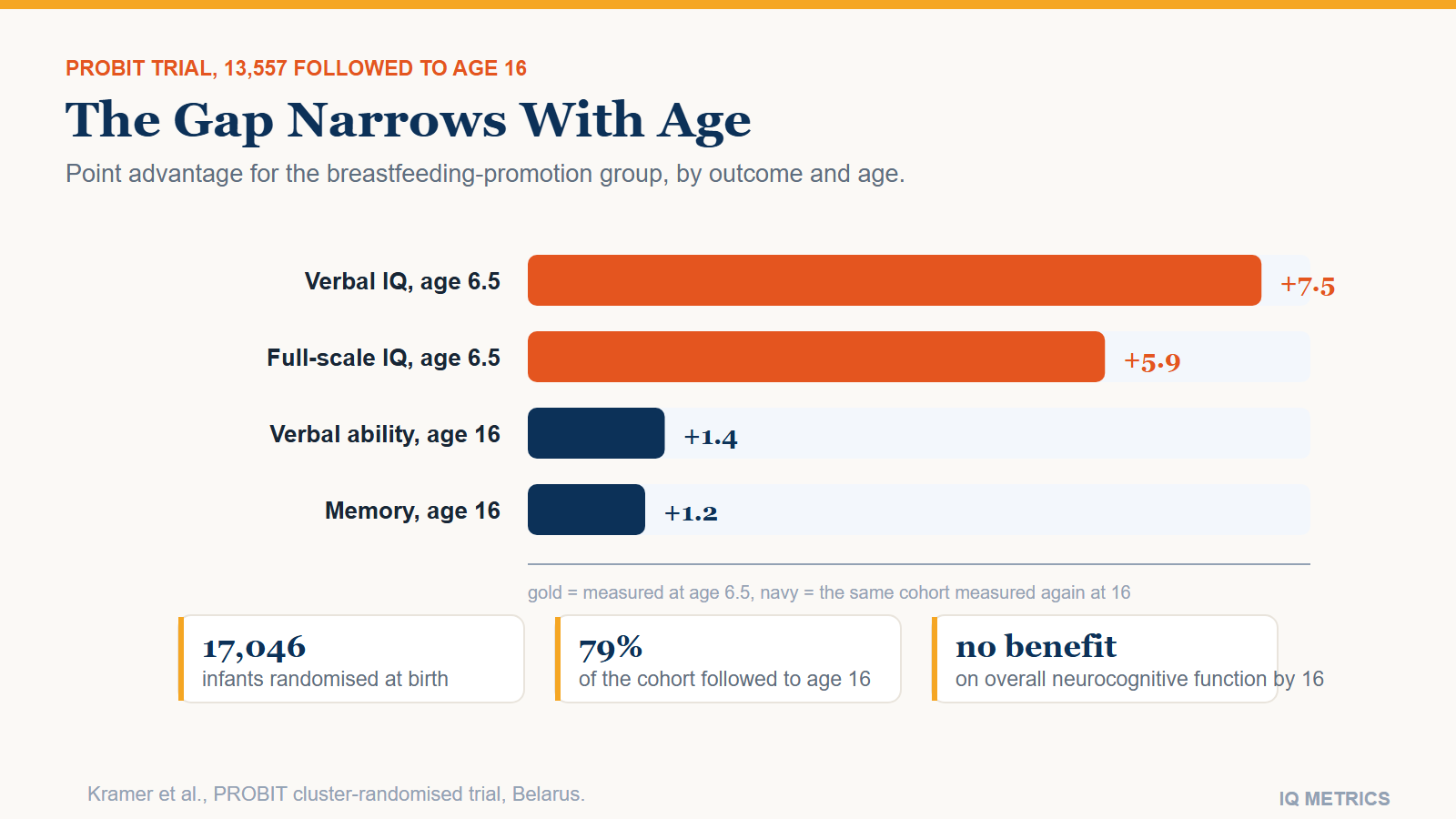
At the 6.5-year follow-up, children from the breastfeeding-promotion hospitals scored 7.5 points higher on verbal IQ (a real, statistically significant gap) and 5.9 points higher on full-scale IQ. The full-scale figure is worth a caveat the trial’s own authors flagged: its confidence interval technically touched zero, meaning it sits right at the edge of conventional statistical significance rather than comfortably past it. Performance IQ — the non-verbal half of the test — showed a smaller, clearly non-significant 2.9-point difference. Verbal ability carried almost the entire effect.
The gap by adolescence
The same cohort was tracked down again at age 16 — 13,557 of the original 17,046 children, a 79.5 percent retention rate that is unusually high for a 16-year follow-up and a real strength of the trial. The headline result: "no benefit of a breastfeeding promotion intervention on overall neurocognitive function was observed." Two narrower measures still showed a small, statistically real gap — verbal function (+1.4 points) and memory (+1.2 points) — but both were well under a fifth the size of the verbal advantage measured a decade earlier.
A shrinking effect with age is exactly what you would expect if breastfeeding gives verbal development an early nudge that schooling, reading and everyday language exposure gradually swamp for everyone, breastfed or not. It is a considerably less dramatic story than the age-6.5 numbers alone would suggest, and a more honest one.
Where would your own score land?
Take the IIF-certified assessment and get your score with the scale it was measured on, the percentile it corresponds to and the confidence range around it — the three figures most online tests leave out.
Find your IQ score now! →Why a trial beats the studies it replaced
Here is the part that is easy to miss: PROBIT’s effect sizes are noticeably smaller than what many older observational studies reported, and that is a feature of the trial, not a weakness. Those larger observational estimates were almost certainly inflated by exactly the confound described above — maternal IQ and socioeconomic status riding along with the decision to breastfeed. When you randomize away that confound, the honest effect is real but modest, concentrated in verbal ability, and fades with age. That is a less exciting headline than "breastfeeding raises IQ by X points," and it is also much more likely to be true.
This same pattern — an early, measurable gap that narrows well before adulthood — shows up again in what randomized early-childhood programmes actually do to IQ scores, for a related but not identical reason: there, the IQ gap itself closes almost completely, while other outcomes that have nothing to do with an IQ number keep a real gap open for decades.
What might explain a real, if modest, effect
The leading biological candidate is the long-chain polyunsaturated fatty acids naturally present in breast milk — DHA in particular, which is a structural component of neural tissue and is added to many infant formulas precisely because of this hypothesis. Duration and exclusivity of breastfeeding also appear to matter in the literature more broadly, which is consistent with a dose-response biological mechanism rather than a purely social one. A competing, non-exclusive explanation is simply more one-on-one verbal interaction during feeding — breastfeeding sessions take longer than bottle-feeding on average, and the verbal advantage found in the trial, concentrated as it was rather than spread evenly across every cognitive domain, is at least as consistent with more talking and eye contact in infancy as it is with a nutrient in the milk itself. Neither explanation is settled with the same confidence as the trial’s headline numbers; both are plausible mechanisms behind them, not independently proven ones, and the trial itself was not designed to distinguish between them.
What this does not mean for any individual family
A population-average difference of a few IQ points, most of which narrows by adolescence, says essentially nothing about any single child. Formula-fed children are not destined toward a lower score — genetics, home language environment, broader nutrition and schooling all move the needle by more than this effect does, and countless people who were formula-fed as infants score well above average by any measure. A few IQ points at the population level, most of which narrows within a decade, is the kind of effect that shows up reliably only when you average across thousands of children — it disappears into the ordinary noise of one particular kid’s life, alongside sleep, illness, the specific school they attend and simple test-day variation. Breastfeeding also carries other, better-established maternal and infant health benefits that have nothing to do with IQ and are outside the scope of this article. If you are curious where your own score sits on a standard scale rather than a research statistic, the age-by-age IQ scale is the place to start.
Keep reading
All articles →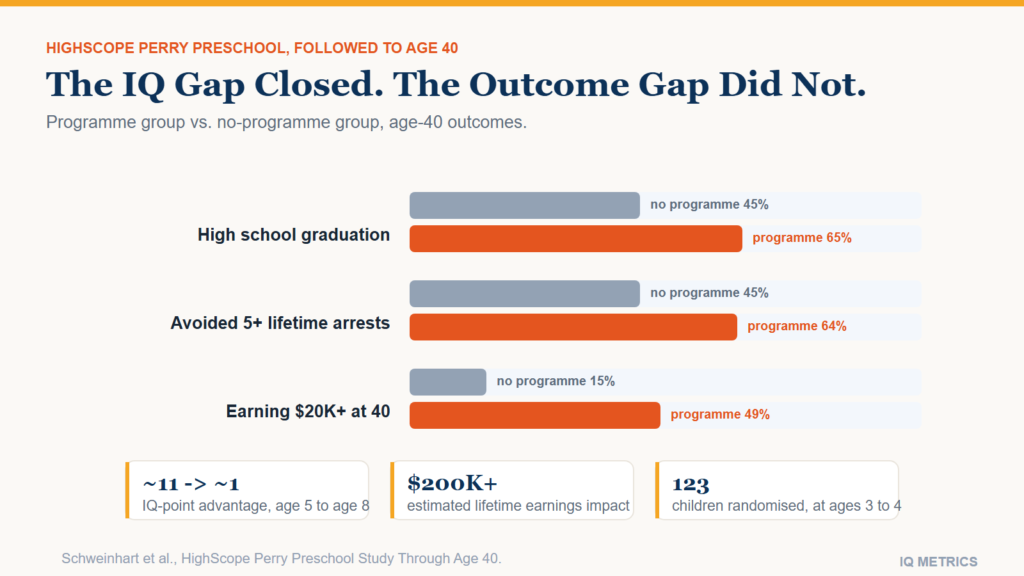 Research & Evidence
Preschool and IQ
The most famous experiment in early-childhood education raised participants' IQ scores by as much as 13 points -- then watched that advantage shrink to almost nothing within a few years. Their income, education and arrest records stayed different for the rest of their lives. Why would outcomes outlast the score that supposedly predicts them?
 Taking a Test
IQ Testing for Children
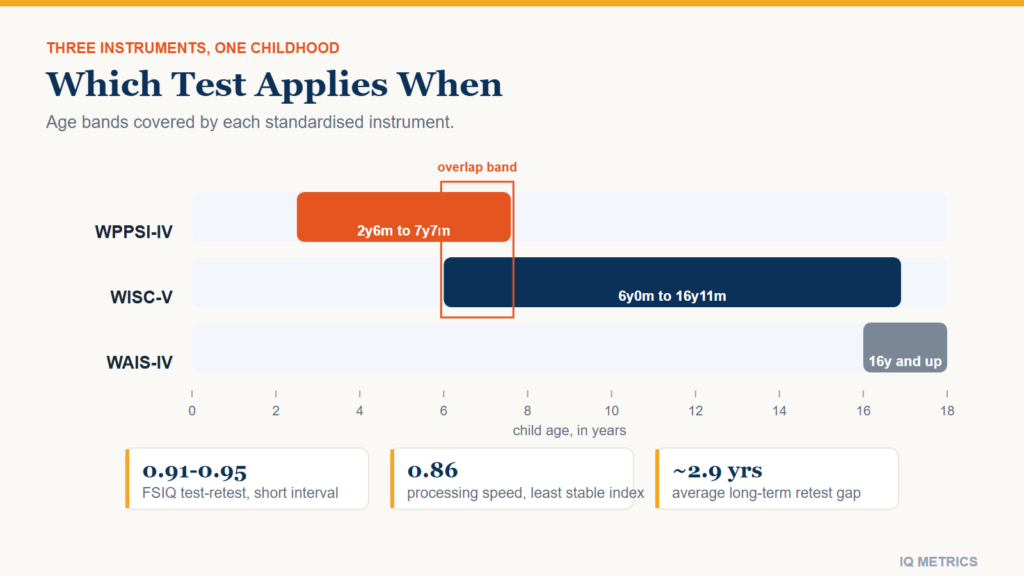
Children are not tested on the same instrument as adults, and the test itself changes twice before age eighteen. Here is which one applies when, how reliable an early score really is, and what a parent should and should not conclude from a single number.
 Research & Evidence
Nutrition and IQ
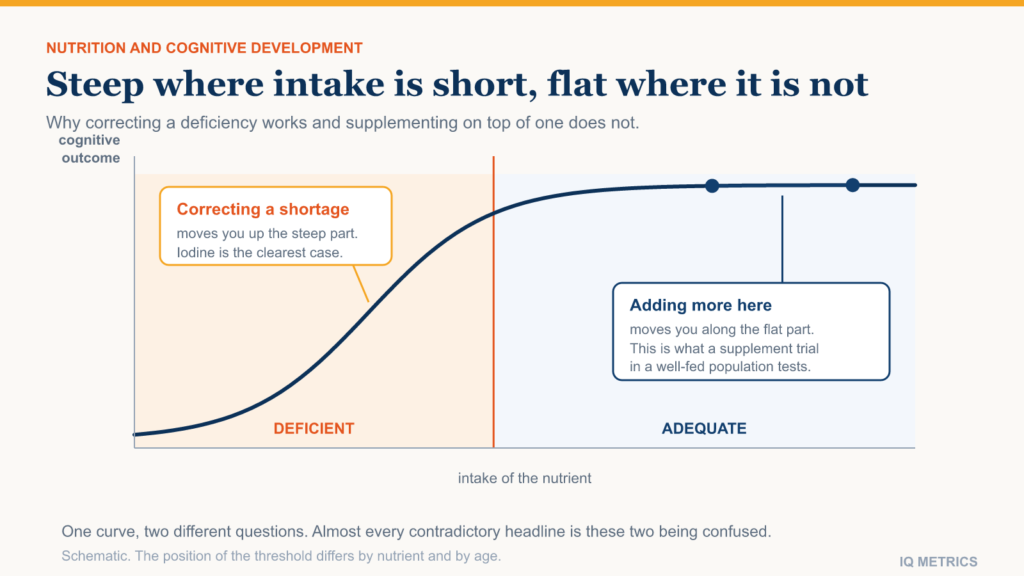
The evidence on diet and intelligence looks contradictory until you separate two questions that get asked as one. Fixing a real deficiency produces some of the largest effects in the field. Adding more of the same nutrient to an already adequate diet produces close to nothing.