
Processing Speed and IQ: Does Thinking Fast Mean Thinking Well?
Fast thinkers are assumed to be smart thinkers, and there is a real finding underneath the stereotype: people who score higher on IQ tests do respond faster on tasks with no reasoning content at all. But the link is weaker than the folklore, and on a professional battery the speed index is the least g-loaded.
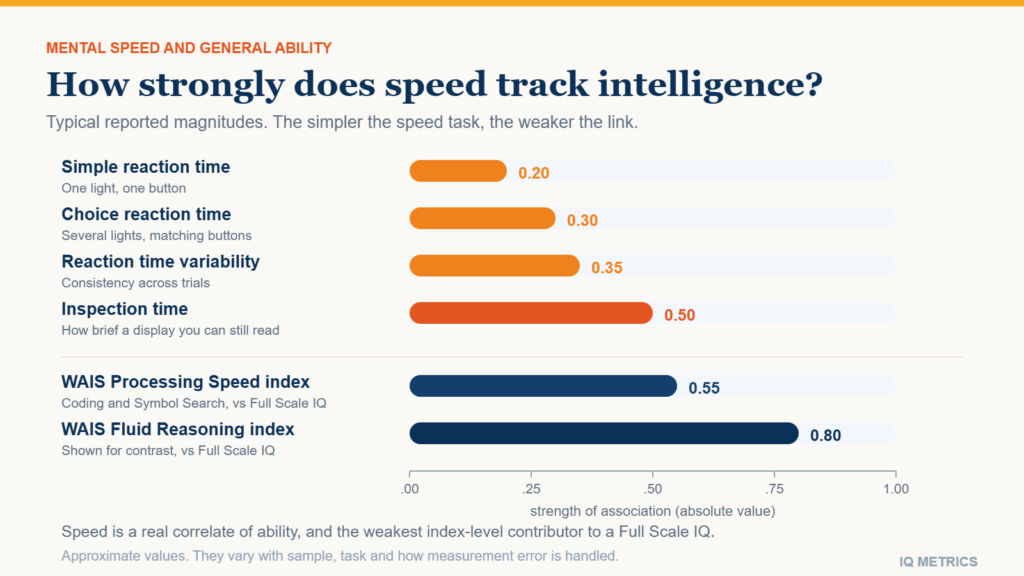
Processing speed and IQ are genuinely related, but far less tightly than the stereotype of the quick-witted genius suggests. People with higher IQ scores do respond faster on tasks that contain no reasoning at all — pressing a button when a light comes on — and that finding has held up for over a century. The association is real. It is also modest, and it gets stronger the more complex the speed task becomes, which tells you something important about what is actually going on.
This matters practically, because speed shows up in three different places: as an index on professional batteries, as a time limit on almost every online test, and as the main casualty of cognitive ageing. Those three are often confused with each other.
Reaction time: the oldest finding in the field
The idea that mental speed underlies intelligence goes back to Francis Galton in the 1880s and was revived by Arthur Jensen in the 1970s. The modern version uses a simple apparatus: a light comes on and you press a button. In the simple reaction time version there is one light and one button. In choice reaction time there are several lights and you must press the matching button.
- Simple reaction time correlates with IQ only weakly — typically around -0.2 (negative because faster means a lower time and a higher score).
- Choice reaction time correlates more strongly, and the correlation rises as the number of alternatives rises.
- Variability in reaction time — how inconsistent someone is across trials — often predicts IQ better than their average speed does.
That last point is the interesting one and it is frequently overlooked. Being reliably quick appears to matter more than being occasionally very quick. Reviews of this literature generally place single-task correlations in the low-to-moderate range, with higher values when several speed measures are combined into a composite rather than used one at a time.
Inspection time
A related paradigm removes the motor response entirely. In an inspection time task, two lines of different lengths flash on screen for a very brief interval and you say which was longer. There is no speed of response involved — you can take as long as you like to answer — only how brief a display you can still make sense of. Meta-analyses of this task have reported associations with IQ around -0.5 once corrections for measurement error and restricted range are applied, making it one of the stronger elementary correlates of general ability.
Where speed sits on a professional test
On the Wechsler batteries described in our guide to professional IQ tests, processing speed is one of the four or five index scores that feed the Full Scale IQ. It is measured with tasks like Coding (matching symbols to digits against the clock) and Symbol Search (scanning for a target shape).
Two facts about that index are worth knowing before you read a report:
- It is usually the least g-loaded of the indices. Verbal comprehension and fluid or perceptual reasoning carry far more of the general factor than speed does.
- It is the most easily disturbed. Fatigue, anxiety, medication, motor difficulty, vision and simple unfamiliarity with a pencil task all push it down without touching reasoning ability.
That combination is exactly why psychologists sometimes report the General Ability Index alongside the Full Scale IQ — a composite that leaves working memory and processing speed out. If a report in front of you shows one, our guide to reading an IQ test report explains when that substitution is appropriate.
Why online tests time you
Almost every online test imposes a limit, and the reason is psychometric rather than dramatic. Without one, reasoning items stop discriminating: given unlimited time, a large majority of test-takers eventually solve a mid-difficulty matrix, so the item no longer separates anyone from anyone. A time limit keeps the difficulty spread usable across the whole range.
The cost is that a timed score blends two things — how well you reason and how fast you work — and different people pay that cost differently. Someone accurate but deliberate loses points that someone quick and careless does not. This is why our timed IQ test is presented separately from the untimed formats in the test hub: they are answering slightly different questions about you.
It is also why speed-accuracy tradeoff advice is not a trick. Working slightly faster than feels comfortable usually helps on a timed test, up to the point where errors start climbing. Our guide to preparing for an IQ test covers where that point tends to sit.
Where would your own score land?
Take the IIF-certified assessment and get your score with the scale it was measured on, the percentile it corresponds to and the confidence range around it — the three figures most online tests leave out.
Can you train processing speed?
You can improve the score, and that is not the same as improving the ability. Coding-type tasks respond strongly to practice: do one twice and the second attempt is faster, because you have learned the symbol pairings rather than because you now process information more quickly. This is one reason retesting on the same battery too soon inflates a result, as we cover in the practice effect on ability tests.
The best evidence on deliberate speed training comes from large randomised trials in older adults, where speed-of-processing training produced substantial and durable improvement on the trained tasks. What it produced on untrained abilities is far more disputed, and the broader claims made for that work have been challenged repeatedly. The pattern matches the training literature generally — near transfer is well supported, far transfer is not — which is the same conclusion our page on improving your IQ reaches.
A more useful distinction is between things that raise your speed and things that were suppressing it. Sleep debt, illness, anxiety and unfamiliarity with the response format all depress measured speed without touching capacity, which is the mechanism behind test anxiety and IQ scores. Removing them recovers what was already yours; none of them make you faster than your own baseline.
Speed and ageing: the clearest real-world case
Processing speed is the single most age-sensitive part of cognition. It begins declining in early adulthood and continues steadily, and Timothy Salthouse’s influential processing-speed theory argues that much of the apparent age-related decline in reasoning and memory is a downstream consequence of that slowing rather than an independent loss.
Two mechanisms are usually proposed: when operations are slow, early results decay before later ones finish, and fewer operations fit into the available window. Statistically, controlling for speed accounts for a substantial share of the age effect on other abilities — though “accounts for” in a statistical model is not the same as “causes”, and this remains debated.
Because age-normed IQ compares you with people your own age, none of this shows up on a reported score. The number stays flat while the underlying speed changes, which our page on IQ and age charts directly.
Does thinking fast mean thinking well?
Not reliably, no. Speed is one contributor to a score among several, it is the weakest of the index-level contributors, and the deliberate-and-accurate profile is common among high scorers. Worth separating clearly:
- Speed of elementary processing — reaction and inspection time — is modestly related to general ability and is not something you can train up meaningfully.
- Speed on a clerical task — the WAIS speed index — is only loosely related to reasoning and is easily depressed by things that have nothing to do with intelligence.
- Speed of judgement — answering fast in conversation or in a meeting — is barely studied, closer to a personality trait, and is often the opposite of good thinking. That is the theme of why smart people make bad decisions.
If you want to see how the two behave for you specifically, take our free IQ test once under its normal limit and note where you were rushed. The gap between what you answered and what you could have answered is your own speed contribution, and it is usually smaller than people fear.
Keep reading
 Scores & Scales
How to Read an IQ Test Report
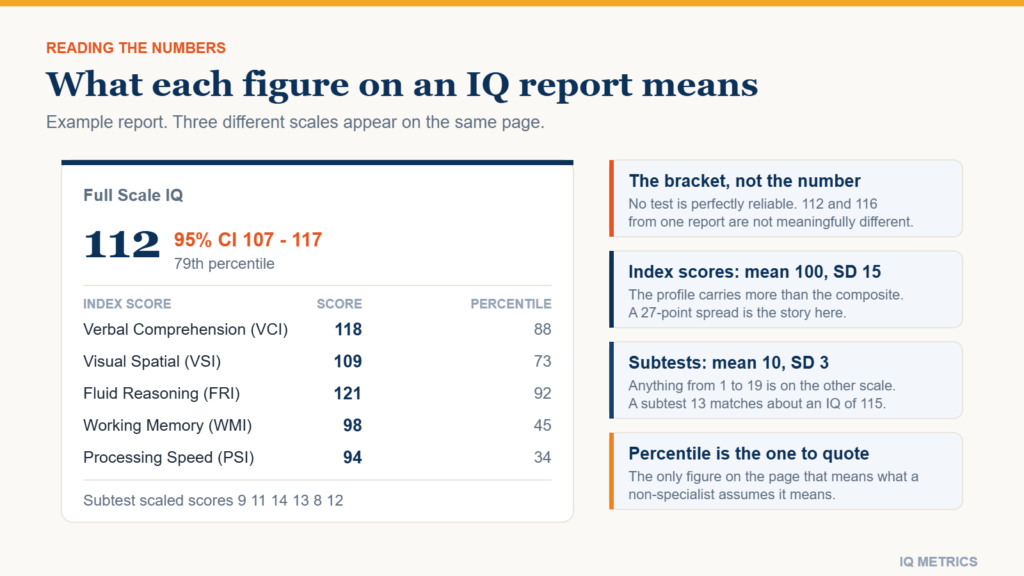
An IQ report puts numbers on at least three different scales and almost never explains which of them matters. Here is what FSIQ, the index scores, the subtest scaled scores, the percentile rank and that bracketed range each mean, and when the headline number should not be read at all.
 Taking a Test
Professional IQ Tests
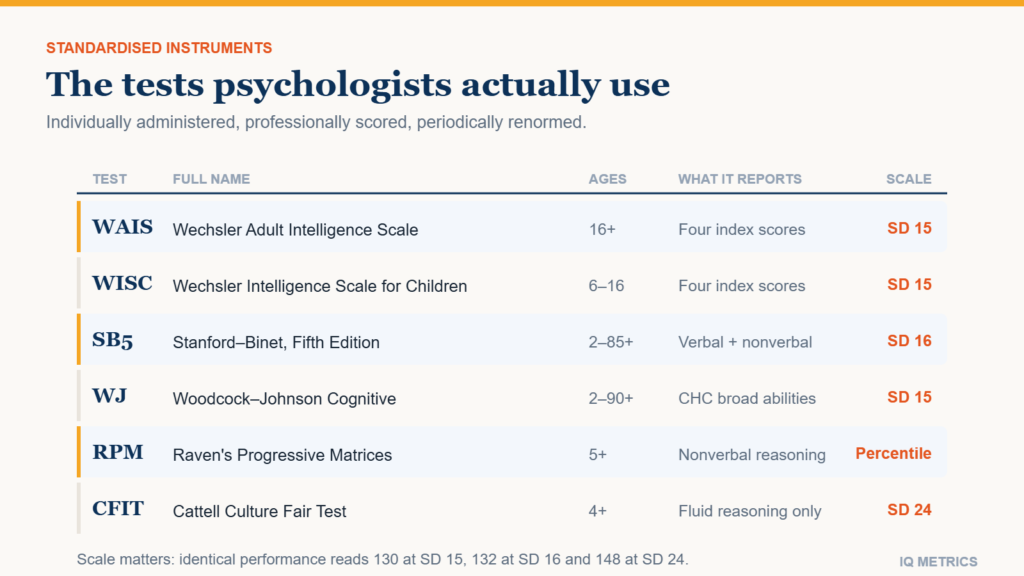
When a psychologist measures intelligence, they reach for one of a small number of standardised instruments. This guide covers what the Wechsler scales, Stanford-Binet, Woodcock-Johnson and Raven’s Progressive Matrices each measure, who each one is for, and where an online test genuinely fits.
 Scores & Scales
Verbal vs Non-Verbal IQ Scores
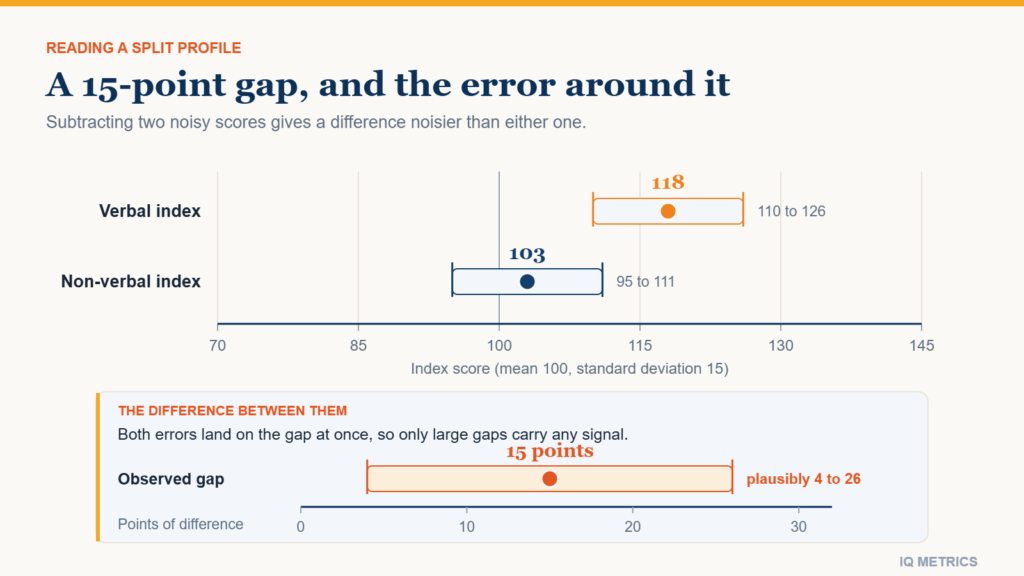
Two people can hold the same IQ number and have completely different profiles, and a split between the verbal and non-verbal indexes is far commoner than most test-takers expect. Here is what base-rate tables and compounding measurement error say about how large a gap has to be before it means anything.