





How Many IQ Points Does Test Anxiety Actually Cost?
Almost everyone who has had a disappointing result has wondered whether nerves cost them fifteen or twenty points. The evidence says no. Test anxiety and cognitive performance correlate at roughly r = -0.20, which works out to a few points on a 15-point scale. Here is the number, and what it changes.

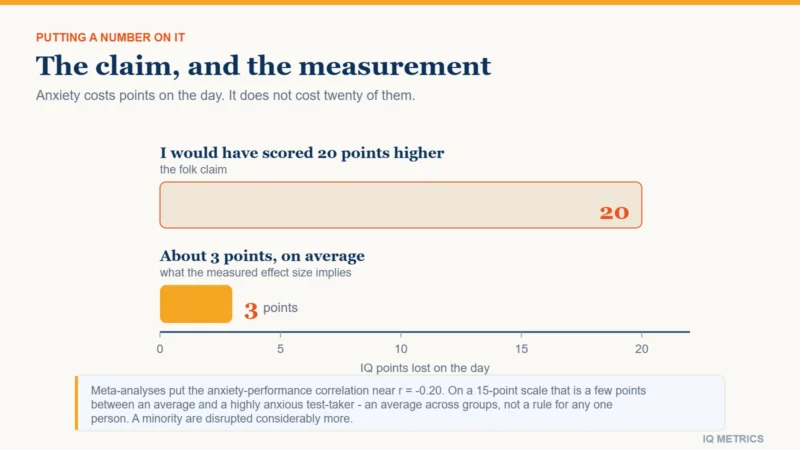
Can anxiety lower your IQ score? Yes — but not by anything close to the margin most people assume. Studies that measure test anxiety alongside cognitive test performance find a relationship of roughly r = -0.20, which translates to something on the order of three points on the familiar 15-point scale. That is a few points between an average test-taker and a highly anxious one, not fifteen and not twenty. The rest of this article shows where that figure comes from, why the effect is small but genuinely real, and what it should change about how you read your own result.
Where the fifteen-point claim comes from
Nearly everyone who has sat a supervised test has said some version of it: I would have scored fifteen or twenty points higher if I had not been so nervous. The thought is appealing because it explains away a disappointing number without asking anything of the person who got it.
The problem is scale. Fifteen points is a full standard deviation — the distance between the middle of the distribution and the edge of roughly the top sixteen percent of test-takers. Ordinary pre-test nerves do not move a person that far. Nothing in the measured relationship between test anxiety and test performance is anywhere near large enough to produce a shift of that size.
What the evidence does support is a smaller, stubborn, fairly consistent drag. Small effects are still real effects. They are just not the ones that rewrite a life story.
What the research actually finds
Meta-analyses pooling many studies of test anxiety and performance on cognitive and academic tests tend to land on a correlation in the region of r = -0.20. Much of that literature is built on school and university assessments rather than on standardised intelligence tests, so carrying the figure across to IQ points is a reasonable estimate rather than a direct measurement. Estimates range roughly from -0.15 to -0.25, and much of that spread is not noise: it moves with who was sampled, how anxiety was measured, and how much the test genuinely mattered to the person sitting it.
Three things push the estimate around, and they are worth knowing before you take any single figure too seriously:
- How anxiety was measured. Questionnaires filled in after the test pick up disappointment as well as anxiety. Physiological measures of arousal track performance more weakly than self-reported worry does, so the method chosen moves the estimate before any real difference does.
- How high the stakes were. A university entrance exam tends to generate more anxiety, and a larger measured effect, than a practice test taken at home out of curiosity.
- Who was in the sample. Student samples dominate this literature, and students are not a random slice of the population, which limits how far any one estimate travels.
A correlation of -0.20 means anxiety is associated with something like four percent of the variation in scores across a group. The other ninety-six percent of the differences between people sits somewhere else entirely. That is the frame to hold before anyone converts anything into points.
Turning that correlation into IQ points
Correlations are hard to feel; points are easy. So here is the translation, with the reasoning shown, precisely so you can see how approximate it is.
Most IQ scales are built with a standard deviation of 15 points. If anxiety and score are related at about -0.20, a person one standard deviation above average in test anxiety is expected to score roughly 0.20 × 15, or about 3 points, below a person of average anxiety. Nothing in that figure is held constant: it is a raw association, not an isolated effect of anxiety. Push it to two standard deviations above the mean in test anxiety, which is uncommon, and the expected gap is around six points — though the linear assumption behind that extrapolation is doing a lot of work out at the tail.
So the honest headline is a few points, not twenty. Every word there is doing work. It is an average across groups, not a prediction about any one person, and it applies to people whose anxiety slows them down rather than stopping them. For the minority who freeze or leave a test unfinished, the loss can be far larger, because what they end up with is not a measure of their ability at all.
Where would your own score land?
Take the IIF-certified assessment and get your score with the scale it was measured on, the percentile it corresponds to and the confidence range around it — the three figures most online tests leave out.
Find your IQ score now! →Why the cost is real but small
The best-supported explanation is crowding. Working memory — the small, temporary workspace where you hold a matrix pattern, a half-finished sequence, or the three candidate answers you are weighing against each other — has a hard capacity limit. Worry is not silent: it occupies that same workspace with self-monitoring, clock-watching and a running commentary on how badly things are going.
That account makes a prediction that can be checked, and it broadly holds up. The cost concentrates on items that load working memory heavily and on tests run against a clock, which is one reason a timed IQ test is likelier to expose anxiety than an untimed one. On easy items, or when you can take as long as you like, there is spare capacity to absorb the interference.
This is the same mechanism driven by a different stressor as the one behind sleep loss and test performance. Fatigue and worry both draw down the same limited resource, and both produce modest average losses concentrated in the same kinds of items. Read that piece as the companion to this one.
There is a trait side to all of this too — some people are dispositionally more anxious, and that disposition travels with a cluster of habits around testing. Rather than re-derive it here, see how personality relates to measured ability.
Anxious test-takers also behave differently
The raw observed gap between anxious and non-anxious test-takers is not purely anxiety pressing on cognition in the moment. Anxious people also do different things, and those things land in the score just as surely.
- They prepare differently. Avoidance is a normal anxiety response, so some anxious test-takers do less familiarisation rather than more, and arrive facing a format they have never seen.
- They start slower. Time spent re-reading the instructions and second-guessing item one is time not spent on items twelve through twenty.
- They abandon hard items sooner. Giving up early is a behaviour, not a capacity limit — but on a scored test it looks identical to being unable to solve the item.
- They are likelier to quit part-way. A test abandoned halfway does not measure ability. It measures how long the person stayed.
Each of those routes lowers a score without anxiety having interfered with reasoning directly. Which means some share of that already-modest -0.20 is behaviour rather than anxiety acting on reasoning in the moment, so the direct cognitive cost is probably smaller still. How much smaller is not something a correlation on its own can tell you.
That is better news than it sounds. Behaviour is a great deal easier to change than temperament, and the routes above are the ones a second, better-organised sitting can actually close.
What a few points should and should not change
An expected loss of around three points is a reason to consider retesting. It is not a reason to discard the result you have. If your score landed near a boundary you care about and the sitting was a genuinely rattled one, that is a legitimate argument for a second attempt.
It is worth being specific about what near a boundary means. A three-point expectation matters if your result sits a handful of points from a threshold you are using for something; it matters very little if you are twenty points away, because a calmer sitting is not going to carry you across a gap that size.
Go in knowing what a retest actually buys. Scores tend to rise on repeat testing for reasons that have nothing to do with your nerves improving: the practice effect on cognitive ability tests is well documented, so a higher second score is partly familiarity with the format and, if the first sitting was unusually low for you, partly ordinary regression toward your own average — and only partly a calmer state of mind.
It also helps to know how much any single sitting can move for perfectly mundane reasons. The guide to IQ test accuracy covers the measurement error surrounding one score. Anxiety is one contributor sitting inside a band that is wider than most people expect, and this article is only quantifying that one contributor.
What actually helps before a test
The interventions with the strongest support are unglamorous: familiarise yourself with the format, and practise under conditions that are genuinely timed. Both work for the same reason — they strip out the novelty and the surprise of time pressure that generate the anxiety in the first place, rather than trying to manage the feeling once it has already arrived.
In practice that means a full-length run with the clock genuinely running rather than a relaxed browse through sample items. The preparation guide and the walkthrough of how a test is structured cover those mechanics, so this piece will not repeat them.
None of this makes anxiety trivial. It makes it tractable. If you suspect nerves cost you something last time, the useful next step is a second run under conditions you control, with the clock running honestly. Take the IQ test that way and compare the two results, holding in mind that a few points of movement in either direction is exactly what the evidence predicts.
Keep reading
All articles → Taking a Test
How to Prepare for an IQ Test?
Is your mind ready to be unleashed by mastering IQ tests? Our all-inclusive guide to IQ test success and mind mastery is your one-stop shop. To help you stand out and increase your IQ, this post contains expert advice, methods, and insights.
 Scores & Scales
Mind Matters: The Surprising Link Between Emotions and IQ Test Scores
In your journey towards intellectual excellence, remember: understanding and managing your emotions is as important as sharpening your cognitive abilities. Embrace this holistic approach, and you are bound to not only excel in IQ tests but also thrive in life’s myriad challenges.
 Research & Evidence
IQ and Creativity
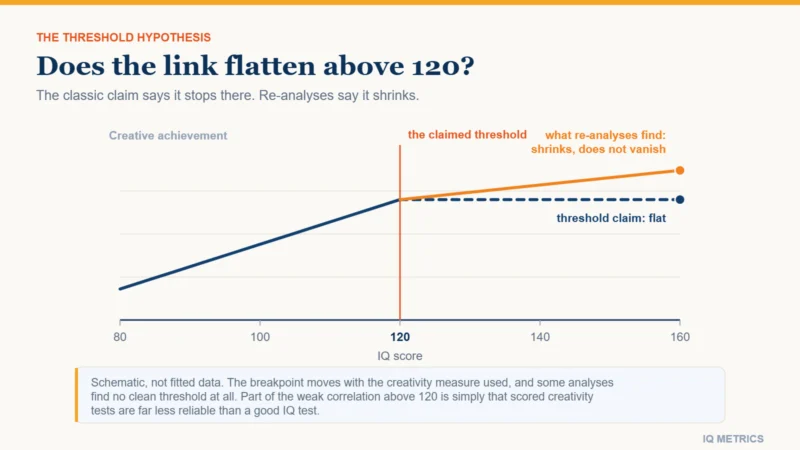
The threshold hypothesis says IQ and creativity move together up to about 120 and barely at all above it. It is a real claim with a real number, and modern re-analyses have weakened it. Here is what the segmented-regression work found, why the two kinds of task differ, and why measurement noise matters.