
Nutrition and IQ: What Diet Can and Cannot Change
The evidence on diet and intelligence looks contradictory until you separate two questions that get asked as one. Fixing a real deficiency produces some of the largest effects in the field. Adding more of the same nutrient to an already adequate diet produces close to nothing.
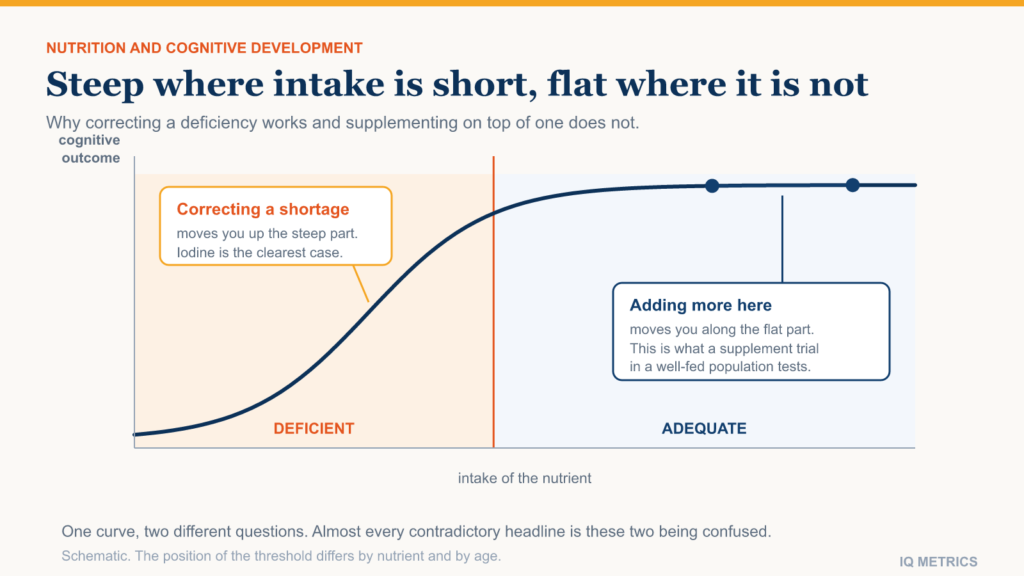
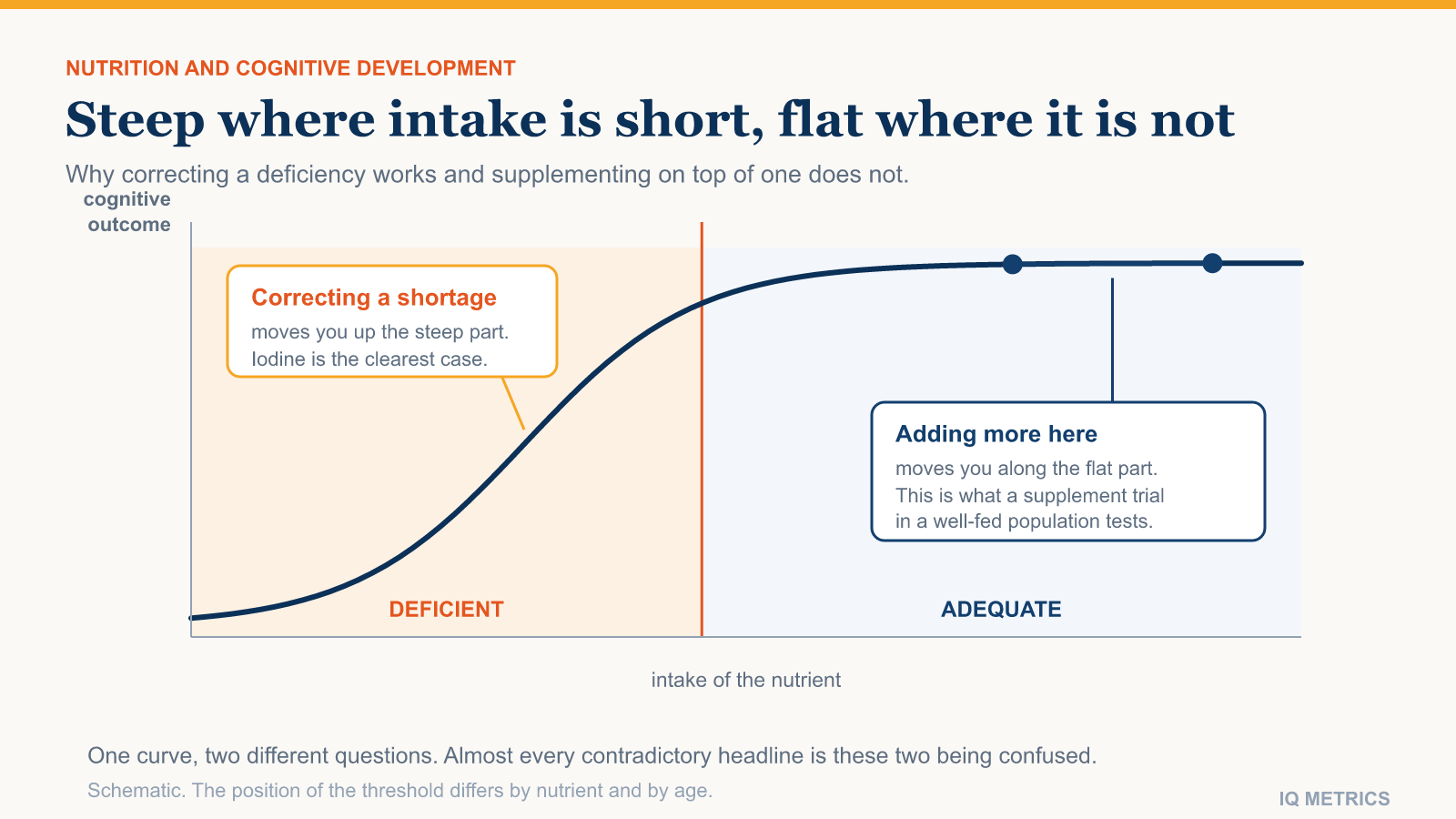
Nutrition affects IQ scores substantially when a real deficiency is present and corrected, and barely at all when it is not. Those two findings are not in tension; they are the same curve read at different points. The relationship between a nutrient and cognitive development is steep where intake is inadequate and close to flat once it is sufficient, which is exactly what you would expect from something the body requires in a fixed amount rather than an unlimited one.
Almost every confusing headline in this area comes from applying a result obtained at one end of that curve to people sitting at the other. This article separates the two, names the deficiencies where the evidence is strong, and explains why the supplement trials in well-fed populations keep coming back empty.
Iodine: the largest nutritional effect on record
Iodine is required to make thyroid hormone, and thyroid hormone governs brain development before and shortly after birth. Severe deficiency during that window produces profound and permanent intellectual disability. What made iodine the standout case is that the milder end of the range turned out to matter too.
Meta-analyses comparing populations in iodine-deficient regions with comparable iodine-sufficient ones have reported differences on the order of thirteen IQ points. That is an enormous figure by the standards of this literature — roughly the gap between the middle of the distribution and the boundary of the bottom sixth. It is also why salt iodisation is routinely described as one of the highest-return public health measures ever implemented.
The caveats are real and worth stating. These are comparisons between regions rather than randomised assignments, and iodine-deficient regions differ from iodine-sufficient ones in other ways. The supplementation trials that have been run give smaller effects than the observational comparisons. But the direction is consistent, the mechanism is understood at the level of a specific hormone, and no serious reviewer disputes that severe deficiency causes cognitive harm.
Iron, and the deficiencies that are common enough to matter
Iron deficiency anaemia in infancy is associated with poorer performance on developmental and cognitive assessments, and the association persists in children who are treated later — which suggests, without proving, that part of the effect is on development rather than on current functioning. General protein and energy malnutrition in early childhood shows the same pattern.
Two features recur across all of these findings and are worth holding on to:
- Timing dominates dose. The same deficiency matters enormously in the first two years and much less later. The periods when the brain is building structure are the periods when a shortage of building material is expensive.
- Correction is incomplete. Treating a deficiency after the developmental window has passed improves things without restoring the counterfactual. This is the single most important reason the deficiency findings do not translate into a supplementation strategy for adults.
- Deficiency travels with everything else. Households where children are iron-deficient differ in many other respects. The better studies adjust for this; adjustment is never complete, and the honest estimates carry wide intervals.
Breastfeeding: the confounding problem in miniature
Observational studies have consistently found that breastfed children score a few points higher on cognitive tests. The problem is that in most countries the mothers who breastfeed for longer differ systematically from those who do not, in education, income and their own test scores — all of which independently predict a child result.
Two study designs have attacked this. Sibling comparisons, which contrast siblings raised in the same household who were fed differently, shrink the association sharply and in several analyses remove it. The PROBIT trial in Belarus did something rarer: it randomised the promotion of breastfeeding across maternity hospitals, producing a genuine experimental contrast. At age six and a half it found a meaningful verbal advantage in the intervention group; by adolescence, much of that had attenuated.
The reasonable position is that there is probably a small effect, that it is far smaller than the raw observational gap, and that anyone quoting the raw gap is quoting mostly the confounding. This is a good general lesson for reading any claim in this area: ask what else differs between the groups being compared, and whether any design in the literature has removed it.
Where would your own score land?
Take the IIF-certified assessment and get your score with the scale it was measured on, the percentile it corresponds to and the confidence range around it — the three figures most online tests leave out.
Why the supplement trials keep coming back empty
Omega-3 fatty acids are the clearest example. The reasoning behind them is sound in outline: long-chain fatty acids are structural components of neural membranes, and infants deprived of them do worse. The inference that adding more to a child who is already getting enough will produce further gains is where it breaks down.
Randomised trials of omega-3 supplementation in adequately nourished children and adults have largely reported null results for general cognitive ability, and systematic reviews of that literature reach the same conclusion. The same pattern holds for most multivitamin trials in well-nourished populations: small, inconsistent, often non-significant, and rarely replicated at the same magnitude.
This is not a claim that supplements are useless. It is a claim about which question they answer. A supplement corrects a deficiency. If there is no deficiency, there is nothing to correct, and the trial measures what happens when you add a nutrient to someone who already has enough of it. The answer, repeatedly, is very little.
How to read a diet-and-intelligence headline
Studies in this area reach the public through a filter that systematically favours the surprising over the reliable. A handful of questions will usually tell you which kind you are looking at, and they can be asked without any technical knowledge of the subject.
- Was the population deficient to begin with? If the sample was already adequately nourished, a null result is the expected result and a positive one needs replication before it is worth anything.
- Was anything randomised? Diet is chosen, and people who choose one diet differ from people who choose another in income, education and health behaviour. Where a trial exists, prefer it to a survey, even a very large survey.
- What was the outcome measure? A change on one reaction-time task is not a change in general ability. Studies often measure several outcomes and report the one that moved.
- How long was the follow-up? Effects that are present at six months and gone at five years were probably never effects on development. The breastfeeding literature is the clean illustration of this.
- Who paid for it? Trials of a specific supplement funded by its manufacturer report positive results more often than independently funded trials of the same compound.
Applying that list to the popular claims removes most of them. What survives is a short list dominated by early-life deficiency, which is the opposite of the story the supplement aisle tells.
Breakfast, glucose and the difference between state and trait
Skipping breakfast does measurably affect performance on attention and memory tasks in the following hours, particularly in children who are undernourished to begin with. This is a real effect and it is not the same kind of effect as anything above.
An IQ score is meant to estimate a stable characteristic. Hunger, sleep loss and caffeine change how well you perform on the day without changing the thing the test is trying to estimate — they add noise to the measurement rather than moving the quantity being measured. That distinction is why “eat before the test” is sensible advice for getting an accurate reading and is not a way to become more intelligent. The rest of the same-day list is in what affects IQ test results, and the case of nerves specifically is in test anxiety and IQ scores.
What to take from all of this
The picture that emerges is narrower and more useful than either “diet determines intelligence” or “diet is irrelevant”.
- Correcting severe deficiency during early development produces some of the largest effects anywhere in this field, and iodine is the clearest case.
- The effects are developmental, so most of the opportunity lies before school age rather than before a test.
- Supplementation on top of adequacy has repeatedly failed to produce cognitive gains in randomised trials, and the honest reading of that literature is that it does not work.
- Same-day factors such as hunger affect the measurement rather than the ability, which is why they matter for accuracy and not for capability.
Nutrition therefore belongs in the same small category as lead exposure: a genuine, well-evidenced influence on population-level cognitive development that operates almost entirely through early childhood, and that has very little to say to an adult wondering about their own result. The wider question of what can and cannot be changed later is covered on can you improve your IQ.
Keep reading
 Research & Evidence
Lead, Pollution and IQ
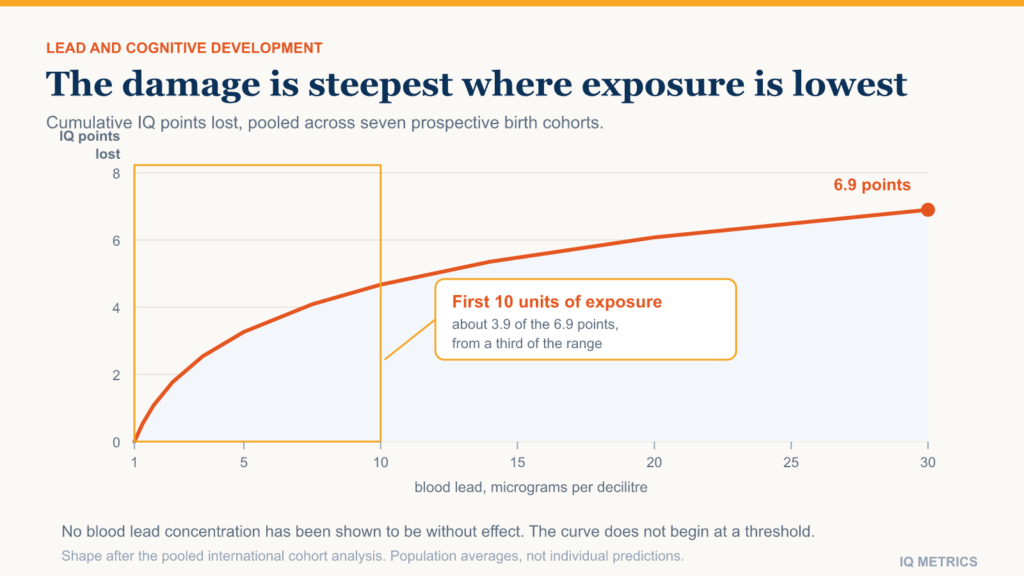
Most things people believe raise or lower intelligence turn out to be small, contested or confounded. Childhood lead exposure is the exception: one of the best-established environmental effects on cognitive test scores anywhere in the literature, with a dose-response curve most people find counterintuitive.
 Research & Evidence
Does School Raise IQ?
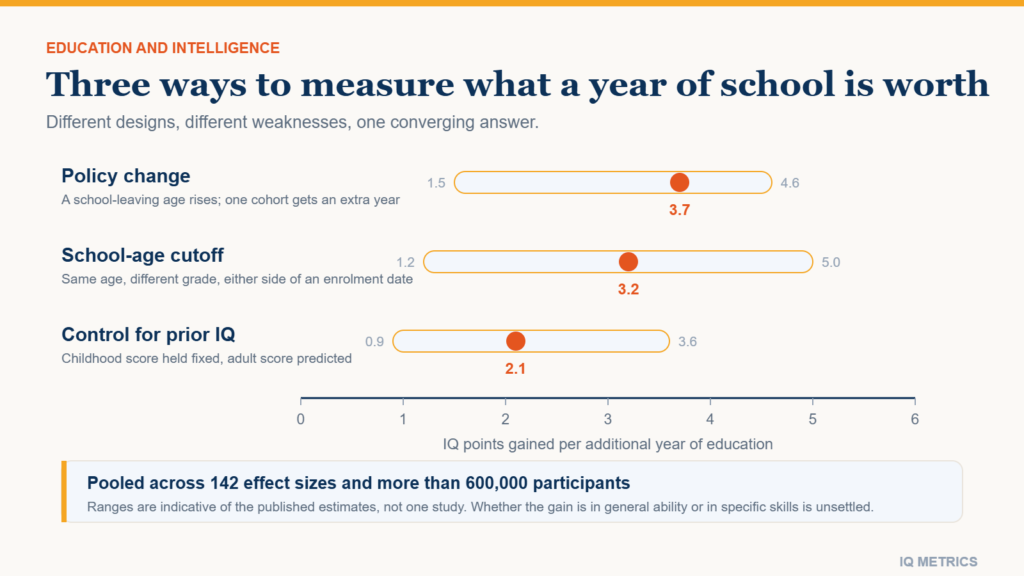
Education is the environmental factor with the strongest evidence for actually raising IQ scores, and the effect is bigger than most people expect. Three independent study designs, pooled across more than 600,000 participants, point the same way. Here is the size of it, and the caveat that gets dropped.
 Research & Evidence
What are the Factors that Affect the Results of an IQ Test?
When you take an IQ test, do you ever find yourself wondering why certain people do better than others? It turns out that your IQ can be affected by a lot of different things. Discover the hidden meaning of these characteristics and how they affect your intelligence in this essay