IQ Metrics
IIF Certified Assessment Start IQ Test
IIF Certified Assessment

Professional IQ Tests

Taking a Test

Professional IQ Tests: What Psychologists Actually Use

When a psychologist measures intelligence, they reach for one of a small number of standardised instruments. This guide covers what the Wechsler scales, Stanford-Binet, Woodcock-Johnson and Raven’s Progressive Matrices each measure, who each one is for, and where an online test genuinely fits.
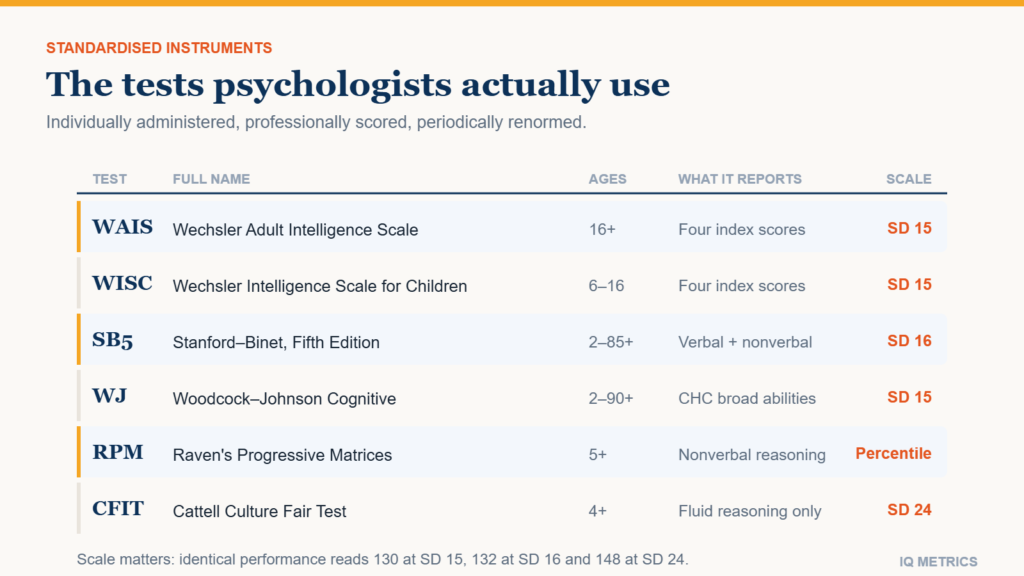
Comparison of the professional IQ tests psychologists use and what each measures

“IQ test” is a category, not a product. When a psychologist actually measures intelligence, they reach for one of a small number of standardised instruments, and those instruments differ in how they are delivered, what abilities they sample, how long they take, what age group they were normed on, and how heavily they lean on language. A score means very little until you know which of them produced it.

This guide walks through the tests professionals actually use, what each is genuinely good at, and how to work out which kind of result you are looking at. If you want to compare the shorter formats available on this site instead, the IQ tests hub covers those.

The first division: individual or group

The most important split is not verbal versus nonverbal — it is whether a trained administrator sits with you.

Individually administered tests are delivered one-to-one over roughly one to two hours. The administrator controls timing, watches how you approach each item, and can tell the difference between not knowing an answer and misunderstanding the question. These are the tests used clinically, educationally and diagnostically, and they are the reference standard for accuracy.

Group tests are delivered to many people at once, usually on paper or screen, with fixed instructions and no individual observation. They are far cheaper and faster, which is why they dominate schools, military selection and large-scale screening. They are also less precise for any single individual, because none of the observational detail survives.

The major individually administered tests
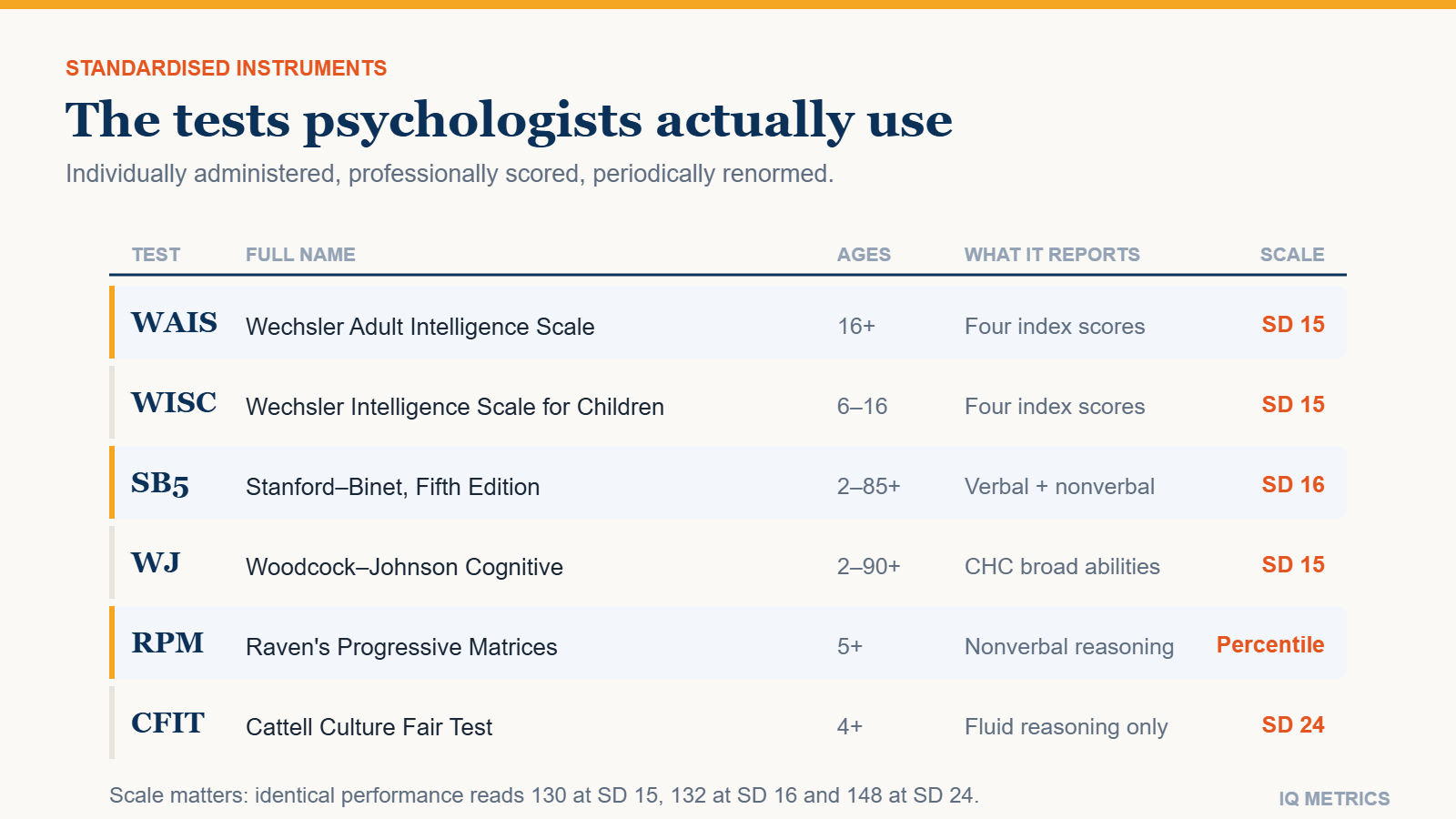
Comparison of the main types of IQ tests and what each one measures

The Wechsler scales: WAIS and WISC

The Wechsler tests are the most widely used individual intelligence tests in the world. The WAIS covers adults and older adolescents; the WISC covers school-age children; the WPPSI covers preschoolers. They are periodically revised, and each revision is renormed on a fresh standardisation sample.

Rather than producing one number, a Wechsler test reports a full-scale score built from index scores covering verbal comprehension, visual-spatial and fluid reasoning, working memory and processing speed. That structure is the real value: two people can reach the same composite by very different routes, and the profile of indexes is often more informative than the headline figure. Wechsler tests use a standard deviation of 15.

The Stanford-Binet Intelligence Scales

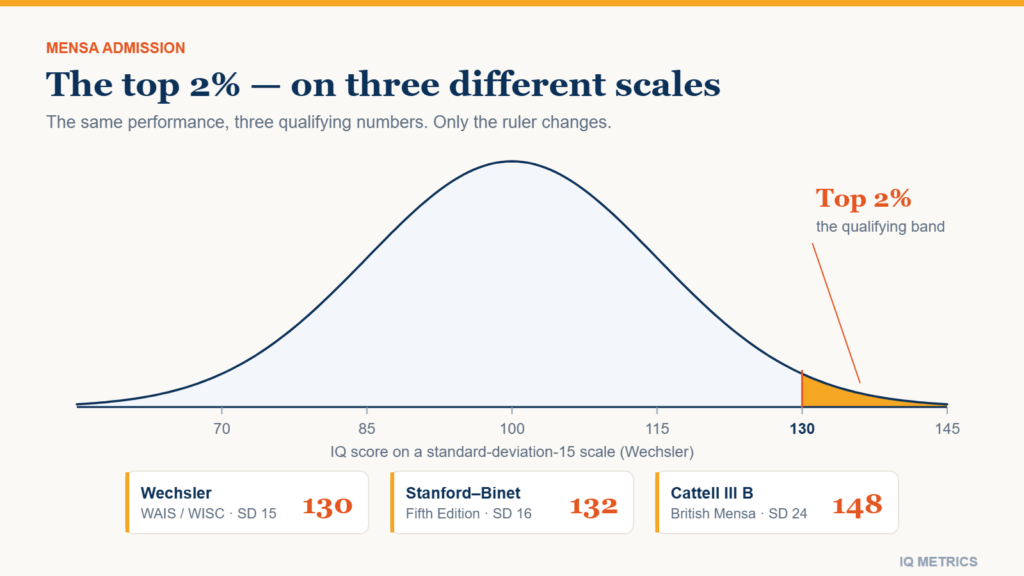
The Stanford-Binet is the direct descendant of the original Binet-Simon scale and the oldest continuously developed intelligence test still in use. Its current edition covers an unusually wide age span in a single instrument and assesses five factors in both verbal and nonverbal form, which makes it useful at the extremes of the range where other tests run out of items. It uses a standard deviation of 16, which is why Stanford-Binet scores sit slightly higher than Wechsler scores for identical performance — a difference our IQ score converter handles directly. The test’s long history is covered in our piece on the history of IQ testing.

The Woodcock-Johnson Tests of Cognitive Abilities

The Woodcock-Johnson is built explicitly on the Cattell-Horn-Carroll model of intelligence, which organises cognitive ability into a hierarchy of broad and narrow factors. Its distinguishing feature is that it pairs with a co-normed achievement battery, so cognitive ability and academic attainment can be compared on the same standardisation sample. That makes it a common choice in educational assessment, particularly where a learning difficulty is in question.

The Kaufman batteries

The KABC-II was designed with a specific concern in mind: reducing the influence of acquired knowledge and language on the resulting score. It offers alternative theoretical scoring models and a version that minimises verbal demands, which makes it useful for children from varied linguistic and cultural backgrounds.

Nonverbal and culture-reduced tests

Every verbal test carries an unavoidable problem: it measures language proficiency alongside reasoning. For someone tested in a second language, or from a background unlike the norm group, that confound can be large. Nonverbal tests exist to reduce it.

Raven’s Progressive Matrices

Raven’s is the best known nonverbal reasoning test and one of the purest measures of fluid intelligence available. Every item is a visual pattern with a piece missing; you choose the piece that completes the rule. There are no words, no cultural references and no general knowledge anywhere in it. It comes in progressive difficulty levels, from Coloured for young children through Standard to Advanced for high-ability adults.

The Cattell Culture Fair Intelligence Test

The CFIT was built for the same purpose using series completion, classification, matrix and conditional reasoning items, all nonverbal. It reports on a scale with a standard deviation of 24, which is why Cattell scores look dramatically higher than Wechsler ones — the ruler is wider, not the person. This is the scale British Mensa uses, as covered in our article on Mensa IQ score requirements.

TONI, UNIT and Leiter

These go further still, minimising or removing language from the instructions as well as the items. They are designed for people who cannot be validly assessed in a language-loaded format — including those with hearing impairment, speech and language disorders, or no shared language with the administrator.

One caveat applies to all of them. “Culture fair” is a design goal, not an achieved state. Familiarity with abstract diagrams, formal schooling and test-taking conventions still varies across populations, and no test has eliminated that entirely.

Your own number

Where would your own score land?

Take the IIF-certified assessment and get your score with the scale it was measured on, the percentile it corresponds to and the confidence range around it — the three figures most online tests leave out.

Find your IQ score now!

Secure & encryptedInstant results10–20 minutes

Group and screening tests

Group-administered cognitive tests are used at scale where individual assessment would be impossible: school-wide ability screening, military and occupational selection, and large research studies. They are efficient and, at the population level, statistically sound.

Their limitation is individual precision. A single low score on a group test can reflect a bad morning, an unfamiliar format, misread instructions or a missed line on an answer sheet, and nothing in the procedure would catch it. Good practice treats a group result as a flag for further assessment, never as a diagnosis. Our article on what makes an IQ test reliable covers why that distinction matters.

Where online IQ tests fit

Online tests occupy a real and legitimate niche, provided everyone is honest about what it is. An unsupervised test cannot verify who is taking it, cannot control the environment, cannot stop you looking something up and cannot prevent retakes. For that reason no online test qualifies anyone for Mensa, and none is diagnostic.

What a well-built online test can do is give you a properly normed estimate. The features that separate a serious one from a novelty quiz are concrete and checkable:

  • It states the scale its score is on, so the number can be compared with anything else.
  • It reports a percentile, not just a score, so the rank is explicit.
  • It gives a confidence range, acknowledging measurement error instead of implying false precision.
  • It is timed and consistent, so your result and someone else’s were produced under the same conditions.
  • It describes its norm group rather than leaving you to guess who you are being compared against.

Our own IQ test reports the scale, percentile and confidence range together, and the IQ tools collection lets you convert a score between scales or see where it sits on the distribution. For a fuller treatment of what separates a good online test from a bad one, see your guide to good online IQ tests.

Choosing the right kind of test

The right test depends entirely on the question you are asking.

  • For a clinical or educational decision — a diagnosis, a placement, an accommodation — only an individually administered test by a qualified professional will do.
  • For someone tested outside their first language, or from a background unlike the norm group, a nonverbal test such as Raven’s gives a fairer reading.
  • For Mensa or another high-IQ society, only an approved supervised test on their published list counts.
  • For personal curiosity, a properly normed online test that reports scale, percentile and confidence range is a reasonable and inexpensive starting point.

One last boundary is worth drawing. None of these tests measures emotional skill, and the emotional intelligence questionnaires sometimes sold alongside them are a different construct with a different evidence base — we compare the two in IQ vs EQ.

What none of them will give you is a single unarguable number that captures your intelligence. Every test samples a slice of cognitive ability through one particular method, and the score is an estimate of where that slice sits relative to other people. Knowing which slice and which method is what turns the number into information.

Share this article

Know someone who keeps seeing these numbers quoted without the scale they were measured on? Send it to them.

How to Prepare for an IQ Test?

How to Prepare for an IQ Test?

Is your mind ready to be unleashed by mastering IQ tests? Our all-inclusive guide to IQ test success and mind mastery is your one-stop shop. To help you stand out and increase your IQ, this post contains expert advice, methods, and insights.

Our authoritative yet approachable brand voice breaks down complex topics for readers from all walks of life. IQ tests might be nerve-wracking, but we’ll make sure you’re prepared for anything.

How to Prepare for an IQ Test?

Brain training and test-taking strategies are just two of the many facets of intelligence testing that we will discuss. Improving your memory, problem-solving skills, and mindset can greatly contribute to your success. You’ll be better prepared to take this difficult test if we debunk some common fallacies about IQ tests.

Our thorough guide is an excellent tool for improving your intelligence and preparing for IQ tests, whether you are currently taking them or are simply curious about them. How about we begin to unleash your full potential?

What’s IQ testing?

An Intelligence Quotient (IQ) test is a standardized test that measures cognitive ability and intellectual potential. Cognitive abilities including logic, problem-solving, memory, and linguistic comprehension are assessed. An individual’s IQ score compares to the overall population.

IQ tests usually examine cognitive abilities with a series of questions or tasks. Pattern recognition, vocabulary, logical deduction, and numerical and spatial reasoning may be asked. IQ tests are used to assess a person’s intelligence, academic potential, and suitability for various jobs or programs.

IQ tests can reveal cognitive talents, but they are not the only indicator of intellect or potential. Emotional intelligence, creativity, and practical abilities also contribute to intelligence and should not be disregarded.

The value of IQ tests

IQ exams affect school, career, and personal development. They standardize cognitive testing, allowing people to evaluate their strengths and shortcomings and make educated future decisions.

In education, IQ tests are used to identify gifted kids who may benefit from specialized programs or advanced training. These examinations allow teachers personalize lessons to specific students and push them intellectually.

IQ tests are sometimes used in the employment process to evaluate candidates’ problem-solving, critical thinking, and job prospects. When paired with other exams and certifications, IQ can help make employment selections.

Self-improvement and growth can be measured by IQ tests. Understanding your cognitive strengths and shortcomings lets you improve specific intelligences and your total intelligence.

A history of IQ testing

IQ testing has a long history going to the early 20th century. French psychologist Alfred Binet and his associate Theodore Simon invented intelligence measurement. Binet and Simon created the Binet-Simon Scale in 1905, the first modern IQ test.

The Binet-Simon Scale identified children who needed extra educational support. The questions and challenges tested memory, vocabulary, and problem-solving. A child’s mental age score compared to average abilities at different chronological ages.

The Stanford-Binet Intelligence Scales were created in 1912 by psychologist Lewis Terman from the Binet-Simon Scale. Terman defined IQ by dividing mental age by chronological age and multiplying by 100. This standardised intelligence comparisons across ages.

Since then, many standardized IQ tests have been devised to assess intelligence in diverse populations and age groups. The Wechsler Adult Intelligence Scale (WAIS), WISC, and Raven’s Progressive Matrices are among these assessments.

A guide to IQ test preparation

Preparing for an IQ exam might raise your score and performance. There are ways to improve your cognitive talents and test-taking skills, even though IQ exams mostly evaluate intrinsic ability. Here are some IQ test preparation tips:


Before taking the IQ test, familiarize yourself with the format, types of questions, and time constraints. Research Raven’s Progressive Matrices and Wechsler IQ tests and practice sample questions to learn the test structure.

Improve your cognitive abilities: IQ exams evaluate memory, problem-solving, logic, and verbal understanding. Activities that test these areas can boost performance. Play strategic games, read tough books, solve puzzles, and practice critical thinking to improve your brainpower.

Improve working memory: IQ test questions require working memory. Memory is the ability to store and modify information. Mental arithmetic and remembering numbers and letters increase working memory.

Practice time management: IQ exams are timed, so managing your time can improve your results. Timed questions help you learn how long you can spend on each question without becoming stuck. This will help you manage test time.

Sleep and eat well: Good sleep and nutrition can boost cognition. Prepare for the test by getting enough rest and eating correctly to give your brain the nourishment it needs.

Remember that while preparation might help, IQ exams should be taken calmly and focused. Avoid tension and worry, which might impair test performance. Be confident in your skills and preparation.

Typical IQ test questions

IQ tests measure cognitive abilities with various questions. Knowing these question types can boost your test confidence. Common IQ test questions include:

Verbal comprehension tests your command of written language. Analogies, synonyms, and word puzzles may be assigned.

Numerical reasoning tests your ability to work with numbers, solve mathematical problems, and spot patterns in numerical sequences. These problems may require math, algebra, or reasoning.

Spatial reasoning: Questions test your spatial visualization and manipulation skills. You may be asked to complete visual patterns, mentally rotate or fold shapes, or identify the next shape.

Logical deduction: Questions test your abilities to analyze and draw conclusions. You may be given premises and asked to draw the proper inference or find the pattern.

Pattern recognition: Pattern recognition questions test your ability to spot and anticipate visual or numerical patterns. The pattern may require you to complete a succession of shapes, numbers, or symbols.

Each question type has distinct obstacles, so practice them to learn effective problem-solving strategies. Online tools and practice exams can help you improve your skills and confidence in answering varied queries.

Tips for IQ boost

IQ tests evaluate natural intelligence, but you can increase your scores. These methods will boost your performance and potential:

Read widely: Reading books, articles, and other intellectually stimulating content helps increase your knowledge, vocabulary, and verbal comprehension. Reading expands your knowledge, viewpoints, and ways of thinking, which can boost your IQ.

Critical thinking exercises test your brain and improve problem-solving. Solve puzzles, riddles, and brain teasers to improve logic and deduction. These activities boost creativity and mental stimulation, which are crucial for IQ test achievement.

Improve your memory: IQ test performance depends on memory. Mnemonic devices and visualization tools can help you remember knowledge faster and better. Practice memorizing lists, numbers, and sequences to improve memory.

Be alert and focused: IQ tests need persistent concentration. Meditation and deep breathing can relax your mind, eliminate distractions, and increase concentration. Focus on one task for a long time to build mental stamina.

Stay healthy: Cognitive performance is connected to physical and mental health. Exercise regularly to boost cerebral blood flow and cognition. Maintain a nutritious diet to boost brain health and intelligence.

Remember that boosting your IQ takes time and persistence. If you follow these guidelines daily, your cognitive ability and test performance will increase.

Techniques for answering tough IQ questions
IQ exams often involve difficult critical thinking and problem-solving problems. Strategies to confidently answer difficult IQ test questions:

Carefully read the question to understand what is being asked. Follow any precise directions, terms, or specifics that may lead you.

Break down complicated questions: If a question seems overwhelming, break it down. Find the main components and their relationships. The question can be simplified and approached methodically.

Eradicate wrong answers: If the question has multiple-choice alternatives, delete obvious errors. This can reduce your options and improve your chances of getting it right.

Logical reasoning helps solve complex situations. Analyze the question and make logical conclusions to find the best answer.

Backward: Sometimes working backward from the answer selections helps you find the right answer. Assess the possibilities and choose one that meets the requirements.

Visualize the problem: Sketching or diagramming spatial logic or visual patterns can help. Visual aids can reveal hidden patterns, relationships, and symmetries.

Effective time management is essential during an IQ test. Don’t get trapped on difficult questions. Move on to the next question and return if time allows. Prioritize confident inquiries and spend time on them.

Practice these tactics throughout preparation to make them easier to use on the test. Stay cool and confident in your ability to solve even the hardest problems.

Online IQ test practise

To prepare for your IQ test, the internet has many tools and practice tests. These reliable online platforms offer IQ tests and practice questions:

A range of online IQ tests and practice questions are available from Mensa, an international high IQ society. These tests determine your IQ by assessing cognitive abilities.

Online assessment and testing platform PsychTests offers many IQ tests. These tests evaluate your IQ and provide extensive feedback.

IQ Test Prep: This thorough website helps people prepare for IQ tests. It provides practise tests, example questions, and test-taking tactics to boost performance.

TestPrep-Online offers IQ test practice tests and materials. Their products imitate the test and help you understand the format and questions.

Practice tests should be on respected sites and closely reflect the ones you’ll take. Practice in a virtual test setting to learn the test format and improve your test-taking skills.

IQ test misunderstandings

Myths and misconceptions surround IQ tests. Let’s dispel IQ testing myths:

IQ scores are fixed: Intelligence is hereditary, however research shows that cognitive talents may be developed and increased. IQ can be raised with training and practice.

IQ tests assess all aspects of intelligence, principally cognitive abilities like logic, problem-solving, and memory. However, they do not measure emotional intelligence, creativity, or practical abilities.

Designing culturally fair and unbiased IQ tests is biased. Comprehensive research and standardization ensure that questions and scoring procedures work for varied demographics. Remember that cultural and societal issues might affect exam performance.

The ultimate measure of intelligence is IQ tests: IQ tests can reveal cognitive talents, but they are not the only measure. Other elements like drive, personality, and social skills also affect IQ and success.

High IQ promises success: A high IQ indicates intellectual aptitude but does not ensure life success. Other factors include perseverance, emotional intelligence, and practicality.


Gifted Cutoff Scores

Gifted Cutoff Scores

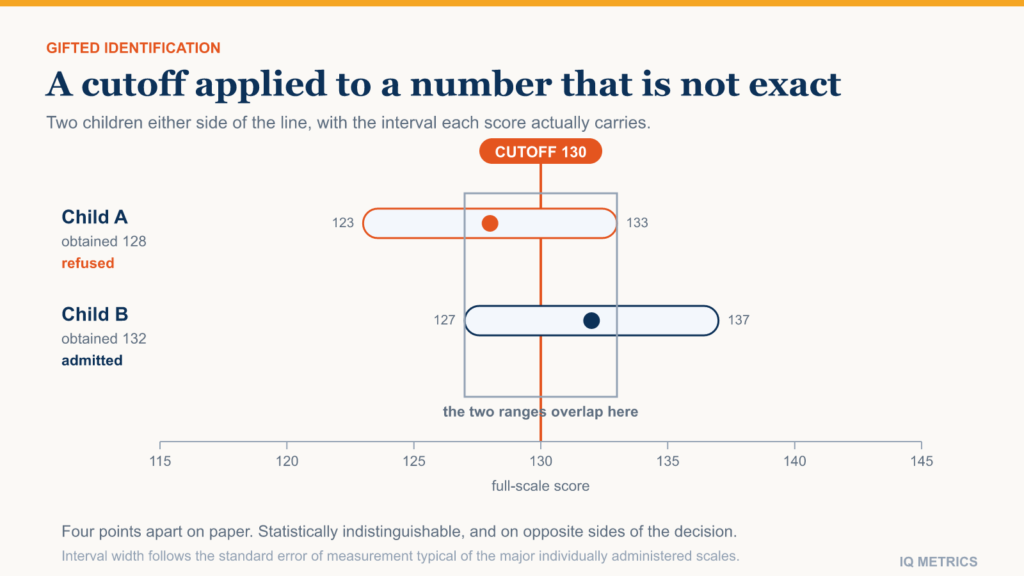
Most gifted programmes draw their line at an IQ of

Stereotype Threat and Test Scores

Stereotype Threat and Test Scores

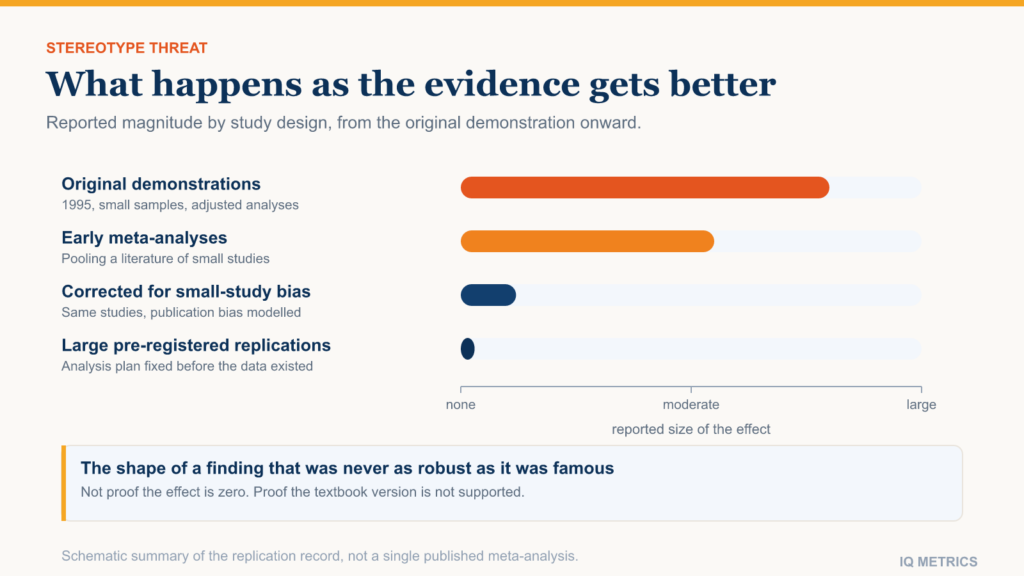
Few findings in psychology have been cited as widely, or

Nutrition and IQ

Nutrition and IQ

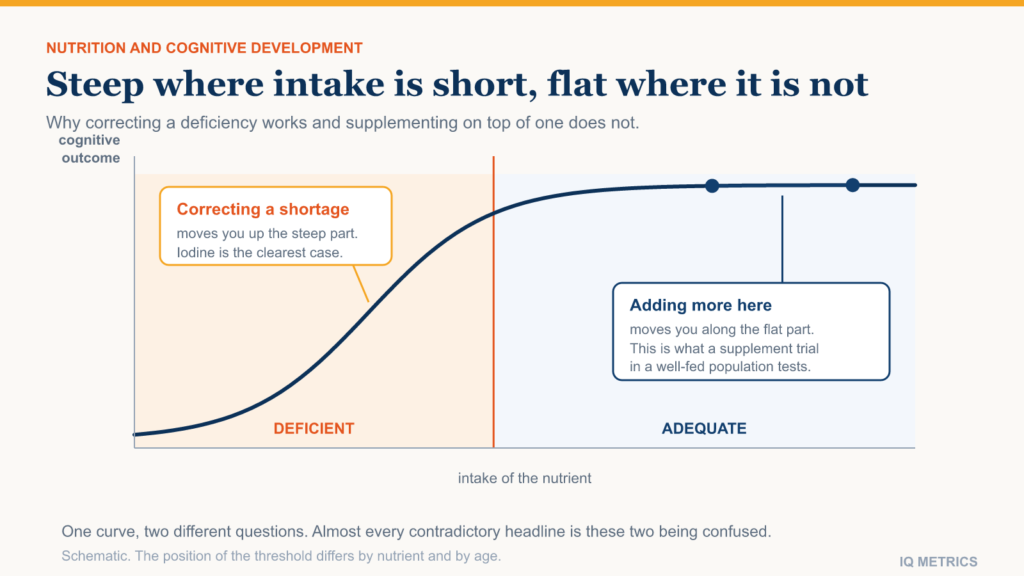
The evidence on diet and intelligence looks contradictory until you

What Your IQ Test Score Really Means?

What Your IQ Test Score Really Means?

Do you ever wonder how to interpret your IQ results? How is your IQ evaluated, and what elements go into determining your score? We shall explore the interesting world of IQ testing and the importance behind those figures in this article.

An IQ test, what is it?

One reliable way to assess a person’s cognitive abilities is via an Intelligence Quotient (IQ) test. It is a quantitative measure of a person’s intelligence and capacity for solving problems. The idea of intelligence quotient (IQ) tests first emerged in the early 1900s as a means to measure cognitive ability and identify future academic success. The results are based on a battery of cognitive tests that measure things like verbal understanding, spatial awareness, and reasoning.

What Your IQ Test Score Really Means?

In most cases, IQ tests will provide numerical results, with 100 being the average score. The majority of individuals fall within the average range, and the distribution of scores follows a bell curve. Smart people tend to have scores above 100, while those with scores below 100 are considered to be below average. Note that IQ scores are not static but can fluctuate with time; this is because intelligence is a complex and multidimensional quality that is affected by many things.

Recognizing the spectrum of IQ tests

To better understand a person’s intellectual capacities, IQ scores are typically placed into several ranges. The following groups usually make up these ranges:

Exceptional Intelligence: An IQ of 130 or above is considered to be extremely high-quality intelligence. People falling under this range are said to have superhuman levels of creativity, memory, and problem-solving abilities.

Excellent: The superb IQ range includes IQs of 120 to 129. People that fall within this group are typically quite bright and successful in their chosen fields

Scores between 110 and 119 on the IQ scale are considered above average. People scoring in this category have above-average intelligence and can breeze through even the most challenging assignments.

Average: An average IQ is somewhere between ninety and one hundred and ten points. A moderate level of intelligence is indicated by the majority of the population falling within this range.

In the below-average range are IQ scores ranging from 80 to 89. People falling into this group could have trouble with activities that call for more complex thought processes.

A borderline IQ is one that falls in between 70 and 79. People falling within this category may need supplementary aid or modifications because they struggle in the classroom.

A mental retardation diagnosis is made when an individual’s IQ falls below 70. People falling into this category may need a great deal of assistance in going about their everyday life and may have severe cognitive impairments.

Keep in mind that intelligence tests should not be considered the only indicator of mental capacity. To be evaluated with other characteristics, they offer a snapshot of cognitive ability at a certain point in time.

The origins and evolution of intelligence testing

IQ testing as we know it began in the early 20th century, although assessing intelligence is ancient. French psychologist Alfred Binet and Theodore Simon produced the first practical IQ test in 1905. Finding students who needed extra help was their goal. Binet’s test assessed memory, attention, and problem-solving.

Modern IQ tests reflect Binet’s exam, which inspired them. Among the most prominent IQ tests are the Stanford-Binet. This 1916 exam developed the IQ score and revolutionized intelligence assessment.

Over the years, several IQ tests have evolved and expanded. These tests evaluate numeracy, spatial awareness, and language skills. A thorough cognitive examination is the goal of growth.

Debate regarding intelligence testing

Despite their popularity, IQ tests have been criticized and controversial. One of the biggest issues is cultural bias. Language and cultural allusions in traditional IQ tests may unfairly benefit some groups. People from various cultures are especially susceptible to IQ inflation due to prejudice.

Another criticism of IQ tests is their narrowness. No single test can accurately assess IQ since it is complex. IQ tests measure thinking and problem-solving, but they don’t measure creativity, social skills, or emotional intelligence.

IQ tests don’t take into account socioeconomic class, education, or culture, which can affect ability. When interpreting IQ results, remember that these factors can greatly impact cognitive development.

IQ testing has limitations, so be careful. IQ testing should be one component in assessing intellect.

Factors affecting intelligence

IQ can be affected by genetic and environmental factors. Though heredity does affect intelligence, other things must be considered. The environment, including social status, education, and early life experiences, profoundly affects intellectual development.

A higher IQ is associated with a more intellectually engaging upbringing, according to the research. Encounters with educational opportunities, availability of resources, and parental support can all play a role in a child’s intellectual development. Conversely, people who are less fortunate, whether because of poverty or neglect, may not have as many opportunities to challenge their minds, which can lead to lower IQ scores.

The effect of schooling on intelligence tests should also be carefully considered. An individual’s cognitive talents and their ability to do well on intelligence tests can both be improved by formal schooling. Nevertheless, there are many other characteristics that contribute to intelligence; hence, schooling cannot explain all the variances in IQ.

The meaning of your IQ test results

To make sense of your IQ test results, you need to know how they were calculated and take into account all the variables that can affect IQ. Keep in mind that intelligence quotients (IQs) are not static and can vary with time. They are only one piece of the puzzle when it comes to evaluating intellectual talents; they only give a picture of cognitive abilities at a particular moment.


It could be beneficial to speak with a psychologist or other competent expert who can offer a thorough assessment after receiving an IQ result. They are able to interpret your IQ results, point out areas of strength and improvement, and offer advice on how to hone your cognitive capacities.

The correlation between intelligence and IQ

Commonly cited as an indicator of intellectual capacity, IQ tests fail to do justice to the complexity and variety of intelligence as a whole. When it comes to measuring intelligence, IQ tests are great at gauging thinking and problem-solving capabilities, but they miss the mark when it comes to measuring emotional intelligence, creativity, and social skills.

The ability to adapt to one’s surroundings, overcome issues, and accomplish one’s goals are all components of intelligence. Emotional intelligence, social ability, and creative capacity are all part of it.

You shouldn’t rely on IQ tests as the only indicator of intelligence, however they can shed light on cognitive capacities. When evaluating a person’s intelligence, it’s crucial to take into account more than just their IQ.

Advice on how to raise your IQ

Contrary to popular belief, intelligence can be developed through a variety of methods, and IQ levels tend to remain fairly constant throughout adulthood. There are a number of ways to improve your cognitive ability, even when raising your IQ might not be feasible:

Read, solve puzzles, and think critically; these are all great ways to exercise your brain and sharpen your cognitive talents. You may improve your thinking abilities and maintain mental acuity by regularly putting your brain to the test.

Regular exercise has a beneficial effect on brain function, so it’s important to keep moving. The brain benefits from increased blood flow, neuronal growth, and general brain health when exercise is practiced regularly.

Make sure you get a good night’s rest: Sleep is essential for brain function and memory consolidation. Get between seven and nine hours of good sleep nightly to keep your brain in tip-top shape.

Proper nutrition is critical for brain function, so eat right. To help your brain work better, eat more foods that are high in vitamins, antioxidants, and omega-3 fatty acids.

Take up a new challenge: A person’s brain activity and cognitive abilities can be stimulated and improved by challenging themselves to do things they aren’t used to doing. Take up a new activity, learn something new, or do anything that challenges you to think critically and solve problems.

Keep in mind that these methods won’t magically raise your IQ, but they will help you become a smarter, more capable person.

Different kinds of IQ testing

Although intelligence tests measuring IQ are the most popular and well-known, there are additional tests that evaluate various facets of intellect. The purpose of these exams is to gauge general intellect by evaluating a set of distinct talents. Additional forms of IQ testing include, among others:

Examining a person’s capacity to both identify and control their own emotions as well as those of others and to appropriately respond to them is the goal of emotional intelligence tests. A high level of emotional intelligence is associated with better social functioning, which in turn has a major bearing on one’s professional and romantic success.

Creativity tests: these assess a candidate’s capacity for original thought, idea generation, and problem solving. Creativity, which includes traits like inventiveness, adaptability, and the capacity to think laterally, is a crucial component of intelligence.

Intelligence is not a fixed quality but rather the result of a person’s capacity to draw on a wide range of experiences and knowledge, according to the many intelligences theory put out by psychologist Howard Gardner. Language, music, space, body-kinesthetic, interpersonal, intrapersonal, and naturalistic intelligences are some of Gardner’s postulated multiple intelligences.

Rather than focusing on a single area of strength or weakness, these alternative intelligence tests give a more holistic picture of a person’s overall ability.

In summary

IQ scores measure intelligence and problem-solving. IQ tests can reveal intellectual abilities, but they should be taken cautiously and with knowledge of their limitations. Because intelligence is multidimensional, no single test can measure it.

Upbringing, environment, and heredity affect IQ. To understand an IQ score, you must grasp how it’s computed and consider all relevant factors.

Remember that cognition can be developed in numerous ways. Intellectual challenge, physical activity, sleep, diet, and intellectual interests can increase cognitive abilities.

The most common intelligence test is the IQ test, but creativity and emotional intelligence tests are also available.

Finally, IQ scores do not replace other cognitive assessments. By understanding your IQ result, you can learn about your cognitive strengths and weaknesses and how to improve.


Gifted Cutoff Scores

Gifted Cutoff Scores

Most gifted programmes draw their line at an IQ of

Stereotype Threat and Test Scores

Stereotype Threat and Test Scores

Few findings in psychology have been cited as widely, or

Nutrition and IQ

Nutrition and IQ

The evidence on diet and intelligence looks contradictory until you

Is Intelligence limited to IQ?

Is Intelligence limited to IQ?

As we explore the fascinating world of intelligence, we will uncover the truth about IQ and the limitations of the human intellect. Beyond traditional measures of intellect, this article explores a wider range of aptitudes that impact our perception and engagement with the natural world.

When Regular Intelligence Exams Are Inadequate

Intelligence is not defined by a single numerical score. Intelligence tests based solely on IQ are becoming obsolete. It is widely understood that intelligence encompasses more than just analytical and logical thinking; it also includes creative and social intelligence, practical abilities, and a strong foundation in logic and reasoning. What gives each of us our unique mental landscape is the sum of these diverse abilities.

Is intelligence limited to iq

Nevertheless, utilizing IQ tests and other traditional assessments of intelligence is not without its flaws. Exams like these focus solely on measuring linguistic and logical abilities, ignoring other, no less important aspects of intellect. Individuals’ true capabilities are disregarded by this narrow perspective. Skills and abilities that don’t conform to the stereotype of “smart” people aren’t considered.

Exploring Intelligence Beyond IQ

By casting doubt on the validity of the assumption that intelligence can be quantified, we rebel against the current quo. Our mission was to delve into the myriad intelligence manifestations by utilizing cutting-edge research and interesting anecdotes. Does the fact that some of us don’t fit the typical profile of intellect mean that our latent talents go untapped?

The Assumption of Various Intelligences

Howard Gardner, a developmental psychologist, revolutionized our understanding of intelligence with his theory of multiple intelligences. According to Gardner, there is more than one way to define intelligence. Some examples include musical, spatial, bodily-kinesthetic, interpersonal, logical, and linguistic abilities.

According to this view, which highlights the diverse range of human cognitive abilities, it is important to value and promote different forms of intelligence. It argues for a broader perspective on intelligence and its growth, rather than depending on a single indicator.

Success through the Use of Emotional Intelligence

In addition to IQ, emotional intelligence (EI) is a crucial but frequently neglected factor. Being emotionally intelligent (EI) means being able to recognize, understand, and manage your own and other people’s emotional states. Success in one’s career and in life depends on it because of the many ways in which it influences relationships, decision-making, and overall health.

Those that score high on the emotional intelligence test excel in managing their own emotions, reading and responding to the emotions of those around them, and finding peaceful solutions to conflicts. They are more equipped to deal with the complexities of modern life, are excellent leaders, and have a natural talent for connecting with people. If you want to be a better person, build stronger relationships, and realize your full potential, you need to work on your emotional intelligence.

The Role of Creativity in Intelligence

Creativity is another aspect of intelligence that is hard to measure with traditional methods. The ability to think creatively is defined as the capacity to generate new ideas and approach problems from various perspectives. Creativity, an essential part of intelligence, is the driving force behind progress and invention in a wide range of domains, not limited to the arts.

Creative people are characterized by their capacity to see connections where none existed before, come up with original solutions to challenging challenges, and uncover previously unknown possibilities. By introducing fresh perspectives and ideas, they can alter the course of history. The only way to unleash the full potential of the human mind is to foster an environment that is conducive to creativity and innovation.

Importance of Social Intelligence in Individual Relationships

Intelligence is a trait that affects every one of our interactions, not just our own. What we mean when we speak about social intelligence is the ability to understand and navigate social dynamics effectively. It includes qualities like empathy, the capacity to read and react to social cues, and the ability to build true connections.

Those with high EQ tend to thrive in collaborative settings where there is room for debate, compromise, and teamwork. Their understanding of human nature is extensive, and they can adapt their strategy to fit any social situation. Strong interpersonal skills, conflict mediation abilities, and the ability to create harmonious communities all stem from a lack of social intelligence. An integral aspect of intelligence, it influences our daily life in the workplace and at home.

Practical Intelligence and Its Role in Everyday Life

While intellectual pursuits are certainly worthwhile, practical intelligence is equally important for getting through the day. Having “street smarts,” or the ability to effectively use one’s knowledge and skills in real-world situations, is one way to describe practical intelligence. It requires creative thinking, adaptability, analysis, and problem-solving abilities.

To overcome challenges, make sound decisions, and achieve one’s goals in life, one needs a high degree of practical intelligence. Because of their exceptional environmental awareness, they effortlessly seize opportunities and triumph over obstacles. To succeed in many things, like handling one’s own finances, climbing the corporate ladder, and solving everyday difficulties, one needs a high degree of practical intelligence.

Promoting and Strengthening Diverse Intelligences

Recognizing the complex nature of intelligence opens us a multitude of possibilities for personal growth. In doing so, we are able to appreciate our own traits while also acknowledging our strengths and opportunities for improvement. A thorough and systematic approach is necessary for the development of varied forms of intelligence.

Some things that can help you grow your emotional intelligence are thinking critically, doing things that encourage empathy, and speaking up for yourself often. Being receptive to new ideas, engaging in creative activities, and viewing failures as learning experiences are all ways to foster creativity. To increase your social intelligence, practice active listening, develop your capacity for empathy, and be receptive to different perspectives. To develop your practical intelligence, practice problem-solving, apply what you’ve learned in real-world situations, and never stop studying.

How IQ Influences Professional and Personal Growth

A person’s professional and personal life can only progress with the help of intelligence. Consequently, it dictates our proficiency in an ever-changing world and our rate of skill acquisition. Discovering and developing one’s own intellect style is the key to unlocking one’s full potential and experiencing true happiness.

In business, there are other indicators of intelligence than a high IQ and academic achievements. A well-rounded skill set, encompassing not just technical knowledge but also EQ, creativity, and social intelligence, is highly prized in today’s employment market. If you want to climb the corporate ladder, lead high-performing teams, and contribute to your company’s success, you need to be proficient in all three forms of intelligence.

Final Thoughts on Intelligence

As our investigation of intelligence draws to a close, its multifaceted character is becoming more apparent. There is no objective way to measure intelligence because it is not a fixed attribute. A person’s abilities impact not only their perception and interaction with the world, but also their talent set. We may unlock the limitless potential within each individual’s intellect by taking a more comprehensive view of intelligence and recognizing its diverse manifestations.

We owe it to the intricate web of human thought to abandon ideas that have outlived their usefulness. In order to give due credit to the various intelligences that people possess, it is necessary to do so. The facts regarding IQ and the boundaries of intellect can only be unveiled using this approach.


Gifted Cutoff Scores

Gifted Cutoff Scores

Most gifted programmes draw their line at an IQ of

Stereotype Threat and Test Scores

Stereotype Threat and Test Scores

Few findings in psychology have been cited as widely, or

Nutrition and IQ

Nutrition and IQ

The evidence on diet and intelligence looks contradictory until you

Which Part of the Brain, IQ Tests Measures

Which Part of the Brain, IQ Tests Measures

Explore the fascinating world of concepts and brain activity. This article examines intelligence test-measured brain areas to better understand intelligence. This in-depth analysis will attract psychology and neuroscience students and anyone who wants to learn more.

By carefully investigating brain networks, we can understand mental abilities. The essay discusses key brain regions involved in IQ testing, including the frontal cortex, which makes decisions and solves problems, and the parietal lobe, which processes math and spatial information.

Which Part of the Brain, IQ Tests Measures

The connections between brain regions affect our IQ. Recent scientific breakthroughs are affecting psychology and education. Join us as we seek enlightenment via knowledge.

Acquiring knowledge of the structure and function of the brain

The complicated network of brain connections affects our thoughts, feelings, and behaviors; this biological marvel is amazing. Understanding the many brain areas and their functions is crucial to understanding intelligence.

The frontal lobe is crucial to intelligence. Executive processes like problem-solving and decision-making depend on the prefrontal cortex. Reasoning, planning, and working memory are prefrontal cortex functions. Research reveals that those with developed frontal lobes have higher IQs.

The parietal lobe houses another essential IQ test component. You may focus, use your senses, and think numerically and spatially here. It aids numerical, visual, and mental computations. Hyperactive parietal lobes are associated with higher IQs, thinking, and problem-solving skills.

Knowledge and the prefrontal cortex

The top of the brain, the frontal lobe, controls many cognitive functions and intellect. The prefrontal cortex in the frontal lobe controls reasoning, decision-making, and working memory.

According to study, a large, active prefrontal cortex is associated with high IQ. People with higher IQs can think abstractly, handle complicated issues, and store and remember a lot of information in working memory.

Planning, impulse control, and self-control are prefrontal cortex-controlled executive functions. Due to the substantial association between intellect and these abilities, IQ tests examine these mental capacities extensively. The prefrontal cortex with higher IQs is stronger and more efficient, allowing for greater emotion management, complex task execution, and decision-making.

The parietal lobe’s role in IQ testing

The posterior cingulate cortex’s parietal lobe is also significant for IQ assessments. In addition to processing sensory information and paying attention, this region controls mathematical and spatial thinking.

The parietal lobe processes mental, visual, and numerical information. Parietal lobe-strong persons thrive at reasoning, problem-solving, and ecological awareness. High IQ is strongly linked to certain cognitive abilities.

Active parietal lobes improve mental rotation, arithmetic, and visual-spatial puzzle-solving IQ tests. Ability to analyze and understand visual and numerical data in the parietal lobe indicates intelligence.

Intelligence and the temporal lobe

The temporal lobes of the brain process language, hearing, and memory, among other things. Standard intelligence tests don’t easily examine the temporal lobe, but that doesn’t negate its importance in intelligence.

Language comprehension and speech are mediated by the temporal lobe. The brain’s memory center also understands language and recognizes faces. Due to their excellent memory recall and language skills, people with well developed temporal lobes have higher IQs.

The temporal lobe processes, makes meaning, and hears. Auditory memory is needed to remember and recreate tone sequences. Memory and auditory perception affect intelligence and performance, even if IQ tests don’t directly assess them.

Impact of the occipital lobe on cognitive ability

At the very base of the skull sits the occipital lobe, the primary area of the brain that processes and perceives visual information. Although it is implicated in cognitive capacities, the occipital lobe is not explicitly assessed in conventional intelligence exams.

Basic to intelligence is the ability to take in visual information, interpret it, and make sense of it. When it comes to processing visual information and mentally representing objects, forms, and patterns, the occipital lobe is crucial. Visual thinking and problem solving tend to come naturally to people whose occipital lobes are fully developed. On top of that, they usually have better visual-spatial ability.

In addition, the occipital lobe helps in visual memory, which is the capacity to identify and recover previously seen images. This skill is necessary for visual recall tasks, including memorizing complicated visual sequences or patterns. Visual perception and memory are not directly measured by IQ tests, but they have a substantial impact on a person’s cognitive capacity and could affect their performance on the test as a whole.

How the cerebellum affects cognitive processes

The cerebellum has long been related to motor control and homeostasis, but only recently to intellect and other cognitive capacities. This rear of the brain region has more neurons per square inch than any other, suggesting it may affect cognition.

Research shows that the cerebellum affects attention, language, and problem-solving. It helps regulate and organize mental functions, which speeds up data processing and task completion. A properly formed cerebellum improves attention, communication, and problem-solving, which raises IQs.

Recent studies suggest the cerebellum contributes to higher-order cognitive abilities, but more research is needed to fully understand its role in intelligence. Despite being mostly responsible for motor coordination, the cerebellum affects intelligence development.

The role of the brain’s limbic system in IQ tests

The cerebellum has long been related to motor control and homeostasis, but only recently to intellect and other cognitive capacities. This rear of the brain region has more neurons per square inch than any other, suggesting it may affect cognition.

Research shows that the cerebellum affects attention, language, and problem-solving. It helps regulate and organize mental functions, which speeds up data processing and task completion. A properly formed cerebellum improves attention, communication, and problem-solving, which raises IQs.

Recent studies suggest the cerebellum contributes to higher-order cognitive abilities, but more research is needed to fully understand its role in intelligence. Despite being mostly responsible for motor coordination, the cerebellum affects intelligence development. .

The relevance of synapses which link various brain regions

Understanding brain area function is key, but understanding their connections is even more important. A sophisticated brain network of information flows improves cognition and intelligence.

The occipital, frontal, parietal, cerebellar, and limbic systems work together to maintain mental sharpness. All these places are related. When the temporal, parietal, and prefrontal lobes cooperate, language, decision-making, and problem-solving improve. Visual perception and spatial awareness need occipital-parietal data transfer.

The cerebellum’s connections to reasoning and memory regions make it more than a motor control center. It may influence higher-order thinking because to its prefrontal cortex, parietal lobe, and limbic system connections.

Information flow in the brain affects intellect and thinking. By examining cross-domain correlations, intelligence and IQ tests can be better understood.

In sum, IQ testing have its limitations, and intelligence is complex.

Intelligence defies quantification by a single metric due to its complexity and multi-dimensionality. Intelligence tests may be helpful in gauging some cognitive capacities, but they may not account for all aspects of human intellect.

The areas of the brain that are assessed by intelligence tests have an effect on a person’s cognitive capacity and performance. The frontal, parietal, temporal, occipital, cerebellar, and limbic systems are all involved. Intelligence is not limited to a person’s IQ but includes a wide range of emotional, social, and cognitive abilities.

Intelligence requires not only the ability to reason and solve problems on one’s own, but also the capacity to empathize with others, be creative, and have intrinsic motivation. Researchers must continue to probe intelligence’s foundations and find more precise ways to quantify its myriad dimensions.

Finally, IQ tests focus on certain regions of the brain to reveal the chemical basis of intelligence. If we want to know how we gain intelligence, we must study the roles and connections between these domains. It is essential to recognize that IQ tests have limitations, and a more thorough assessment of intelligence is necessary. Since intelligence includes many different types of emotional and social skills, its evaluation requires a comprehensive approach that goes beyond traditional testing.


Gifted Cutoff Scores

Gifted Cutoff Scores

Most gifted programmes draw their line at an IQ of

Stereotype Threat and Test Scores

Stereotype Threat and Test Scores

Few findings in psychology have been cited as widely, or

Nutrition and IQ

Nutrition and IQ

The evidence on diet and intelligence looks contradictory until you