





What IQ Score Do You Need for Mensa?
Mensa admits the top 2% of scorers, but "the top 2%" is a rank, not a number, and the number it maps to changes with the test you sat. Here is what qualifies on the Wechsler, Stanford-Binet and Cattell scales, the two routes to membership, and what the supervised admission test is actually like.
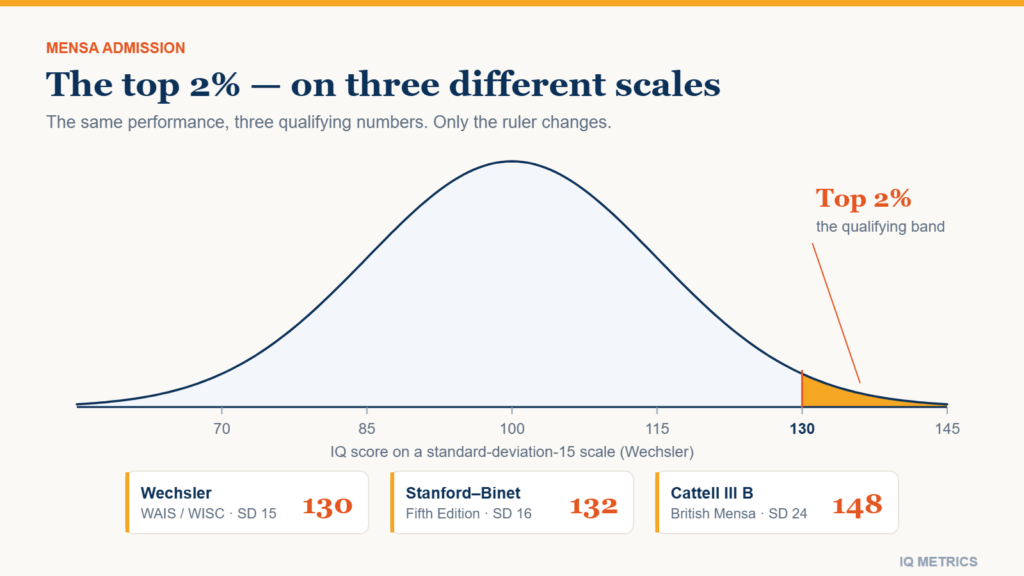
Mensa is the oldest and best known high-IQ society in the world, and the question people ask about it more than any other is the simplest one: what score do you actually need? The short answer is the 98th percentile — the top 2% of the population. The longer answer is the one that helps, because a percentile is a rank, not a score, and the number that rank corresponds to changes depending on which test you sat.
That is why you will see 130, 132 and 148 all quoted as "the Mensa score" by sources that are each telling the truth. This article explains the one requirement that never changes, why three different numbers can describe the same performance, and how the two routes into Mensa differ.
The one requirement that never changes
Mensa has exactly one entry criterion: a score at or above the 98th percentile on an approved, supervised test of intelligence. Nothing else counts. Your age, education, occupation, nationality and income are all irrelevant to eligibility, and there is no interview, no essay and no recommendation.
Two words in that criterion do most of the work. Supervised rules out anything you take unproctored at home, including every free online quiz. Approved means the test appears on the list your national Mensa maintains — that list is genuinely long, running to dozens of instruments, but it is finite and it is published.
The 98th percentile itself is worth pausing on. It means that out of a hundred people drawn at random from the general population, roughly ninety-eight would score below you. It does not mean you answered 98% of the questions correctly, which is the single most common misreading of any percentile figure. If you want to see how a given score translates into a rank, the IQ percentile calculator does the conversion directly.
Why the qualifying number is not always 130
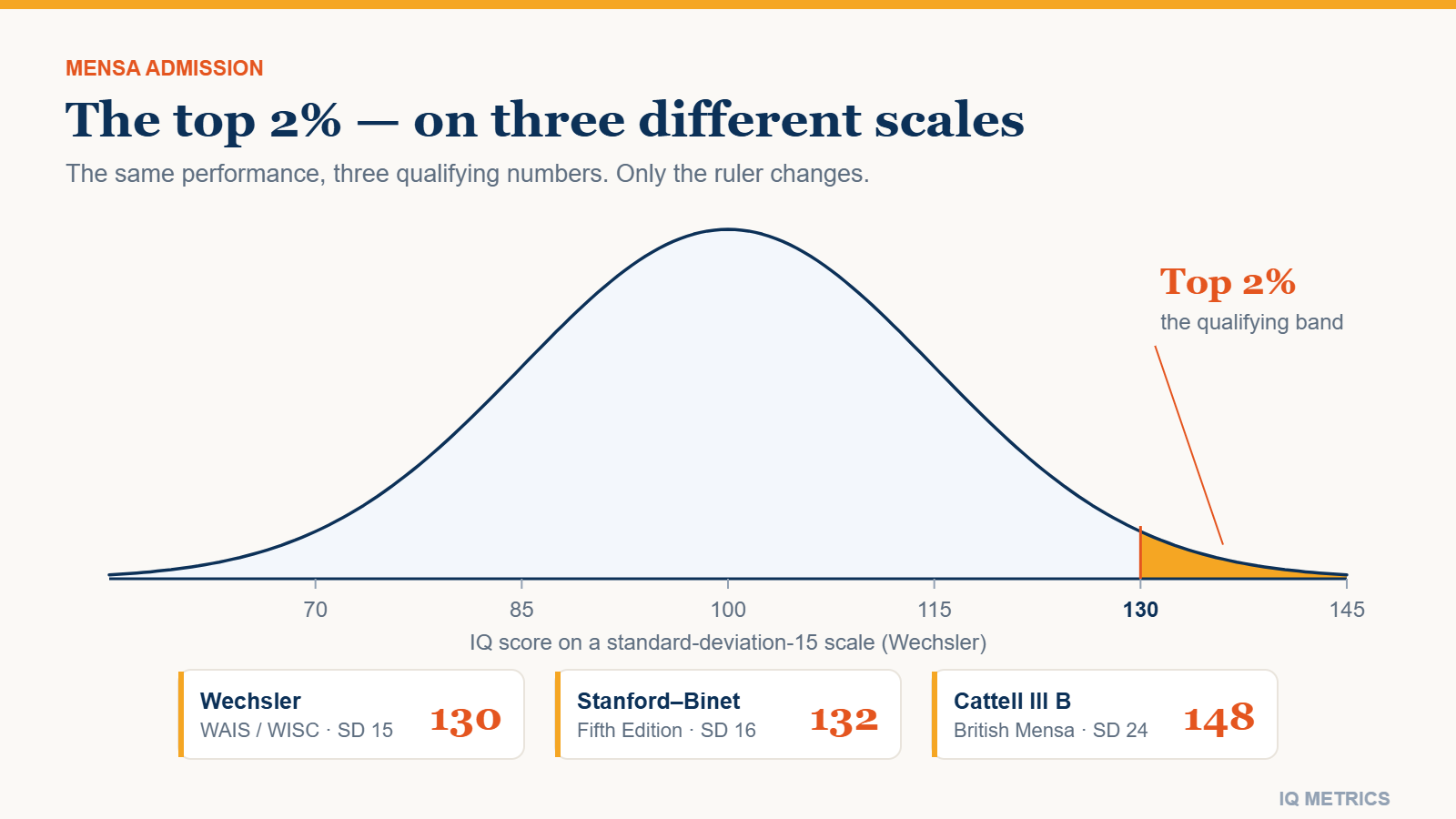
An IQ score is not a count of correct answers. It is a statement about how far your performance sits from the average, measured in standard deviations. The average is fixed at 100 by convention on essentially every modern test. The standard deviation is not fixed at all: different publishers picked different values decades ago and never converged.
The 98th percentile sits about 2.05 standard deviations above the mean. Multiply that distance by whatever standard deviation your test uses, add 100, and you get the qualifying score for that test.
Tests scaled to a standard deviation of 15
The Wechsler family — the WAIS for adults and the WISC for children — uses a standard deviation of 15, and so do most tests published in the last forty years. On this scale the 98th percentile lands just under 131, and the qualifying score is commonly listed as 130.
Tests scaled to a standard deviation of 16
The Stanford-Binet Intelligence Scales use a standard deviation of 16. The same performance that produces 130 on a Wechsler test produces roughly 132 here. Nothing about the person changed; only the ruler did.
The Cattell III B and its standard deviation of 24
British Mensa's own supervised test reports on the Cattell III B scale, which uses a much wider standard deviation of 24. The qualifying score there is 148. This is the single biggest source of confusion about Mensa scores, and it is why someone quoting "148" is not exaggerating — they are quoting a different scale.
The same person, three different numbers
It is worth stating the consequence plainly. A person who performs at exactly the 98th percentile would be reported as roughly 130 on a Wechsler test, 132 on a Stanford-Binet, and 148 on the Cattell III B. All three numbers describe one identical level of performance.
This is also why comparing your score against a friend's is meaningless unless you both know which scale each number came from. A score quoted without its standard deviation is an incomplete piece of information. The IQ score converter exists for exactly this problem: give it a score and the scale it was measured on, and it will tell you what the equivalent is elsewhere.
- A score of 130 on an SD-15 test is not below a score of 132 on an SD-16 test.
- A score of 148 on the Cattell scale is not near-genius on a Wechsler scale.
- Any score without a named scale cannot be compared with any other score.
The two routes into Mensa
Every national Mensa offers the same two paths, and you only need one of them.
Route one: sit Mensa's supervised admission test
This is the standard route and the one most applicants use. You book a session, attend in person at a scheduled testing location, and sit a proctored battery under timed conditions. There is a modest administration fee, and the result comes back as a straightforward qualified or not qualified, usually within a few weeks.
Most national chapters allow only a limited number of attempts in a lifetime — often just one or two — precisely because practice effects would otherwise inflate scores on repeat sittings. Check your own chapter's rule before you book, because it is not the kind of thing you can undo.
Route two: submit evidence from a test you have already taken
If you have previously been assessed on an approved test — often through a school psychologist, an educational assessment, a clinical evaluation or an occupational selection process — you can submit that documentation instead of sitting anything new. Mensa reviews the paperwork and admits you if the score clears the threshold.
The evidence has to be the original scored report from a qualified administrator, not a self-reported number, and some chapters will not accept results from before a given date because the test norms have since been restandardised. That restandardisation is itself a real phenomenon worth understanding, and we cover it in our article on the Flynn effect.
Where would your own score land?
Take the IIF-certified assessment and get your score with the scale it was measured on, the percentile it corresponds to and the confidence range around it — the three figures most online tests leave out.
Find your IQ score now! →What the supervised admission test is like
The details vary by country, but the shape is consistent. You should expect a battery lasting somewhere between forty-five minutes and two hours, delivered under strict time limits, with sections that lean heavily on pattern recognition, sequence completion, verbal analogies and logical reasoning.
Two features surprise people. The first is the pace: the tests are deliberately built so that almost nobody finishes every item, and being unable to complete a section is normal rather than a sign of failure. The second is the absence of general knowledge. You are not being asked what you have learned; you are being asked how quickly you can work out something you have never seen before. If you want a sense of the item formats in advance, our guide to the types of questions asked on an IQ test walks through the common categories.
Can you prepare for it?
Partly, and it is worth being precise about which part. You cannot meaningfully raise the underlying reasoning ability the test is trying to measure in a few weeks of study. What you can do is remove the friction that costs people points for reasons that have nothing to do with ability.
- Learn the item formats, so you are not decoding instructions while the clock runs.
- Practise working at speed, because unfamiliar time pressure is itself a handicap.
- Sleep properly the night before — fatigue is one of the few factors with a reliably measurable effect on test performance.
- Sit the test at a time of day when you are normally alert, not squeezed around something stressful.
Our article on how to prepare for an IQ test goes into this in more depth, including the factors that genuinely move a score and the ones that do not.
What Mensa membership is, and what it is not
Mensa is a social and intellectual society. Membership gives you access to local and national groups, special interest groups covering an enormous range of subjects, publications, and international gatherings. Many members join for the community rather than the credential.
It is not a professional qualification, it is not recognised by employers as one, and it does not certify competence in anything. It certifies a single test performance on a single day. That is worth remembering both if you qualify and if you do not, because a great deal of what people actually want from a high score — confidence, credibility, opportunity — is not what the score is for. We looked at this gap more broadly in is intelligence limited to IQ.
If you fall short of the threshold
Roughly 98 people in every 100 do, which is the entire point of the criterion. A score below the cutoff is not a verdict on your intelligence, your capability or your prospects; it is a statement about where one timed performance sat relative to a norm group.
It is also worth knowing that scores carry a margin of error. A well-constructed test typically reports a confidence interval of several points either side of the number, so someone who scores 127 and someone who scores 131 are not reliably different people — they are two draws from overlapping ranges. Any score reported without that range is being presented more precisely than it deserves.
Checking where your own score lands
If you want to know your position before committing to a supervised sitting, the sensible first step is a properly normed assessment that reports the three figures that make a score interpretable: the scale it was measured on, the percentile it corresponds to, and the confidence range around it. Our IQ test reports all three, and the IQ tools collection lets you convert between scales and see where any score sits on the distribution.
That will not qualify you for Mensa — nothing unsupervised can — but it will tell you whether a supervised sitting is worth the fee, which is the practical question most people are really asking.
Keep reading
All articles → Scores & Scales
What Is Genius IQ Level
It is highly recommended that you seek out the assistance of a psychologist or educational specialist who can boost your IQ to the level of a genius
 Scores & Scales
IQ Classifications
This article discusses the various factors that affect intelligence, the several IQ classifications, and their significance. IQ testing definitions and the origins of “gifted,” “average,” and “intellectually disabled” are revealed.
 Taking a Test
Professional IQ Tests
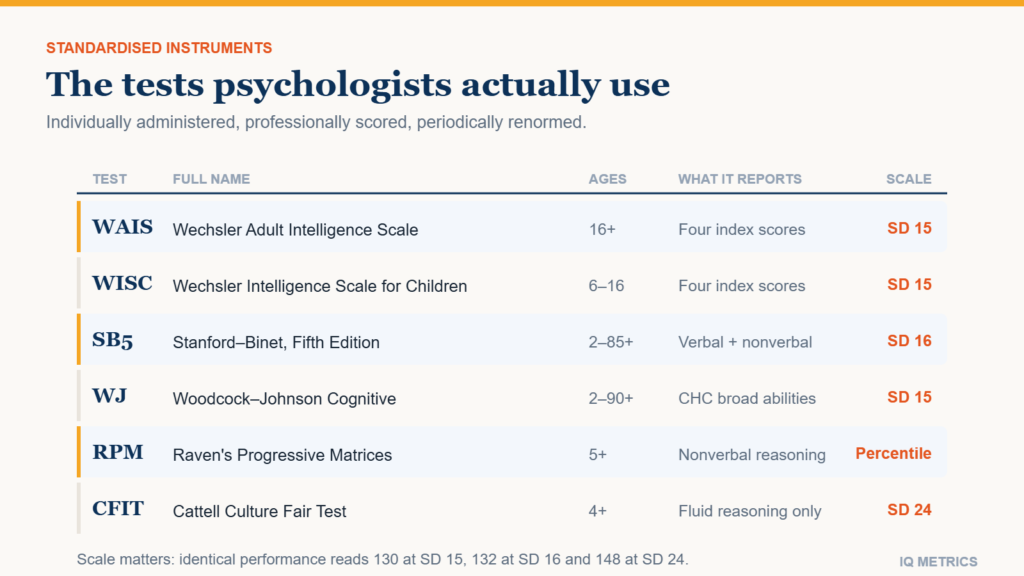
When a psychologist measures intelligence, they reach for one of a small number of standardised instruments. This guide covers what the Wechsler scales, Stanford-Binet, Woodcock-Johnson and Raven's Progressive Matrices each measure, who each one is for, and where an online test genuinely fits.