





Can Your IQ Be Zero? What a Score That Low Would Actually Mean
Mathematically, the IQ scale has no floor built in - but no test has ever reported a zero. Where the deviation IQ scale actually stops working, why real tests bottom out around 40, and what a score that low would even require.

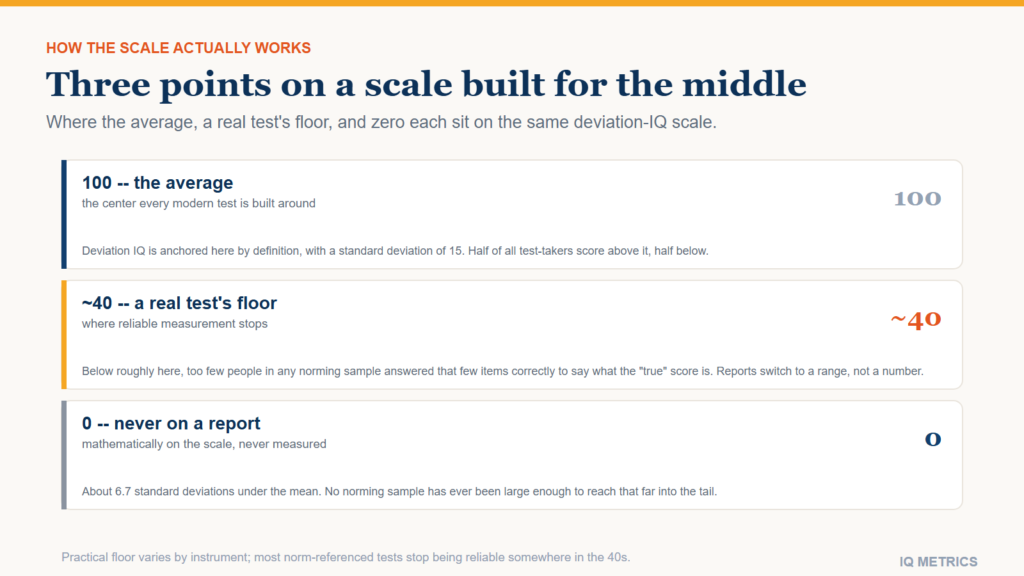
Mathematically, yes: the deviation IQ scale used by every major test today has no built-in floor, and the arithmetic behind it continues cleanly through zero and into negative numbers. In practice, no test has ever reported a score of zero, and no real test ever will. This article covers how the scale is actually built, where real testing stops working long before it gets anywhere near zero, what a score that low would actually require of a person, and how clinical practice handles the small number of people whose ability genuinely cannot be captured in a single number at all.
That gap between the math and the reality is not a flaw in the test. A ruler with a foot of usable markings can still, in principle, describe a distance of ten miles — the formula never stops working, but nothing anyone would actually measure with it gets anywhere close.
How the modern IQ scale is actually built
Every mainstream test in current use — the Wechsler scales, the Stanford-Binet 5 — reports what is called deviation IQ: a score built around a mean of 100 with a standard deviation of 15 (some scales use 16). How IQ is scored by age covers the mechanics in full, but the short version is that a deviation IQ score is really a statement about rarity relative to same-age peers, not a raw count of correct answers. Scoring 115 does not mean answering 15% more questions right; it means scoring higher than roughly 84% of people the same age who took the same test.
This is a relatively modern convention. Early twentieth-century testing used ratio IQ instead: mental age divided by chronological age, multiplied by 100. Deviation IQ vs. ratio IQ explains why psychologists abandoned that formula, but it matters directly here: under the old arithmetic, a very low score genuinely was reachable. A ten-year-old assessed at a one-year mental age computed to a ratio IQ of 10, mechanically, no special case required. Deviation IQ does not work that way at all, which is a real part of why zero does not come up today even in principle for anyone who can be meaningfully tested.
Why zero is "on" the scale but never reached
Zero sits 100 points below the mean, which on a standard deviation of 15 works out to about 6.7 standard deviations below average. To see how fast that escalates: about 68% of people fall within 1 standard deviation of the mean (85 to 115), about 95% fall within 2 (70 to 130), and about 99.7% fall within 3 (55 to 145). Each additional standard deviation past that point does not shrink the remaining share by a little; it shrinks it by orders of magnitude. By roughly 6.7 standard deviations out, the normal-curve model treats the remaining share as rarer than one person in the entire population that has ever lived, let alone the few thousand people in any single test’s norming sample. Long before a real distribution gets anywhere near that far out, the bell-curve approximation has already stopped describing anything real. There is no group of people zero could be measured against, because no such group exists to be rare within.
Does IQ even have a "true zero"?
This is a different, more technical question than whether a zero score has ever been recorded, and it has a clean answer: no. Measurement theory distinguishes an interval scale, where equal gaps mean the same thing at any point but zero is arbitrary, from a ratio scale, where zero means a true absence of the thing being measured. Temperature in Celsius is an interval scale — 0°C is not "no temperature," it is just where water freezes — while weight is a ratio scale, where 0 kg really does mean no mass. Deviation IQ is built as an interval scale. It supports statements like "115 is 15 points above 100," but it was never built to support a statement like "an IQ of 150 is twice as smart as an IQ of 75," because doubling and halving are ratio-scale ideas that do not carry over. Even in the hypothetical world where a test could reach all the way down to 0, that score would not mean "zero intelligence" any more than 0°C means zero heat — the scale simply is not built to make that kind of claim in the first place.
That also covers the colloquial use of the phrase, which shows up constantly online as an insult — "their IQ is zero," "IQ below zero." As internet shorthand for "acting foolishly," it is harmless hyperbole. As a literal claim about a measured score, it is not just false in practice, as this article covers throughout; it is not really a coherent claim on this kind of scale to begin with.
Where a real test actually stops measuring
Most standardized tests can reliably measure down to somewhere in the neighborhood of 40, depending on the specific instrument and its norming sample; scores below roughly 20 to 25 are generally treated as unreliable regardless of test. This is a floor effect: once someone is missing nearly every item on the easiest end of a test, the instrument can no longer tell a true score of 35 apart from a true score of 15, because too few people in the norming sample ever scored that low for the statistics to be trustworthy. Researchers have specifically studied how to compute meaningful index scores for children who "floor" the WISC-IV in this way, precisely because the standard scoring tables simply run out.
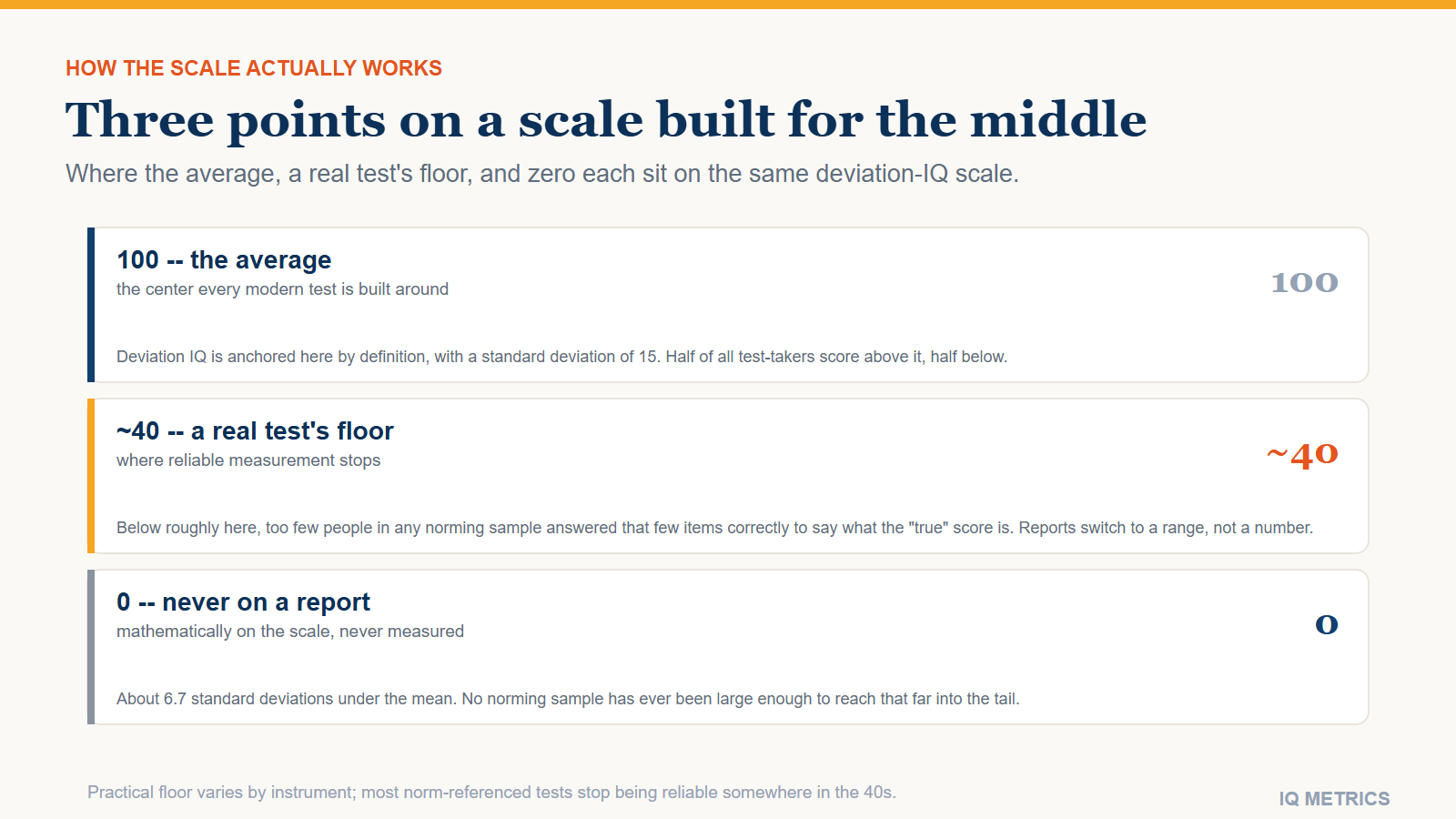
When a test hits this wall, a competent report does not print a guess. It reports a ceiling on the estimate instead — something like "below 40" — rather than pretending to distinguish one very low score from another with a precision the data cannot support. How to read an IQ test report covers what a real report actually contains, which is always a range and a set of index scores, never a single bare number standing in for a person’s whole ability.
Where would your own score land?
Take the IIF-certified assessment and get your score with the scale it was measured on, the percentile it corresponds to and the confidence range around it — the three figures most online tests leave out.
Find your IQ score now! →What a score that low would actually require
Getting close to a test’s floor means missing nearly every item written for the easiest end of the norming sample — typically material aimed at very young children on an adult-normed test. Below that point, the practical problem stops being about reasoning ability at all. Sitting through a timed, instructed, standardized assessment requires baseline attention, motor coordination and communication just to produce a response in the first place. Someone whose impairment is severe enough to theoretically approach a near-zero score is, in the overwhelming majority of cases, someone for whom those basic prerequisites cannot be assumed either — which means the instrument cannot separate "very low reasoning ability" from "unable to engage with this particular kind of task" at all.
For research purposes, specialists sometimes work with extended or extrapolated norms that project a curve mathematically below a test’s actual floor, the same way extended norms exist above a test’s ceiling for profoundly gifted children. Those extrapolated numbers are useful for research comparisons across studies, but nobody treats them as a directly observed score in the way a report hands a family a number like 92. They are a modeling tool, built on the assumption that the same statistical pattern continues past the point where it was ever actually observed — which is exactly the assumption that stops being trustworthy the further out it is pushed.
How very low ability is actually assessed today
Clinical practice has moved well past the idea of a single IQ cutoff for this reason. The DSM-5 and the American Association on Intellectual and Developmental Disabilities both define the severity of intellectual disability primarily through adaptive functioning — conceptual, social and practical skills for daily life — with a test score treated as supporting evidence rather than the sole basis for a diagnosis. That shift happened specifically because a bare number was never an adequate description on its own, at either end of the scale but especially at the low end, where the measurement itself becomes least trustworthy exactly where the stakes for getting it right are highest.
The high end runs into the identical problem, in reverse
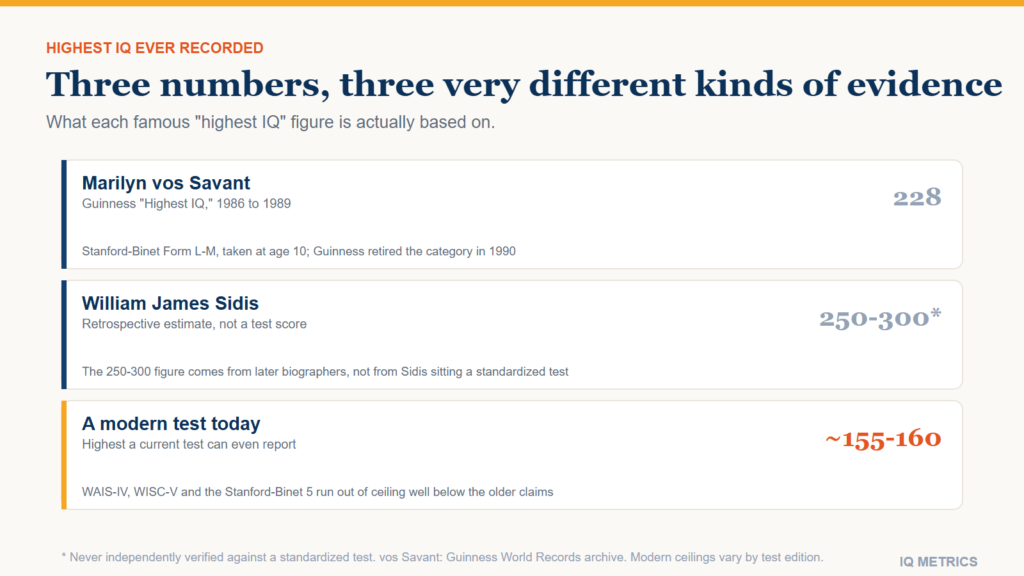
The ceiling effect is the mirror image of everything above: every test also has a highest score it can report, set by how many people in its norming sample answered every item correctly, and claims that outrun it deserve the same scrutiny. The highest IQ ever recorded covers what happens when a headline number tries to describe someone past the point where any real test can actually distinguish one score from another — the same honest-measurement problem this article covers, just at the opposite tail.
The bottom line
A score of zero is a real point on the deviation IQ formula and a point no test has ever measured, for the same reason: the formula is built to describe the middle of a distribution precisely, and it keeps working on paper long after the actual population it describes has run out. This is the same idea behind a ranking like average IQ by college major being meaningful only as a group comparison, never a verdict on one person: a score only means something next to the sample it was measured against, and at either extreme of the curve, that comparison sample has already run out.
Keep reading
All articles →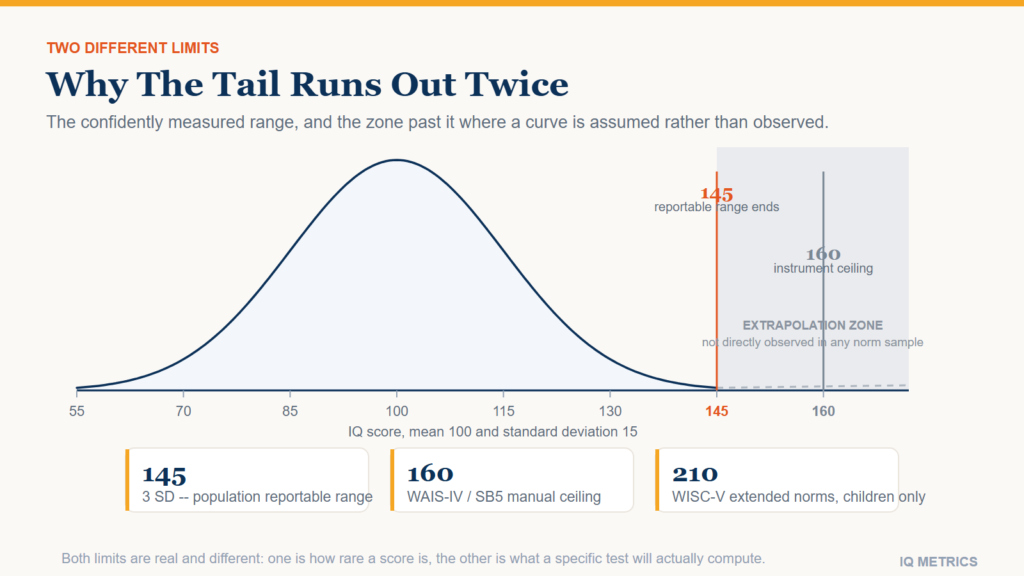 Scores & Scales
IQ Score Ceiling Effects
Two different numbers get used as "the top of the scale," 145 and 160, and they come from two different kinds of limit. One is a statement about population statistics; the other is about what a specific test manual will actually compute.
 Scores & Scales
What an IQ of 70 Means
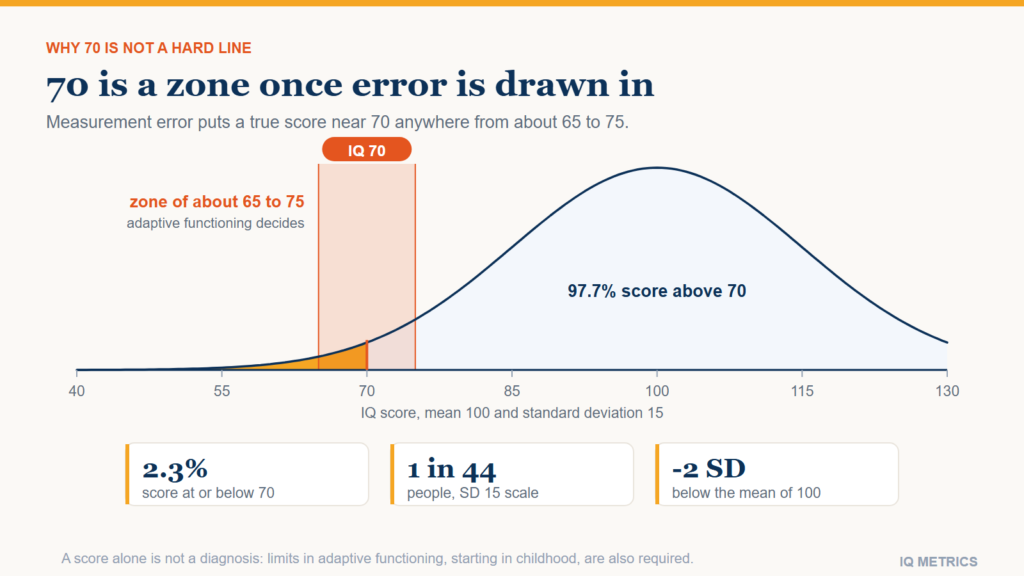
An IQ of 70 sits two standard deviations below the mean, at about the 2nd percentile. It is the score most often linked with intellectual disability, but a diagnosis never rests on the number alone: measurement error turns the line into a zone, and adaptive functioning decides who is inside it.
 Scores & Scales
Highest IQ Ever Recorded
The highest IQ ever recorded is usually given as Marilyn vos Savant's 228 or William James Sidis's claimed 250 to 300 - neither from a test in use today. Where the famous numbers actually come from, and what a modern test can really report.