





Average IQ by College Major: What 70 Years of Data Actually Show
Average test scores really do differ by college major, and the rank order has barely moved in 70 years. What a landmark cross-dataset analysis found, why SAT and GRE scores are not IQ scores, and what the ranking cannot tell you about one student.

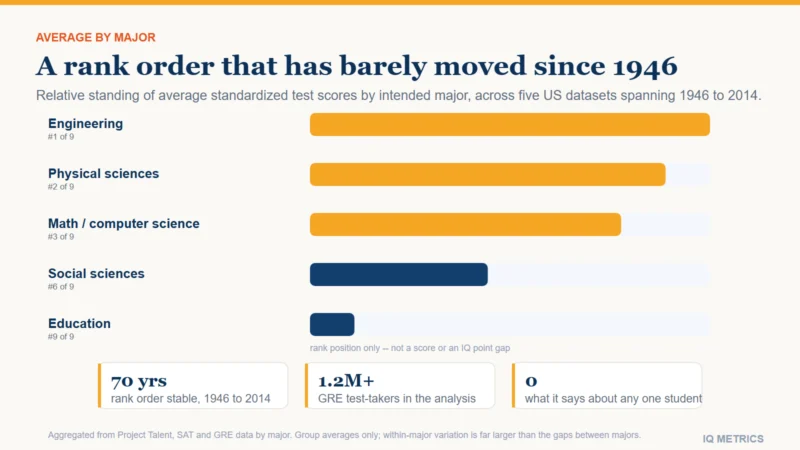
Yes, on average — and the gap has held remarkably steady for decades. Students who go on to major in engineering, the physical sciences, or math and computer science score higher, on average, on the standardized tests researchers have studied than students heading into fields like business or education, and that basic ranking has barely moved since researchers first started tracking it in 1946. This article covers what the research actually measured, what the ranking looks like, why it has stayed so stable, and — just as important — what a group average like this cannot tell you about any individual student, including the one reading this article about their own major.
What the research actually measured
The most thorough version of this analysis comes from psychologist Jonathan Wai, who lined up five different measures of American students’ academic aptitude spanning 1946 to 2014 and compared them by intended field of study. The datasets include Project Talent, a stratified sample of roughly 400,000 American high school students tested in the early 1970s, and more than 1.2 million people who took the Graduate Record Examination between 2002 and 2005 and reported an intended graduate major, alongside SAT data. None of this is a single study of a single year; it is a comparison across independent samples, tests and generations.
One caveat belongs up front: "intended major" is not the same as "final degree." Students switch fields, and a first-year plan is not a guarantee. The analysis captures where students stood when they declared an interest, not a lifetime outcome.
The ranking
- Engineering and the physical sciences (physics, chemistry, earth science) rank highest across every dataset Wai examined, a position they have held since the earliest data in 1946.
- Math and computer science follow close behind, with the biological sciences not far after that.
- The humanities and social sciences occupy the middle of the field, scoring above most of the remaining majors but well behind the top group.
- Business and education post the lowest average scores among the nine broad fields in the analysis.
The gap between the top and bottom of that list is real but should not be overstated: these are group averages built from broad fields that each contain enormous internal variation, not a precise scoring ladder where every engineering student outscores every education student.
One reason business and education sit at the bottom is not just about ability — it is partly arithmetic. Fields like physics and engineering draw a smaller, more self-selected pool of students who already committed to a demanding quantitative track well before declaring a major. Business and education are among the largest, most broadly accessible majors in the country, drawing a wider cross section of every incoming class. A more selective, smaller pool sitting further out in the distribution will almost always show a higher average than a large, open one, independent of any difference in how demanding the coursework itself turns out to be later on.
Why the order has barely moved in 70 years
What makes this finding worth taking seriously is not any single number but the stability: the same rough ranking shows up in a 1970s high-school sample, in SAT data, and in GRE data collected decades later, across a period when college attendance, the applicant pool, and the tests themselves all changed substantially. A pattern that survives that much churn in the underlying population is more likely to reflect something structural about how students sort themselves into fields than an artifact of any one test or one generation.
It is not one kind of ability doing all the work
"Smarter" is not a single dial, and the majors at the top of this ranking are not uniformly ahead on every kind of ability. Much of what separates STEM fields specifically from the rest of the ranking is concentrated in quantitative and spatial reasoning rather than verbal ability, which is spread far more evenly across majors. Verbal vs. non-verbal IQ scores covers that distinction directly: a student with outstanding verbal reasoning and average quantitative reasoning can post a perfectly strong composite score while still looking unremarkable on the specific subscore this ranking is really tracking.
This also means the same overall composite number can hide very different profiles. Two students with identical total scores can arrive at them in very different ways — one carried mostly by verbal reasoning, the other by quantitative and spatial reasoning — and a ranking built from composite or subject-specific test scores by major is really describing the second kind of ability more than the first.
Where would your own score land?
Take the IIF-certified assessment and get your score with the scale it was measured on, the percentile it corresponds to and the confidence range around it — the three figures most online tests leave out.
Find your IQ score now! →SAT and GRE scores are not IQ scores
It matters that none of this comes from an IQ test. SAT score to IQ conversion covers the relationship in detail: research correlating the SAT with general cognitive ability has found a strong relationship, on the order of 0.8 once statistical corrections for range restriction are applied, but "strongly correlated" is not "identical." An admissions test is built, timed and scored for a different purpose than a clinical IQ test, and converting one into the other always adds a layer of approximation that a "your major means your IQ is X" headline tends to erase.
Self-selection, not causation
Nothing about this ranking shows that choosing engineering raises a score, or that choosing education lowers one. Students sort into majors well before they finish a degree, partly on the basis of ability and preparation they already had going in — a pattern that is self-selection, not something the major itself causes. Does school raise IQ and Does IQ predict school success both cover pieces of the mechanism this ranking depends on without directly showing it.
One concrete mechanism behind that self-selection: choosing an engineering or physical-science major in college is downstream of choosing calculus and physics in high school, and access to that coursework is not distributed evenly. A student who never had a school offering a calculus track is far less likely to arrive at college even considering a major that assumes it, regardless of their underlying ability. The major-level ranking partly reflects years of unevenly distributed opportunity to prepare for exactly the kind of quantitative reasoning these tests measure, compounded well before anyone sits the SAT or the GRE.
Access and preparation are part of the story too. Socioeconomic status and IQ and stereotype threat in test-taking both cover factors that shape who arrives at a selective major already well-prepared for a standardized test, well before any question of raw ability comes into it. Wai’s data also shows differences in which fields men and women disproportionately choose; IQ tests and gender differences is a better starting point for that separate and more contested question than this article.
What this ranking does not tell you
The variation within any one major dwarfs the gap between majors. Plenty of education majors outscore plenty of engineering majors on any given test; the distributions overlap heavily, and only the averages pull apart. A ranking like this describes a large group compared with other large groups — it says nothing reliable about any one student’s ability, potential, or how they will actually perform once they are in a program.
How this compares to average IQ by occupation
Average IQ by occupation covers a related but distinct question: where people end up working, often years after graduation and shaped by factors well beyond a college major. A major chosen at eighteen and a career entered at thirty are not the same measurement, even though the two rankings tend to rhyme.
The bottom line
Average IQ by college major belongs to a long list of variables people search for a link to intelligence. Not all of them hold up the same way once real data is examined; IQ and testosterone is a good example of one that does not. This one does have real, replicated data behind it — a consistent rank order across 70 years and multiple independent tests — which makes it worth taking seriously as a description of groups, and exactly as useless as any other group average for judging one person.
Keep reading
All articles →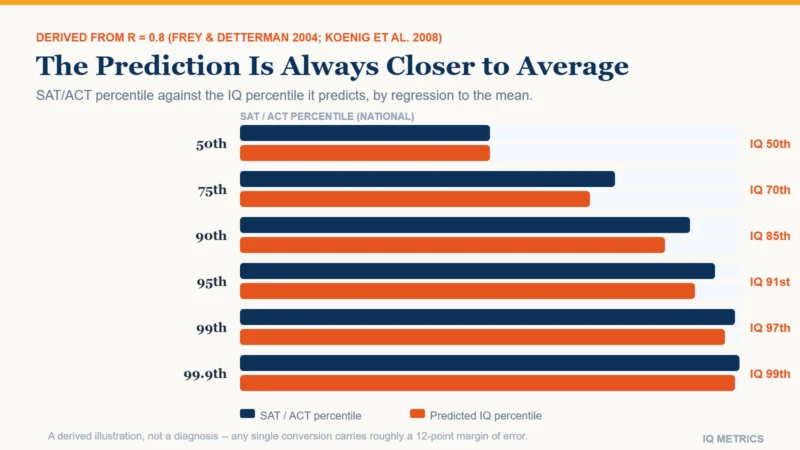 Scores & Scales
SAT and ACT Score to IQ Conversion
Neither the SAT nor the ACT is an IQ test, but two landmark studies found they correlate with general cognitive ability at 0.77 to 0.86. Here is what that correlation actually predicts by percentile, the real 12-point margin of error around any single conversion, and why the method breaks down at the extremes.
 Research & Evidence
Does IQ Predict School Success?
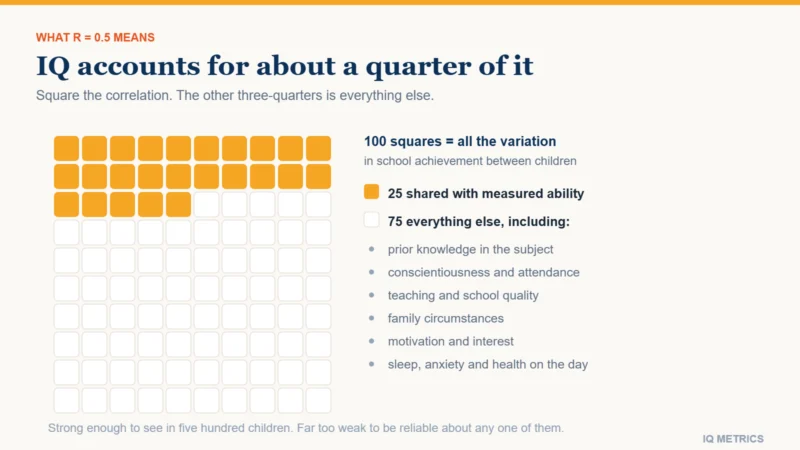
IQ predicts school achievement better than any other single measure psychologists have found, and still leaves roughly three-quarters of the variation unexplained. Both halves of that sentence get ignored by somebody. Here are the actual correlations, what they mean for one child, and what accounts for the rest.
 Research & Evidence
IQ and Testosterone
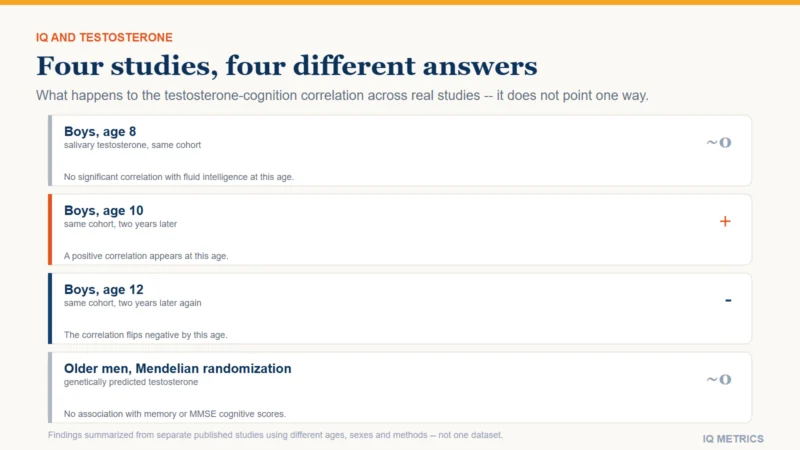
A popular online chart claims a clean link between testosterone and IQ. Real studies disagree with each other on direction and size, and the most rigorous test found no effect at all. What the actual research says, and why the meme persists.