





IQ and Crime: What the Correlation Does and Does Not Explain
IQ and crime show a real but modest correlation: offenders average eight to ten points lower than non-offenders. What actually drives the gap, including a specific environmental cause with its own evidence, and what the finding cannot tell you about any one person.

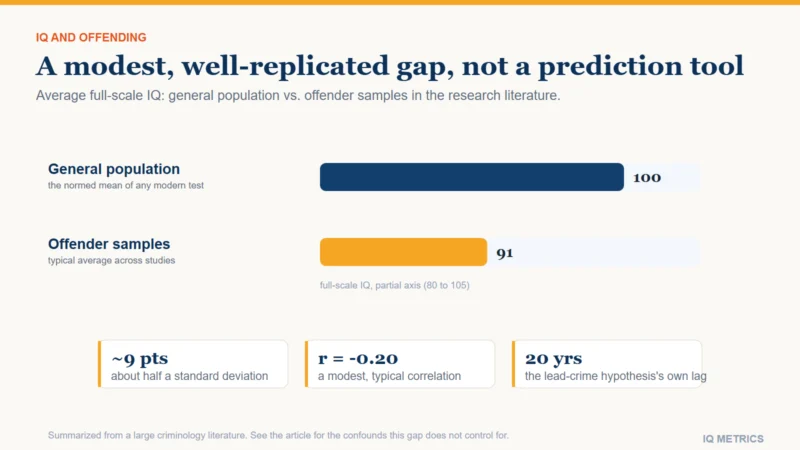
IQ and crime show a real but modest correlation. People convicted of crimes score, on average, about eight to ten points lower on IQ tests than people who are not — roughly half a standard deviation, with a correlation researchers typically report around r = -0.20. That pattern shows up consistently across decades of criminology research, and it explains far less than it sounds like it should: the correlation is small, it says nothing about any individual, and a large share of it traces back to causes that have nothing to do with intelligence itself. This article covers the size of the finding, what actually seems to be driving it, and where the research gets misused.
How big is the IQ-crime correlation, really?
An r of -0.20 means intelligence and offending share only a small slice of their variation — on the order of 4% by the crude squared-correlation arithmetic researchers use as a rough guide — alongside dozens of other factors that matter far more for any individual case: family stability, peer group, substance use, neighborhood, and plain chance among them. The eight-to-ten-point gap is consistent enough across studies to be treated as a solid finding, but “solid” describes the correlation’s reliability, not its size or its meaning.
Reviews in this area go back generations. Travis Hirschi and Michael Hindelang’s influential 1977 synthesis is often credited with re-establishing IQ as a variable criminology could not responsibly ignore, after some decades in which the field treated it as close to a taboo subject following its misuse earlier in the twentieth century. Later meta-analyses have generally confirmed the size of the gap they reported, even as the explanations offered for it have grown more careful.
A pattern that only holds for some kinds of crime
The eight-to-ten-point gap is not uniform across offense types. It shows up most consistently for repeated, impulsive and violent offending, the kind most closely tied to weak executive function and poor future-planning. White-collar crime tells close to the opposite story: fraud, embezzlement and similar offenses are disproportionately committed by people with above-average education and, by extension, likely above-average measured cognitive ability — the institutional access that large-scale financial crime generally requires is exactly what low educational attainment forecloses. A single “IQ and crime” correlation is really an average across very different phenomena with different, sometimes opposite, relationships to cognitive ability.
What the correlation is not evidence of
A correlation this size cannot predict who will offend. Most people with below-average IQ scores never commit a crime, and most people convicted of crimes do not have unusually low scores; the two distributions overlap heavily, with only the averages pulled apart. Reading the finding as “low IQ causes crime” also skips past a more basic explanation researchers take seriously: detection and prosecution are not neutral processes. Cultural bias in IQ testing and what national IQ rankings cannot support both cover how easily aggregate score comparisons get misused when the groups being compared differ in far more than the trait being measured.
Socioeconomic status and IQ is the confound that does the most work here. Poverty is linked to worse schooling, more environmental exposure to cognitive harms, more contact with a justice system that treats the same behavior differently by neighborhood, and lower average IQ scores — all independently of each other. Statistical models that control for socioeconomic status typically shrink the IQ-crime correlation, though it does not disappear entirely, which is part of why researchers still treat it as real if modest rather than pure confounding.
Where would your own score land?
Take the IIF-certified assessment and get your score with the scale it was measured on, the percentile it corresponds to and the confidence range around it — the three figures most online tests leave out.
Find your IQ score now! →The lead-crime hypothesis: an environmental cause for both
One of the more evidence-backed explanations for part of the correlation runs through a specific environmental exposure: leaded gasoline. Economists Rick Nevin and Jessica Wolpaw Reyes independently found that the rise and fall of childhood lead exposure, tracked through leaded gasoline consumption, closely parallels the rise and fall of violent crime rates roughly two decades later — the lag matching the time it takes a child exposed to lead in early life to reach peak crime-committing age. Lead exposure and IQ covers the underlying dose-response relationship: lead lowers IQ scores and, separately, appears to impair impulse control through the same neurological pathways, giving it two routes into offending rather than one.
The hypothesis is taken seriously in economics and public health, not accepted as the whole story. It rests on an ecological correlation across time, a weaker form of evidence than a controlled study of individuals, and it competes with several other explanations proposed for the same decades-long rise and fall in crime — changes in policing, incarceration rates, the crack cocaine epidemic’s own arc, and legalized abortion among them. Most researchers in the area now treat lead as one real contributor among several, not a single cause that settles the question.
Why this research keeps getting misused
The same small correlation gets stretched in two directions by people with opposite agendas: read as proof that IQ determines crime, to justify broad claims about groups, or dismissed entirely to avoid an uncomfortable but real, modest finding. Both misreadings skip the same step, which is asking what is actually being measured and what else moves alongside it. Is IQ genetic? and what twin studies on IQ heritability actually show cover a closely related trap: even a trait with substantial heritability within a population says nothing about why two different groups or two different eras differ on average, because environment and genes are tangled together at the population level in ways a heritability estimate cannot untangle.
This is not a new debate. The eugenics era of IQ testing shows how an earlier generation of researchers used exactly this kind of correlational data, stripped of its confounds and caveats, to justify forced sterilization and immigration restriction. That history is a direct warning about what happens once a modest, confounded correlation gets treated as a settled, deterministic fact.
The responsible reading of the IQ-crime literature is the boring one: a small, real, well-replicated correlation, driven substantially by shared environmental disadvantage and at least partly by specific, identifiable exposures like lead, that explains almost nothing about any individual person and should never be used to sort people — only to inform where prevention resources, better schooling, lead abatement, early intervention, might do the most good.
Where self-control fits in
A fair amount of criminology research treats weak self-control and executive function as a more direct predictor of offending than IQ itself — planning ahead, resisting impulse, managing frustration. Those are largely the same executive functions covered in the research on ADHD in people with a high IQ, where attention and impulse control run on a mostly separate track from reasoning ability. The overlap is a useful reminder that “smart” and “self-controlled” are different traits measured by different tools, whether the setting is a classroom, a hiring test, or a criminology dataset. Programs that directly train planning and impulse-control skills in at-risk children show up in the intervention literature far more often than programs aimed at raising IQ itself, which is a reasonable response to just how separate the two systems appear to be.
The policy implications researchers actually draw from this literature point toward prevention, not sorting: universal early-childhood cognitive enrichment, removing lingering environmental sources of lead exposure such as old pipes and legacy soil contamination, and addressing the socioeconomic conditions that independently predict both lower scores and higher offending. None of that requires believing IQ is a strong individual predictor of criminality; it only requires taking the population-level correlation seriously enough to address its most plausible shared causes.
The bottom line
The IQ-crime correlation is real, small, and thoroughly confounded with poverty, schooling, and at least one specific environmental exposure with its own well-studied mechanism. It is a finding for policy researchers thinking about prevention at a population level, not a tool for judging any individual, and the research literature itself treats it with far more caution than the number tends to get treated with once it leaves an academic paper.
Keep reading
All articles →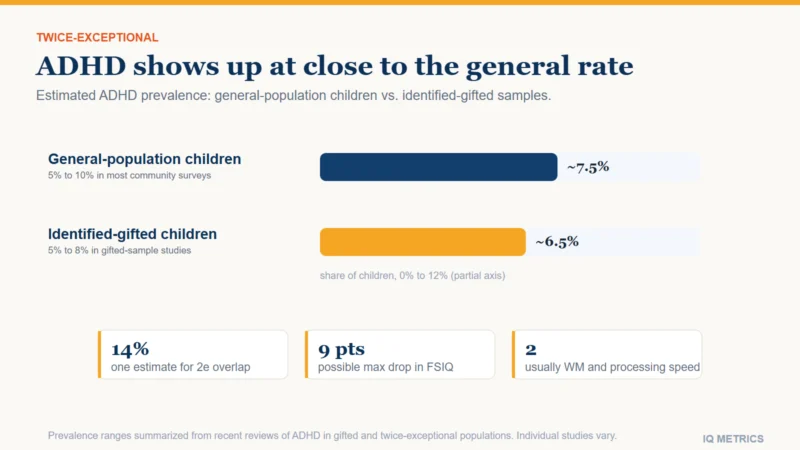 Understanding IQ
High IQ and ADHD
High IQ and ADHD can and do coexist, at close to the general-population rate. What twice-exceptional actually means, why the combination gets missed in both directions, and how ADHD can pull down a full-scale IQ score without touching real reasoning ability.
 Research & Evidence
Lead, Pollution and IQ
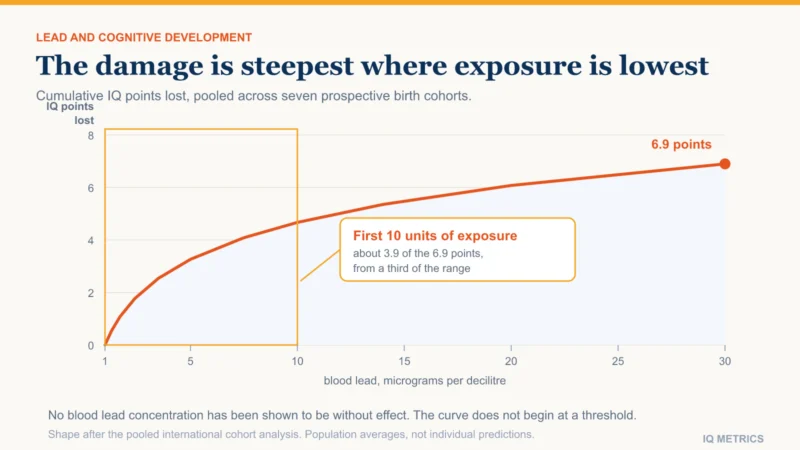
Most things people believe raise or lower intelligence turn out to be small, contested or confounded. Childhood lead exposure is the exception: one of the best-established environmental effects on cognitive test scores anywhere in the literature, with a dose-response curve most people find counterintuitive.
 Research & Evidence
Socioeconomic Status and IQ
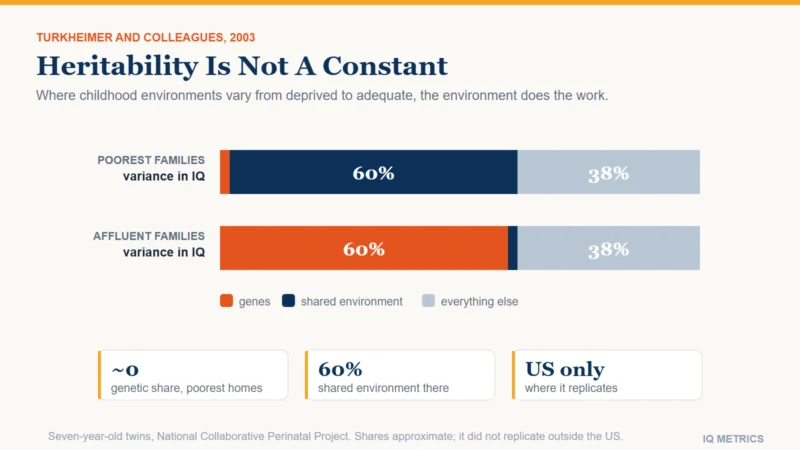
Family circumstances track IQ scores, and the relationship is stranger than a simple gap. In the poorest families studied, genes explained almost none of the variation in childhood scores and shared environment explained most of it. In affluent families the pattern reversed. Here is what that finding does and does not support.