IIF Certified Assessment
Start IQ Test
IIF Certified Assessment
JEE candidates never take a standardized IQ test, so no study has directly measured the correlation. Here is what decades of research on ability and exam performance say instead — and what a 2026 analysis of JEE's own questions found about how reasoning-heavy the exam really is.
Every JEE season, some version of the same search shows up: does IQ matter for JEE, what's the average IQ of a JEE topper, do IITians have unusually high IQs. The honest answer to the direct question is that nobody has ever measured it — and the more useful answer is what the surrounding research on ability and exam performance actually supports.
JEE Main and JEE Advanced test physics, chemistry and mathematics against a fixed syllabus under strict time limits. Neither exam includes a standardized cognitive ability test, and the IITs do not administer or publish one for admitted students. That means any number circulating online for “the average IQ of an IITian” or “of a JEE topper” is not drawn from a real dataset — there is not one to draw from. Treat those figures as invented until someone can point to the underlying study.
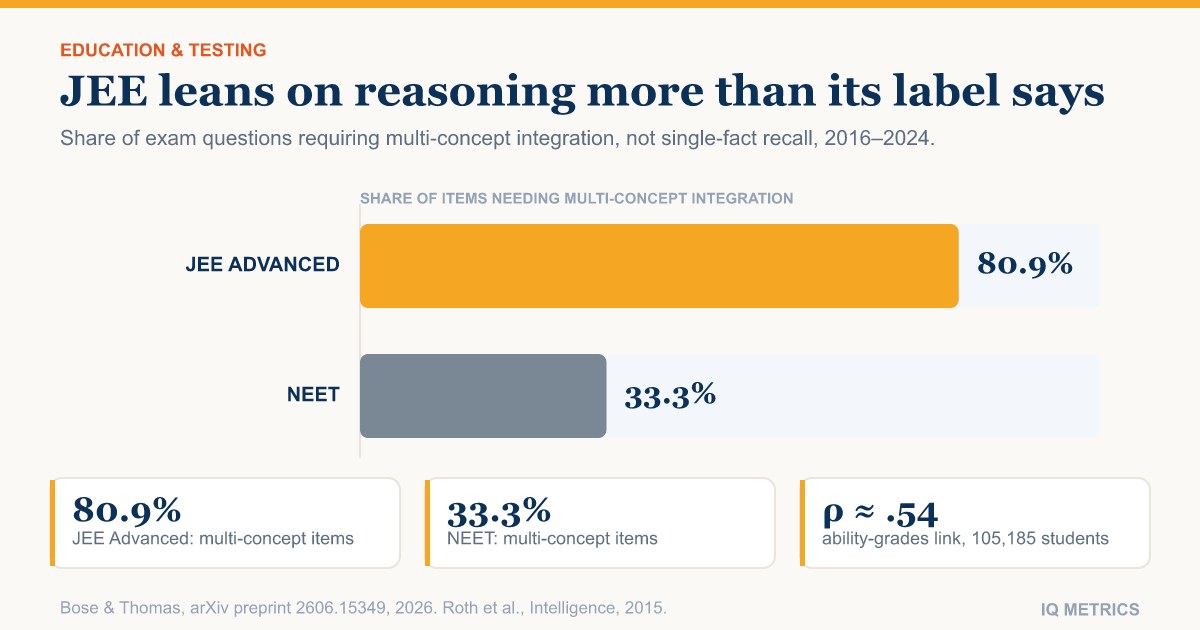
The closest real evidence is indirect but substantial. A 2015 meta-analysis in the journal Intelligence, pooling 240 independent samples and 105,185 students, found a corrected population correlation of about .54 between general cognitive ability and school grades — one of the largest and most consistently replicated effect sizes in educational psychology. The strength of the link depended on the kind of test used: mixed-format tests correlated highest at .60, verbal tests at .53, and purely nonverbal tests lowest at .44.
JEE's own format sits closer to the higher end of that range — it is quantitative and multi-step rather than narrowly verbal, the profile the meta-analysis found correlates most strongly with general ability. But two things pull the other way. First, the correlation in that meta-analysis was highest in primary school and weakened progressively through higher levels of education, and JEE sits at the far end of that range, testing 17- and 18-year-olds. Second, and more sharply, JEE candidates are an extremely selected population to begin with: everyone sitting the exam has already chosen the science stream, prepared for years, and cleared JEE Main to reach JEE Advanced.
Measuring a correlation only among people who already cleared a difficult filter is like measuring the link between height and being a professional basketball player using only NBA players — the filter has already thrown out most of the variation you needed to see it.
That statistical pattern — restriction of range — is well documented in exactly this kind of context. In a study of the SAT's relationship to general cognitive ability, the raw correlation between SAT scores and a matrix-reasoning test was .48 among a sample of academically similar undergraduates, but rose to .72 once researchers statistically corrected for the fact that everyone in that sample had already been filtered by college admission. A correlation measured only among JEE qualifiers, or only among IIT students, would run into the identical problem: the exam has already removed most of the low-reasoning-ability tail of the applicant pool before anyone could measure it.
A separate line of evidence looks at the exam itself rather than at test-takers. A 2026 preprint by researchers Joy Bose and Om Thomas mapped nine years of JEE and NEET questions (2016–2024) onto a knowledge-graph model of the cognitive skills each item demands. It found JEE Advanced's questions are dominated by what the authors call multi-concept integration — items that cannot be solved by recalling one formula and instead require combining two or more separately taught ideas — at close to 80.9% of the exam, against 33.3% for NEET. The researchers describe exam tier as shaping this cognitive structure more strongly than subject or year.
Put the two findings side by side and a coherent, unglamorous picture emerges. General cognitive ability does correlate substantially with exam performance in the wider population, and JEE's own format leans on the kind of multi-step reasoning that ability tests are built to measure — so reasoning ability is very likely part of what separates a JEE Advanced qualifier from a non-qualifier. But coaching quality and access, years of targeted practice, prior schooling, and speed under timed pressure all move independently of reasoning ability, and by every account of India's test-prep culture are doing a large share of the work. Our piece on achievement tests versus IQ tests covers the general version of this distinction: an exam tied to a taught syllabus measures what was learned and practiced, which is not the same instrument as one built to measure reasoning independent of instruction.
The scale of India's JEE coaching industry is itself a kind of evidence for this point. Kota, in Rajasthan, is a city built substantially around the business of preparing teenagers for JEE and NEET, drawing residential students from across the country into dedicated coaching campuses every year. An entire local economy organized around drilling exam-specific technique is hard to reconcile with the idea that JEE rank mostly reflects a fixed, untrainable trait — whatever role reasoning ability plays, the market is betting heavily that practice moves the number a great deal too.
None of this is unique to India. The same pattern shows up wherever a competitive, coachable exam gets treated as an IQ proxy — our coverage of the SAT-to-IQ conversion traces the same substantial-but-imperfect relationship for America's most-studied college entrance exam. If you want to see exactly how a raw score becomes a percentile, our percentile calculator shows the conversion step by step.
If you want an actual reasoning-ability estimate rather than a syllabus-based exam score, it has to come from an instrument built and normed for that purpose, with a percentile and a confidence range attached.
Find your IQ score now! →So: does IQ matter for JEE? Nobody has measured that exact question, and the honest sources say so. What the evidence supports is narrower and more interesting — a well-replicated link between general reasoning ability and exam performance generally, an exam format that leans on reasoning more than its “knowledge test” label suggests, and a candidate pool so pre-filtered that no simple average would mean what it looks like it means. If you want to know where your own reasoning stands, take a proper test built for that question specifically — not a syllabus exam repurposed to answer it.
No study has directly measured a correlation between JEE performance and IQ, because JEE candidates do not take a standardized IQ test. Indirectly, decades of research show general cognitive ability correlates substantially with exam performance broadly (about .54 in a 2015 meta-analysis of over 105,000 students), and JEE Advanced's own questions lean heavily on multi-step reasoning, so reasoning ability likely plays a real role alongside preparation, coaching and practice.
There is no reliable figure. IIT admissions do not include a standardized IQ test, and no public dataset links JEE scores to IQ scores. Any specific number circulating online is unsourced. IIT students are also a heavily pre-filtered population, which would make any such average misleading even if it existed.
Officially it is a knowledge-based exam tied to a physics, chemistry and mathematics syllabus. A 2026 computational analysis of nine years of JEE questions found about 80.9% of JEE Advanced items require combining multiple concepts at once, well above the 33.3% found in NEET, India's medical entrance exam — meaning it leans unusually heavily on reasoning for an exam in its category.
Practice reliably improves performance on the specific problem types JEE uses, which is what coaching is built around, but the evidence that this transfers into a general reasoning-ability gain is much weaker than the evidence that it improves the practiced skill itself. Preparation, not a change in underlying IQ, explains most rank improvement with study.
Corrections: spotted an error? Email corrections@iqmetrics.org and we will update this story and note the change here.
National reading results have dropped again, and around forty per cent of American fourth-graders are now below the NAEP Basic level. That is a fact about an achievement test, and achievement tests are built to show exactly the movement an IQ score is built to hide.
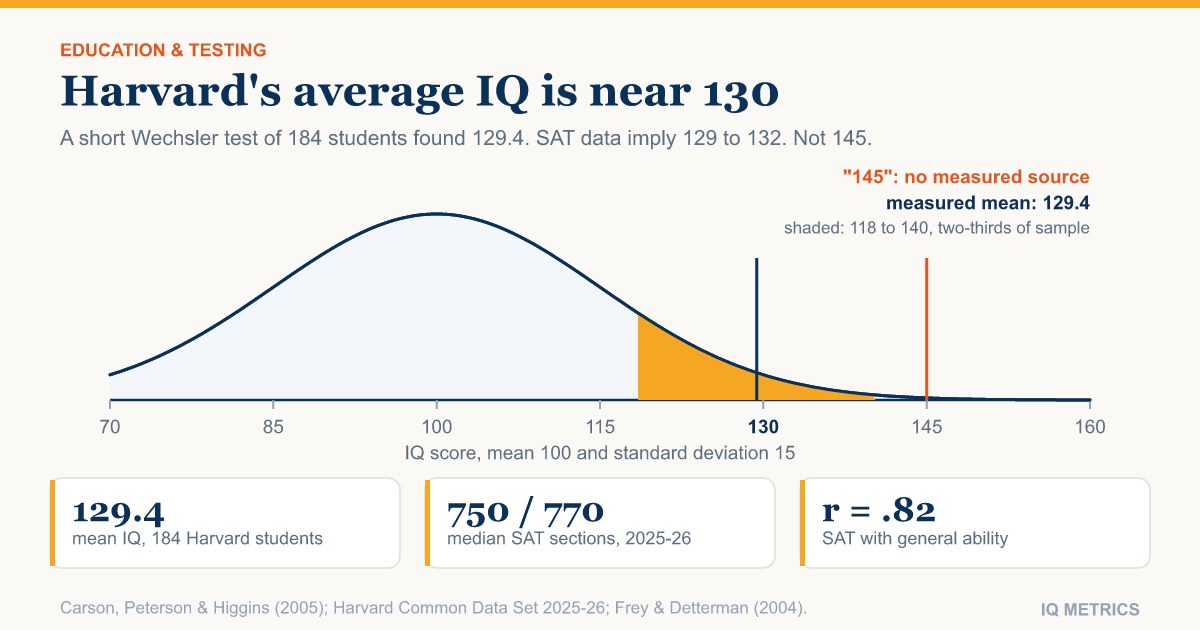
Harvard does not test its students' IQ, but it does publish their SAT scores, and one study gave 184 Harvard students a short Wechsler IQ test. Both routes land in the same place: an average close to 130, not the 145 or higher that circulates online.

A WISC-V report does not hand back one score. It hands back six — and the headline Full Scale IQ is built from a specific seven of ten subtests, not an average of all five indexes.
Our IIF-certified assessment reports your score with its scale, percentile and confidence range — and a breakdown of the cognitive domains behind it.
Start IQ Test →