



Average IQ of College Students: Is It Really 115 or Higher?
A 2024 meta-analysis puts the average undergraduate near 102 on Wechsler tests, and a May 2026 conference poster reported means of 101 and 103. The old 115-to-130 figure traces back to the 1940s and 1950s, when only about one adult in twenty held a degree.

What you need to know
- Bob Uttl, Victoria Violo and Lacey Gibson posted a meta-analysis in 2024 of college student samples tested on the Wechsler Adult Intelligence Scale between 1939 and 2022. They report a present-day average near 102 IQ points, a decline of about 0.2 points a year, and a spread by university selectivity. We could not confirm that it has been peer reviewed.
- A poster at the Association for Psychological Science's 2026 convention (27 May 2026, by Uttl, Sikma and Surjko of Mount Royal University) reported mean IQs of 101 and 103 in two large samples tested on the Wonderlic Personnel Test and the Shipley-2. The abstract does not give sample sizes.
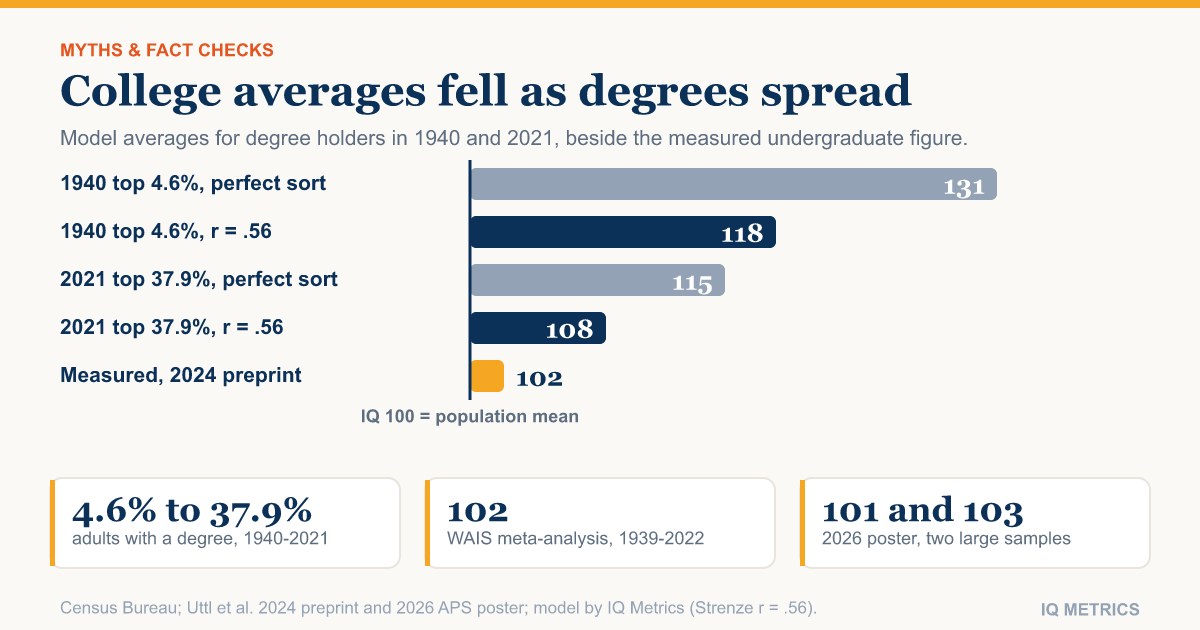
- The U.S. Census Bureau says 4.6% of adults aged 25 and over had a bachelor's degree in 1940 and 37.9% in 2021. If degrees were handed out strictly by IQ, the 1940 group would average about 131 and today's about 115. With a realistic correlation of .56 between intelligence and attainment, the averages fall to about 118 and 108.
- Averages hide the spread. Selective institutions admit students with much higher scores than the typical campus, and the preprint reports that student IQ varies across universities with selectivity. A national average near 102 says little about any one college or any one student.
Search for the average IQ of college students and most pages repeat a range of 115 to 130. It is quoted as settled fact, often to argue that a degree signals brains. Two newer pieces of work say it is out of date: a 2024 meta-analysis that puts the average undergraduate near 102, and a poster at the 2026 convention of the Association for Psychological Science that reported means of 101 and 103. Both come from the same research group, and neither is a final word. Here is where the old number came from, what the new data show, and how far each can be trusted.
Where did the 115-to-130 figure come from?
According to the meta-analysis by Bob Uttl, Victoria Violo and Lacey Gibson, the belief traces to intelligence data collected in the 1940s and 1950s, when university education was the privilege of a few. The Census Bureau's attainment history shows how few: in 1940, only 4.6% of adults aged 25 and over had a bachelor's degree or higher. A group that small is, by construction, the top end of the distribution. If people had been admitted strictly in order of IQ, the top 4.6% of a normal distribution with a mean of 100 and a standard deviation of 15 would average about 131 (the average of a top slice depends only on its size).
Admission has never been strictly by IQ. Tarmo Strenze's 2007 meta-analysis, which we discuss in our guide to average IQ by education level, put the correlation between intelligence and eventual educational attainment at about 0.56. At that correlation the average gain above 100 for a group selected on attainment is 0.56 times what perfect sorting would give. For the top 4.6% that comes to about 118 (0.56 times 31.5 points above the mean). A band of 115 to 130 is therefore not surprising for mid-century samples drawn from such a small, selected group.
What does the newer data say?
The meta-analysis gathered mean IQ scores from samples of college and university students tested on the Wechsler Adult Intelligence Scale (WAIS) between 1939 and 2022. It was posted on OSF Preprints on 10 February 2024 and a revised version appeared on ScienceOpen on 17 March 2024. We could not confirm that it has gone through peer review. Its abstract reports three findings: the average IQ of undergraduates today is "a mere 102"; the figure fell by about 0.2 points a year; and student IQ varies substantially across universities, correlated with the selectivity of the institution as measured by the average SAT score of admitted students.
The second piece is more recent. Uttl, Kiefer Sikma and Staz Surjko of Mount Royal University presented a poster titled "University Students' Average IQ Has Declined to the Population Average" in Poster Session V at the 2026 APS Annual Convention in Barcelona on 27 May 2026. The abstract says that across two large samples tested with the Wonderlic Personnel Test and the Shipley-2, mean IQs were 101 and 103, matching the general population. A conference abstract is not a paper, and ours does not state sample sizes or how the scores were converted to IQs.
- Meta-analysis (posted 2024): WAIS samples from 1939 to 2022, present-day undergraduate average about 102, decline about 0.2 IQ points a year
- Conference poster (27 May 2026): Wonderlic Personnel Test and Shipley-2 means of 101 and 103 in two large samples; sample sizes not stated in the abstract
- Census Bureau: bachelor's degree or higher held by 4.6% of adults aged 25 and over in 1940 and 37.9% in 2021
- Strenze (2007): correlation about 0.56 between intelligence and educational attainment
A straight-line reading of the decline is a useful check on the story, though it is our extrapolation and not a finding of the study. Eighty-three years at 0.2 points a year is about 17 points, which takes a present-day 102 back to roughly 119 in 1939. That is consistent with the 115-to-130 belief having been true of the students tested then.
If almost every young adult in a country can attend college, the average student will move toward the average of the population.
Does the selection arithmetic agree?
It does in direction and rough size. By 2021, 37.9% of adults aged 25 and over held a bachelor's degree or higher, per the Census Bureau. A group that large cannot average 131 even under perfect sorting: the top 37.9% of a normal distribution averages about 115, and at a correlation of 0.56 the average falls to about 108. That is a simple model, built on adults of all ages and bachelor's degrees only, so it is not meant to reproduce 102. It shows why the shift from the high teens above 100 to single digits is what you would expect once degrees became common, with no change in anyone's brainpower needed.
The model also shows why an average can mislead. The Flynn effect, the long rise in IQ test scores through the twentieth century, means old norms flatter later test takers, a drift we cover in why IQ norms expire. The preprint addresses the same issue when it questions using obsolete IQ data and tests to make high-stakes decisions about individuals. A norm that was calibrated on a small, selected group of mid-century students cannot tell you where today's students stand.
Do elite universities still differ?
Yes, and the preprint's own finding is that the spread across universities tracks selectivity. That fits the evidence that the SAT and general intelligence are strongly related: Frey and Detterman (2004) reported a correlation of .82 in 917 young adults. Our analysis of the average IQ of Harvard students and of MIT, Oxford and Yale students shows how such estimates are built from SAT data, with wide uncertainty. For this year's SAT figures, see our report on SAT scores for the class of 2026. A national average near 102 and an average near 120 or more at a highly selective institution can both be true.
What should readers take from this?
- Treat "college students average 115 to 130" as a claim about the mid-twentieth century, not a current fact
- Expect the average of an expanding group to move toward the population average, and expect selective schools to remain the exception
- Do not apply a campus-wide average to any individual student, who can sit anywhere in a wide range
- Check which test and which norms an IQ figure rests on, and whether it comes from a full battery or a short form
- Use your own score, on a current scale, rather than an old group average, to see where you stand
Where would your own score land?
A degree is a poor proxy for a score. To see where your own reasoning sits on the current IQ scale, take the IQ Metrics test and get a percentile and a full report.
Find your IQ score now! →Our IQ Metrics test reports on a standard scale, and the IQ percentile calculator shows what any score means as a rank. If you are comparing fields of study rather than whole campuses, our page on average IQ by college major covers what the major-level data show.
Common questions
What is the average IQ of a college student?
A 2024 meta-analysis of Wechsler Adult Intelligence Scale samples reports about 102 for undergraduates today, and a May 2026 conference poster reported means of 101 and 103 on the Wonderlic and the Shipley-2. Both come from Bob Uttl's group. We could not confirm that the meta-analysis was peer reviewed.
Is the average college student smarter than the general population?
On the newest data, barely. The 2024 preprint puts the average undergraduate near 102 and the 2026 poster at 101 and 103, against a population mean of 100. Selective universities remain above that, and the preprint reports that student IQ varies with the selectivity of the institution.
Where does the 115 to 130 figure for college students come from?
The preprint traces it to data collected in the 1940s and 1950s, when university education was the privilege of a few. In 1940 only 4.6% of U.S. adults aged 25 and over had a bachelor's degree, against 37.9% in 2021, so a much smaller and more selected group was being tested.
Do students at Harvard and other elite universities have higher IQs?
Estimates put them well above the national student average, and the SAT is strongly related to general intelligence (r = .82 in one 2004 study). The estimates rest on SAT data and old short-form tests, so they carry wide uncertainty, as our analysis of Harvard students explains.
Sources for this story
- Uttl, Violo and Gibson, Meta-analysis: On average, undergraduate students' intelligence is merely average (OSF Preprints, 10 February 2024; ScienceOpen, 17 March 2024) — OSF Preprints / ScienceOpen
- Uttl, Sikma and Surjko, University Students' Average IQ Has Declined to the Population Average (poster abstract, 2026 APS Annual Convention, 27 May 2026) — Association for Psychological Science
- Highest Educational Levels Reached by Adults in the U.S. Since 1940 (Census Bureau release CB17-51, 30 March 2017) — U.S. Census Bureau
- Census Bureau Releases New Educational Attainment Data (24 February 2022) — U.S. Census Bureau
- Frey and Detterman, Scholastic Assessment or g?, Psychological Science 15(6), 373-378 (2004) — Psychological Science (SAGE)
Corrections: spotted an error? Email corrections@iqmetrics.org and we will update this story and note the change here.
Related stories
All news →
Average IQ of Harvard Students: What the SAT Data Implies
Harvard does not test its students' IQ, but it does publish their SAT scores, and one study gave 184 Harvard students a short Wechsler IQ test. Both routes land in the same place: an average close to 130, not the 145 or higher that circulates online.
Average IQ by Education Level: The Arrow Points Both Ways
Tables ranking average IQ by degree level circulate constantly and are read as though schooling simply sorts people. Pooled longitudinal evidence puts the correlation at about 0.56, and a meta-analysis of more than 600,000 people found that education also raises scores.

Does a Photographic Memory Mean a High IQ? What the Research Shows
Eidetic imagery is found in some children and almost no adults, and it is not photographic. World Memory Championship competitors scored high-average on IQ-type tests, and their feats came from a method anyone can learn.
Read the research.
Then find your own number.
Our IIF-certified assessment reports your score with its scale, percentile and confidence range — and a breakdown of the cognitive domains behind it.
Start IQ Test →