IIF Certified Assessment
Start IQ Test
IIF Certified Assessment
A 2017 study found that colleagues' ratings of leaders peak near IQ 120 and then dip. It measured how others rated mid-level managers, not how their teams performed, and larger datasets on real outcomes show no such ceiling.
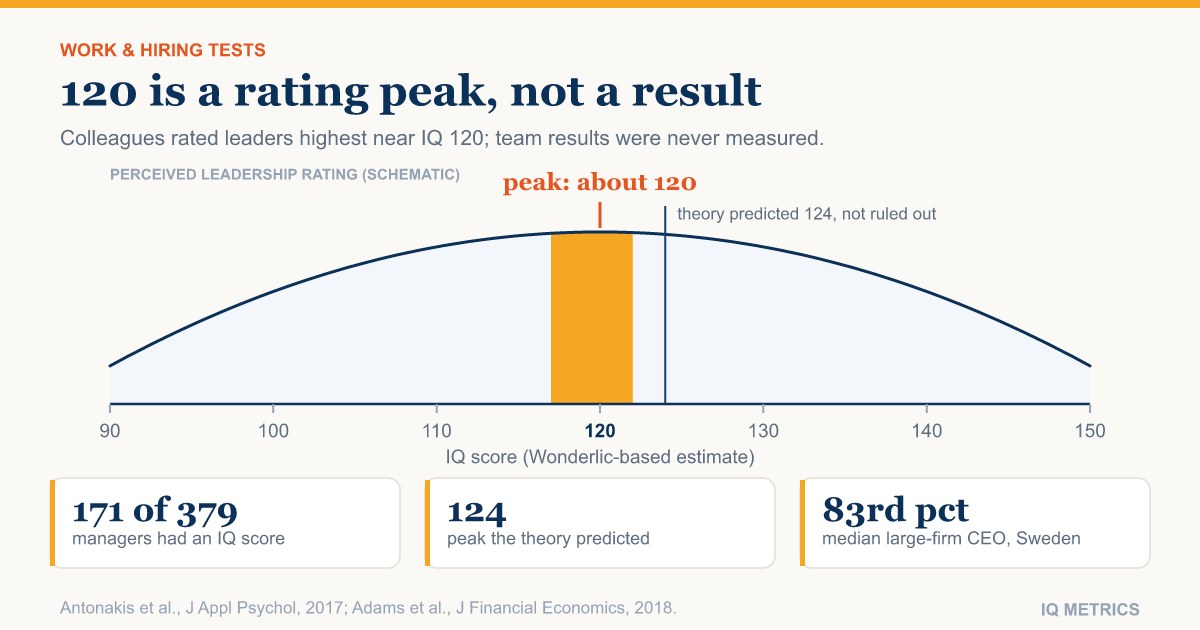
Search “leader IQ” and one claim comes back again and again: the ideal IQ for a leader is about 120, and beyond that leaders get worse. The claim traces to a single study, and it is narrower than the headlines make it. It measured how colleagues rated a leader’s behavior, not how the leader’s team performed. This article goes through what the study did, how firm the number 120 is, and what larger datasets say about being “too smart to lead”.
It comes from a 2017 paper in the Journal of Applied Psychology by John Antonakis, Robert House and Dean Keith Simonton, titled “Can super smart leaders suffer from too much of a good thing?” The authors set out to test a prediction from Simonton’s 1985 models of intelligence and influence: a leader is seen as most effective when he or she sits about 1.2 standard deviations above the mean IQ of the group being led. A standard deviation is the usual unit of spread on IQ scales; on the common scale where it equals 15 points, 1.2 of them is 18 IQ points. So the idea is about a gap between leader and followers, not a fixed number. The proposed reason is communication: a leader far ahead of the group may be harder to follow.
The sample and scoring details below are taken from the authors’ accepted manuscript; the headline result is in the published abstract.
That IQ figure deserves a caution of its own. Our explainer on converting Wonderlic scores to IQ shows why double-plus-sixty is a rule of thumb rather than a published conversion, so an “IQ” derived from it is best read as an estimate.
The published abstract reports that ratings followed an inverted-U function of intelligence, peaking at an IQ of about 120. The figures underneath are softer than the headline:
The dip is in how leaders were rated. It is small, it becomes clearly significant only well past the peak, and it says nothing direct about how well teams perform.
Not as a universal figure. Because the theory is about a gap, the best IQ depends on who is being led. The study’s own prediction of 124 assumed followers averaging about 106 plus the 18-point gap. The same arithmetic gives about 118 for followers averaging 100, which is the figure the lead author used in later popular summaries, and about 128 for followers averaging 110. The 120 peak is also an estimate from one sample of mid-level managers whose own average was about 111, so it sits roughly three-quarters of a standard deviation above their mean, around the 78th percentile within that group.
Against the whole population, an IQ of 120 is 1.33 standard deviations above the mean: the 90.9th percentile, so about 1 person in 11 scores at or above it. Our percentile calculator converts any score, and what an IQ of 120 means covers the score in general.
The larger datasets on objective outcomes do not show a ceiling. A 2004 meta-analysis in the same journal, covering 151 independent samples, found an average correlation of .21 between intelligence and leadership, or .27 after correcting for range restriction, the distortion that comes from studying only people who have already been selected. That is a modest, positive relationship, lower than earlier reviews had suggested, and it was stronger when intelligence was rated by others than when it was tested.
A 2021 analysis in Perspectives on Psychological Science followed four cohorts and 48,558 people. Most effects of cognitive ability on life outcomes were linear or null, the authors reported no support for any downside to higher ability, and they found no sign of a threshold at IQ 100 or 120. Leadership there meant supervisor status and span of control, so it is not a replication of the 2017 perception study, and its data cannot test the gap theory. It simply does not find a ceiling in objective outcomes.
The most direct look at chief executives comes from Sweden. Adams, Keloharju and Knüpfer linked cognitive tests taken at the military draft at about age 18, for around 1.3 million men, to later careers, including about 26,000 who were CEOs between 2004 and 2010. The median chief executive of a large company (assets above about US$1.3 billion) had scored above roughly 83% of men his age, which on the mean-100, SD-15 scale is about IQ 114. A quarter of large-company CEOs scored below the 70th percentile and a quarter above the 92nd, about IQ 122. Fewer than one in five was in the top 5%, and CEO pay rose roughly in a straight line with cognitive ability, with no downturn at the top. The draft composite is not an IQ score, so treat the IQ-scale figures as an approximate translation.
For a hiring panel or a manager, a cut-off at 120 is not supported by any of this. What the 2017 study points to is a communication effect: colleagues rated leaders less favorably once leader IQ passed a certain point, which the authors attribute to a widening gap with followers. That explanation was proposed rather than tested, and follower IQ was never measured. For the straight-line evidence on job performance, see what cognitive ability tests predict at work. Because tests lose precision at the top of the scale, the IQ ceiling effect explains why very high scores are hard to compare, and presidents ranked by IQ shows how shaky leader IQ figures usually are.
A score means something only next to its norm group. To see where a result sits on the curve, use a test that states its scale and reports a percentile and a confidence range.
Find your IQ score now! →So: is there an IQ sweet spot for leaders, about 120? In one study of mid-level managers, colleagues’ ratings of leadership peaked near 120 and then dipped, a small and imprecise effect that says more about how a large gap is perceived than about leadership results. Larger datasets on real outcomes find benefits that keep rising or level off, not a ceiling. To see where your own reasoning score sits, the full IQ test reports a percentile and a confidence range. More on work and scores: what quant trading firms look for and average IQ by occupation.
Not on the evidence for real-world results. Large datasets on pay, roles and life outcomes show flat or rising patterns with higher ability. The one study that found a peak measured how others rated leadership behavior, around an IQ of 120, not how well leaders performed.
No, not as a universal figure. It was the peak in one sample of mid-level managers. The theory behind it puts the best position about 1.2 standard deviations (18 IQ points) above the group being led, and the study’s own prediction was 124.
Above average but not extreme. In Swedish military-draft data the median large-company CEO scored above about 83% of men his age, roughly IQ 114 on the usual scale, and fewer than one in five was in the top 5%.
Yes, modestly. A meta-analysis of 151 samples found an average correlation of .21, or .27 after correcting for range restriction.
On a scale with a mean of 100 and a standard deviation of 15, an IQ of 120 is 1.33 standard deviations above the mean. That is the 90.9th percentile, so about 1 person in 11 scores at or above it.
Corrections: spotted an error? Email corrections@iqmetrics.org and we will update this story and note the change here.
Aptitude tests are among the better-studied hiring tools, and for decades the headline validity figures were quoted with more confidence than the corrections behind them deserved. A 2022 reanalysis pulled those numbers down.
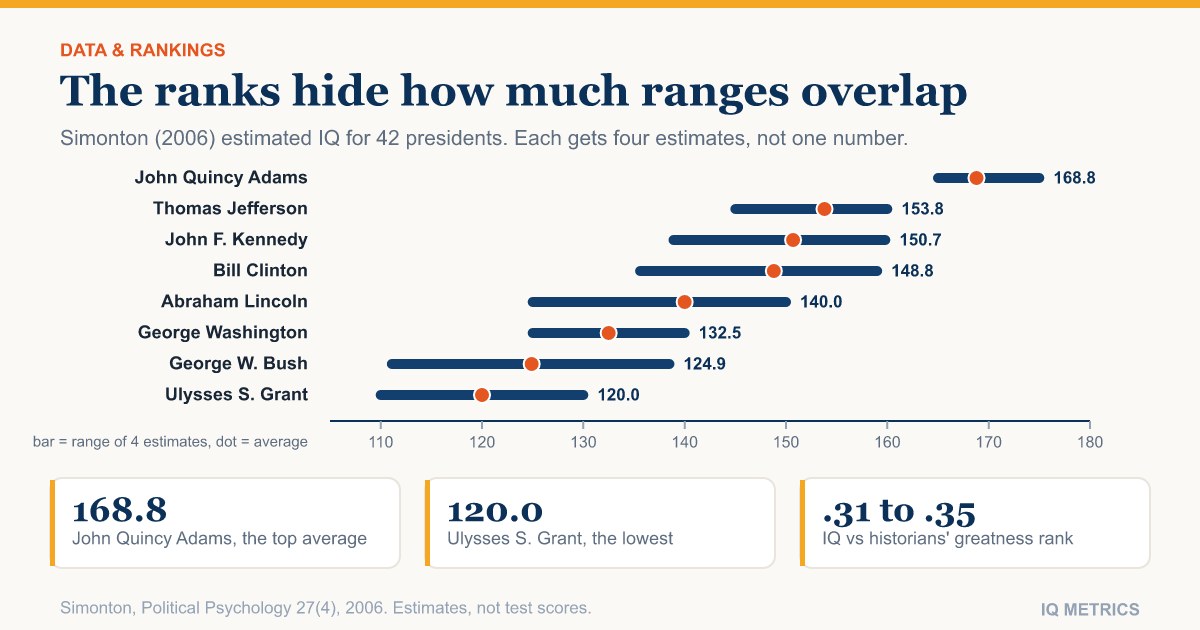
One peer-reviewed study estimated the IQ of every president from George Washington to George W. Bush. It put John Quincy Adams first at 168.8 and Ulysses S. Grant last at 120. No president was ever given an IQ test for it, and the ranges overlap far more than a ranked list suggests.
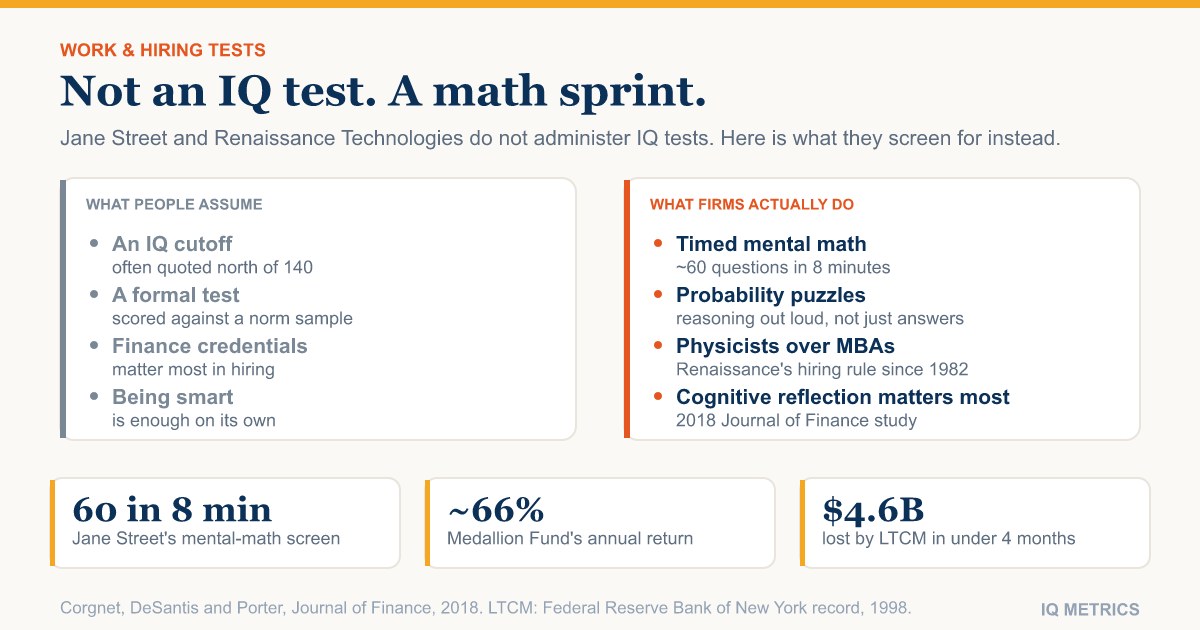
Jane Street opens its process with a timed mental-math test. Renaissance Technologies built the most successful hedge fund in history hiring physicists over finance graduates. Neither one runs an IQ test.
Our IIF-certified assessment reports your score with its scale, percentile and confidence range — and a breakdown of the cognitive domains behind it.
Start IQ Test →